80% of Algerians Boycott Legislative Elections: What Are the Messages?
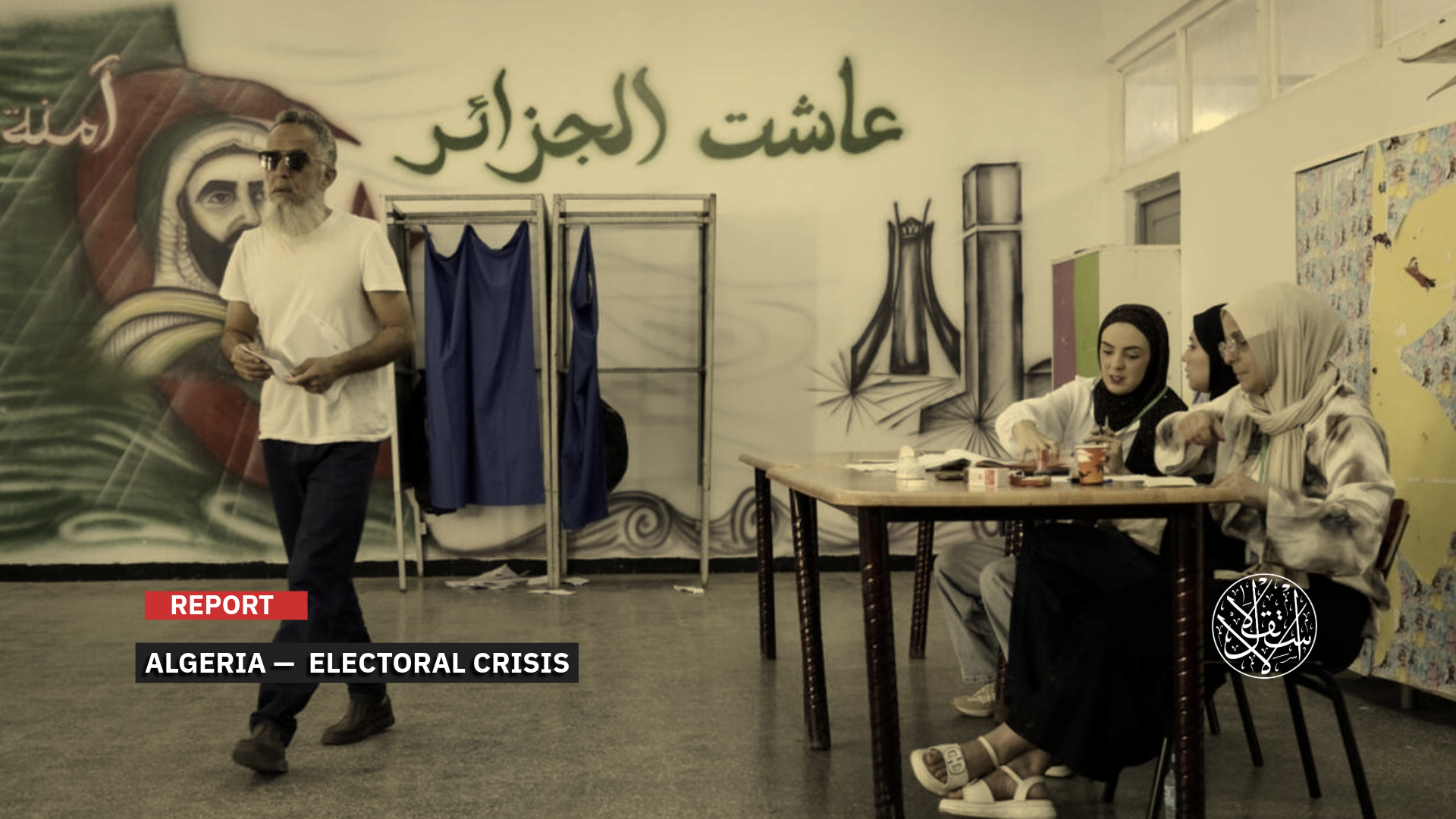
Electoral apathy confirms that the gap between the people and the system is widening further.
Algeria has drawn the curtain on parliamentary elections that sparked widespread debate across the country due to the low voter turnout, carrying political messages for the ruling system.
The legislative elections held on July 3, 2026, recorded a turnout of only 20.79% of the total electorate, with 5,071,020 voters casting ballots out of 23,872,756 registered voters, according to the National Independent Authority for Elections.

Shocking Figures
These figures mean that more than 19.6 million voters did not take part in the ballot, both inside the country and abroad. They also reflect a decline compared with the 2021 legislative elections, when the official turnout rate reached 23% among voters inside Algeria.
The National Liberation Front (FLN), a party close to the authorities, won 90 seats out of 407, including 85 seats inside Algeria and five representing the Algerian diaspora abroad, without securing a majority. It lost eight seats compared with the previous elections.
The National Democratic Rally (RND), also close to the authorities, came second with 73 seats, gaining 16 seats compared with the previous election and recording the biggest success among the parties.
The Future Front Party, another party considered close to the authorities, increased its seats from 48 to 59, while the number of seats held by independent candidates dropped from 85 to 32.
Among Islamist parties, the Movement of Society for Peace (MSP/Hamas) lost 22 seats, securing 43 seats, while the National Construction Movement lost one seat, winning 38 seats.
The Voice of the People Party recorded a notable rise, increasing its seats to 17, compared with only three in the previous election.
The Socialist Forces Front (FFS), Algeria’s oldest opposition party, won 12 seats after boycotting the previous elections.
Meanwhile, the Rally for Culture and Democracy (RCD), which also boycotted the previous election, secured four seats.
The Freedom and Justice Party and the New Dawn Party each won six seats, while the Dignity Party obtained five seats, the Justice and Development Front won four, and the Workers’ Party, New Generation Party, and TAJ (Rally of Hope of Algeria) each secured three seats.
The Renaissance Movement and the National Unity and Development Party each won two seats, while the Righteous Governance Front, Republican Alliance, Algerian Renewal, Free Citizens Front, and New Algeria Front each obtained one seat.
These elections were the 10th legislative elections since Algeria gained independence in 1962 and the second since the 2019 Hirak popular movement, which led to the ouster of former President Abdelaziz Bouteflika and brought Abdelmadjid Tebboune to the presidency.
Party Anger
Several political parties in Algeria expressed reservations over the results of the legislative elections, with some announcing plans to challenge the results in certain electoral districts.
In this regard, the Movement of Society for Peace (MSP/Hamas) strongly protested the announced results, arguing that there was an attempt to limit its presence in the People’s National Assembly.
During a press conference held on July 7 to assess the electoral process, the movement’s leader Abdelali Hassani Cherif said that the party had been leading in several provinces during the vote-counting process before the figures changed after the electoral system’s electronic network went down overnight.
He noted that the preliminary results received by the party showed it ahead in several provinces, including Medea, Relizane, Oran, Tlemcen, Mostaganem, Constantine, Tebessa, and El Oued.
He said that after the threshold, the number of votes required for a list to compete, was raised following the network outage; this affected the distribution of seats in several electoral districts.
Cherif linked the election results to what he described as a political trust crisis, saying that Algeria recorded its lowest voter turnout since independence and that holding political parties solely responsible for the low participation rate does not reflect the reality of the situation.
He said electoral abstention had become “a popular political stance that is expanding with every electoral process,” holding the authorities responsible for the situation.
Cherif also argued that institutions elected with a turnout of only around 20% remain underrepresented institutions and do not fully reflect public opinion trends, stressing that continued low electoral participation directly affects the strength of elected institutions and their political legitimacy.
The Renaissance Movement said that the timing of the elections, which coincided with the summer season, the organization of the World Cup, and baccalaureate exams, were additional factors that intensified the phenomenon of abstention, which it described as having become notably chronic, calling for policies to address it.
Politically, the movement added in a statement issued on July 7 that this abstention represents a serious indicator, especially as it approaches 80% of voters, as it fails to achieve the desired level of general political mobilization and popular participation, which are essential pillars of any electoral process.
The movement stressed that one of the most serious political consequences of electoral abstention is the decline of voting based on programs and political visions, in favor of growing family, tribal, and regional considerations. It said this weakens the role of political parties in organizing society and serving as a bridge between citizens and the state.
The statement warned that “if this trend continues, it will pose a challenge to the process of building a modern state based on institutions, programs, and democratic competition, rather than on traditional loyalties that prevailed in pre-state societies.”
The leader of the New Generation Party, Lakhdar Amokrane, said that voter turnout in any election is not merely a figure announced when polling stations close, but rather the most significant indicator of the nature of the relationship between the state and society.
In an article published by the local website Auras on July 7, Amokrane stressed that repeated and growing electoral abstention over time is not a temporary event, but rather an expression of a profound shift in society’s relationship with politics.
He said that political life in Algeria has not developed at the required pace, creating a gap between a society that is constantly changing and institutions that have not always been able to keep up with these transformations.
Amokrane warned that electoral abstention is not an accusation against the state, nor is it a victory for those calling for a boycott.
Rather, he described it as a political warning calling on everyone to undertake a deep review, including the authorities, political parties, elites, the media, and civil society, saying that no one can exempt themselves from responsibility.
He argued that “restoring Algerians’ trust requires a national reform project based on expanding spaces of freedom, strengthening institutional independence, enhancing the powers of parliament, ensuring equal opportunities among all political actors, consolidating a culture of dialogue and consensus, and involving young people and qualified individuals in decision-making.”
Lacking Legitimacy
On the other hand, the acting president of the National Independent Authority for Elections, Karim Khelfan, praised the transparency and integrity that characterized the legislative elections.
During a press conference held on July 6 to announce the preliminary election results, he said that “the turnout rate recorded should serve as a lesson for political parties and civil society to make greater efforts to win voters’ trust.”
Khelfan expressed hope that the results would encourage political parties and civil society actors to make greater efforts by preparing for the electoral process in advance, with the aim of gaining the confidence of the electorate and convincing voters of the importance of participation.
He explained that the law does not force citizens to vote, but rather that voters must be persuaded through political discourse and grassroots work that helps achieve the results everyone hopes for.
Regarding the management of the electoral process by the National Independent Authority for Elections, Khelfan said that the body “maintained equal distance from all participants.”
He noted that the elections were conducted according to standards of transparency, integrity, neutrality, and fairness, in accordance with the laws of the republic, while ensuring access for party representatives serving as observers at polling centers and stations to prevent anyone from questioning the credibility of the results.
Analyzing the elections and the significance of the low turnout, Algerian analyst and journalist Walid Kabir said that electoral abstention is not a new phenomenon, but that this time it confirms that the gap between the people and the system is widening further.
Speaking to Al-Estiklal, Kabir said that the political authorities and their media outlets acknowledged the historic level of abstention after turnout did not exceed 21%, while some voices claimed that actual participation rates were even lower than the officially announced figures.
He argued that what is happening represents a break by the people, because, in his view, the system does not have a reform project capable of leading the country toward the desired democracy.
Kabir warned that the election campaign was lackluster because the public understood that the elections would be merely symbolic.
He claimed that the authorities only wanted to establish a parliament that reflected their preferences rather than the general will.
He said this means Algeria would end up with a parliament lacking legitimacy and public trust, one that Algerians did not vote for.
He also claimed that the elections reflected the preferences of the military rather than the people, citing images broadcast by state media showing soldiers in civilian clothes rushing to polling stations as an attempt to conceal the high level of voter abstention.
Kabir continued, “During the campaign period, state media repeatedly said that the system had done everything possible to organize elections that fulfilled the aspirations of the people, and that the ball was in the court of citizens or voters,” stressing that “what is happening proves otherwise.”
He argued that “the political system in Algeria has not yet understood that repression and the lack of political and media openness lead to electoral abstention, and that what is happening is the natural result of weakening parties and suppressing opposition voices.”
Kabir added that Algerians do not trust the political system’s programs and have therefore boycotted elections on a large scale since 2019, because, according to him, they reject living under intimidation and authoritarian rule.
The political activist concluded that the country’s future remains uncertain under the current political system, stressing that Algeria needs to move toward building a “Second Republic” based on genuine democracy rather than a symbolic or formal version of it.

Credibility Crisis
Writer and political analyst Mohamed Tahar Aissani believes that Algeria’s crisis “is no longer only an electoral crisis, but a crisis of trust, representation, and credibility.”
Speaking to the website Akhbar al-Watan on July 5, Taher Aissani said that the 21% turnout figure carries political significance, as it means that nearly four out of every five voters chose not to go to the polls to select their representatives in the People’s National Assembly.
He stressed that “such a high level of abstention cannot be treated as a minor detail. Rather, it is an indicator of a widening gap between citizens and political representation, and of a clear decline in confidence in elections’ ability to produce a tangible impact on public life.”
He explained that “the significance of the 2026 figure becomes clearer when placed within a longer timeline. Turnout in the 2012 legislative elections reached 43.14%, then fell to around 35.4% in 2017, before dropping to 23% in 2021. With the 2026 rate, Algeria has crossed a new symbolic threshold in the path of electoral decline.”
Tahar Aissani emphasized that this decline does not appear to be an isolated event or the result of a single political circumstance, but rather a continuing structural trend, with electoral participation losing more than 20 percentage points over 14 years.
He argued that “the political meaning of this is that citizens are no longer punishing a specific party or rejecting a particular program; rather, they appear to be reassessing their relationship with the very role of elections within the existing political system.”
In other words, the political analyst said that “abstention is turning from a negative stance into a silent message: voting changes nothing. This is a dangerous message because it does not always stem from indifference, but may instead come from a frustrated political awareness and a loss of trust.”
To overcome the crisis, he said that Algeria needs to strengthen the credibility of the electoral process, protect political pluralism, restore the role of parliament, expand the space for public freedoms, and strengthen political parties while renewing their leadership.
In its analysis of the context and outcomes of Algeria’s legislative elections, the Africa-focused website Africa Intelligence said that the situation reflects the continued gap between a significant segment of society and political life due to the high level of abstention that characterized the electoral process.
In an analysis by writer and researcher Moncef al-Rifai published on July 3, the website noted that abstention was not limited to voters, but was preceded by a clear decline, with the number of candidates and electoral lists falling by half compared with the 2021 elections.
This, he said, reflects declining enthusiasm for political competition even among party and independent elites.
Regarding the reasons behind this situation, al-Rifai said that one factor is that the years following the 2019 Hirak movement failed to rebuild trust between citizens and elected institutions, despite the legal and constitutional reforms introduced in the country.
He added that a broad segment of citizens believes that parliament has failed in recent years to establish itself as an institution capable of having a real influence on decision-making or exercising effective political oversight over the executive branch.
Nevertheless, al-Rifai argued that the next parliament still has an opportunity to restore part of this trust through more effective legislative and oversight performance, greater engagement with citizens’ daily concerns, and by giving practical substance to the reforms announced by the authorities in recent years.
He concluded, “The real challenge is not only to hold regular elections, but to transform them into a mechanism that gives citizens the feeling that their vote can make a difference in public policies.”