A New Armed Movement Surprises "Israel" in Southern Syria: What’s the Scoop?
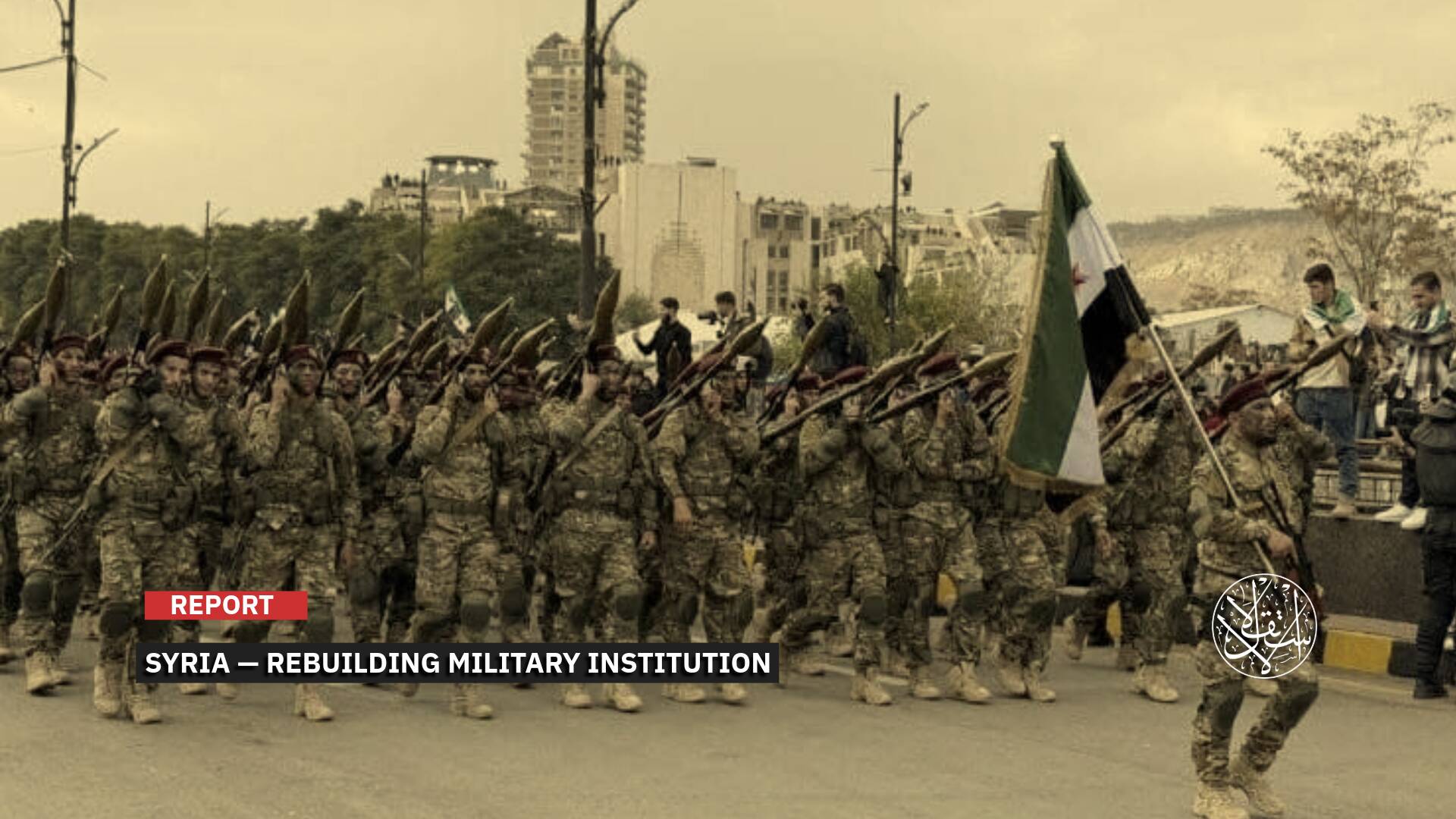
"Syrian authorities are proceeding with a comprehensive restructuring of the new Syrian army."
On February 11, 2026, the formation of a new armed group named 'the Occupation Deterrence Movement' was announced in southern Syria; the group pledged to liberate the Golan Heights and confront the Israeli military presence in the region.
On July 5, 2026, the establishment of a branch of the movement in the Daraa Governorate of southern Syria was announced, with the aim of countering the Israeli army, which had seized new territories following the collapse of Bashar al-Assad’s rule. The movement also called upon all Syrian youth to join its ranks.
According to Syrian reports, the movement comprises armed groups made up of remnants of the Syrian revolution.
Videos released by the movement called for targeting Israeli occupation forces in the Golan and forcing their withdrawal from the territories they had seized in southern Syria after the end of Assad's rule.
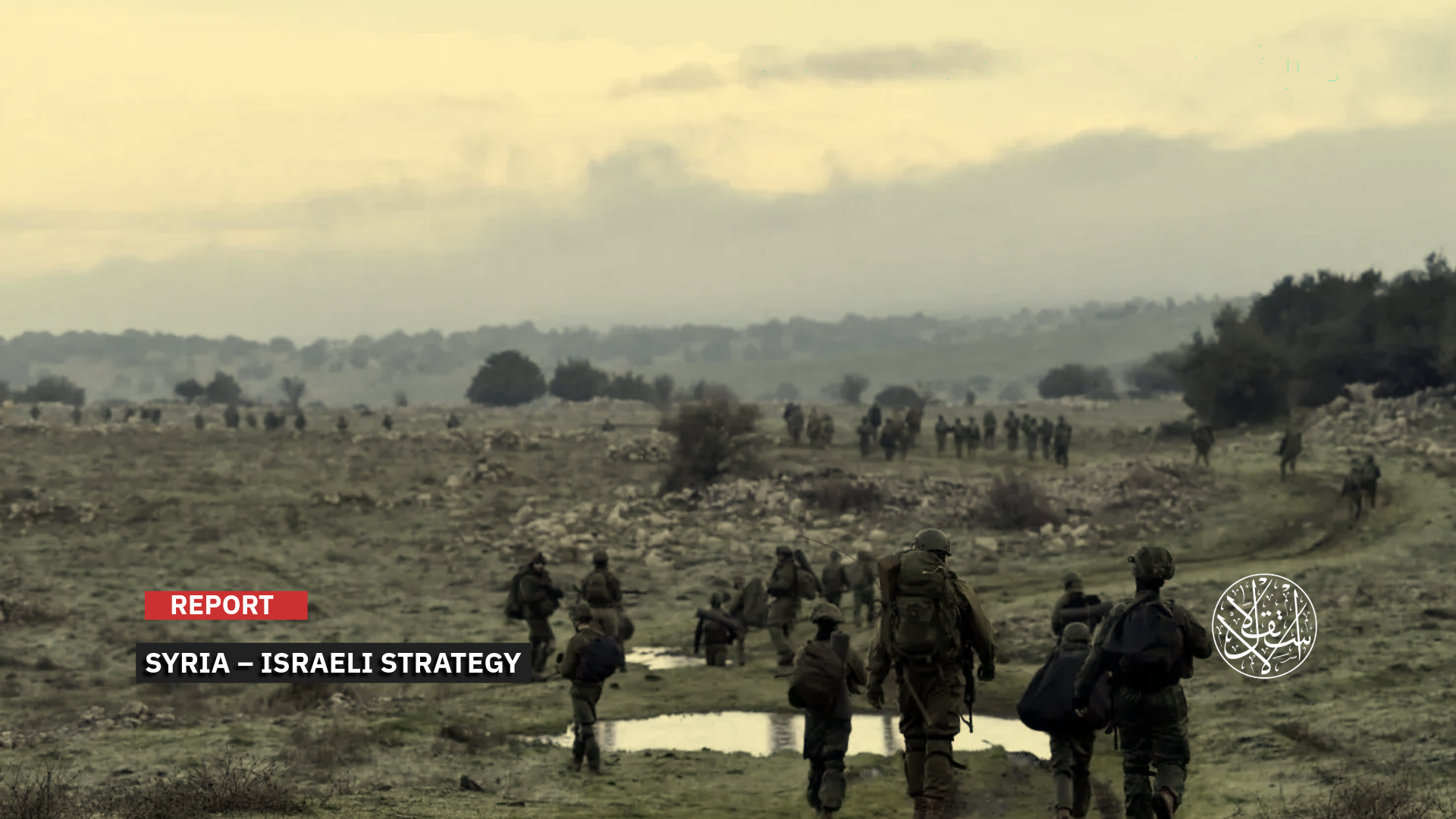
Since the fall of the Assad regime in December 2024, "Israel" has expanded its control, occupying the buffer zone that was previously under UN supervision and establishing new military outposts there.
Israeli officials have affirmed their intention to remain in these areas indefinitely. This has sparked a popular movement to resist the occupation, particularly given the absence of the new Syrian army from these areas—a result of its weakness and repeated bombardment.
New Movement
Following the fall of the Assad regime, "Israel" entered southern Syria and occupied new parts of its territory—specifically Mount Hermon—while also advancing into the countryside of Daraa, Quneitra, and the approaches to Damascus.
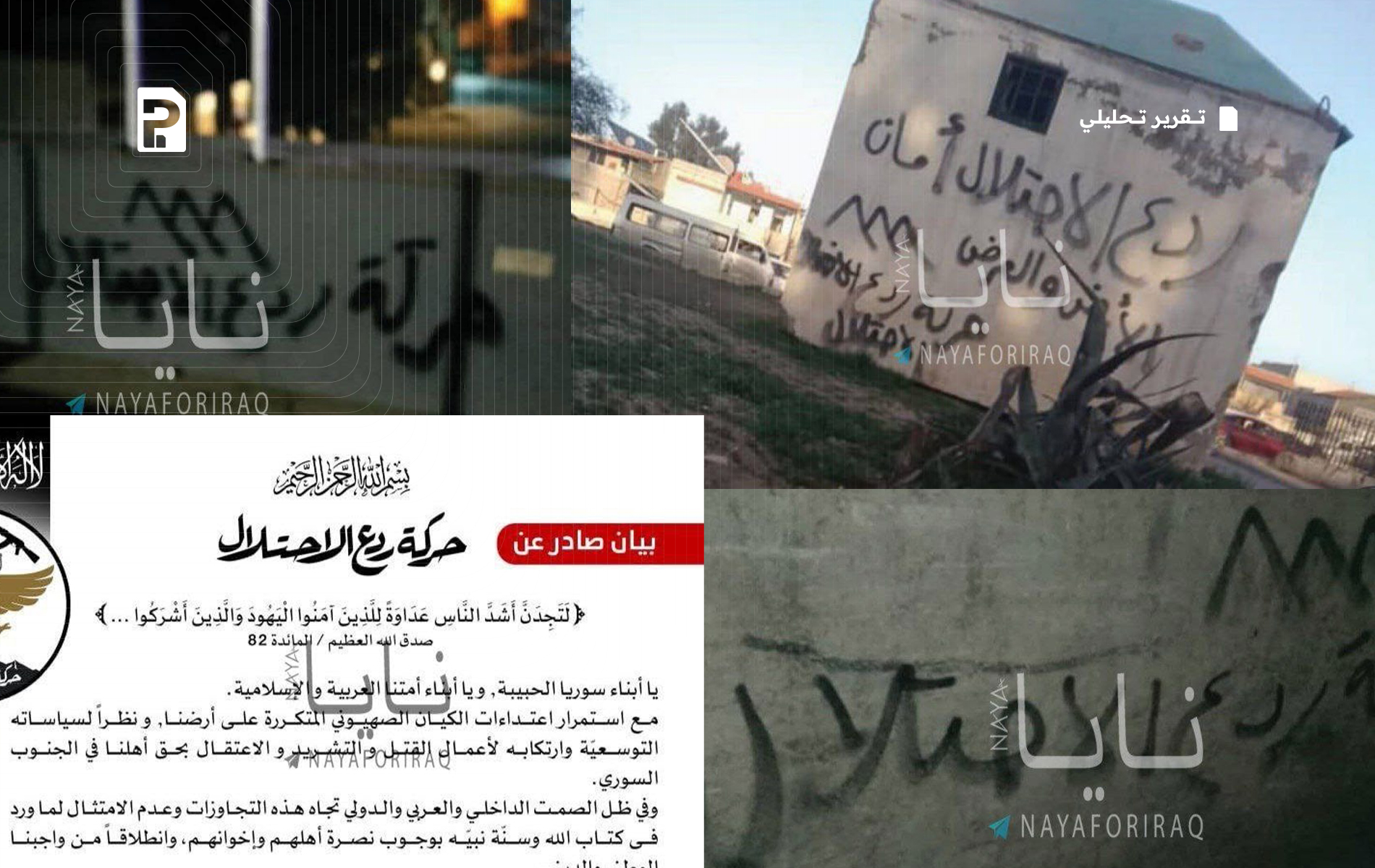
In response, a movement calling itself 'the Occupation Deterrence Movement' emerged. The movement, active in the Hauran region—which encompasses Daraa and parts of Quneitra and As-Suwayda—has disseminated statements and posters and launched an online channel. Through these mediums, it has affirmed its aim to combat Israeli expansion in the south and to lift the injustice facing the people of Hauran.
The movement released its founding statement via social media platforms, declaring its objective to resist the Israeli occupation of Syrian territory and carry out operations against Israeli forces in southern Syria.
It called for the unification of popular and military efforts to confront Israeli incursions and to prevent the entrenchment of Israeli control over the buffer zone and the Golan Heights.
In a statement attributed to the movement, it urged Syrians to unite to halt Israeli attacks on Syrian territory and to work toward thwarting the David Corridor scheme.
This plan, which was previously thwarted by Turkiye and Syrian revolutionaries, was linked to expanding Israeli influence in collaboration with Syrian Kurds allied with the US and the occupation.
The movement also affirmed its commitment to protecting civilians, avenging the "blood of the martyrs" shed by the Israeli occupation, and striving for the release of detainees and the return of displaced persons to their homes.
Furthermore, the movement announced plans to reclaim territories occupied by Israel, ultimately aiming for the full liberation of the Golan Heights.
A video clip attributed to "Hauran tribes" has also circulated, in which they announced their joining of the "Movement to Deter the Occupation" under the slogan "Defending Land and Honor." In a statement, they declared that the move was made "in defense of the faith and in response to appeals from local residents," amidst developments on the ground in southern Syria—particularly Israeli incursions into Daraa and Quneitra—and with the aim of thwarting enemy plans to impose a security zone inside Syrian territory.
Statements indicate that the group's declared area of operations encompasses the governorates of Daraa and Quneitra, as well as regions near the occupied Syrian Golan, where Israeli military incursions and acts of aggression against the local population are frequent.
The movement has claimed responsibility for several attacks against Israeli forces in southern Syria; however, these claims have not yet been independently verified by neutral sources, nor has sufficient information been released regarding the group's military strength or the outcomes of these operations.
Analysts describe it as an emerging group whose identity and organizational structure remain unclear, making it difficult to definitively determine the nature of its affiliations at this stage.
Some have linked the group to well-known Syrian factions—specifically the revolutionaries who toppled Assad—while others allege it is loyal to the Israeli occupation, claiming its objective is to provide Tel Aviv with a pretext to occupy southern Syria and maintain a presence there.
The announcement of the group's formation coincided with escalating tensions between Israel and the local population in southern Syria, following an expansion of Israeli military activity in the region since late 2025.
Consequently, the emergence of any new organization championing resistance against the Israeli presence has drawn significant public and international attention.
Israeli occupation forces frequently conduct military incursions into the villages of the Yarmouk Basin and western Daraa, provoking residents and subjecting them to searches at numerous military checkpoints, in addition to carrying out airstrikes and direct attacks against the local population.
Israeli circles have expressed concern over the emergence of this armed movement, fearing a repeat of the Palestinian Intifada scenario in southern Syria, where local anger could gradually escalate into armed operations against the Israeli occupation army.
However, the movement's potential activity remains in its early stages, limited to operations such as shelling Israeli military positions or carrying out hit-and-run attacks, with a focus on media and propaganda efforts intended to distract the enemy.
According to the Political Keys website, as of early March 2026, the emergence of the 'Occupation Deterrence Movement' at this juncture raises several possibilities.
Most notably, the movement may be driven by actors seeking to escalate tensions in southern Syria—whether to disrupt the security landscape or to derail undeclared understandings between Damascus and Tel Aviv.
The announcement could also serve as a provocative move aimed at capitalizing on public anger over Israeli airstrikes and incursions in the Daraa countryside, or at stoking internal friction between Damascus and the Hauran region.
Furthermore, "the movement's media presence may well outweigh its actual organizational structure; it could be linked to remnants of the former regime or to external actors seeking to destabilize the local situation under a political guise," according to the website.
However, Syrian sources in the occupied areas confirm that the emergence of the movement is directly linked to public anger over Israeli expansion in southern Syria.
As the movement is still in its formative stages and under close surveillance by the occupation forces, it operates covertly, revealing neither its true capabilities nor the nature of its leadership.
Meanwhile, other sources speculate that the movement may be linked to the Syrian authorities—operating under their supervision—or that Damascus is backing it (akin to armed popular resistance) to force an Israeli withdrawal, given the weakness of the Syrian Army and ongoing efforts to restructure it.
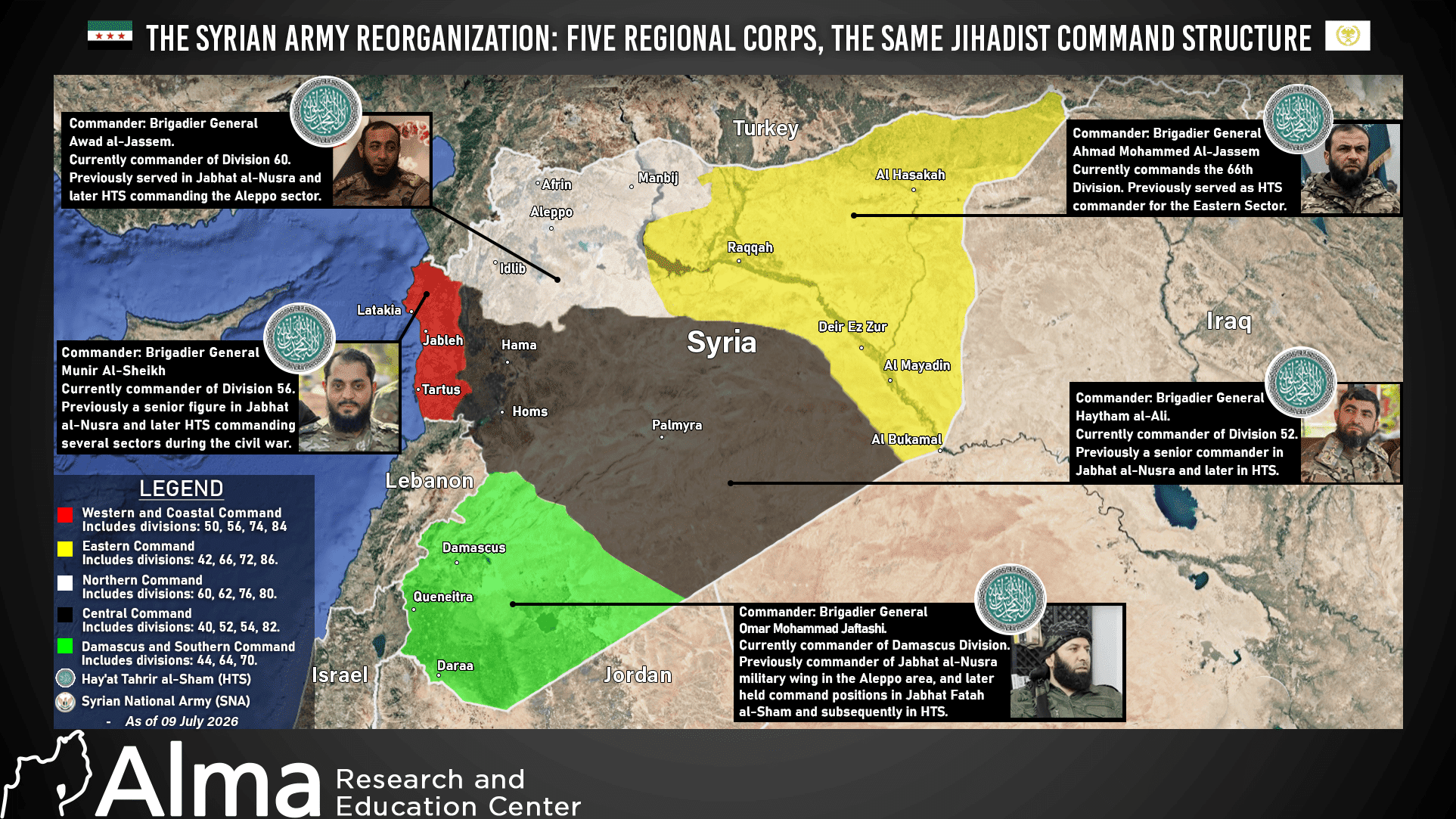
An Israeli institute suggests that the new Syrian Army is being reorganized into five corps led by figures with jihadist backgrounds.
The Israeli security research institute Alma confirms that Syrian authorities are proceeding with a comprehensive restructuring of the new Syrian Army, replacing the existing division-based system with a structure comprising five corps.
In a report published on July 12, 2026, the Israeli institute noted that four of the five corps commanders previously held leadership positions in Hay'at Tahrir al-Sham (HTS), which emerged from the Al-Nusra Front.The fifth commander belongs to the Turkish-backed Syrian National Army.
The institute assessed that this reform did not alter the essence of the military leadership but rather reorganized it within a new institutional framework.
The report indicated that the reorganization aims to establish five geographic commands to oversee various Syrian regions. This move is designed to enhance command and control as well as the speed of troop deployment, aligning with the army reconstruction process that began in early 2025 with Turkish support.
The Eastern Command will assume responsibility for the governorates of Deir ez-Zor, Raqqa, and Al-Hasakah, as well as the Iraqi border. Meanwhile, the Northern Command will oversee Aleppo, Afrin, Manbij, and the Turkish border, while the Central Command covers Homs, Hama, and the Syrian Desert (Badia).
The Damascus and Southern Command will oversee the capital and its countryside, Daraa, Quneitra, and the borders with Israel and Lebanon—an area the institute deemed the most sensitive sector for Israel.
Finally, the Western and Coastal Command will be tasked with securing the Latakia and Tartus governorates, Syrian ports, and the Russian Hmeimim Air Base.

Israeli Cattle Company
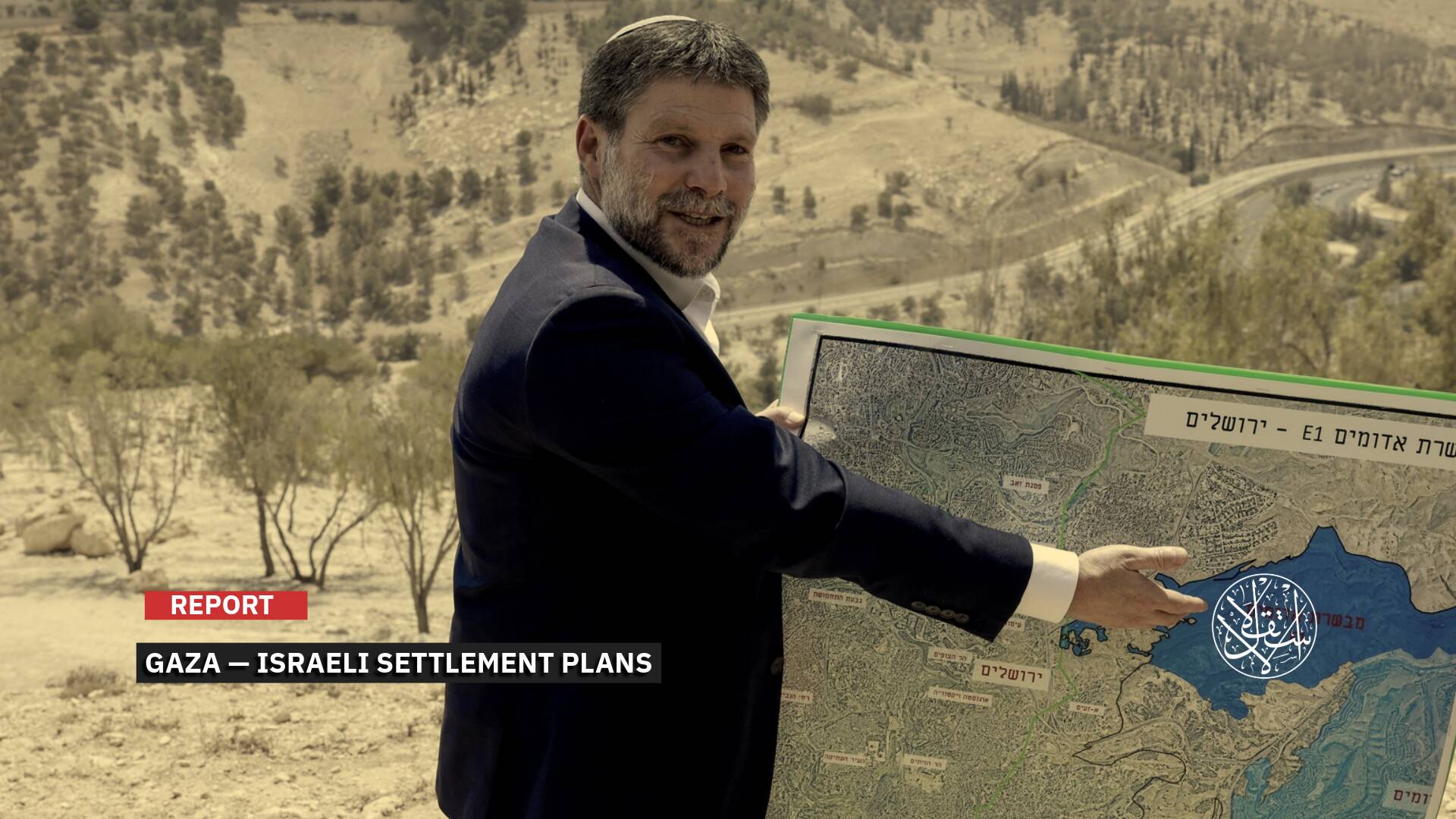
A striking irony emerged alongside the rise of the 'Occupation Deterrence Movement'—which declared its intent to drive the occupation forces out of occupied Syrian territory—as Tel Aviv accelerated settlement activities in southern Syria.
These activities ranged from establishing cattle farms to reports of settlers attempting to enter the south to build homes.
On July 4, the Yedioth Ahronoth newspaper revealed details of an Israeli project dubbed the Cattle Company, located in the buffer zone between the occupied Syrian Golan and the Quneitra Governorate.
The project reportedly began about six months ago as a collaboration between the Israeli army and the Hashomer HaChadash organization.
Its aim was to deploy a herd of approximately 140 cattle across an area of roughly 10,000 dunams situated between the Israeli fence and the 1974 ceasefire line.
According to the newspaper, the project is part of the Israeli security establishment's plans to control the area by establishing a permanent Zionist civilian presence; occupation officers state that the initiative has helped keep Syrian herders away from Israeli army positions.
Hashomer HaChadash—or The New Guard—is a settler militia founded in 2007 that advocates an ideology of expanding settlement activity by cementing civilian and agricultural control over occupied lands.
Yoel Zilberman, the founder of Hashomer HaChadash, told Yedioth Ahronoth that the Syrian border zone had previously been frequented by Syrian herders and their livestock; however, the occupation forces' entry into the area and the introduction of the Israeli cattle herd displaced them and drove them away.
The outgoing commander of the Golan Brigade, Colonel Benny Kata, spearheaded the effort to introduce the Israeli cattle unit into the area, resulting in the creation of a large Israeli-controlled enclave on the Syrian side of the barrier.
Israeli army officers stated that the project achieved its objective of clearing the area of Syrian herders; in their place, the military deployed its cattle herd and erected an iron fence spanning approximately 22 kilometers to enforce effective control over the border.
The area where the Israeli occupation deployed the Cattle Company unit is effectively under occupation due to the difficulty of accessing it; reaching the area requires crossing a valley that exposes local residents to the risk of Israeli sniper fire. Consequently, Syrian herders have been forced to abandon the land, despite its lush, abundant pastures.
Israeli occupation authorities did not stop at these measures; they also resorted to the arbitrary arrest of local residents and herders in the area to drive them away and consolidate their occupation of the territory.
Ongoing Aggression
Following the collapse of the Assad regime, the Israeli occupation seized control of the border buffer zone. It has continued its aggressive incursions into the Hauran region—an area spanning vast parts of southern Syria that includes the governorates and rural areas of Daraa, as well as parts of Quneitra and As-Suwayda, extending into northern Jordan.
Israeli military vehicles have repeatedly conducted incursions into the Yarmouk Basin area in the western countryside of Daraa and the villages of Quneitra Governorate. During these operations, forces comb the area, erect earthen berms and checkpoints, search Syrians and their homes, arrest individuals, and bulldoze land.
Since the fall of the Bashar al-Assad regime on December 8, 2024, there have been 16 major Israeli ground incursions and attacks on villages in southern Syria. The occupation forces focused on ground incursions, establishing military positions and permanent outposts, repeatedly raiding villages, and effectively expanding the buffer zone in Quneitra and parts of the western Daraa countryside.
According to reports, Israeli ground incursions totaled 620 operations between December 2024 and February 2026. Concentrated primarily in the Quneitra and Daraa governorates, these operations involved constructing military roads, bulldozing land, setting up observation posts, and conducting arrests and searches.
On December 8, 2024—coinciding with the collapse of the Assad regime—Israeli forces entered the buffer zone established by the 1974 Disengagement of Forces Agreement. They seized positions in Quneitra Governorate and on Mount Hermon before expanding into several adjacent villages.
Throughout December 2024, Israeli forces raided the villages of Rasm al-Rawadi, Al-Hamidiyah, and Kodna; established temporary military posts; and forced dozens of families to leave their homes, all while conducting searches and confiscating weapons.
On January 9, 2025, Israeli officials announced the army's intention to maintain a long-term zone of control within southern Syria extending approximately 15 kilometers deep, alongside the creation of a broader sphere of influence reaching up to 60 kilometers.
On February 2, 2025, the Israeli army established new positions and bases near Jubata al-Khashab and surrounding villages in the Quneitra countryside, initiating the establishment of a permanent military presence.
Subsequently, on February 23, the Israeli army confirmed the establishment of nine military positions within Syrian territory, including sites on Mount Hermon and inside the buffer zone.
Two days later, on February 25, Israeli forces carried out extensive incursions into the countryside of Daraa and Quneitra—covering areas around Izra, Ain al-Bayda, Saida al-Golan, Saida al-Hanout, and Al-Bakkar—while also erecting checkpoints and conducting fortification works.
In early March 2025, the Israeli army conducted a series of raids on villages in southern Syria, announcing the seizure and destruction of weapons and ammunition depots.
On March 19, 2025, Israel carried out its largest ground incursion since the fall of the regime, temporarily seizing control of the village of Al-Adnaniya in the Quneitra countryside.
March 25, 2025, marked the first day of popular confrontation with the Israeli occupation; clashes erupted in the town of Kuya—located in the Yarmouk Basin west of Daraa—after an Israeli force entered the area. This was followed by drone strikes that resulted in Syrian casualties, including both dead and wounded.
On April 2, 2025, Israeli forces advanced toward the city of Nawa in the western Daraa countryside, prompting thousands of residents to mobilize in an effort to prevent the seizure of the Al-Jabaliya Dam.
The forces subsequently withdrew following clashes and shelling that, according to local reports, left nine people dead. A week later, on April 10, 2025, the Yedioth Ahronoth newspaper revealed that the Israeli army had fired upon Syrian shepherds and prevented farmers from accessing their lands near the Al-Mantara Dam in Quneitra; approximately 100 head of sheep were also killed during these operations.
Throughout May 2025, periodic incursions into villages in Quneitra and Daraa continued, involving searches, arrests, and weapons confiscations, while the Syrian Observatory for Human Rights documented hundreds of ground incursions since December 2024.
In early June 2025, following the launch of rockets from Syrian territory toward the Golan, Israel carried out artillery strikes and incursions into the countryside of Daraa and Quneitra, holding the new Syrian government responsible for any attacks originating from the south.
On June 2, 2026, Syrian sources reported that Israel had effectively imposed an undeclared buffer zone in southern Syria after seizing control of approximately 665 square kilometers and establishing nine military outposts, alongside ongoing incursions into the eastern and northern Quneitra countryside and the Yarmouk Basin.
On July 6, an Israeli force again pushed into the southern Quneitra countryside, conducting searches inside several homes before withdrawing the latest in a series of ground incursions.
On July 11, Syrian media confirmed that Israeli forces had entered the village of Al-Asha in the Quneitra countryside, searching homes and properties before withdrawing, amidst continuing tension along the buffer zone.
Sources
- Emergence of a New Armed Faction in Southern Syria: The “Occupation Deterrence Movement”—Between Ambiguity and Field Implications [Arabic]
- What is the story of the Israeli “cattle secret” in the buffer zone in Quneitra? [Arabic]
- How Israel’s ‘tactical cattle’ guard the Syrian border
- The Syrian Army Reorganization: Five Regional Corps, the Same Jihadist Command Structure