Hezbollah Rejects Phase II: Where Is Lebanon’s Disarmament Crisis Heading?
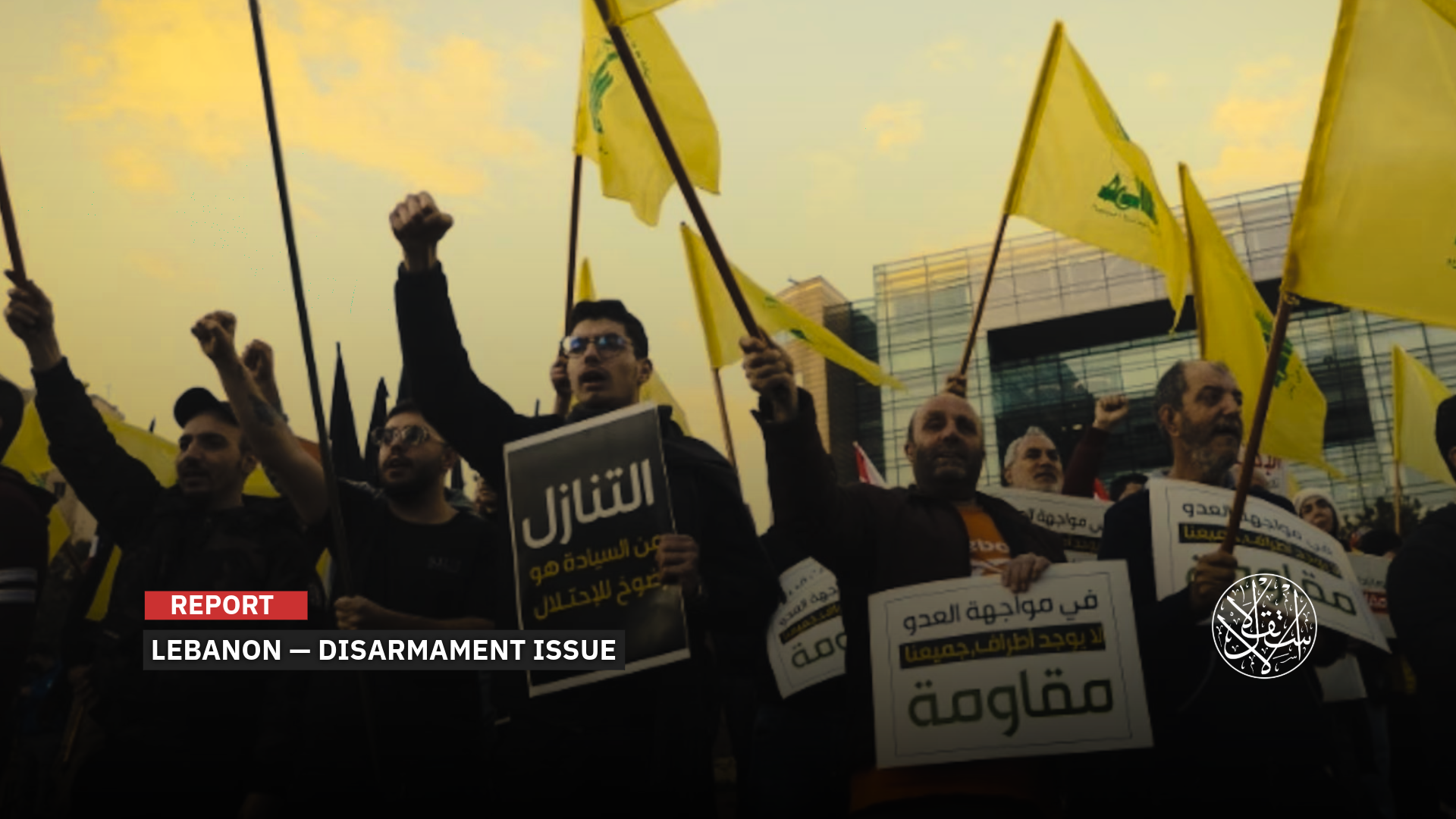
Hezbollah has rejected Phase II of the disarmament plan amid ongoing Israeli attacks.
Lebanon’s crisis has grown more tangled, as Israeli Occupation, in coordination with U.S. envoys, has shifted the spotlight from occupation and the right to retaliate toward an internal standoff between Beirut and Hezbollah amid mounting talk of a second phase in the group’s disarmament plan.
Following the November 27, 2024, ceasefire agreement between “Israel” and Hezbollah, the Lebanese government adopted a policy to centralize arms under the state, tasking the Lebanese army with a five-stage plan to implement it. The first stage was carried out in the south, along the Litani River, bordering the Israeli Occupation.
But the second stage, stretching from north of the Litani River to the Awali near Sidon—about 60 kilometers from “Israel” and 40 kilometers south of Beirut—has faced Hezbollah’s opposition.
The group regards the zone as a key redeployment area for its forces after the war, a move that has heightened tensions and increased the risk of internal confrontation.
Hezbollah’s rejection comes amid continued Israeli attacks and growing speculation about a potential U.S.-Iran clash, in which the group could align with Tehran against “Israel.” The standoff highlights a deeper clash between the logic of the state and the logic of resistance.
The Lebanese government, formed after the Israeli war on the country, has remained determined to pursue disarmament and dismantle the “deterrence-for-retaliation” dynamic, exposing deep divisions over Lebanon’s future security framework. Supporters of resistance warn that this approach could leave the country exposed to further Israeli aggression.
Phase II
On August 5, 2025, the Lebanese government decided to push forward with its plan to bring all non-state weapons, most notably Hezbollah’s arsenal, under state authority, placing arms exclusively in the hands of the Lebanese army according to a fixed timeline.
The first stage focused on the area south of the Litani River. On January 8, 2026, the Lebanese army announced it had established control over the region, preventing any armed activity outside the state framework.
The army said the southern disarmament plan, known as “Homeland Shield,” had entered an advanced phase, achieving the goals of stage one “effectively and tangibly,” with full control established over the south of the Litani, except for areas still under Israeli occupation.
Hezbollah appeared to respond tacitly to the army’s initial move, relocating a significant portion of its capabilities to north of the Litani River, despite ongoing Israeli strikes. Yet Israeli Prime Minister Benjamin Netanyahu dismissed the first stage as “entirely insufficient,” claiming there was an agreement on the need to fully disarm the group.
With “Israel” refusing to withdraw from the south and the Beirut government announcing on February 17, 2026, the launch of Phase II of the disarmament plan north of the Litani, the issue entered an even more sensitive stage after Hezbollah formally rejected this phase.
The Litani River forms a geographic boundary separating the south from the rest of Lebanon. South of the river lie villages and towns along the Israeli Occupation border, which before the 2023–2024 war ceasefire were among the group’s main zones of deployment outside the state framework.
Western and Israeli analyses indicate that south of the Litani was the core of Hezbollah’s fixed military infrastructure, including underground depots and other facilities.
North of the Litani stretches to the Awali River near Sidon. Intelligence estimates suggest that after the war, a substantial share of Hezbollah’s capabilities was relocated to north of the Litani and the Bekaa Valley, creating a practical “depth” that became a key logistical hub for its deployment and weapons storage.
The sensitivity of Phase II lies in its focus on Hezbollah’s deeper infrastructure, including depots and logistics networks, which the group refuses to relinquish. Hezbollah links any discussion over its arsenal to its deterrence strategy against “Israel” and to the full withdrawal of Israeli Occupation forces from the south.
Successfully implementing this phase requires broad internal consensus and a stable security environment that can entrench the state’s monopoly on force, as well as an Israeli withdrawal, before attention can shift fully to disarmament. This marks a clear departure from the government’s previous approach, which considered Hezbollah’s weapons part of the state’s defensive equation.
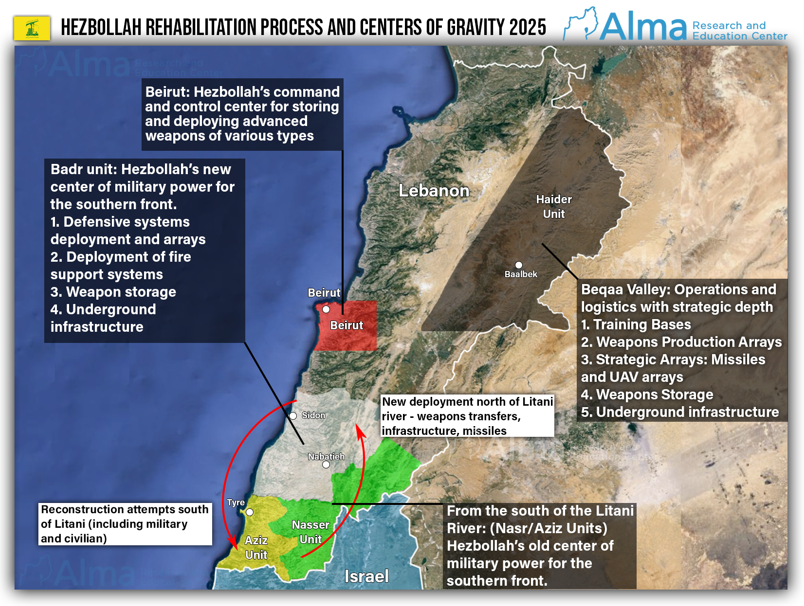
According to a report by the Israeli research and education center, Alma, on October 28, 2025, Hezbollah accelerated the rehabilitation of its military infrastructure north of the Litani, in what the report described as its new geographic center of gravity (Badr Unit sector).
It noted that north of the Litani had become the group’s main operational hub on the southern front in terms of fire, defense, and weapons storage, shifting from its previous focus south of the river in the Nasser and Aziz units.
As a result of the heavy losses these units suffered during the war, the center of gravity shifted north of the Litani, particularly into the Badr units’ area—precisely the zone slated to fall under Phase II of the disarmament plan—further complicating the landscape and raising the risk of internal escalation.

Widespread Debate
Although the timeline requested by the Lebanese government and army to bring Hezbollah’s weapons north of the Litani—set at four months, extendable to eight—appears on paper as a technical measure reflecting the operational and logistical complexities of a multi-stage plan, it has sparked a broad political debate.
Critics argue that concerns go beyond the practical challenges on the ground. Many point to the likelihood that Hezbollah will reject the second phase, potentially prolonging implementation and undermining the plan’s substance. Proponents of disarming the group warn that extending the deadline could send negative signals to international backers of the Lebanese army.
Rosana Bou Monsef wrote in Annahar on February 15, 2026, that the north Litani phase “raises eyebrows over its duration,” highlighting unease at the prospect of the timeline stretching to eight months and the potential political and security repercussions.
She noted that such delays could impact France-hosted donor conferences aimed at supporting the army and weaken Lebanon’s chances of emerging from its ongoing crisis, particularly if international aid levels shift. The extended timetable also risks giving “Israel” a pretext for a new phase of war amid Lebanon’s fragile stability and continuing Israeli attacks.
Bou Monsef argued that Lebanon needs a clear declaration from Hezbollah that it is transitioning into a political civil movement and renouncing arms. She noted that some members of the five-nation committee on Lebanon (the United States, France, Qatar, Saudi Arabia, and Egypt) appeared uneasy about the timeline of Phase II.
Politically, the proposed schedule has frustrated anti-Hezbollah forces in Lebanon, who fear the extended period could allow the group to reorganize and strengthen its influence on the country’s political and security landscape.
Lebanese army commander Gen. Rodolphe Haykal floated the timeline during talks with Hezbollah, saying implementation could extend to eight months depending on conditions on the ground, a flexibility that leaves the door open to anything from a gradual easing of tensions to deeper internal strain.
Raising the Stakes
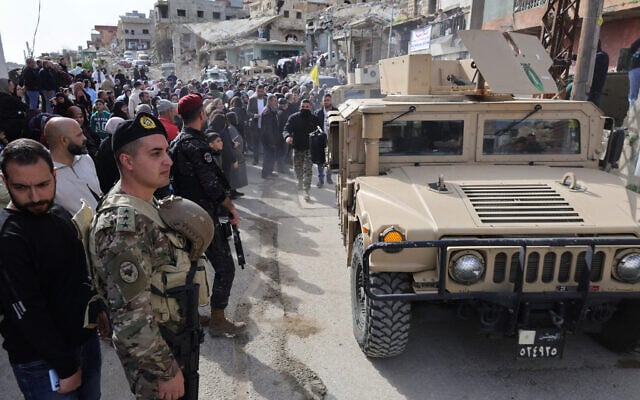
Following the Cabinet’s approval of the army’s plan to roll out Phase II of arms centralization north of the Litani River, Hezbollah dug in its heels, in what was widely read as a political escalation against the government.
The group was further encouraged by army leaders’ insistence that they have no intention of confronting Hezbollah militarily and will proceed with caution—an approach opponents warn may only entrench the group’s defiance.
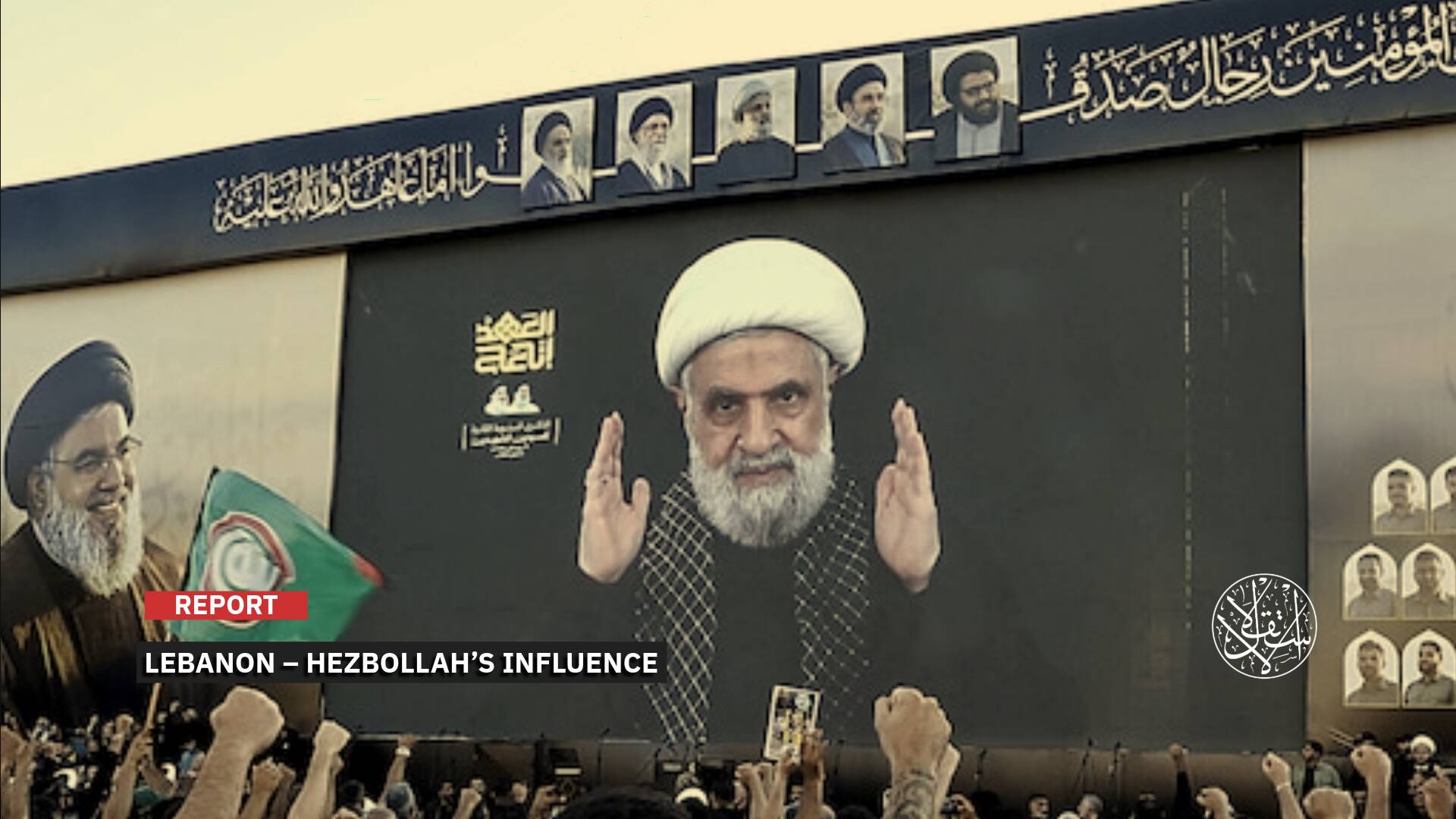
On February 17, 2026, Hezbollah’s secretary-general described the government’s push to disarm the group as a “major sin,” claiming it “advances the goals of Israeli aggression.”
Calling for an end to “any move aimed at monopolizing arms,” he accused the government of helping fuel the enemy’s greed through repeated concessions and acquiescence to pressure.
Party MP Hassan Fadlallah echoed the group’s stance, declaring, “We cannot compromise,” in reference to the proposed timeline and overall approach to disarmament. Hezbollah has described the government’s decision as “nonexistent,” framing it as the result of U.S. diplomatic pressure and labeling it part of a strategy of capitulation that undermines Lebanese sovereignty.
The group insists it will not hand over its weapons or integrate them into state authority without security and political guarantees, chiefly “Israel’s” full withdrawal from Lebanese territory, an end to attacks and assassinations, and the reconstruction of war-damaged areas. Hezbollah also argues that the plan exceeds UN Security Council Resolution 1701, which limits its disarmament to areas south of the Litani.
Hezbollah presents its arsenal as a key deterrent against the Israeli Occupation, warning that transferring its weapons to state control without clear safeguards could expose Lebanon to security risks and weaken its position in any future confrontation. Supporters cite the 1989 Taif Agreement, which ended the civil war and disbanded militias but explicitly exempted resistance forces countering Israeli occupation in southern Lebanon. They argue that “Israel’s” ongoing occupation of five points in the south justifies Hezbollah’s continued resistance role.
Meanwhile, other political actors have voiced concern that Hezbollah’s stance could indirectly affect the army’s approach and the timeline for Phase II, questioning how the plan can be implemented north of the Litani if the group continues to resist. The army’s insistence that it will not use force and its decision not to search private property south of the Litani despite pressure raise further doubts over whether the same approach will apply in the north, complicating the consolidation of weapons in practice.
Clash Looming
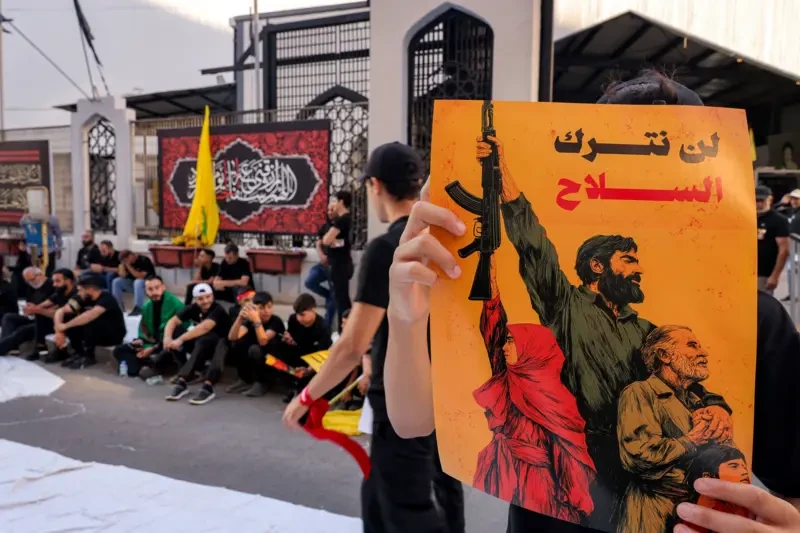
Since the Lebanese government tasked the army with drawing up a timeline to consolidate weapons under state control, some political currents have denounced the move as a “coup against the constitution and the Taif Agreement,” which, in their view, had legitimized the option of resistance against the Israeli Occupation based on Lebanon’s right to self-defense.
Analysts argue the decision marks a turning point in the state’s political approach to Hezbollah’s arms and points to increasing compliance with U.S. and Israeli pressure, warning that assigning the army to carry out the plan could draw it into a direct confrontation with Hezbollah and heighten the risk of internal conflict.
For years, successive Lebanese governments framed their ministerial statements around the “army, the people, and the resistance” trilogy, at a time when Hezbollah was the most politically and militarily powerful force, enjoying backing from Damascus and Tehran. The current government under Nawaf Salam dropped this framework from its ministerial statement, a move widely seen as stripping Hezbollah’s weapons of political cover.
The shift was also evident in the oath-taking speech of the Lebanese president, a former army commander, which for the first time in more than 25 years omitted reference to “resistance.” Previous presidents had included it as part of the “army, people, and resistance” formula, despite the domestic divisions it generated.
In 2016, the president had described Hezbollah’s weapons as “complementary to state capacity” in countering external threats, a balanced approach aimed at managing power without full disarmament. The current president, by contrast, emphasized only “the state’s monopoly on arms.”
Hezbollah’s rejection of the government’s deadline to move to Phase II of its disarmament plan is seen as a pivotal moment in the south’s tentative calm and a signal that political tensions could escalate to a more dangerous level.
The group opposes not only the principle of disarmament but also the abandonment of the “deterrence-for-aggression” equation, a framework previously upheld by past governments and presidents to regulate relations with the Israeli Occupation, which the current administration and the president have now discarded.
From Hezbollah’s perspective, any attempt to disarm while the Israeli occupation and attacks continue would upset the balance of deterrence in “Israel’s” favor. Its objection to Phase II is also tied to the area itself: a strategic depth north of the Litani, beyond the border zone, where its influence is entrenched, raising the stakes politically and militarily.
Possible Scenarios
There are five main potential trajectories for Phase II of Lebanon’s disarmament plan:
First, the stalemate continues between the government and army on one side and Hezbollah on the other, making implementation slow and incremental. The army has implicitly accepted this path by extending the expected timeline from four to eight months. While this scenario preserves a fragile minimum of internal stability, it leaves the crisis unresolved.
Second, domestic political escalation led by Hezbollah and its supporters could block the government’s plan entirely, particularly if a U.S.-Iran confrontation erupts or Israeli attacks and assassinations continue. In this case, the disarmament plan could be effectively frozen, weakening Lebanon’s position internationally.
Third, some Christian factions supporting the government could escalate tensions against Hezbollah, heightening the risk of serious internal clashes. With certain parties maintaining armed networks, fears of sliding into civil conflict would resurface.
Fourth, the Israeli Occupation could exploit Lebanon’s divisions, expanding its attacks under the pretext of diplomatic failure. This is the most dangerous scenario, potentially sparking a full-scale military confrontation between Hezbollah and “Israel,” possibly even more intense than previous wars.
Fifth, the Lebanese army could face Hezbollah directly if the state moves to enforce disarmament without prior agreement. Analysts at the Arab Center for Research and Policy Studies warn that this scenario carries high risks of internal conflict.
Taken together, these scenarios underscore the urgent need for political understanding to prevent Lebanon from sliding into internal confrontation and to block “Israel” from exploiting the division to turn Lebanese forces against one another.
Sources
- Hezbollah has rejected the second phase of the disarmament plan amid ongoing Israeli attacks.
- Special Report – Hezbollah’s Rehabilitation Composite in Lebanon — Situation Report
- North of the Litani: Phase Triggers Sudden Upheaval [Arabic]
- Hezbollah Condemns Lebanese Government Over ‘Major Sin’ in Move to Disarm Resistance [Arabic]
- Lebanese Army Marks Disarmament Milestone; Israel Criticizes Effort as ‘Insufficient’ [Arabic]
- Political and Security Implications of Lebanon’s Decision to Bring Weapons Under State Control [Arabic]