Geopolitical Ban: How the US Visa Crisis Is Spoiling World Cup Fans’ Dreams
“The Trump administration’s exclusionary immigration policies will inevitably be part of the tournament’s legacy.”
With the start of the 2026 FIFA World Cup, hosted by the United States, Canada, and Mexico, attention has extended beyond the on-field competition to include political and human rights issues related to visas, immigration, and security measures in the most prominent host country.
The three countries are organizing the first-ever World Cup with 48 teams instead of 32, while the United States will host 78 of the 104 matches, including the final. This makes obtaining a US visa a prerequisite for most fans wishing to attend the tournament.
While FIFA promotes this edition as the largest in World Cup history, the tournament has been accompanied by a series of criticisms and concerns regarding visa procedures, organization, security, ticket prices, transportation and accommodation, as well as the stadiums and facilities.
The logistical and security arrangements in the U.S. host cities have sparked international reactions and criticism, amid calls from some football fans to boycott the tournament.
Between official promises to guarantee participation regardless of the circumstances and the reality of unprecedented restrictions, a gap is emerging that raises serious questions about how the 2026 World Cup will end.
US Procedures
The 2026 World Cup has entered the arena of global controversy, with social media platforms reacting to complaints and criticisms from fan groups and participating sports federations.
One of the most controversial issues in this edition is the procedures for entering the U.S. Washington, in coordination with FIFA, launched a system to expedite visa interview appointments for World Cup ticket holders through the FIFA PASS program.
However, this program does not guarantee automatic visa issuance; it only prioritizes appointments, with the final decision remaining subject to US vetting procedures.
The visa sponsorship program, which required travelers from certain countries to pay up to $15,000, sparked considerable controversy before Washington announced exemptions for some World Cup ticket holders who met specific criteria.
However, US travel restrictions remained a point of contention, particularly for fans from participating countries, including those subject to full or partial restrictions. This raised questions about the tournament's ability to truly embrace the principle of inclusivity for fans of all participating nations.
A BBC report indicated that fans from more than a quarter of the participating countries faced similar difficulties due to travel restrictions or high visa refusal rates.
The list of countries affected by US travel restrictions includes four participating nations: Iran, Senegal, Ivory Coast, and Haiti. This effectively prevents their citizens from obtaining the visitor visas recommended by US authorities for fans.
The report noted that only 42 countries benefit from the US Visa Waiver Program (VWP) through the Electronic System for Travel Authorization (ESTA), while citizens of the remaining countries are required to pay visa fees and undergo personal interviews and additional vetting procedures.
Despite Washington's announcement last May of the elimination of the $15,000 deposit requirement for citizens of some qualifying countries, fans of Senegal and Ivory Coast still needed to secure visas in advance.
A BBC analysis of US State Department data revealed that visa refusal rates exceeded 40% in 11 countries that qualified for the World Cup, including Egypt, Algeria, Jordan, Ghana, Senegal, Iran, Ecuador, Haiti, Cape Verde, the Democratic Republic of Congo, and Uzbekistan.

Security Incidents
After weeks of uncertainty, the Iranian national team received permission to enter the United States, but only for one day before each match.
They were also forced to move their training camp to Mexico, a move reflecting the political and security concerns surrounding their participation in the World Cup.
The Iranian national team's coach stated that several members of the technical and administrative staff have not yet received permission to attend the tournament, despite the Trump administration's assurances to CNN that the necessary visas had been granted.
Fans of Ivory Coast and Senegal will be unable to travel to the 2026 World Cup after US visa restrictions prevented many from obtaining entry permits, officials from both teams confirmed to AFP.
Several fans from Scotland had their travel authorization suddenly revoked, while dozens of Moroccan fans have been denied visas, despite having purchased tickets to the tournament.
Many other qualified countries are on the Trump administration’s visa pause list, including Egypt, Ghana, Jordan, Morocco, Uruguay, and Uzbekistan, which only applies to immigration visas.
On June 6, Iraqi vice-captain Ayman Hussein was detained and interrogated for about seven hours at a Chicago airport, according to Reuters. He was eventually allowed entry, but the team photographer was not.
Moroccan player Zakaria El Ouahidi also faced significant difficulties obtaining a visa before the issue was resolved.
Some administrators, technical staff, and media personnel from Arab national teams faced longer than usual waiting times for visa processing, sometimes even resulting in deportation.
The head of the Palestinian Football Association, Jibril Rajoub, announced that the United States had refused to grant him a visa to attend the 2026 World Cup.
Gianni Merlo, president of the International Sports Press Association (AIPS), expressed his deep concern about the complex procedures that have so far prevented journalists officially accredited by FIFA to cover the World Cup finals from entering the U.S.
Politicization of FIFA
US President Donald Trump's statements regarding visas for participants and fans have sparked a wave of questions about the impact of security and immigration policies on the world's biggest football event.
Trump said his administration is working closely to ensure that the right people enter the U.S.
In turn, the US government defended its policies, asserting that the immigration system must be strict given the security challenges related to border management.
On June 11, US Homeland Security Secretary Markwayne Mullin defended the Trump administration's decisions to deny certain visas related to the 2026 World Cup.
He emphasized that national security considerations remain the top priority for US authorities, stressing that the decisions to deny entry are based on clear security criteria.
In a press statement, he said, "We will not allow people who have criminal records, or who are likely to have criminal records, into this country. I don't care about their status."
Mullin also rejected accusations of targeting based on nationality, including those concerning Somali citizens, asserting that these claims do not reflect the reality of the procedures followed.
U.S. Secretary of State Marco Rubio has stated: “A ticket is not a visa and it doesn’t guarantee admission to the U.S.,” but said those who apply with a ticket could get an interview within six to eight weeks.
Meanwhile, FIFA President Gianni Infantino defended FIFA’s handling of visa issues, stating that the federation is working to find solutions but lacks the authority to override government decisions.
Following the fallout from the denial of entry to the United States for Somali referee Omar Abdulkadir Artan earlier this week, Infantino’s advice to everyone was simply to remain calm.
US restrictions prevented Artan—despite his valid visa and selection as a World Cup referee—from becoming the first Somali referee to officiate at the tournament, opening the door to accusations of politicizing the event and linking it to US immigration and visa policies.
On the other hand, Infantino considered Iran's participation in the World Cup, despite its ongoing conflict with the United States, an achievement for his organization.
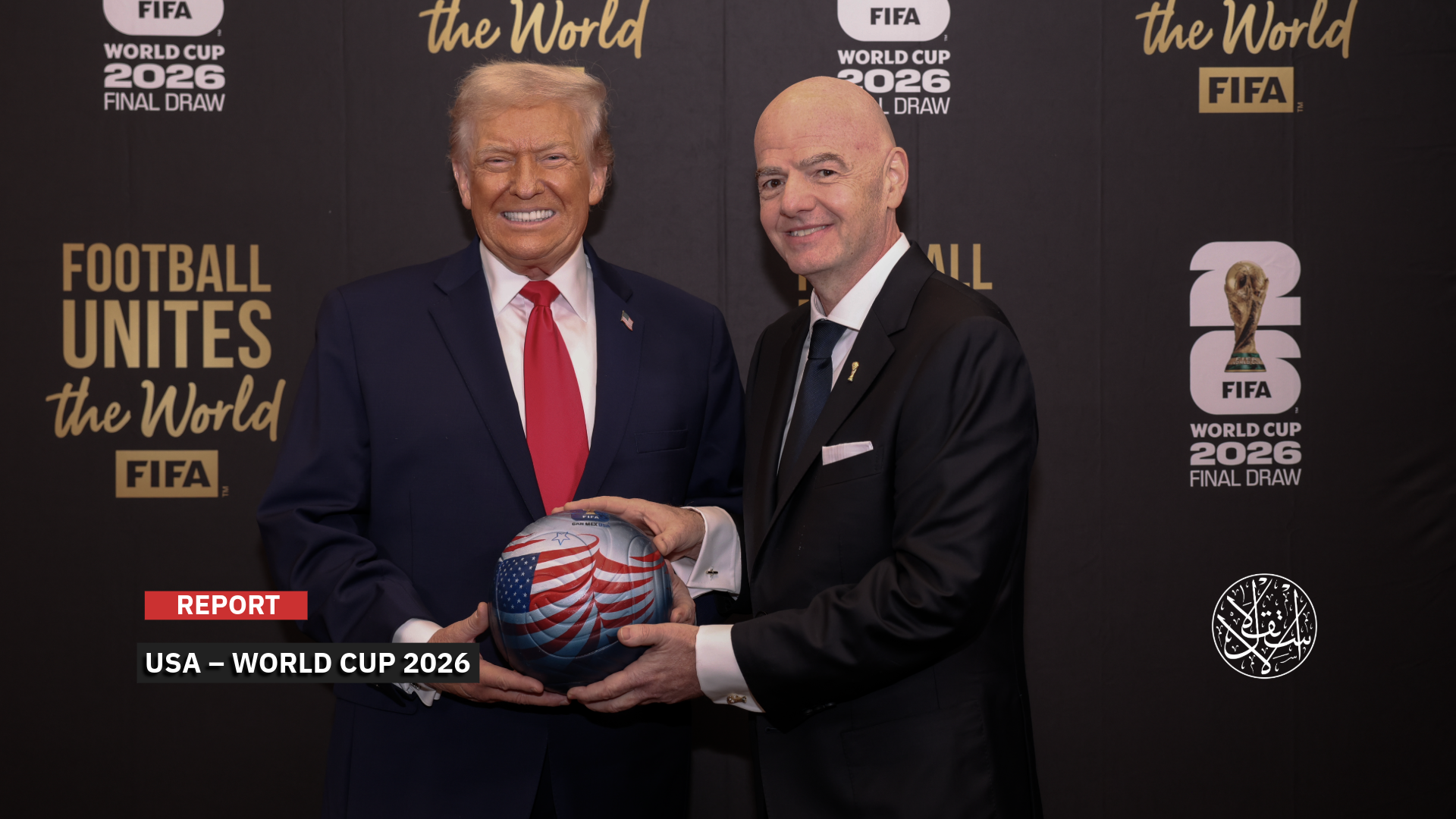
Infantino continued his visits to the White House, meeting again with Trump and asserting that the World Cup will be the greatest and most inclusive in history. This has intensified the controversy surrounding his close relationship with the U.S. administration.
It is worth noting that Infantino's close relationship with Trump had come under scrutiny before the tournament began, but Infantino emphasized that Trump played a crucial role in the preparations.
Infantino has gone to great lengths to strengthen those relations, awarding Trump the inaugural FIFA Peace Prize last year after he was overlooked for the Nobel Prize.
A Tiffany-crafted golden Club World Cup trophy has also sat in the Oval Office since the US hosted the tournament last year.
In a somewhat illustrative way, The New York Times revealed that Infantino showered Trump with praise, trophies, and honors in an effort to ensure the tournament proceeded without political or administrative obstacles.
Meanwhile, Le Monde considered the rapprochement between the two leaders to be the culmination of FIFA's politicization, and that it helped Washington establish itself as a dominant force within world football.
It pointed out that the story of American influence within FIFA did not begin with Trump, but rather dates back to 2010, following the shock caused by Qatar's winning bid to host the 2022 World Cup over the U.S.

Repeated Experience
The visa crisis facing fans wishing to attend the 2026 World Cup in the U.S. is bringing back to the forefront similar scenes experienced by thousands of football fans before the 1994 World Cup in the US, when the tournament turned into a diplomatic and media crisis for some European and African governments and fans.
This experience seems to be repeating itself today in a more complex and widespread form, with tightened security restrictions and concerns related to illegal immigration, which has frustrated a large segment of fans who are being prevented from accompanying their national teams to the world's biggest football event.
An Associated Press report revealed events that occurred before the 1994 World Cup, in which hundreds of Romanian fans were unable to obtain visas to enter the U.S.
Others from Bulgaria and Fiji faced the same fate, amid reports at the time that rejection rates at some US embassies had reached extremely high levels.
The Washington Post reported that the US embassy in Bucharest rejected nearly 50% of applications during the tournament, at a time when US immigration authorities were dealing very cautiously with citizens of former Eastern European countries, fearing that some visitors might become political asylum seekers or illegal immigrants.
In Bulgaria, the source indicates that the rejection rate reached 80%, sparking widespread discontent among fans who were preparing to travel to support their national team.
According to the Los Angeles Times, the Nigerian government entered into direct negotiations with US authorities after visas were denied to hundreds of fans wishing to attend their team's matches.
Amidst this, the U.S. was forced to ease the flight ban imposed on Nigerian airlines, allowing special flights to transport the national team and over a thousand fans.
Additional security measures were implemented, including a stopover in Senegal for thorough inspections under US supervision—a move that reflected the high level of security sensitivity surrounding the World Cup even at that time.
The Irish experience, however, stands out as one of the clearest examples of how a visa crisis can escalate into a full-blown political issue.
According to documents published by the Irish press from the National Archives, the Irish government was deeply concerned about the public and media repercussions of refusing visas to fans before the 1994 World Cup.

For his part, sports analyst Waleed Awad explained to Al-Estiklal that Trump's recent statements clearly demonstrate that security considerations still take precedence over sporting considerations, presenting Washington with a real challenge in balancing the protection of its borders with maintaining the open, global nature of the World Cup.
According to Mr. Awad, the World Cup, followed by the 2028 Los Angeles Olympics, represents a test of the Trump administration's ability to reconcile its 'America First' political agenda with its commitments to hosting major international sporting events.
On the other hand, the analyst pointed out that between FIFA's ambition to deliver the biggest World Cup in history and the escalating controversy surrounding US restrictions, the 2026 World Cup appears to be a new test of the complex relationship between sports and politics, specifically the politics of Western double standards.
Sources
- 'A World Cup for them not us': Fans' anger at US travel bans and visa restrictions
- FIFA World Cup 2026: The Geopolitical Tensions at Play Off the Pitch
- Everything wrong with the 2026 World Cup
- Gianni Infantino, the controversial emperor of football business
- Football and politics collide as World Cup kicks off in shadow of war, travel bans
- WORLD CUP '94; Romania's Other Revolution