When Tunisia Went Dark: Why Kais Saied’s Regime Failed to End the Power Crisis
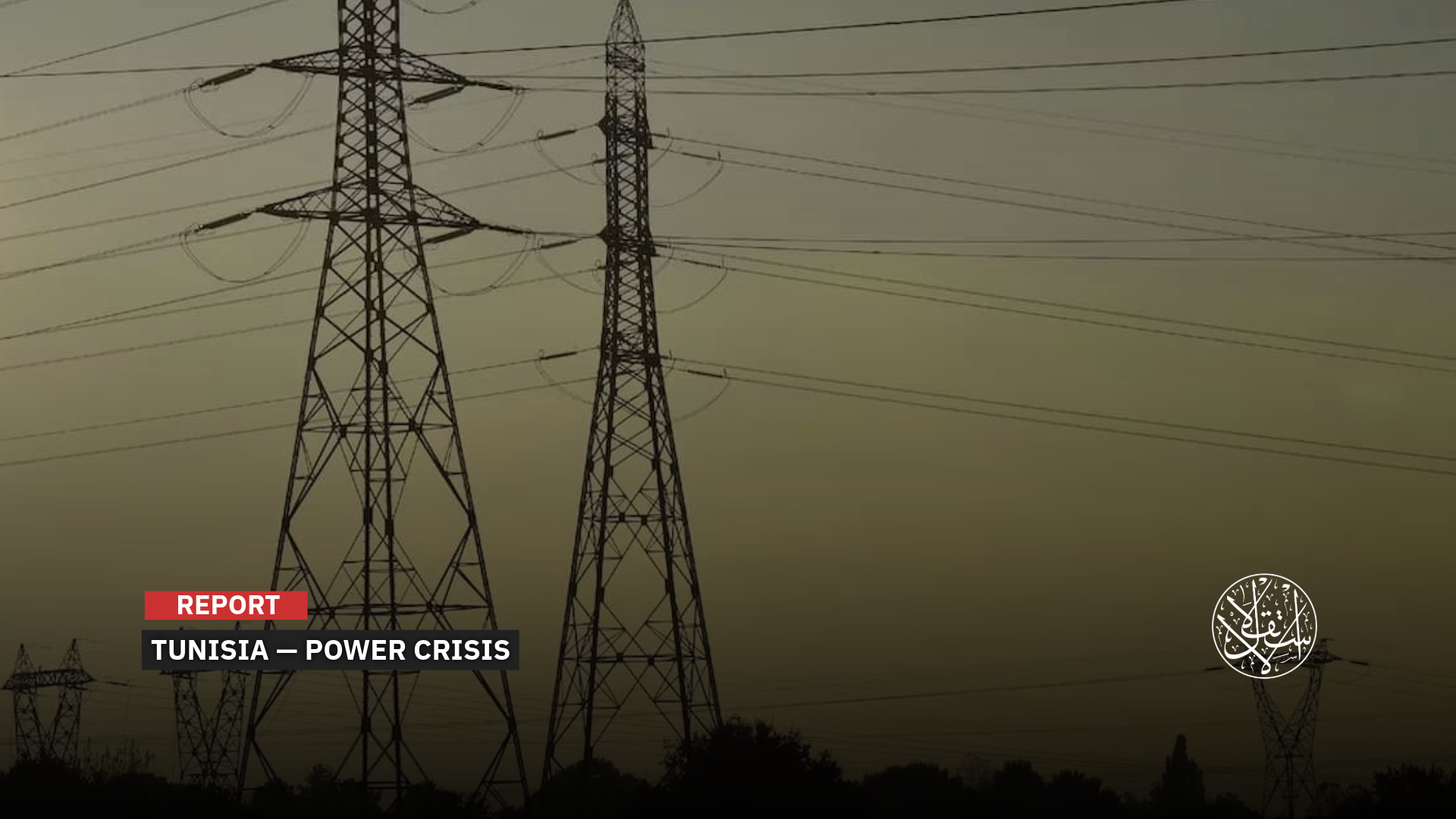
Tunisians are enduring power outages amid a record-breaking heat wave.
Tunisia has entered one of its worst energy crises in years. During the summer of 2026, scattered local blackouts gave way to scheduled power cuts across large parts of the country, exposing the depth of a crisis that had been building for years.
As Tunisians endure electricity outages in the middle of a record-breaking heat wave, coup leader Kais Saied’s system continues to lean on the language of “national sovereignty,” “self-reliance,” and what it calls a “war of liberation.”
Official data from the National Observatory for Energy and Mines and the Ministry of Industry, however, tell a very different story. Tunisia is facing a structural energy crisis that cannot be solved through political rhetoric or security measures. Instead, it requires major investment, long-term strategic planning, effective economic diplomacy to secure gas and electricity supplies, and genuine international partnerships capable of easing the country’s widening budget gap and chronic energy shortages.

A System Under Strain
Without warning or prior notice, electricity was cut off for millions of Tunisians as the country endured a record-breaking heat wave, with temperatures reaching 48°C (118.4°F) in some inland areas and exceeding 49°C (120.2°F) in cities such as Kairouan and Medjez el Bab, more than 13°C (23°F) above normal seasonal averages.
The outages were not confined to one region. Instead, they spread across the country under a rolling blackout program designed to reduce pressure on the national grid. The cuts were concentrated during peak demand, typically from 11 a.m. until midnight, with outage durations varying by area in an effort to prevent a total collapse of the electricity system.
The crisis quickly spread beyond the power grid. Repeated disruptions to electricity interrupted drinking water pumping, while telecommunications networks experienced widespread instability that knocked administrative and digital services offline, leaving many Tunisians unable to complete routine daily transactions.
The prolonged blackouts also inflicted significant economic losses, disrupting factories, businesses, and essential services through equipment failures, spoiled goods, and broken production chains.
Heavy Toll on Key Sectors
The rolling blackouts quickly rippled through Tunisia's economy, hitting agriculture, fisheries, and livestock production at the peak of the summer season.
Power outages brought tomato processing plants to a standstill, leaving trucks loaded with harvested crops parked outside factories for more than three days under extreme heat. The delays caused nearly 100,000 tons of tomatoes to spoil, with farmers suffering an estimated 30 million dinars in direct losses. The damage is expected to deepen debt for growers, who already face production costs of about 20,000 dinars per hectare, while driving up the price of tomato paste on the domestic market.
The fishing industry also came under pressure as repeated blackouts shut down ice plants essential for preserving fresh catches. Fishermen, particularly in the ports of Zarzis and Kelibia, were forced to sell sardines and other fish at rock-bottom prices that failed to cover even fuel costs rather than risk watching their catch spoil. Others chose to keep their boats in port altogether, adding to mounting financial losses.
The poultry sector was hit just as hard. Prolonged power cuts crippled ventilation and cooling systems inside enclosed farms, with outages lasting between nine and ten consecutive hours. Continuous operation of backup generators also led to mechanical failures and equipment damage.
In some areas, particularly in Sousse Governorate, poultry producers reported losing nearly half their flocks, according to industry groups.
As losses mounted, the Tunisian Union of Agriculture and Fisheries issued an urgent appeal, holding the state electricity and gas utility responsible for the widespread damage. The union called for the immediate activation of the Competitiveness Development Fund to compensate affected farmers and fishermen and prevent key production sectors from sliding toward bankruptcy.

Human Cost of the Crisis
The consequences of Tunisia’s energy crisis extended far beyond economic losses, reaching into the country’s healthcare system and creating a mounting human toll.
The Tunisian Organization of Young Doctors (OTJM) warned in a statement issued on July 22, 2026, of serious health risks caused by the combination of an extreme heat wave and widespread power outages.
According to independent figures compiled by the OTJM from reports by medical teams across 31 university and regional hospitals, between 150 and 200 deaths were linked to the crisis during the days when the situation reached its peak.
Most of the fatalities occurred among the most vulnerable groups, including older adults, people with chronic illnesses, and respiratory patients who rely entirely on oxygen machines and home ventilators.
As the Tunisian Company of Electricity and Gas (STEG) implemented rolling blackouts to reduce pressure on the grid, these life-sustaining devices stopped working, forcing families to rush patients to emergency departments that were themselves struggling with power disruptions.
At Kairouan Hospital, around 18 deaths were recorded within just 72 hours, linked to heat exhaustion and heatstroke caused by the absence of cooling systems inside the facility, offering one of the starkest examples of the human suffering caused by the crisis.
Managing the Crisis
Faced with a crisis that has brought severe consequences for millions of Tunisians, Kais Saied has maintained the same narrative he has used throughout previous crises, focusing on accusations against unnamed actors while holding them responsible for the power outages.
During a cabinet meeting at Carthage Palace on July 22, 2026, Saied said at the start of the session that he was closely monitoring developments across the country around the clock.
He described the repeated electricity and water cuts, along with the spread of fires, as “unusual phenomena,” adding that the state would not stand idle in the face of those seeking to harm citizens and fuel instability.
His response echoed his broader approach to crises since he assumed sweeping powers on July 25, 2021.
Saied has repeatedly shifted between accusing the opposition, which he labels “conspirators,” and blaming unidentified forces for a range of worsening problems, from rising prices and inflation to medicine shortages and the growing crisis of irregular migration.
At the same time, his public statements have largely avoided presenting concrete solutions, while his agenda has shown little evidence of meetings with experts or specialists to develop scientific and sustainable responses to the country’s challenges.
Adding to the uncertainty, Saied dismissed the energy and mining minister on April 28, 2026, leaving the position vacant and further deepening institutional confusion over how to handle the crisis.
Official figures reveal the scale of the sector’s challenges. Tunisia’s energy trade deficit reached nearly 1.6 billion dinars (about $500 million) during the first months of the year, while the STEG accumulated record debts of 7.356 billion dinars by June 2026.
The widening financial gap suggests that Tunisia’s electricity crisis is not the result of “conspiracies” or acts of sabotage, but rather a structural failure linked to the inability to finance gas imports and years of delayed investment in aging energy infrastructure.
Despite this, authorities continued to adopt a security-focused approach consistent with the system’s “conspiracy” narrative. On July 22, 2026, prosecutors in several courts, including Tunis, Nabeul, Sfax, and Bizerte, opened judicial investigations into the prolonged and repeated power outages that affected several areas without prior notice.
Prosecutors also ordered hearings with officials and engineers from the STEG and instructed authorities to take further measures based on the findings of the investigations.
Amid the crisis, parliament announced an emergency session on July 27, 2026, to discuss the electricity outages. However, the prime minister and cabinet members failed to attend, sparking widespread criticism and preventing lawmakers and the public from receiving official explanations about the causes of the crisis or the system’s plans to address it.

The Limits of Populism
Tunisia’s electricity crisis during the summer of 2026 has exposed the hard limits of a populist approach. No matter how forceful the rhetoric, it ultimately collides with the reality of a complex technical and financial challenge.
Securing energy supplies requires funding far beyond the capacity of the current budget, long-term strategic planning, and economic diplomacy capable of diversifying gas and electricity sources while securing stable contracts to guarantee reliable supplies.
Without these tools, the slogan of “self-reliance” remains little more than political messaging repeated with every crisis, while the economic and social damage continues to spread across large segments of Tunisian society.
At the same time, the state faces growing financial risks as it turns to domestic banks and the central bank for borrowing and, in some cases, relies on external loans with high interest rates and demanding conditions.
In this context, Tunisian economics professor Aram Belhadj said that what Tunisia is experiencing today is the inevitable result of the absence of strategic thinking and proactive planning in dealing with changing circumstances and, therefore, the absence of effective public policies.
In a Facebook post published on July 25, 2026, responding to the electricity crisis, Belhaj warned, “What we will face tomorrow will be harsher and more painful than the reality we are living through today, for the same reasons.”
The indicators point to a painful reality: Tunisia’s economy is heading toward further decline due to the slow accumulation of investment shortfalls, distorted pricing policies, weak governance, and a series of external shocks.
To avoid this trajectory, Belhadj called for the creation of a cross-sector crisis task force operating under the supervision of the country’s highest authorities, with the mission of managing the energy and economic crisis through an urgent and coordinated approach.
Yet observers say the authorities continue to handle crises through a policy of political isolation. Kais Saied’s system has kept its distance from political parties, labor unions, and social organizations, while avoiding any broad national dialogue or consultation on how to address the mounting challenges.
Analysts of Tunisian affairs argue that, in recent years, the authorities have succeeded in weakening most organized opposition structures and deepening a sense of public apathy among broad segments of society. Years of political polarization and what state media describes as the “Black Decade” have pushed many citizens to accept the status quo out of fear that instability could return.
But observers warn that the continued deterioration of living conditions, combined with repeated power and water cuts and shortages of some basic goods, could fuel a buildup of public frustration that may become increasingly difficult to contain.
With traditional “safety valves” largely absent, including political parties, unions, and civil society organizations that once helped channel protests and create avenues for negotiation, any potential social explosion could emerge in a spontaneous and unorganized form, potentially overwhelming state institutions’ ability to respond.
Against this backdrop, Tunisia’s electricity crisis appears to be more than a temporary technical failure. For many experts, it reflects a deeper crisis of management, governance, and financing, while raising serious questions about the state’s ability to secure one of the foundations of economic and social stability in the years ahead.
Sources
- Expert: Five Days of Rolling Blackouts Cost Tunisia 12.5 Billion [Arabic]
- Tunisia’s Energy Trade Deficit Hits 1.6 Billion Dinars by February 2026 [Arabic]
- International Energy Expert: Why Tunisia’s Energy Independence Fell to 35% in 2026 [Arabic]
- STEG Debt Reaches Nearly 7.356 Billion Dinars by June 23, 2026 [Arabic]
- STEG Debt Reaches Nearly 7.356 Billion Dinars [Arabic]
- Deaths at Home Linked to Heat and Power Cuts: Young Doctors’ Union Chief Raises Alarm [Arabic]
- Farmers Union Sounds Alarm as Power and Water Outages Threaten Food Security and Inflict Heavy Losses [Arabic]
- Parliament Holds Emergency Session on Water and Power Outages and Their Fallout [Arabic]