Amid Welcome and Skepticism: Is Libya Moving Toward Elections After the Haftar–Dbeibah Agreement?
Should any of the signatory or concerned parties engage in any form of delay or stalling, the agreement will be referred to the UN Security Council, and from there it will enter into force.
In a move aimed at accelerating Libya’s transition toward elected and stable institutions, the parties participating in the dialogue agreed to move forward with national elections, amid differing assessments of the prospects for this step to succeed in ending the country’s political division.
On August 30, 2026, the United Nations Support Mission in Libya (UNSMIL) hosted a signing ceremony for the Mini-Group Agreement, which seeks to advance the political process and create the conditions necessary for holding elections.
The agreement addresses two phases of the political roadmap sponsored by the UN mission.
The first phase includes restructuring the board of the High National Elections Commission (HNEC) and addressing outstanding issues in the constitutional and legal frameworks governing presidential and legislative elections.
The agreement also provides for amendments to the electoral framework, including arrangements that would allow presidential and legislative elections to be held under a single executive authority.
It commits the parties to working toward holding elections within a period not exceeding 24 months.
It also includes arrangements for the agreement to be endorsed by the House of Representatives and the High Council of State within one month, as well as the establishment of a mechanism to monitor and support its implementation.
The signing ceremony took place at the headquarters of the United Nations Support Mission in Libya in the capital, Tripoli, in the presence of members of the “4+4” Mini-Group Dialogue Committee, a number of ambassadors, members of the House of Representatives and the High Council of State, as well as a representative of Libya’s Presidential Council.
Members of the International Follow-up Committee on the Berlin Process for Libya also attended the signing ceremony.

An Important Step
In this context, the United Nations Secretary-General’s Special Representative, Hanna Tetteh, said in her remarks during the signing ceremony, “Today’s signing represents an important step toward overcoming the political and institutional deadlock that has hindered the electoral process in Libya.”
Tetteh added, “This agreement also demonstrates what can be achieved when Libyans engage constructively in dialogue and seek practical and workable solutions to outstanding issues.”
“The responsibility now is to translate this agreement into concrete action by securing its adoption at the national level, implementing the agreed electoral framework, and continuing efforts to create the institutional and political conditions necessary for holding fair elections.”
The UN official stressed that “the United Nations will continue to facilitate and support this process, while Libya’s political future remains in the hands of the Libyan people.”
She cautioned that “the signing is not the end of Libya’s political process, but rather an important step that takes us to the next stage,” calling on “all Libyan institutions and political actors to engage constructively with the agreement, fulfill their commitments, and prioritize the national interest and the right of the Libyan people to choose their representatives through free, fair, and inclusive elections.”
The European Union Mission and the diplomatic missions of EU member states in Libya said that the final agreement reached by the Libyan “4+4” Mini-Group Dialogue Committee represents “an important step toward unifying institutions” and creating the conditions for national elections.
This came in a statement issued on Sunday, in which the EU mission and the diplomatic missions welcomed the agreement on restructuring the board of the High National Elections Commission (HNEC) and reviewing the electoral framework for the presidential and legislative elections.
“We recognize that this agreement represents an important step toward unifying institutions and creating the conditions for fair national elections,” the statement said.
The missions commended the Libyan participants for “their constructive approach, political responsibility, and willingness to find common ground in the national interest.”
They called on the House of Representatives and the High Council of State to “engage positively with the outcomes of the Mini-Group meeting and take the necessary steps to implement them without delay.”
They also reaffirmed their “full support for the efforts of the United Nations Support Mission in Libya (UNSMIL) and the United Nations Secretary-General’s Special Representative for Libya, Hanna Tetteh, to facilitate a Libyan-led political process with genuine Libyan ownership.”
Separately, 60 Libyan municipalities announced their support for the outcomes and signing of the 4+4 Committee agreement, describing it as an important national step toward breaking the political deadlock, creating suitable conditions for completing the national electoral milestones, and reaching free and fair elections.
According to a report published by Al-Marsad on August 31, the municipalities stressed that Libya’s unity, stability, sovereignty, and the building of its institutions on legitimate and constitutional foundations represent firmly established national principles.
They noted that the consensus bringing together representatives of various Libyan parties demonstrates that a political solution is possible when national will exists and the national interest is placed ahead of narrow interests and calculations.
The municipalities called for the immediate implementation of the outcomes of the 4+4 Committee without obstruction or delay, as well as the completion of the complementary executive steps.
They also called on all political parties and institutions to assume their national responsibilities, prioritize the higher interests of the state, work toward unifying its institutions, and consolidate the principle of the peaceful transfer of power.
The municipalities affirmed their readiness to play their role in supporting local stability and creating the appropriate conditions for the success of the electoral process, paving the way for the establishment of a unified state whose institutions derive their legitimacy from the will of the Libyan people.
The list of municipalities supporting the outcomes and signing of the 4+4 Committee agreement includes: Benghazi, Sirte, Tobruk, Sabha, Jufra, Tocra, Ghat, Suloug, Germa, Al-Qurda Al-Shati, Brega, Wadi Etba, Bint Bayya, Ajdabiya, Zuwaila, Al-Abyar, Jalu, Gulf of Sirte, Kufra, Al-Qatrun, Bargan, Zella, Ajdabiya, Harawa, Awjila, Qaminis, Hun, Al-Bardi, Bir al-Ashhab.
The list also includes the municipalities of Al-Melitaniya, Wadi al-Bawanis, Al-Bayda, Ubari, Tahala, Al-Sharqiya, Barkat, Al-Awaynat, Al-Sahil, Musaid, Al-Wifaq, Al-Gharyifa, Soussa, Traghen, Al-Marj, Al-Baydan Antalat, Sultan Al-Zawitina, Tjerhi, Al-Jawf Al-Gharbi, Tazirbu, Qasr Al-Jadi, Wardama, Madwar Al-Zaytoun, Brak Al-Shati, Adiri Al-Shati, Murzuq, Jardas Al-Abid, Qarara, Al-Ruqaybah, and Al-Wadi Al-Sharqi.
A Single Executive Authority
The agreement sets a timetable for holding legislative and presidential elections, to be conducted under a single executive authority and unified national institutions, with the period leading to the elections not exceeding 24 months.
It also provides for the restructuring of the board of the High National Elections Commission (HNEC), with Dho Ibrahim Atiya appointed as Chairman of the Commission’s Board and Sanaa al-Lishani as Deputy Chairperson.
The agreement addresses one of the most prominent points of contention surrounding the elections: the eligibility of military personnel and dual nationals to run for office. It allows dual nationals to stand in presidential elections, while establishing safeguards requiring the winning candidate to renounce their non-Libyan citizenship before taking the constitutional oath.
The agreement proposes a legal mechanism allowing the electoral process to be repeated if the winning candidate is unable to meet this requirement. It also allows military personnel to participate in presidential elections both as candidates and voters.
The agreement sets the number of endorsements required for a presidential candidate at 20,000 registered voters from across Libya.
Regarding the constitutional track, the 4+4 Committee agreed to empower the newly elected parliament to address matters relating to a permanent constitution, including its adoption.
The agreement also provides for regular sessions of the elected House of Representatives and the executive authority, according to a fixed rotation between Tripoli, Benghazi, and Sabha, as part of the arrangements it establishes for elected institutions and the executive authority.
The agreement also sets out a mechanism for dealing with the possibility that it is not approved by the House of Representatives and the High Council of State. It stipulates that if it is not approved within one month, the parties will seek to adopt it at the national level as a constitutional document through broad-based national mechanisms, while securing international support for it through the United Nations Security Council.
If elections cannot be held within a period of no more than two years, the agreement stipulates that the parties will work with the United Nations Support Mission in Libya (UNSMIL) to identify the optimal mechanism for proceeding toward the electoral process.
It should be noted that the political process aimed at ending the conflict, which has persisted for more than a decade, stalled after the elections scheduled for December 2021 failed to take place, following disputes over the eligibility of several leading candidates.
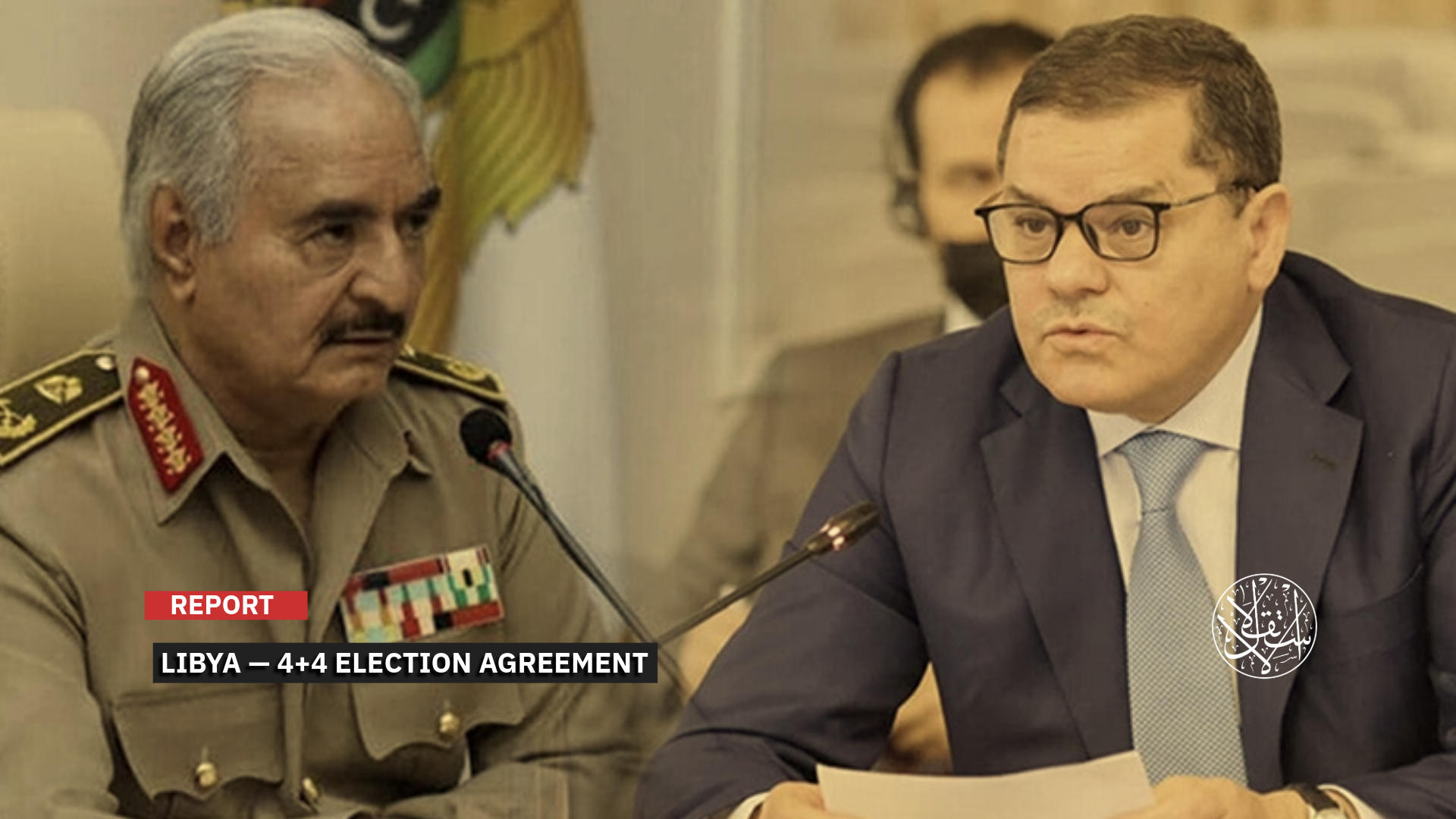
Libya has experienced instability and insecurity since the 2011 uprising that toppled the regime of Muammar Gaddafi. The country subsequently became divided after Khalifa Haftar resorted to armed force and consolidated control over eastern Libya, while Abdul Hamid Dbeibah heads the internationally recognized government based in the capital, Tripoli, in the west.
The country has not experienced major fighting since the 2020 ceasefire agreement, but political disagreements over the rules and arrangements governing the elections have prevented the electoral process scheduled for 2021 from taking place.

Dbeibah’s Position
In this context, Prime Minister of the Government of National Unity Abdul Hamid Dbeibah welcomed the signing of the 4+4 Mini-Group Dialogue Committee agreement, saying that it “is an important step that strengthens the path we have advocated from the outset, based on ending the transitional phases and moving toward elections.”
Dbeibah continued in a Facebook post, “Our vision has been clear: the decision should belong to the Libyan people, through elections that end the state of division and give all institutions their genuine legitimacy through the will of citizens, away from any arrangements that would reproduce the existing transitional phases and bodies.”
The prime minister expressed his hope that the agreement would constitute a practical step in the right direction, preserving the priority of elections and paving the way for a national electoral process that puts Libya on the path toward stability and development.
However, political activist Mohammed al-Qnedy responded to Dbeibah, holding him partly responsible for the delay in holding elections.
In a Facebook post dated August 30, 2026, al-Qnedy added, “Your government was established in the first place for a clear mission: to prepare for elections within a period not exceeding 18 months, as proposed when it was formed.”
He continued, “But instead of 18 months, the period has stretched to 78 months, and today we are hearing about understandings to extend the period in office once again.”
The political activist went on, “The question that naturally arises is: When will the transitional period end and the decision be left to the people?”
“We do not want temporary governments to become permanent, nor do we want exceptional extensions to become the norm. Libyans deserve to choose who governs them through genuine elections, and for power to be a means of serving the country, not an end in itself for remaining in power,” he added.
Outstanding Issues
Libyan political analyst and researcher Mohammed Qashout said that the substance of the new agreement raises a number of questions, particularly with regard to the challenge of adhering to its timetable.
Qashout told Al-Estiklal that the one-month deadline stipulated in the agreement expires on September 30, 2026. This is the period available to the House of Representatives and the High Council of State to approve the 4+4 Committee agreement, which represents the Dbeibah government and the General Command of the Libyan Armed Forces.
The political researcher warned that should any of the signatory or concerned parties engage in any form of delay, the agreement will be referred to the UN Security Council, and from there it will enter into force.
“There is only one month for these two councils, which have lost any respect or popular standing among the Libyan people as a whole. After that, the process will move beyond them, and their continued existence will no longer serve any purpose,” as he put it.
“As for the Presidential Council, it has been out of the picture as of today. A new Presidential Council will be formed with stronger and broader powers, and it will be led by nothing less than a strong figure who will emerge, God willing.”
Raqi al-Mismari, a law professor at the University of Derna, said he rejected any approach based on one side prevailing over the other among Libya’s rival parties, stressing the importance of moderate political discourse that brings people together rather than divides them.
In a Facebook post dated August 31, al-Mismari stressed that Libya has room for everyone and needs sincere, impartial, and transparent national efforts to rebuild and develop the country in order to secure a better life for future generations.
He added, “No to exclusion, no to rhetoric of incitement and hatred, no to sedition, no to revenge, no to obstruction, and no to hindering [the process],” adding that “consensus is a historic opportunity that must not…”
A number of political figures also reacted to the signing, including Ashraf Tulty, the former spokesperson for the Presidential Council of the Government of National Accord, who welcomed the final 4+4 agreement in a Facebook post dated August 30.
Tulty expressed hope that the agreement would bring an end to the state of division and rescue our country from the grip of chaos and failure in managing most aspects of life.
Political analyst Hashim Belkheer said that the 4+4 agreement did not produce a final solution, but that it removed some obstacles and opened the door to the most important next stage: a unified executive authority.
In a Facebook post, he added, “Each side views the agreement from its own perspective: some are thinking about the presidency, some are seeking to remain in power, some want to change the government, and others are looking for their place in the arrangements to come. But amid all these calculations, where is the citizen?
“The citizen is not only concerned with who will govern, but also with what will change in their life over the next 24 months, and how their livelihood, income, and public services will be protected.”
Belkheer continued, “Here is the most important question: Can the mission, with American and international support, reach someone who is accepted in the east, not rejected in the west, and capable of working from Tripoli and leading the state without being beholden to any side?”
He added, “The 4+4 agreement may be the train that sets off with everyone aboard, but it has stations along the way, where positions and roles will change and figures capable of meeting the requirements of the next stage will emerge.” He stressed that “the goal is not who reaches power, but for Libya to reach statehood.”