After the Houthis Seized Control of Bab al-Mandab, Why Did Mohammed bin Salman Visit Cairo?
Saudi Arabia Asked Egypt, France, the United Kingdom, and Pakistan to Deploy Air Defense Reinforcements to Help Counter Houthi Missiles and Drones.
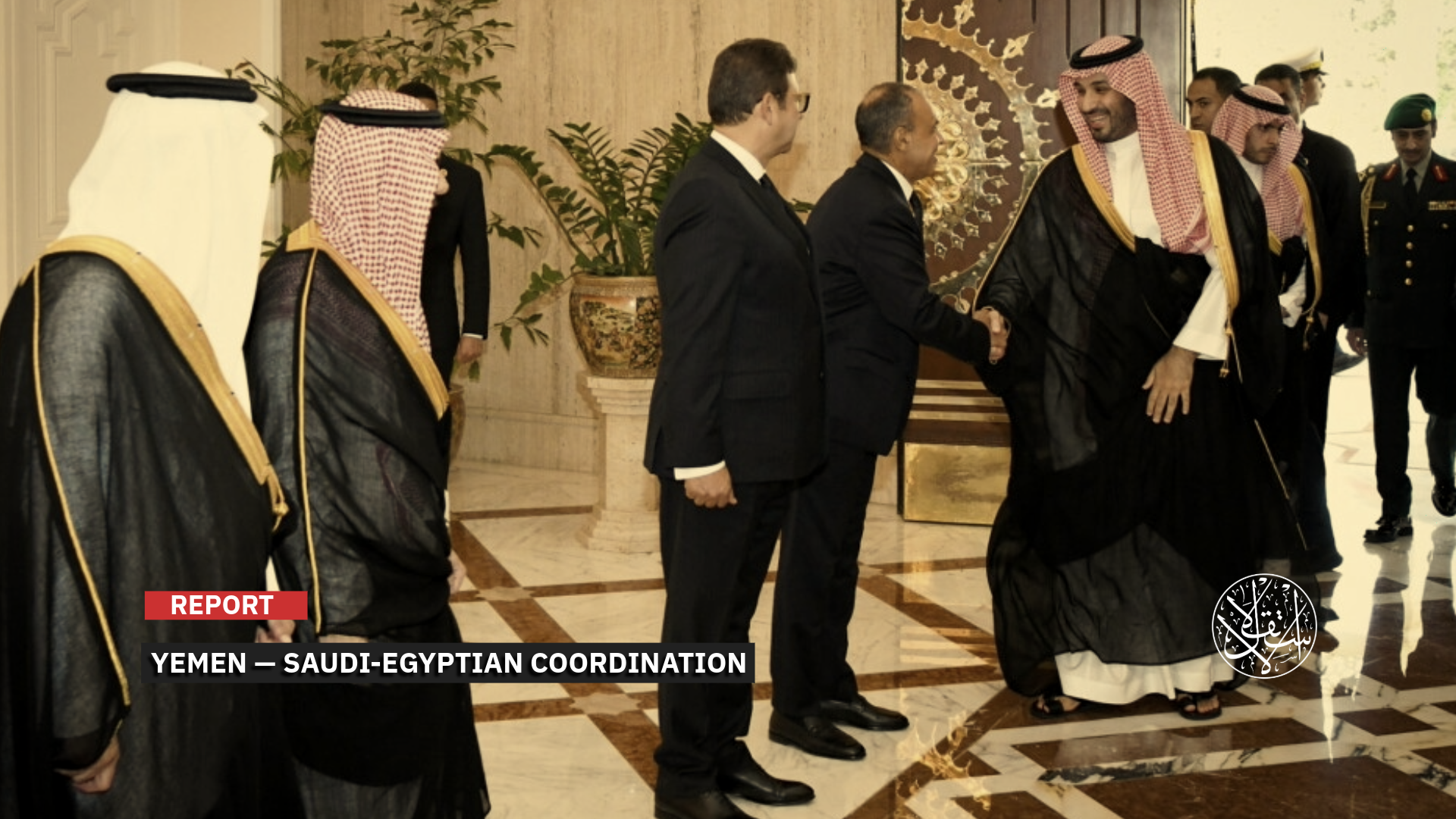
Five days after the Houthis seized control of Yemen’s western coast and established dominance over the Bab al-Mandab Strait and the surrounding islands, and just one day after meeting with the commander of U.S. Central Command, Saudi Crown Prince Mohammed bin Salman visited Egypt on September 15, 2026.
The visit came amid expectations that he would seek military support and discuss with Cairo ways for the two countries to jointly address the new challenge that the situation in Bab al-Mandab poses to the Suez Canal.
The significance of the visit extends beyond its timing, which followed the Houthi takeover of Bab al-Mandab and the threat it poses to Saudi interests, including oil supplies, oil facilities, and military bases, as well as to Egypt’s interests tied to the Suez Canal.
The visit takes on additional significance because it came after the United States, and to some extent Pakistan and Turkiye, declined to intervene to protect the kingdom from Houthi attacks, suggesting that Riyadh may be seeking support from Cairo.
Analysts believe the visit’s first significance is military, relating to Riyadh’s need for military support, given Egypt’s strategic location, naval capabilities, and political presence on the opposite shore of the Red Sea.
The second significance is strategic, involving coordination between the two countries on Red Sea affairs and the establishment of new frameworks for dealing with the reality imposed by the Houthis in Bab al-Mandab.
Although various assessments and analyses suggested that the publicly announced outcomes of the visit did not go beyond Egypt’s “moral support” for Saudi Arabia, others expected Cairo to take a step similar to its previous action toward the UAE, as a symbolic measure.
On May 7, 2026, Egyptian head of the regile Abdel Fattah el-Sisi had previously sent a group of Egyptian pilots and fighter jets to the UAE, in a move that Emirati media said was aimed at “enhancing operational capabilities and preparedness for various challenges.”
The move raised questions about the rationale for sending symbolic forces to the UAE but not Saudi Arabia, despite the latter also coming under attack, and whether this represented symbolic support for an ally or involvement in a confrontation with Iran.
This development comes amid efforts to consolidate an Egyptian-Saudi axis in response to an increasingly challenging regional security environment affecting the Gulf and the Red Sea. However, the absence of clear mechanisms for such an axis makes Egyptian support for Riyadh more likely to take the form of political and symbolic steps, similar to those reflected in previous agreements and understandings, such as the Mecca Agreement and others.

Routine Statements
It was noteworthy that both the Egyptian presidency’s statement and the Saudi Royal Court’s statement, as repeated in previous announcements, emphasized Egypt’s support for Saudi Arabia while maintaining a commitment to a political solution. This indicated that Mohammed bin Salman’s visit to Cairo was primarily security-related and political in nature, despite the statements also highlighting economic cooperation and other regional issues.
The Egyptian statement conveyed a clear message regarding the Yemeni issue, namely that “Cairo supports Saudi measures to protect its security and stability,” while simultaneously emphasizing the need to “reach a comprehensive and sustainable political solution to the Yemeni crisis.”
The official spokesperson for the Egyptian presidency stated that “the security of Saudi Arabia and the Gulf states is an integral part of Egypt’s national security.”
He also affirmed that “Egypt considers the security of Saudi Arabia and maritime navigation in the Red Sea among its direct interests.” This indicates alignment with Saudi Arabia’s position on the conflict with the Houthis and Red Sea security, but without declaring a direct military commitment in Yemen.
He further highlighted “Egypt’s complete reservation, rejection, and condemnation of any attacks or threats affecting the sovereignty, stability, or territorial integrity of the Kingdom, or freedom of navigation in international waterways.” He added that current circumstances require greater solidarity and coordination between the two countries, and that “the interests and objectives of both countries are aligned.”
By contrast, the Saudi statements on the visit were brief, referring to discussions on a number of issues on the Arab and Islamic fronts, developments in the Middle East, and particularly matters related to regional security and stability, including maritime security and freedom of navigation, as well as coordination of efforts in this regard.
The overall message of the two statements indicates that the official outcomes of the visit focused on the same issues raised on previous occasions, particularly Cairo’s reaffirmation that Saudi Arabia’s and the Gulf’s security is part of Egypt’s national security, along with Egyptian-Saudi coordination in addressing the maritime corridor crisis, without specifying the nature of this coordination.
Accordingly, some assessments and analyses concluded that the publicly announced outcomes of the visit amounted to “moral support” from Egypt for Saudi Arabia. However, other reports suggested that the issue of military support, including its nature and scope, may have been discussed behind closed doors, particularly given that the visit began with a private meeting between el-Sisi and Mohammed bin Salman alone, before national security officials joined them.
Military Implications
When Saudi Arabia announced on July 30, 2026, that it would host an international meeting to discuss establishing a maritime defense coalition to protect navigation in the Red Sea, following the announcement by Iran-backed Houthis that they were imposing a “maritime blockade” on the Kingdom, Egypt’s position was unclear.
When Egyptian Foreign Minister Badr Abdelatty was asked about his country joining the coalition, he indicated that Egypt had participated in its recent meetings. However, he added that “agreements involving military commitments are carefully studied in order to make the appropriate decision,” suggesting that Egypt had reservations.
Therefore, the most significant military implication of the visit was that it came at a time when Saudi Arabia was seeking a regional network of support and coordination to confront Houthi threats and protect its airspace and maritime domain, without revealing any specific agreement or direct Egyptian participation in operations against the Houthis.
Meritte Mabrouk, a researcher at the Middle East Institute in Washington, told Agence France-Presse on September 14 that Mohammed bin Salman “is seeking assurances that Egypt will intervene to protect Bab al-Mandab if necessary.”
Mabrouk said, however, that Egypt’s position on military intervention remains “cautious,” adding that it “will not be drawn into a military confrontation that it does not believe serves its interests and that can be avoided.”
The Washington Post reported on September 16, citing “regional officials,” that bin Salman’s visit was linked to Saudi Arabia’s request for “help from its allies because its stockpile of interceptor missiles had dwindled and was beginning to run out,” amid the continuing confrontation with the Houthi militias.
The two officials explained that Saudi Arabia had asked Egypt, France, the United Kingdom, and Pakistan to deploy air defense reinforcements to the region to help counter missiles and drones launched by the Houthis and other Iran-backed groups.
One of the officials said the move came after the United States, Saudi Arabia’s main ally and primary arms supplier, experienced a decline in its own stockpile of interceptor missiles during the six-month-long war with Iran.
One regional official said Saudi Arabia was facing a “very difficult” situation, as it had to protect not only its military bases and vital government facilities, but also oil facilities spread across the Kingdom.
The Associated Press reported on September 16 that Saudi Arabia was seeking regional defense alternatives, facing pressure on its air defense missile stockpiles, and seeking military assistance from countries including Egypt, France, the United Kingdom, and Pakistan.
It said bin Salman’s visit to Cairo came in the context of an “attempt to expand the regional defense support network,” but noted that Egypt, despite its regional weight, “is unlikely to send troops to Yemen.”
Reuters reported on September 14 that Egyptian-Saudi defense coordination was being strengthened as part of a broader Saudi effort to explore security and military support, without any actual Egyptian deployment.
The Egyptian-Saudi statement explicitly emphasized the security and freedom of navigation in Bab al-Mandab, the Red Sea, and the Strait of Hormuz. Militarily, this means that the security of maritime routes has become a more clearly shared issue between Cairo and Riyadh, particularly amid the escalation of Houthi attacks.
Egyptian analysts interpreted head of the regime el-Sisi’s affirmation that the security of Saudi Arabia and the Gulf states is part of Egypt’s national security as providing an important political framework for any potential security or military cooperation, but not as an announcement of direct Egyptian military participation in the war against the Houthis.
Regarding the military significance of Saudi Crown Prince Mohammed bin Salman’s visit to Cairo, researcher and military and strategic affairs analyst Mahmoud Gamal said that bin Salman’s departure from the Kingdom and visit to Cairo amid the highly volatile security and military situation there carried implications beyond the usual political nature of such visits.
In a post on X, he explained that the timing of the visit “indicates that it was linked to an urgent and pressing matter that prompted the Crown Prince to travel personally to Cairo to meet with el-Sisi, despite the dangerous security situation.”
He said the matter involved requests for support in the form of military personnel and technical capabilities, as well as the provision of personnel and expertise that could have a direct impact on the ability to manage the air battle and defend Saudi airspace in light of the ongoing developments between Ansar Allah, the Houthis, and the Kingdom of Saudi Arabia.
Saudi Arabia’s outreach to Cairo may have come after the Kingdom observed that Egypt had provided the UAE with an air detachment during the Iranian-American war, and that el-Sisi had sent an Egyptian air detachment to the UAE, following an Emirati request, consisting of fighter aircraft and Egyptian pilots.
He explained that under unstable security conditions, officials’ movements are usually kept to the narrowest possible scope and may be halted altogether based on assessments and evaluations of the level of risk. Therefore, the decision to travel outside the Kingdom under such circumstances carries particular significance.
Gamal suggested that the visit was linked to the Kingdom’s military needs in confronting attacks carried out by Ansar Allah, the Houthi movement.
He said Riyadh “is seeking defensive military support from multiple parties, whether in the form of equipment or personnel, particularly in the fields of air forces and air defense.”
Such support could include requirements involving air formations or an “air detachment” consisting of fighter aircraft and pilots, in addition to air defense systems and air defense officers. This would strengthen the Kingdom’s ability to respond to Houthi attacks and maintain the readiness of its defensive system amid mounting military pressure on it.
Some Egyptians commented that the reason for the visit could be to draw Egypt into the war, invoking a poetic passage from Majnun Layla by poet Ahmed Shawqi, which circulated in the story of Majnun Layla and says, “Did you come seeking fire, or perhaps did you come to set the house ablaze?”
It was noteworthy that on September 15, one day after bin Salman’s visit ended, the newspaper al-Masry al-Youm published a report about the approaching maturity date, in two weeks, of a $5.3 billion Saudi deposit, even though the maturity date had been known in advance. This may suggest that Saudi Arabia was considering extending the deposit in exchange for military support from Cairo.
A senior source at the Ministry of Finance told the website al-Manassa on September 16 that a preliminary agreement had been reached to renew the Kingdom’s $5.3 billion deposit with the Central Bank of Egypt and to inject $10 billion in new Saudi investments into Egypt, although there was no official confirmation.
According to the latest data from the Central Bank of Egypt, published in its report The External Position of the Egyptian Economy, a medium- and long-term Saudi deposit with an original value of $5.3 billion is due to mature in October 2026.
According to the bank’s data, the total obligations due on the Saudi deposit by the end of its maturity period in the second half of 2026 amount to approximately $5.434 billion, consisting of $5.3 billion in principal, in addition to approximately $134.8 million in interest accrued over the same period.
The $5.3 billion Saudi deposit is one of the long-term Arab deposits held at the Central Bank of Egypt, which totaled approximately $9.3 billion, comprising $5.3 billion in Saudi deposits and $4 billion in Kuwaiti deposits, according to central bank data.
These developments came after bin Salman asked the U.S. president for direct military assistance in confronting the Houthis. However, CNN reported on September 14, citing an unnamed source, that the Saudi Crown Prince spoke with Trump twice and urged him to launch strikes against the Houthis, but Trump did not respond to the request.
Reuters confirmed this on September 16, reporting that Washington had not agreed to direct military intervention and had instead limited its assistance to intelligence support and help with target identification, after Trump said that the Houthis had contacted him and, in his words, “they don’t want our involvement.”
The following day, bin Salman met with the commander of U.S. Central Command, Admiral Brad Cooper, to discuss regional developments and the escalation of Houthi attacks. No details of the discussions were made public. He then traveled to Egypt, which some analysts viewed as an indication that Saudi Arabia did not have a clear military option it could rely on alone and was seeking solutions with Cairo.
Former intelligence official, strategic expert, and academic adviser to the Egyptian Center for Thought and Strategic Studies, Dr. Mohamed Mogahed al-Zayat, had indicated that one such option could be seeking direct Egyptian mediation with the Houthis, particularly because Cairo has a channel of communication with Tehran, and head of the regime el-Sisi met his Iranian counterpart, Masoud Pezeshkian, during the BRICS summit in New Delhi.
Al-Zayat told al-Manassa on September 15 that Cairo was already conducting contacts at multiple levels, and that describing them as mediation with the Houthis was not accurate. He explained that any potential Egyptian role could take place through communication with Iran, as the party capable of influencing the Houthis.
He noted that the timing of the visit required direct coordination between Egypt and Saudi Arabia, as two pillars of Arab national security, amid developments in the Strait of Hormuz and Bab al-Mandab, as well as Houthi attacks on Saudi territory and facilities.

Strategic Implications
Egyptian assessments indicate that the most significant implication of the visit was not the announcement of a new military alliance, as the official statement did not include any announcement of a defense agreement or joint military operation. Rather, it was Cairo and Riyadh’s move toward establishing a broader level of strategic coordination on issues related to Gulf security, the Red Sea, Bab al-Mandab, Yemen, and Sudan.
These issues are becoming increasingly important amid the pressures facing the regional security system, which explains the significance of the visit from a strategic perspective that goes beyond its protocol or economic dimensions.
According to Arab and foreign reports and assessments, there is a broader way of understanding the visit. It indicates that the Saudi Crown Prince did not come to Cairo solely because of the Houthi issue, but also amid the renewed escalation in the region and the resulting need to reassess the importance of Egyptian-Saudi coordination, particularly regarding the security of the Red Sea and the maritime routes connected to it.
The importance of this coordination lies partly in the geographical positions of the two countries. Saudi Arabia lies on the eastern shore of the Red Sea and directly faces the repercussions of the Houthi threat in Yemen and at Bab al-Mandab.
Egypt, meanwhile, controls the northern gateway to this maritime route through the Suez Canal, whose revenues have been severely affected by the decline in maritime traffic in the Red Sea since the Houthis began attacking ships in 2023, amid the war on Gaza.
Suez Canal revenues reached approximately $4.67 billion during the 2025/2026 fiscal year, nearly half the levels recorded before the outbreak of the Red Sea shipping crisis, according to the cited data.
Data from the International Monetary Fund’s PortWatch platform show that average daily traffic through the Suez Canal has remained below half the levels recorded before the war on Gaza that began in 2023, indicating the continued direct impact of security disruptions in the Red Sea on one of Egypt’s most important sources of foreign currency.
On September 14, Egyptian Foreign Minister Badr Abdelatty said that Egypt’s losses resulting from the decline in traffic through the Suez Canal had reached approximately $11 billion, reflecting the scale of the prolonged economic cost of a security crisis occurring geographically outside Egyptian territory.
From this perspective, any sustained threat to navigation through Bab al-Mandab does not remain solely a Saudi or Yemeni problem. It becomes a direct Egyptian concern because of its impact on shipping bound for the Suez Canal and the revenues generated by that traffic.
The presence of the head of Egypt’s General Intelligence Service in the delegation participating in the talks carries additional significance in this context, as it suggests that the level of coordination between Cairo and Riyadh extends beyond the immediate Yemeni issue to a broader assessment of security threats affecting the stability of the Red Sea and the region.
Accordingly, the Bab al-Mandab crisis can be viewed as a point where Egyptian and Saudi security and economic interests converge.

For Riyadh, the security of the strait and the Red Sea is linked to protecting its coastline and facilities, as well as the movement of oil exports and trade. For Cairo, meanwhile, the issue is directly connected to maritime security, the Suez Canal, and its revenues.
The continued Houthi control of parts of the coastline overlooking the Red Sea, along with their ability to threaten navigation through Bab al-Mandab, also adds an international dimension to the crisis, given the strait’s connection to trade between Asia and Europe and to energy transportation routes. This makes its repercussions extend beyond Yemeni and Saudi calculations to the security of global trade routes.
In this context, Reuters reported on September 14 that the threat posed by the Houthis to navigation in the Red Sea could affect Saudi oil exports and global trade.
According to this strategic assessment, the importance of Egyptian-Saudi rapprochement at this stage is therefore not limited to confronting a specific threat, but is also linked to reshaping the concept of shared security in the Red Sea.
The stability of Bab al-Mandab has thus become a common Egyptian and Saudi interest, and containing its repercussions requires coordination that goes beyond immediate security responses toward a broader approach to the security of the Red Sea and the trade routes connected to it.
Western reports have indicated that the visit’s most significant strategic implication was Saudi Arabia’s attempt to broaden its security reliance beyond Washington to regional partners, particularly Egypt, at a time when control of Bab al-Mandab and threats to Saudi oil export routes have become a shared national security concern.
Reuters directly linked the visit, citing sources, to Riyadh’s search for support following a decline in U.S. and European willingness to intervene militarily in Yemen.
Accordingly, the Cairo-Riyadh statement emphasized the importance of ensuring freedom of navigation in the Strait of Hormuz, Bab al-Mandab, and the Red Sea.
According to Modern Diplomacy on September 16, Chinese intelligence and strategic circles, including the Beijing Institute for International Strategic Studies and research centers affiliated with China’s Ministry of State Security, viewed bin Salman’s visit to Cairo as “a highly important security and strategic axis for reshaping the balance of power in the Red Sea.”
It also linked the visit to protecting global energy security and strengthening economic cohesion and mutual understanding within the BRICS group.
Saudi Arabia has increasingly relied on Egypt to export oil, particularly through the SUMED pipeline, which transports crude oil from the Saudi port of Yanbu on the Red Sea to Ain Sokhna in Egypt, from where it is transported through pipelines to the port of Sidi Kerir on the Mediterranean.
On September 14, al-Araby al-Jadeed reported, citing Egyptian sources, that Egyptian authorities had rejected a proposal from Yemen’s Houthi movement concerning coordination with the Suez Canal Authority and maritime ports, as well as the organization of maritime navigation in Bab al-Mandab and the Red Sea.
Egypt is keen to avoid granting the Houthis any official recognition of their presence, while ensuring that military operations do not affect the passage of Egyptian vessels or international maritime traffic in the Red Sea and the Suez Canal, or alter the political equation, given that Egypt recognizes only the legitimate Yemeni government.
Sources
- Saudi Crown Prince Seeks Egypt’s Backing as Houthi Attacks Rattle Red Sea Oil Routes [Arabic]
- Saudi Crown Prince, U.S. CENTCOM Chief Discuss Developments After Houthi Escalation [Arabic]
- Saudis Seek Allies’ Help as Missile Defenses Run Low in Fight With Houthis, Officials Say [Arabic]
- Why MBS’s Cairo Visit Matters for BRICS and the Global South [Arabic]
- Central Bank: $5.3 Billion Saudi Deposit Matures in Days [Arabic]
- Bin Salman’s Visit to Egypt: Saudi Arabia Seeks a Way Out of the Pressure From Hormuz and the Houthis [Arabic]