After Netanyahu’s Threat: What Mansour Abbas’ 'Ra’am' Exit Means for the Islamic Movement

“From Netanyahu’s perspective, a divided Arab vote is more dangerous than a unified one.”
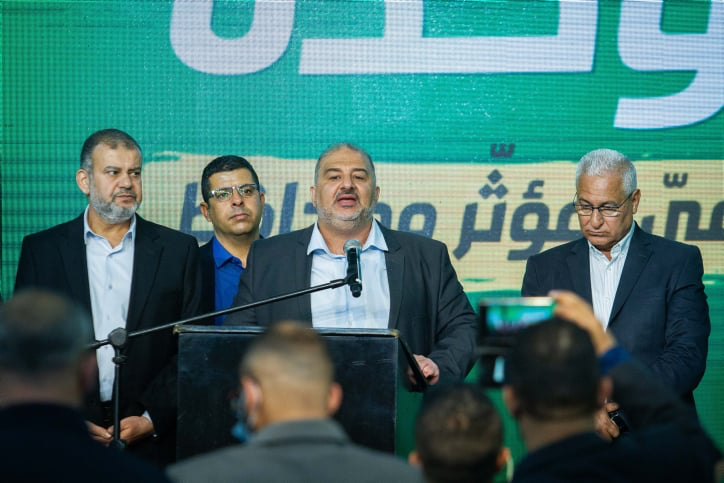
As Israeli Occupation Prime Minister Benjamin Netanyahu moves to ban the United Arab List, known by its Hebrew acronym, Ra’am, rooted in the southern branch of the Islamic Movement in 1948 Occupied Palestine, under the pretext of dismantling the remaining Muslim Brotherhood presence in “Israel,” party leader Mansour Abbas has announced a split from the Islamic Movement.
Abbas announced that Ra’am would formally break away from the Islamic Movement, a decision widely read as an attempt to shield the party from a looming ban and keep its five seats in the 120-member Knesset ahead of the pivotal 2026 elections.
Speaking on December 6, 2025, Abbas was explicit, saying, “First of all, we are not a part of the Muslim Brotherhood. If we were part of the Muslim Brotherhood, I wouldn’t be in the Knesset, I wouldn’t even be sitting with you here. [...]. Ra’am today is moving in the direction of being a completely civic party, with separate institutions.”
The move has split opinion. Critics accuse Abbas of disowning the Southern Islamic Movement’s history and ideological roots and of accommodating “Israel’s” political establishment at the expense of his community. Supporters counter that the break is a tactical necessity, a way to outmaneuver Netanyahu’s effort to dismantle the Southern Islamic Movement inside the Israeli Occupation, much as the northern branch was previously outlawed.
To his allies, Abbas is not abandoning principle but practicing survival politics, a maneuver designed to stay relevant in Israeli politics and bolster opposition parties to unseat Netanyahu in the upcoming elections, just as they did in 2021.
What’s Behind the Split?
The Islamic Movement in 1948-occupied Palestine is a religious and political organization founded in 1971 by Sheikh Abdullah Nimr Darwish.
It achieved early success, winning leadership of several Arab municipalities in the 1980s and 1990s as part of efforts to improve conditions for Palestinians in the Israeli Occupation. However, the movement split in the 1990s over disagreements about participation in Knesset elections.
The northern branch, led by Sheikh Raed Salah alongside Sheikh Kamal al-Khatib, opposed participation, seeing it as an implicit recognition of “Israel” as a Jewish state and a form of legitimizing the Israeli Occupation.
The southern branch, led by the movement’s founder Sheikh Nimr Darwish, together with Mansour Abbas, Hamed Abu Daabas, and Ibrahim Sarsur, argued that entering the Knesset was essential to influence decisions affecting the remaining Palestinian population within “Israel.”
The split formalized in 1996, with the northern branch facing heavy repression from the Israeli Occupation after supporting the 1987 uprising in the West Bank and championing al-Quds institutions and the defense of al-Aqsa.
In 2015, Netanyahu banned the northern branch, arresting and pursuing its leaders, taking advantage of broader regional crackdowns on the Muslim Brotherhood following the suppression of the Arab Spring and the resurgence of counter-revolutions, as per Israeli Occupation reports.
Following U.S. President Donald Trump’s designation of the Muslim Brotherhood as a “foreign terrorist organization” on 23 November 2025, Netanyahu announced plans to ban the remaining branches of the Brotherhood in “Israel.” This specifically targeted the southern branch of the Islamic Movement, represented by the United Arab List (Ra’am), after the northern branch was outlawed in 2015.
Responding to Netanyahu’s threat, Mansour Abbas told Israel’s Channel 12 on 6 December 2025 that his party would sever ties with the Islamic Movement’s Shura Council and become fully civilian.
Abbas emphasized that his party was not part of the Muslim Brotherhood but a local Islamic movement.
Party statements often appeared under the joint name “Islamic Movement and United Arab List,” most recently on 15 November 2025. Abbas’ decision means the party’s name will no longer be formally linked to the Islamic Movement.
Ra’am currently holds five seats in the Knesset, and polls suggest it is likely to maintain this representation in the October 2026 elections.
Israeli analysts note that Netanyahu’s threat to disband the party may have backfired, giving divided Arab parties an incentive to rally and overcome internal disputes.
A poll conducted on October 29, 2025, indicated that unifying Arab parties under a single list could increase their Knesset representation to 15 seats, up from nine, making them the third-largest bloc in Israeli Occupation politics.
Three Goals
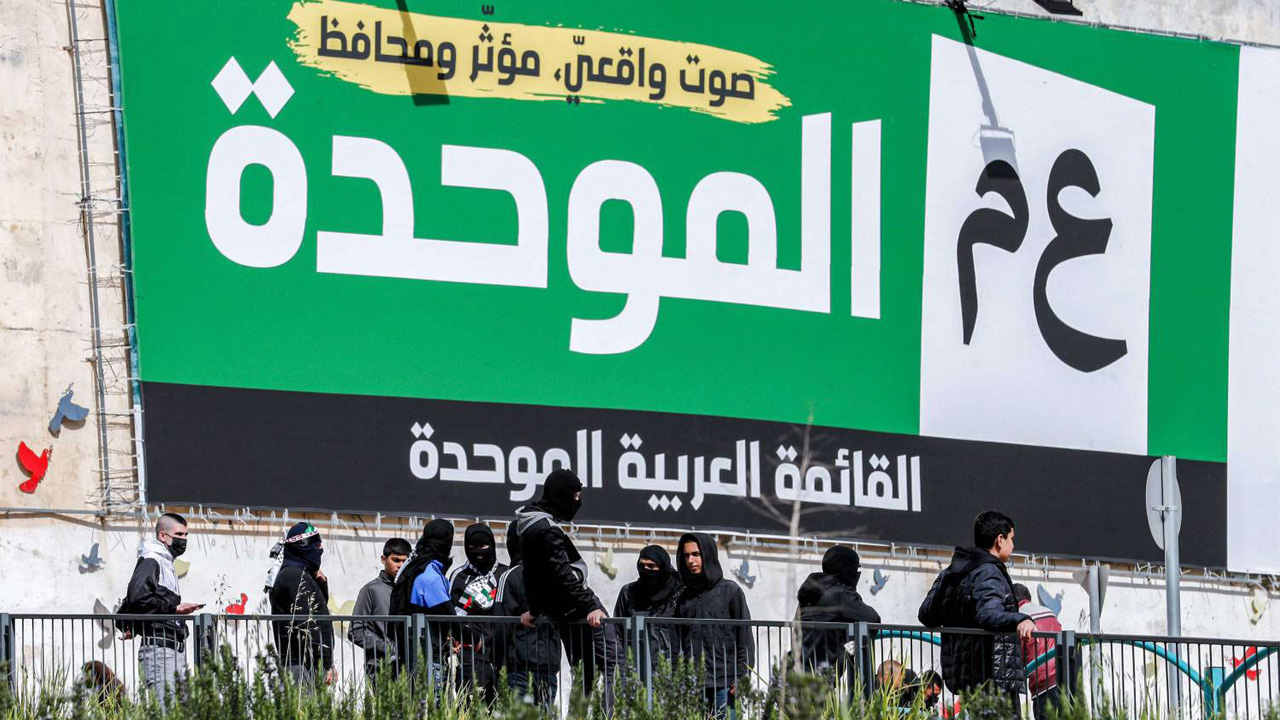
Mansour Abbas’s decision to separate the United Arab List (Ra’am) from the southern branch of the Islamic Movement is driven by several clear motivations: avoiding the risk of the movement—and then the party—being banned by distancing his party from the Muslim Brotherhood; expanding its base to become a civil, non-religiously bound party; and strengthening its chances in the next election, where its five Knesset seats give it influence in forming Israeli governments.
Abbas told Channel 12 that the aim of the split was to transform the party into a broad civil party, one that does not represent only the Islamic current but seeks to attract a wider Arab audience across “Israel,” beyond a narrow religious identity.
Israeli analyst Jack Khoury said the move could open the party to a broader public and reinforce its standing as an independent Arab party, unconstrained by religious institutions, though it may lose its ideological base of support.
On December 8, Abbas described the decision as a “strategic move” to pave the way for a new framework. It is not a split or a break, he said, but an adaptation to reality, with party members remaining loyal to the principles of the Islamic Movement’s founder in “Israel,” Sheikh Abdullah Nimr Darwish. He added that the goal was to open the party to a wider audience, not to renounce the Islamic Movement, but to become an independent and broad-based entity.
Analysts say Abbas’s step serves three main purposes ahead of the elections. First, to increase internal Arab support by appealing to voters outside political Islam. Second, to integrate non-religious candidates, possibly from sectors outside the Islamic Movement’s traditional circles. Third, to send a message to Israeli voters that Ra’am is a civil, independent party not beholden to religious institutions, undermining narratives of exclusion and preemptively challenging Netanyahu should the matter reach the Supreme Court.
The overarching aim, however, is clear: to avoid the party being banned by Netanyahu’s government. Organizational independence allows Ra’am to operate without the threat of dissolution, as separating from the Islamic Movement severs ties with an entity that could be outlawed.
Analysts also view the move as a preemptive strike against Netanyahu, denying him the opportunity to block the party from contesting the upcoming elections. Under Abbas, Ra’am is expected to remain a kingmaker in any attempt to form a government after the 2026 elections, and shedding its narrow religious and movement-based identity increases its leverage in Israeli politics.
The party has previously played this role, acting as a kingmaker in the May 2020 elections when it chose opposition over an alliance with Netanyahu, siding with Naftali Bennett. This history may explain Netanyahu’s push to ban the southern branch of the Islamic Movement, to prevent Ra’am from playing a similar role in 2026.
The split strengthens the party’s profile as an independent political actor, capable of negotiating and forming alliances with non-Islamic or broader-background parties.
Haaretz notes that Abbas is also working on another front: challenging “Israel’s” political system itself. He believes the move will undermine right-wing arguments seeking to dissolve Ra’am on the grounds that it is a political arm of the Islamic Movement. Yet it remains unclear whether formal separation will be enough; some in the right still see the split as proof of its prior ties to the movement.
There is also the possibility that the move could accelerate efforts to ban the Islamic Movement, undermining its institutions and senior leaders, thereby putting Abbas in a difficult position before his constituents.
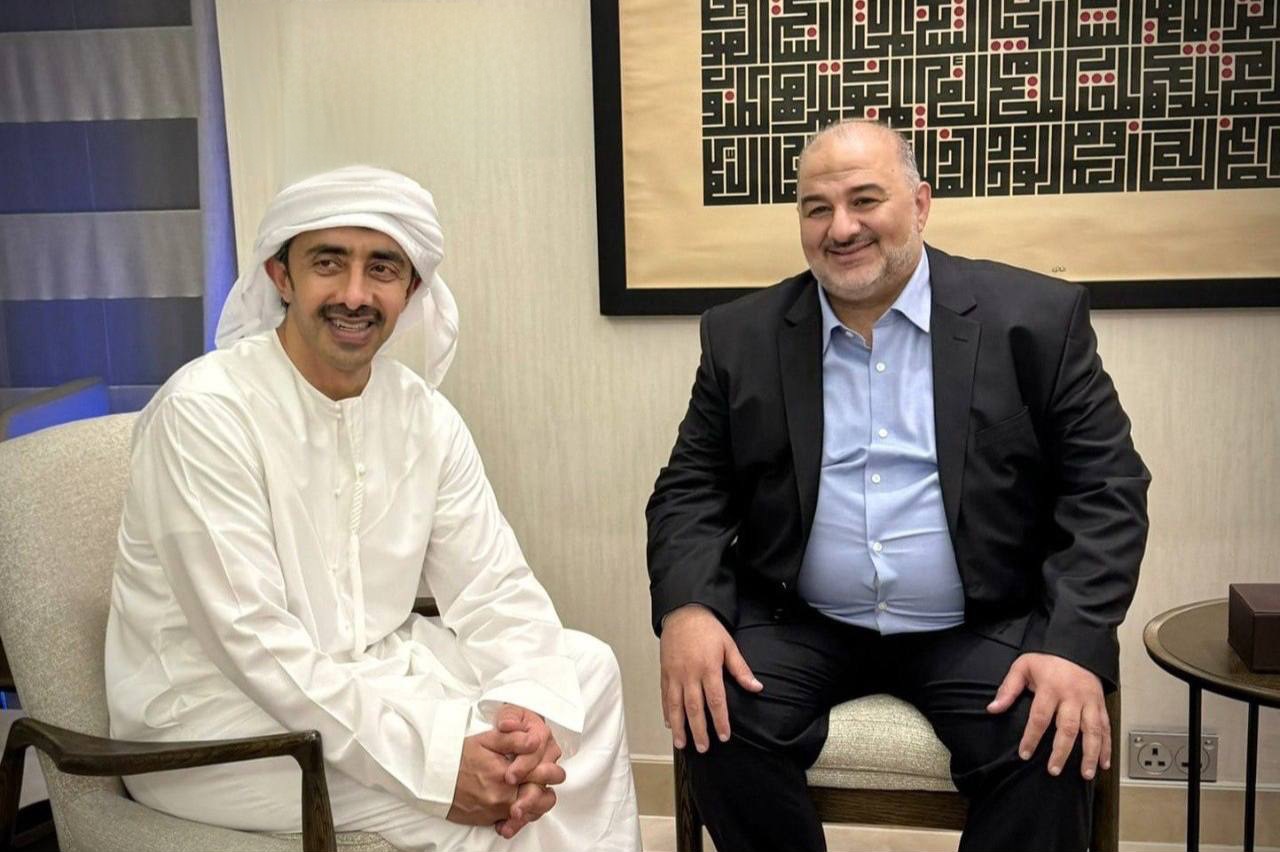
The Islamic Movement Strikes Back
The decision to split sent shockwaves through the Islamic Movement itself, sparking anger and internal disputes. Some of its leaders described it not as a neutral move but as a “radical strategic shift” away from the movement’s traditional organizational direction.
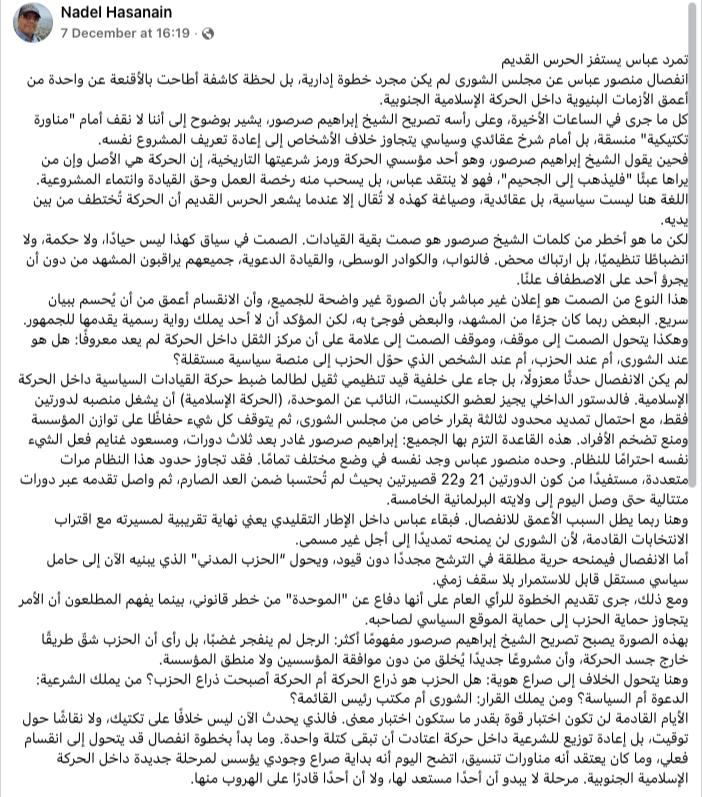
While most current officials in the Islamic party remained silent after Abbas announced the break, his decision provoked the old guard. The movement’s former head, Sheikh Ibrahim Sarsur, was particularly scathing, writing on Facebook, “The Islamic Movement is the true origin and the solid pillar. It built its political party as a protective fence! If he [Abbas] sees it as a burden, let him go to hell!”
Palestinians within the Green Line saw Mansour Abbas’s split from the Shura Council not as a mere administrative move, but as a revelatory moment exposing one of the deepest structural crises within the southern branch of the Islamic Movement.
They interpreted Sheikh Ibrahim Sarsur’s statement as a clear sign that this was not a coordinated “tactical maneuver” but an ideological and political rift that goes beyond personal disputes, reaching into a redefinition of the Islamic project itself.
When Sarsur, a founder and symbol of the movement’s historical legitimacy, declares that the movement is the true origin and that anyone who sees it as a burden “can go to hell,” he is not merely criticizing Abbas but stripping him of his mandate, leadership, and claim to legitimacy.
Observers predicted the start of an existential struggle, setting the stage for a new chapter within the Southern Islamic Movement—one that no one seems prepared for or able to avoid—effectively splitting the Southern Movement into three separate entities under the banner of “the Islamic Movement in Israel.”
The dispute has escalated to the point where Palestinians in Occupied Jerusalem accused Mansour Abbas of following the UAE’s agenda, describing it as “the guardian of Abbas’s steps,” and suggesting that his recent statements are only the beginning of a long path that will ultimately lead to the creation of a new party under his leadership, reflecting the UAE’s vision and values, without any connection to religion, nationalism, or any other principle known to the ‘48 Palestinians.
Some of Abbas’s political opponents within the movement even claim that he might replace Islam with the “Abrahamic Religion” introduced by the UAE in recent years as a symbol of normalization with the Israeli Occupation, according to journalist Adl Alhmamdt.

‘A Foolish Move’
Mansour Abbas accused Netanyahu of seeking to undermine Arab representation and remove the United Arab List (Ra’am) from the electoral race for political reasons, arguing that the Israeli prime minister is trying to influence the election results in advance because he knows Ra’am could be the key to changing the government.
Speaking at a Knesset press conference on November 24, 2025, Abbas said Netanyahu had adopted a Ben Gvir-style approach in inciting the Arab community and undermining the legitimacy of a democratically elected party, stressing that such behavior damages the democratic system.
Abbas added that Netanyahu’s steps were part of a gradual plan that begins with targeting the Islamic Movement’s legal associations, then attempts to outlaw the movement, and ultimately seeks to ban Ra’am from participating in the elections.
Israeli analyst Michael Milstein said Netanyahu’s attempt to silence the Arab vote was a foolish move that could inadvertently achieve what the late Hamas leader Yahya Sinwar once sought.
Milstein noted Abbas’s criticism of Sinwar, whom he called “the Abu Jahl of our time” for accusing the party of surrendering al-Quds to the Israeli Occupation and for condemning Abbas over Operation al-Aqsa Flood.
The analyst added that Netanyahu is trying to steal the elections and undermine the legitimacy of the United Arab List to block its participation, securing his own victory. This threatens the rights of Arab citizens and the democratic system.
The Israeli prime minister had previously acknowledged the possibility of forming a government with the United Arab List during discussions with Abbas before the formation of the “change government” in 2021.
Milstein warned that Netanyahu’s hints deepen the isolation of Arabs from both the government and Jewish society, a divide worsened by the war, with crime and violence rampant in Arab towns inside the occupied Palestinian territories (235 civilians killed since the start of the year) and spreading steadily into “Jewish areas.”
He stressed that proposals to ban the Islamic Movement and prevent the United Arab List from running could cause serious harm to a large portion of the Arab public, the same community that supports Abbas’s pragmatic approach of cooperating with Jewish parties without confronting the “Israeli state” on issues related to the “Israeli-Palestinian conflict.”
In a report published by +972, Israeli writer Ameer Makhoul said, “From Netanyahu’s perspective, a divided Arab vote is more dangerous than a unified one.”
Two separate Arab lists increase the likelihood that the Israeli opposition could form a governing coalition with the United Arab List, ending Netanyahu’s long rule.
If the Arab parties were united on a single list, the opposition’s total seats would likely fall below 60, effectively blocking it from forming a government and strengthening Netanyahu’s grip on power.
For this reason, analysts say Netanyahu’s threats to disband the Islamic Movement are a calculated provocation aimed at destabilizing Ra’am and forcing it to join a joint list with other Arab parties.
Sources
- Analysis This Israeli Arab Leader's Break With the Islamic Movement Puts His Party on the Line
- Ra’am leader says party will cut ties with religious council, become ‘completely civic’
- Mansour Abbas says Ra'am will split from Shura Council, Muslim Brotherhood
- UAL Set To Break From Islamic Movement as Abbas Seeks Broader Political Base
- Netanyahu’s veiled threat to outlaw Ra’am is a message to all Palestinian citizens