Turkiye’s Multiple Moves in Libya: Can It Succeed in Reconciling the Warring Sides?
Libya is one of the arenas where Turkiye has demonstrated a remarkable capacity to manage the balance of power.
Turkiye is sending positive signals in its efforts to pursue flexible and diplomatic engagement aimed at reaching a political settlement between Libya’s rival parties, at a time when the country of the martyr Omar al-Mukhtar is in need of the efforts of friendly states to achieve this goal.
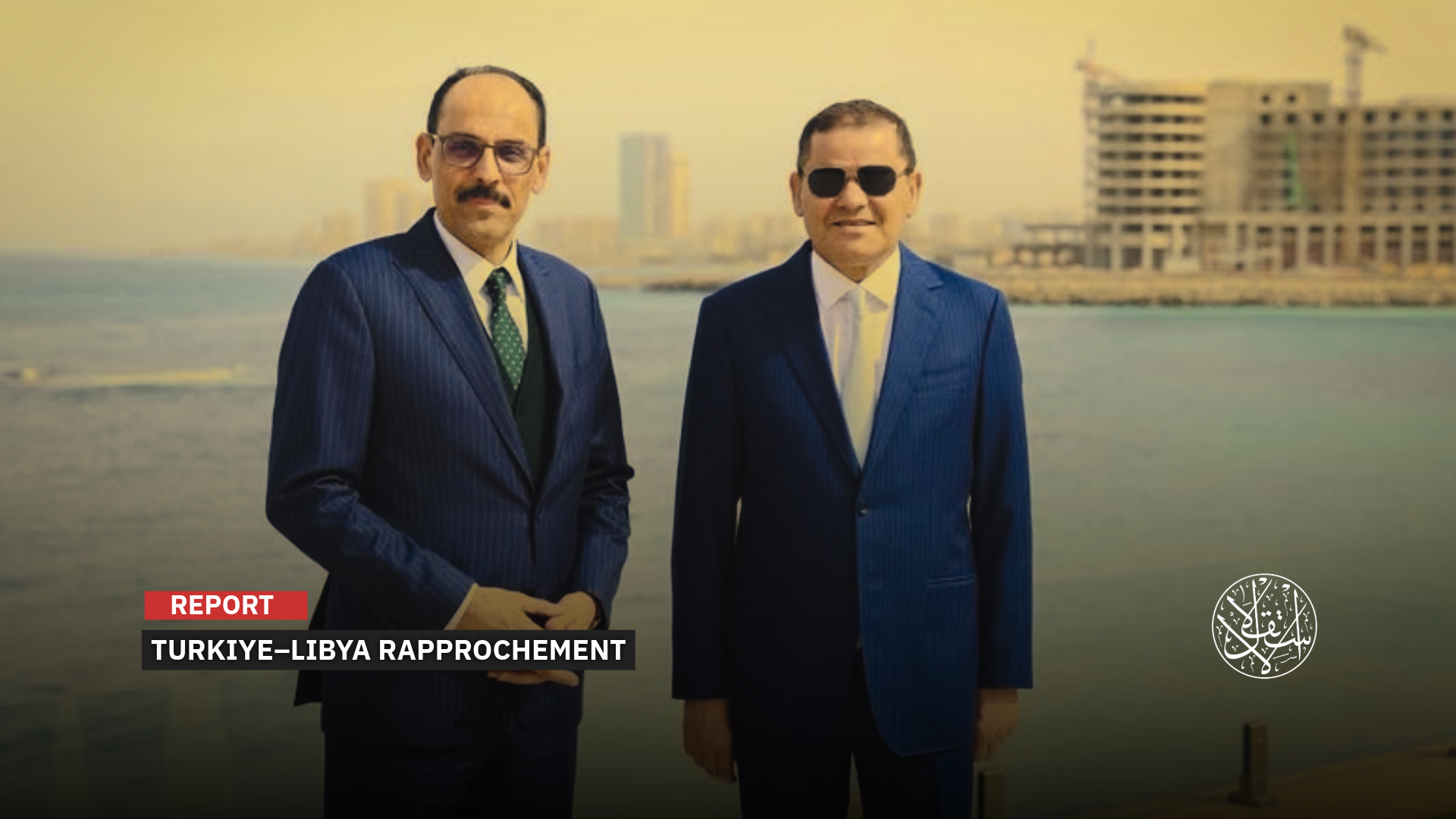
In this context, the head of Libya’s Government of National Unity, Abdul Hamid Dbeibeh, received the head of Turkiye’s National Intelligence Organization, Ibrahim Kalin, on February 12, 2026.
Strengthening Stability
The Libyan Prime Ministry said the meeting addressed the latest local and regional developments, and included an exchange of views on a number of issues of mutual interest.
The meeting also discussed the importance of strengthening coordinated international efforts to support the political track in Libya, in a way that contributes to consolidating national consensus and pushing the political process toward sustainable solutions that enhance stability and preserve the unity of the country.
Both sides affirmed the “continuation of consultation and coordination in a manner that serves common interests and supports stability in the region.”
The head of the Presidential Council, Mohamed al-Menfi, received the Turkish official, who affirmed Ankara’s commitment to continuing direct and regular consultation with the Libyan leadership in a way that contributes to consolidating stability and advancing the path of a political solution.
According to a statement published by the council on its Facebook account on February 12, the meeting reviewed the latest developments on the local and regional scenes, alongside an exchange of views on a number of issues of mutual interest.
It explained that the meeting addressed ways to strengthen bilateral cooperation and intensify coordination in support of the political track, and to enhance the prospects for national consensus, while stressing that Libya’s stability represents a fundamental pillar of regional security.
“Both sides also stressed the importance of continuing Libyan-Turkish consultation to ensure support for security and stability, and to consolidate state institutions on solid foundations, in a way that prevents any tensions that could hinder comprehensive settlement efforts,” it stated.
Two governments are competing in Libya. The first is the Government of National Unity, headed by Abdul Hamid Dbeibeh and based in Tripoli, in the west, which administers the entire western region of the country.
The second was appointed by the House of Representatives in early 2022, headed by Osama Hammad and based in Benghazi, in the east, from where it administers the eastern region and most cities in the south.
Political Perspective
Writer and political analyst specializing in Turkish affairs Ahmed Darwish believes that Libya is one of the most complex files in Turkiye’s foreign policy, yet at the same time one of the arenas in which it has shown a remarkable ability to manage balances.
Darwish told Al-Estiklal that “after years of clear engagement alongside the internationally recognized Government of National Accord in Tripoli, Turkiye realized that bypassing the political and military reality in eastern Libya, where Khalifa Haftar imposes himself as a de facto authority, was no longer a practical option, but rather a political approach that must be dealt with.”
He said this Turkish move “reflects an acknowledgment of the impossibility of bypassing Haftar, as he represents an authority that is not easily removed in the short or medium term without broad military intervention, the conditions for which are not currently available.”
On this basis, Darwish added that “Ankara has moved toward a more pragmatic approach based on gradual openness to both sides, without abandoning its core alliances.”
“Turkiye today seeks to benefit from the decline of Russian influence in Libya, a retreat imposed by Moscow’s preoccupation with the war in Ukraine, in addition to its loss of strategic cards in the eastern Mediterranean after the transformations witnessed in Syria,” Darwish said.
In this context, Darwish added that “Ankara presents itself as a potential guarantor of security on the southern shore of the Mediterranean, and as a partner capable of filling the vacuums left by the withdrawal or retreat of other powers.”
He continued that Libya, should Turkiye succeed in consolidating a strategic presence there, is viewed as a gateway for broader Turkish expansion within Africa, particularly in the Sahel region, which is itself witnessing rapid security shifts.
The political analyst said Turkiye’s openness to the authorities in eastern Libya does not mean it is abandoning its partnership with the Dbeibeh government in the west.
Confirming this, Ankara and Tripoli signed an agreement aimed at strengthening military partnership, including advanced training, exchange of expertise and logistical support, in a clear message that the existing alliance remains firm.
“Turkish Airlines also resumed its direct flights to Misrata after a 10-year suspension, an economic and political indicator of the depth of the relationship,” he said.
Among other indicators, Darwish added, is the Turkish Parliament’s approval of extending the mission of Turkish forces stationed in Libya for two years, as well as its keenness to participate in the memorial ceremony for the victims of the Libyan plane crash in Tripoli, through the representation of Chief of Staff Selcuk Bayraktaroglu at the ceremony to bid farewell to the victims of the plane that was carrying the late Chief of Staff Mohammed al-Haddad and four other companions.
He stressed that “the level of this Turkish participation is a step that demonstrates Ankara’s keenness to maintain the close relationship with the Presidential Council and the government in the west, led by al-Menfi and Dbeibeh.”
In contrast, Darwish continued, “Haftar views improving relations with Turkiye within his broader strategy of diversifying international partnerships and gaining broader recognition of his authority.”
He said that “the repeated visits of his son, Saddam Haftar, to Ankara are an indication of a mutual desire to open a new page, which may grant Haftar greater room for maneuver in confronting his opponents and give Turkiye broader influence in eastern Libya.”
At the regional level, Darwish added, “this rapprochement raises concerns in Greece and reduces Egypt’s ability to use the Libyan file as a pressure card against Turkiye, at a time when Europe appears less willing to enter into confrontation with Ankara, especially if the Turkish role is linked to curbing irregular migration from the Libyan coasts.”
Regarding the meeting of the intelligence chief with Dbeibeh and al-Menfi, the political analyst said it “can be considered an extension of a Turkish policy based on crisis management through direct presence and communication with various centers of decision-making, rather than relying solely on traditional political support.”
“Ankara views Libya as a strategic arena where regional security, energy, migration and eastern Mediterranean balance intersect, and therefore seeks to consolidate the state of calm that followed rounds of tension, especially after its role in mediating to contain violence in September 2025,” Darwish explained.
He continued, “Turkiye’s moves also aim to protect bilateral agreements in the fields of military, security, energy and reconstruction cooperation, while maintaining balanced relations between the government on one hand and the Presidential Council on the other, in a way that enhances its image as a party capable of de-escalation rather than escalation.”
At the same time, Darwish said, “this intensive Turkish activity reflects a desire to strengthen political influence through soft tools such as mediation, security guarantees and economic cooperation, an approach that has become evident in Turkiye’s foreign policy across more than one regional file.”
Sustained Efforts
Kalin’s meeting with both Dbeibeh and al-Menfi came days after Turkiye hosted a security meeting that brought together officers from eastern and western Libya under United Nations auspices.
According to a statement published by the United Nations mission in Libya on February 4, 2026, the meeting concerned the Joint Technical Coordinating Team for Border Security, which includes senior officers from the military and security institutions in eastern and western Libya.
It explained that “these visits were jointly facilitated by Turkiye and the United Nations Support Mission in Libya, combining Turkish technical expertise with the mission’s role in coordination and confidence-building, in support of enhancing cooperation among Libyan security institutions.”
The mission noted that “in addition to the technical dimension, this visit contributes to strengthening coordination and building trust between Libyan security entities, reinforcing practical coordination within the relevant security and military institutions, and helping to create a favorable environment for the political track.”
In September 2025, a high-level delegation from the Turkish intelligence service, headed by Deputy Chief Cemaleddin Calik, arrived in Libya, where it held a series of meetings with various parties as part of efforts to contain tensions.
The delegation began its visit at the time with a meeting with the Conflict Resolution Committee, before later meeting the leadership of the Deterrence Apparatus, in a session devoted to discussing security developments and ways to spare the capital any military escalation.
Those moves came amid Turkiye’s efforts to prevent the outbreak of a new war in Tripoli, especially given the presence of its forces inside Mitiga Air Base, one of the most prominent sites of its deployment.
Western Libya is witnessing a state of anticipation as fears of armed confrontations grow, amid local, regional and international calls to adopt dialogue as the option for settling disputes.
Turkiye’s focus on stabilizing the situation in Libya is a matter of state policy, as stated by Justice and Development Party spokesperson Omer Celik, who affirmed that “Ankara attaches great importance to Libya’s stability.”
In remarks carried by the Turkish Anadolu News Agency on February 9, 2026, following a meeting of the party’s central committee chaired by Erdogan in Ankara, Celik said that “Turkiye is trying to make the best possible positive contribution to removing the division between eastern and western Libya.”
The Turkish party official stressed that his country continues to strengthen its cooperation with Libya, including in the defense sector.
“In the next phase, these efforts will be further strengthened under the close supervision of the Ministry of Defense, and the Ministry of Foreign Affairs, the intelligence service and the ministries concerned with the economy, in short, our entire team is working hard to ensure this rapprochement with Libya,” Celik added.
Partnership Summit
The headquarters of the Ministry of Foreign Affairs and International Cooperation in Tripoli also hosted an extensive coordination meeting between the Political Steering Committee tasked with preparing Libya to host the African-Turkiye Partnership Summit scheduled for 2026, and a delegation from the Turkish Embassy in Libya.
The Libyan Foreign Ministry said in a statement on February 2 that the meeting, which comes within the framework of unifying visions between the two countries, aimed to discuss a range of vital files included in the committee’s action plan.
It added that the meeting reviewed the political and organizational arrangements necessary to ensure the success of the summit, and the mechanisms for joint coordination with the African Union Commission, particularly regarding procedures for the hosting agreement and issuing high-level invitations.
The same source noted that both sides discussed “ways to enhance cooperation between the Ministry of Foreign Affairs and International Cooperation and its Turkish counterpart on all levels, especially in coordination on the media front between the summit’s media committee and the relevant authorities in the Republic of Turkiye, ensuring the necessary readiness for this important international event.”
It concluded that the participants agreed on “the necessity of maintaining communication and intensifying coordination meetings and mutual visits during the coming period, to formulate a shared vision that guarantees the summit produces results supporting the strategic partnership and reflects Libya’s strong and active return to the regional and international arenas.”
Security and military cooperation remain among the most prominent files of the Turkiye-Libya partnership. In this regard, the Turkish Parliament in December 2025 approved the presidential decree signed by President Erdogan to extend the mandate of Turkish forces operating in Libya for an additional 24 months.
The extended Turkish mission in Libya began on January 2, 2026, after the presidency submitted the memorandum to the legislature for approval in November 2025.
The memorandum stated that the purpose of continuing the Turkish military presence is to protect national interests in accordance with international law, and to take all necessary measures to confront emerging security threats from illegal armed groups in Libya.
The official military relationship between Turkiye and Libya began on January 2, 2020, when Turkiye sent its forces to Libya in response to a request from the internationally recognized Government of National Accord amid the conflict at the time, under Article 92 of the Turkish Constitution, which regulates the deployment of forces abroad.
Since that date, several extensions of the Turkish military mandate in Libya have been approved, including in June 2021, when the Turkish Parliament decided to extend the forces’ mission for 18 months amid the ongoing political and security instability in Libya.
Advancing Reconciliation
In November 2023, a memorandum was approved for a 24-month period to continue until January 2026, before Parliament now approved an additional two-year extension.
According to the Libya al-Ahrar website, these “repeated extensions come in the context of the ongoing political instability and governance challenges in Libya.”
The site added in a post dated February 4, 2026, that “the Turkish side sees the presence of its forces as contributing to supporting the ceasefire and political dialogue, and protecting Turkish interests in the Mediterranean and North Africa.”
It concluded that the presidential decrees aim to grant the Turkish government a legal legislative mandate for the presence of forces in Libya in accordance with the Turkish Constitution, and that they are closely linked to the changing security situation on the ground in Libya, as well as to supporting international efforts to protect Libyan sovereignty and achieve stability.
Looking ahead at the Libyan scene, particularly regarding reconciliation, writer and political analyst Darwish believes that the difficulties in achieving reconciliation in Libya are linked to “the depth of institutional division and the multiplicity of military and political power centers.”
“In addition to the lack of trust between the parties holding the reins of power, whether in the east or west, where each side fears that any settlement could reduce its influence or redistribute resources at its expense,” Darwish continued.
On this basis, the political analyst told Al-Estiklal that “Turkiye focuses on a practical role to overcome the crisis, based on gradual steps and building trust through supporting the unification of economic and security institutions and encouraging understandings between influential forces before moving toward comprehensive elections.”
“Ankara also relies on its relationships with key actors in western Libya and on open channels of communication with other stakeholders, to bring perspectives closer together and provide guarantees related to security, power sharing, and resources.”
“However, the success of this role remains linked to Turkiye’s ability to coordinate with regional and international powers to reduce external competition and create an environment that allows for the gradual formation of a unified government, maintaining stability and preventing a return to violence, reflecting a Turkish approach based on managing balances rather than imposing quick fixes that may not last,” Darwish concluded.