Arab Athletes’ Refusal to Confront Israelis at the Tokyo Olympics Sparks Wide Impact
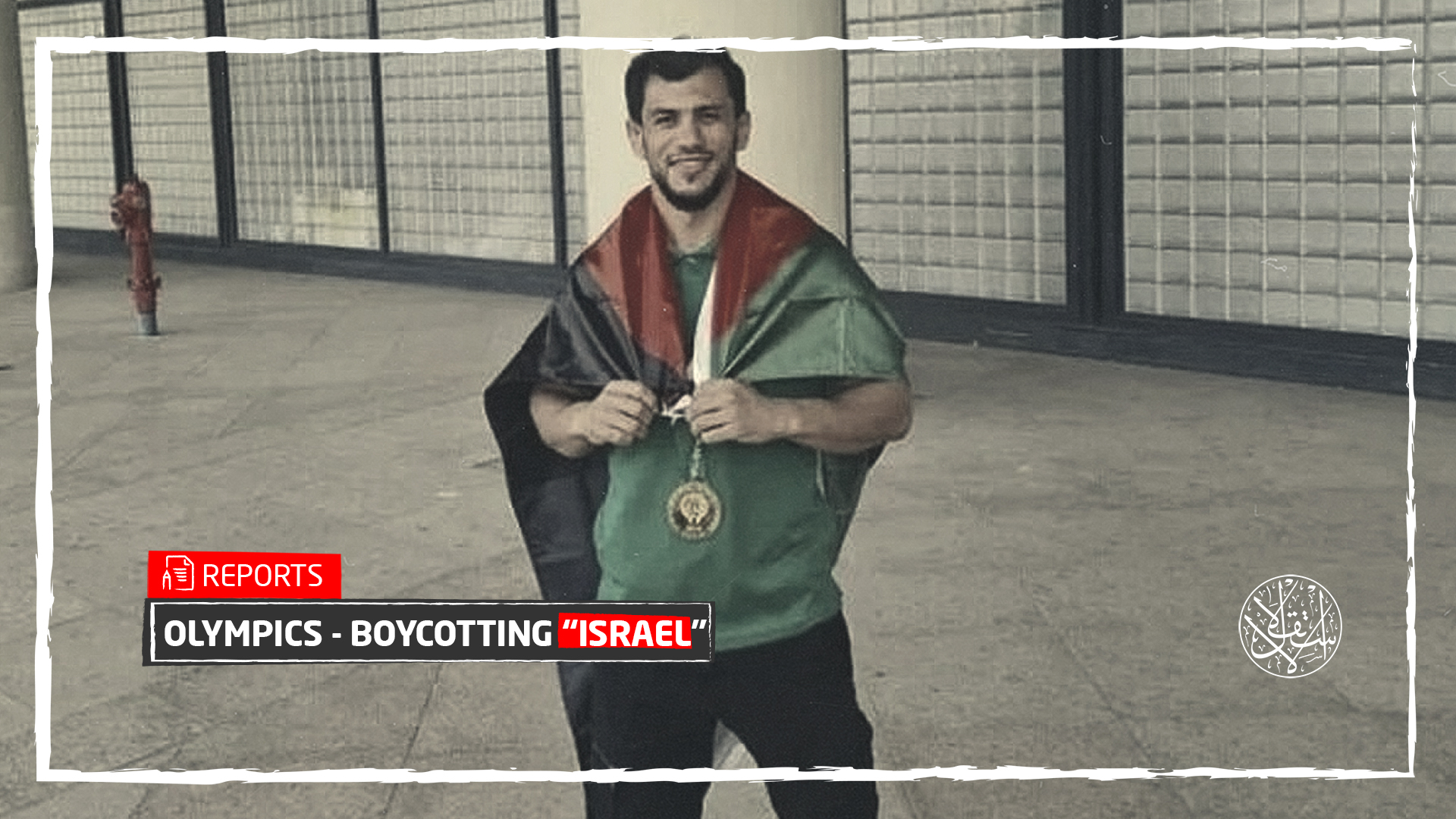
Despite the efforts made by the Arab champions in the Olympics, and the 4-year preparation period for the tournament, they proved that "Palestine is more valuable to them than any medal."
The refusal of the Arab champions in the current Tokyo Olympics, to compete with any Israeli player, to deprive the occupation of the honor of normalization is a popular response to the normalization of rulers, which was represented in the signing of a series of “Abraham agreements” with the occupation in 2020.
On July 23, 2021, Algerian judoka Fathi Norine announced his official withdrawal from the Olympic Games in Tokyo, after the lottery drew him against an Israeli player, and preferred the boycott the normalization.
His coach, Ammar Bin Yakhlef, supported him, emphasizing clearly that they withdrew from the Olympics for their refusal to normalize with Israel, and to support the Palestinian cause, despite their suspension by the International Judo Federation.
Article 50 of the Olympic Charter prohibits athletes from taking a political position during tournaments.
The matter did not stop here, as Sudanese judo player Mohamed Abdel-Rasoul refused to confront the Israeli Potpol Tahar, despite Khartoum signing a normalization agreement with the occupation on October 23, 2020.
This is not the first time that Arab athletes boycott the occupying state. Throughout the Olympic tournaments that have been held since 1991, many of them took this step because they did not recognize the legitimacy of the entity.
Humiliating Loss
Other Arab players participated against Israelis, but they lost. They played giving the occupying entity the legitimacy in vain, according to what a number of tweeters comment on Twitter.
Among them is the Egyptian player Islam El Shehaby, who participated in the 2016 Olympics in Brazil and lost to his Israeli counterpart. He was punished locally and internationally for refusing to shake hands with him after the defeat.
The Saudi judoka, Tahani Al-Qahtani, who refused to withdraw in the current Tokyo Olympics, and lost on July 30, 2021 humiliatingly, against an Israeli player, with a score of 11-0.
A video clip, shared by users on social media, showed both Al-Qahtani and the Israeli player shaking hands 3 times after the match in Tokyo.
Saudi Arabia, Tahani Al-Qahtani, suffered a defeat (0-11) in front of an Israeli judo competitor after she refused to withdraw honorably and not to meet an Israeli plyaer on the footsteps of other players (Fethi Nourine "Algeria" and Mohamed Abdalrasool "Sudan").#TokyoOlymbics pic.twitter.com/oDwmYKdti6
— Quds News Network (@QudsNen) July 30, 2021
Al-Sharq al-Awsat newspaper said on July 26, 2021 that Saudi officials had given the player a "green light" to confront her Israeli counterpart, claiming that she and the Judo Federation would avoid any sanctions that the International Olympic Committee might impose.
Al-Qahtani appeared before the match, accompanied by the Minister of Sports and President of the Saudi Olympic Committee, Prince Abdulaziz bin Turki Al-Faisal, who supported her in the stadium until she bid farewell to the Olympics.
Before the match, Saudis, including writer Khaled Al-Dakhil, demanded that the Saudi player withdraw because Saudi Arabia does not recognize Israel, and the Saudi people consider it an occupying country, and do not recognize its legitimacy.
It is noteworthy that there are honorable positions of Saudi players who refused normalization and chose to withdraw and sacrifice titles over fighting the occupation players in international tournaments.
The Most Famous Withdrawals
The refusal of Arab players to meet the Israelis in the Tokyo Olympics 2021 is not unprecedented. The pattern has been repeated since 1991. Algeria began by refusing its player Meziane Dahmani to play against an Israeli competitor in the 1991 Barcelona Championship.
Indeed, the Algerian player "Norine" had previously taken such a step, when he withdrew from the World Judo Championship in 2019 refusing to play with an Israeli, and this is the second time in the 2021 Olympics.

In the 2016 Olympics in Brazil, Saudi judo champion Jodi Fahmy preferred to withdraw from meeting Israeli player Gilly Kahn, and Saudi taekwondo champion Fahd Al-Samih as well.
The player Ahmed Al-Ghamdi withdrew from the World Junior Championships in Spain 2017 for refusing to play with an Israeli player.
During the International Youth Championship held in Ukraine 2018, the Saudi badminton team players withdrew before the start of their match with the Israeli team, and left the stadium, refusing to shake hands with the occupation players.
In judo competitions, Algerian Mariam Moussa refused to face the Israeli "Shahar Levy" in the World Judo Championships, which was held in the Italian capital, Rome in 2011.
Yemeni judoka Ali Khasrouf withdrew from facing an Israeli player in the World Cup tournament in Dusseldorf, Germany, in the qualifying tournament for the 2012 London Olympics.
Kuwaiti taekwondo player Abdullah Al-Farhoud withdrew from facing his Israeli opponent in an international tournament held in Sweden in 2013.
The Libyan judo champion, Muhammad Al-Hadi Al-Kwaish, refused to play in the World Judo Championships in Kazakhstan in 2015, with an Israeli player, as an expression of his support for the Palestinian cause.
Other players refused to play with the Israelis in different tournaments over the past 22 years, according to the Al-Estiklal newspaper.
The boycott is not limited to Arabs, as athletes from Muslim-majority countries are also boycotting their Israeli counterparts during international competitions, most notably from Iran and Pakistan.
Because of the escalation of the boycott of Israel, both mathematically and economically, Professor Noah Dana, a member of the so-called “National Leaders Forum,” wrote an article in the newspaper “Maariv” on July 26, 2021 about a “strategic plan to improve Israel’s image.”
He accused the BDS movement of playing an important role in presenting a negative image of Israel, which led to a boycott by countries around the world, including the American company "Ben & Jersey" for ice cream.
Egyptians Against Normalization
What bothers Israel most is the refusal of Arab players whose countries have concluded peace agreements with it, such as the withdrawal of the Egyptian players or their refusal to shake hands with the Israelis even though there is a peace agreement between the two countries.
Judoka Islam Shehabi's refusal to shake hands with his Israeli opponent, Or Sasson, sparked an uproar in Tel Aviv.
At that time, the Egyptian Federation punished the player for refusing to shake hands with the Israeli, and it was reported that the head of the regime, Abdel Fattah Sisi, apologized to former Prime Minister Benjamin Netanyahu for the Egyptian player’s behavior.
At the time, Netanyahu said, during his reception of the Israeli player, that he had received a "special message from Egypt", revealing that "there are those who expressed their respect and appreciation for his victory and for his attempt to shake hands with the Egyptian player."
Through his account in the Arabic language, he claimed: "I told the judo player Or Sasson, I received a message from Egypt that after your impressive victory and initiative to shake hands with the Egyptian player, there were other supportive voices in Egypt."
Followers on Facebook wondered: What did Netanyahu mean to say? One of them wrote: "Does he mean that Sisi called him to apologize for what was done by the Egyptian player?"
The Egyptian hockey team had previously withdrawn from facing its Israeli counterpart in the hockey final in 2012, and thus gave up its gold medal, preferring to boycott.
Egyptian judo player Ahmed Awad also withdrew in front of Israeli player Til Blacker at the 2012 World Championships in Austria.
Rawan Ali, a taekwondo player, withdrew from facing Israeli Sivan Finster in the quarterfinals of the Croatian Open in November 2011.
Former Egyptian national team captain Ahmed Hassan played with his former Belgian team Anderlecht against the Israeli "Hapoel Tel Aviv" team, in the European Champions League in Belgium, but he refused to play the return match in Israel in 2007.
The player, Mohamed Salah, participated in his former Swiss team, Basel, playing against the Maccabi Tel Aviv team in the European Champions League in 2013, for fear of punishment, but he resorted to a ploy to avoid shaking hands with the Israeli team players, by closing his hands and passing quickly on them.
Muhammad Abu Trika, the former Egyptian national team star, refused to participate in a friendly match with world stars in September 2014, at the invitation of the Pope of the Vatican, due to the participation of the Israeli Yossi Benayoun, and commented on the refusal by saying: “We are raising generations.”
Normalization Collapse
The continued boycott of the Israelis by Arab players, and their refusal to play with them in the Tokyo Olympics, despite Abraham's agreements, angered Tel Aviv.
Hebrew newspapers called the "the normalization with Arab countries Collapsed," and spoke of its futility.
The political analyst of the Yedioth Ahronoth newspaper wrote angrily on July 27, 2021: "They have made a joke of us… Arab athletes have proven that Israel does not exist!"
The Algerian player's statement, "I don't want my hands to get dirty if I play with the Israeli," was considered a dangerous indication of the negative image of Israel painted by these Arab heroes who boycotted it despite the normalization agreements.
He said, "In the past, the Arab boycotters used to make plots and pretend to be injured in order not to play with the Israelis, but Norine spat on us and the Olympic Committee when he said (his mentioned statements)."
He also criticized the Olympic Committee’s “lightened” punishment for Norine, despite the committee’s emphasis on restricting political expression during the matches, and its contention with its demand to stay away from the Olympic village as if he was infected with Corona.
He also criticized the withdrawal of the Sudanese player, Mohamed Abdel-Rasoul, saying: "Aren't we in normalization with the Sudanese?"
He considered that what happened was a "cold peace that cannot change reality," as evidenced by the Egyptian player's refusal to shake hands with the Israeli also in the 2016 Brazil Championship, despite the Camp David agreement.
Arab experts described the withdrawal and boycott of Arab athletes facing the Israelis as "evidence of the peoples' rejection of Abraham's agreements and any normalization of regimes with the occupation."
Professor of Political Science at Cairo University, Hassan Nafaa, described their refusal to play with the Israelis as "proving that the Arab rulers are in one valley and the Arab peoples are in another."
He stressed that the continuation of the popular boycott means that "the normalization with Israel imposed on the Arab regimes is doomed to complete failure."
He stated that the withdrawal of Arab players against Israeli competitors in the Tokyo Olympics "raises once again the question of the feasibility of boycotting in protest of Israel's oppression of the Palestinians."
He also claimed that it is possible to put forward arguments such as: "Why not boycott Saudi Arabia because of the atrocities of the horrific murder of journalist Jamal Khashoggi? Or the boycott of other repressive Gulf states?"
Why not boycotting China for its oppression and persecution of the Muslim Uyghurs, and for its increasing control over the people of Hong Kong? Or against Russia for its invasion of Crimea and its treatment of dissident Alexei Navalny?
Yet, the newspaper acknowledged by the end, the usefulness of the moral boycott, stressing that "these arguments do not mean that all boycotts directed at the Israeli occupation of the Palestinian territories are always wrong or ineffective."