How the “Law To Execute Palestinian Prisoners” Legitimizes Killing Under a Legal Cover

“Critics have described the new law as discriminatory.”
In a racist and discriminatory move that sparked widespread legal and ethical controversy internationally, the Israeli Knesset passed a law allowing the death penalty for Palestinian prisoners, igniting a wave of public outrage.
This law, proposed by the far-right Otzma Yehudit party led by Itamar Ben-Gvir, represents a dangerous shift in the so-called Israeli-Palestinian conflict, as it legally enshrines the policy of extrajudicial killings.
Despite the far-right's push for the law, which they hailed as a security and legislative achievement, it has provoked objections within Israel, primarily focused on the potential legal and diplomatic repercussions for “Israel”.
Opinion polls have shown a majority of Jewish Israelis backing executing Palestinian militants, at least in principle.
Amid the Israeli divisions and mounting international criticism, the question remains whether the law will actually be implemented, or whether it is merely a political tool for political maneuvering and blackmailing coalition partners during one of the most sensitive periods in Israel's history.
Racist Law
On March 30, the Knesset passed, with a vote of 62 to 47, a law imposing the death penalty on Palestinian prisoners accused by the Israeli occupation authorities of carrying out or planning attacks against Israeli citizens.
National Security Minister Itamar Ben-Gvir welcomed the passage of the law, describing it as a political shift aimed at strengthening deterrence against what he termed terrorist crimes, asserting that its passage fulfilled his election promises.
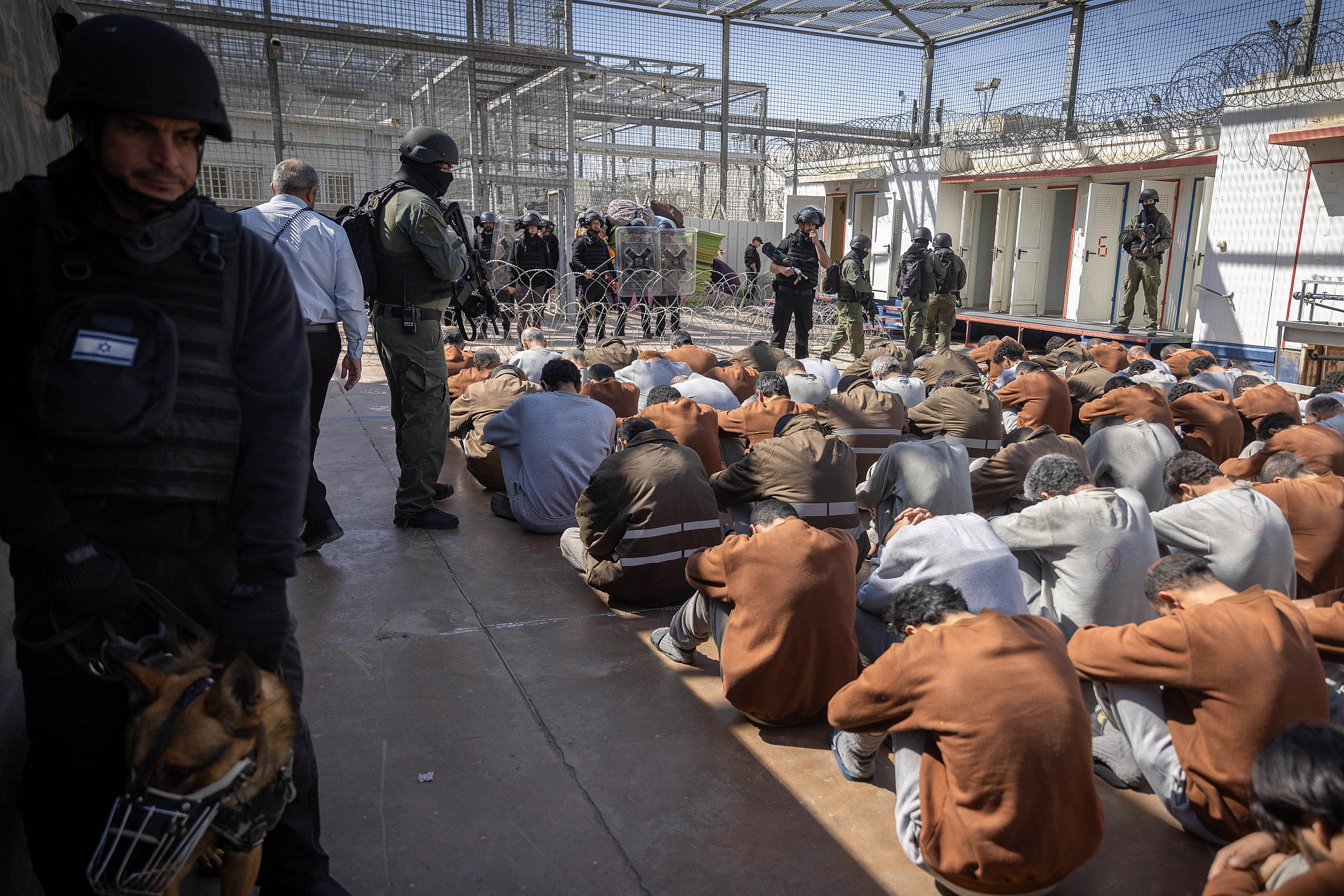
More than 9,300 Palestinians are currently imprisoned in Israeli jails, including approximately 350 children and 66 women. According to Palestinian and Israeli human rights organizations, these prisoners are subjected to conditions that include torture, starvation, and medical neglect, resulting in the deaths of dozens.
According to the text of the law, which was promoted by Ben-Gvir and Knesset member Limor Son-Har Melech, a death sentence will not require a unanimous decision from the judges, unlike in some similar cases.
It stipulates that the death penalty becomes the default and mandatory punishment for any Palestinian convicted of committing a terrorist act that killed Israelis in the occupied West Bank.
Palestinians in the West Bank are tried before Israeli military courts, while Israelis are subject to civilian criminal law, in blatant violation of the principle of equality before the law.
It also stipulates that the sentence be carried out by hanging by the Israeli Prison Service within 90 days of its issuance, and denies the prisoner the right to an effective appeal, placing them in solitary confinement and preventing visits.
This law constitutes a clear violation of the provisions of international humanitarian law, most notably the Fourth Geneva Convention of 1949, which is the cornerstone of the protection of civilians under occupation.
Furthermore, the Rome Statute of the International Criminal Court of 1998 considers execution without a fair trial or under discriminatory legislation to be a war crime.
The law also violates the International Covenant on Civil and Political Rights, which “Israel” has ratified.
Article 6 of the Covenant stipulates that no one shall be arbitrarily deprived of their right to life and limits the application of the death penalty to the narrowest possible circumstances.
Article 7 prohibits subjecting anyone to torture or cruel, inhuman, or degrading treatment or punishment.
Even more alarming is that the law includes provisions that could be applied retroactively to prisoners who have already been sentenced, which contradicts one of the most important principles of modern criminal law, according to analysts.
It is worth noting that Israeli Prime Minister Benjamin Netanyahu and his Likud party supported the death penalty law for prisoners, along with the other factions in his right-wing coalition, as well as the opposition party Yisrael Beiteinu.
The law was opposed by Yair Lapid’s Yesh Atid party, the predominantly Arab Joint List (Hadash-Ta’al), and the left-wing Democratic Party.
The Association for Civil Rights in “Israel” (ACRI) asserted that the law is vindictive legislation designed with legal engineering aimed at applying punishment in a discriminatory and selective manner.
Following the law's passage, ACRI announced that it had filed a petition with the Supreme Court against the law.
It explained that there are two grounds for challenging the law: “First, the Knesset does not have the authority to legislate for the West Bank, and Israel has no sovereignty there.”
“Secondly, the law is unconstitutional as it contradicts Israel’s Basic Laws, which prohibit any arbitrary discrimination,” it added.

Serious Violation
The Palestinian Presidency, along with ministries and institutions concerned with prisoners, rejected the law to execute prisoners passed by the Israeli Knesset, considering it a war crime and a flagrant violation of international law, and warning of its serious repercussions on security and stability.
It emphasized that this law constitutes a war crime against the Palestinian people and comes within the context of the escalating measures pursued by the Israeli occupation throughout the Palestinian territories.
It asserted that these measures will not succeed in breaking the will of the Palestinian people or undermining their steadfastness, nor will they deter them from continuing their legitimate struggle to achieve their freedom and independence, and to establish their independent state with East Jerusalem as its capital.
The Palestinian Ministry of Foreign Affairs affirmed that this law constitutes a dangerous shift towards legitimizing genocide and adopting extrajudicial killings.
For its part, Hamas considered the passage of the law to reflect the bloody nature of the Israeli occupation and its approach based on murder and terrorism.
Fatah considered the law to confirm the efforts of the Israeli colonial occupation regime to implement its genocidal plans, explaining that this law represents the pinnacle of the racism, criminality, and terrorism to which Netanyahu's government has sunk.
For their part, prisoners' institutions, in a joint statement, demanded the activation of the principle of universal jurisdiction to prosecute those responsible for crimes against humanity committed against prisoners, and to treat the Knesset and Israeli courts as institutions that legitimize racist policies, and to work towards their international isolation.
Arab and Western countries, along with international organizations, condemned and denounced this move, describing it as racist, discriminatory, and illegitimate legislation that violates international law.
However, the United States affirmed its respect for Israel's right to determine its own laws.
A spokesperson for the US State Department said, “The U.S. respects Israel's sovereign right to determine its own laws and penalties for individuals convicted of terrorism,” adding, “We are confident that any such action will be carried out under a fair trial.”
For its part, the League of Arab States called on the international community, the United Nations, the Security Council, and the International Criminal Court to take immediate and decisive action to repeal the law, and warned of its dangerous repercussions.
The General Secretariat of the Organization of Islamic Cooperation expressed its strong condemnation of the decision, considering it a dangerous and unprecedented step that effectively grants a license for the crime of murder and political execution against the Palestinian people.
The Israeli law sparked widespread European reactions, with the European Union and the European Parliament deeming it a blatant violation of international human rights standards and a step that undermines fundamental freedoms and the right to life.
The European Commission strongly condemned the Israeli vote, stating that it was a clear step backward, both in terms of the introduction of the death penalty and the discriminatory nature of the law.
Petra Beyer, President of the Parliamentary Assembly of the Council of Europe, suggested that the Israeli Knesset could lose its observer status with the Assembly after passing the death penalty law.
The foreign ministers of France, Germany, Italy, and the UK expressed their deep concern about the law, emphasizing that Ben-Gvir's law is potentially discriminatory and threatens Israel's commitments to democratic principles and international law.
Spanish Prime Minister Pedro Sanchez described the law as a further step towards apartheid.
Israeli Incitement
The New York Times stated that this law represents a victory for the far-right in “Israel” and reflects the country's shift towards a more hardline stance towards Palestinians following the genocide against Gaza since October 7, 2023.
It noted that while the death penalty has always been legal in “Israel”, only one execution has been carried out in the country's 78-year history—an exception reflecting profound shifts within Israeli society and institutions towards increased hatred and oppression of Palestinians.
Since October 2023, this situation has led to the deaths of 88 prisoners due to medical negligence and torture, while other estimates suggest the number of deaths is closer to 100.
The French newspaper Le Monde stated that this law was designed to leave little room for maneuver for judges and lawyers, and that the decision could be adopted by a simple majority of judges, rather than a unanimous court ruling.
The vote on the law also came at a time when the Israeli army has changed its rules of engagement in the West Bank, effectively allowing its soldiers to use their weapons against Palestinians to kill them as soon as a soldier feels threatened.
Palestinians fear that the law will become a domestic political tool, used by Ben-Gvir to bolster his image within the ruling coalition and in the upcoming elections, amid the ongoing Israeli genocide against Gazans, which has resulted in more than 72,000 martyrs and approximately 172,000 wounded since October 2023.

Dr. Anas Altikriti, CEO and Founder of the Cordoba Foundation in London, stated to Al-Estiklal that “it cannot be denied that the law to execute prisoners will be interpreted as a further act of incitement, even though the occupation already practices killing without any deterrent and without waiting for legislation to legitimize it.”
He also pointed out that it represents a dangerous escalation that threatens the lives of Palestinians and exacerbates the already precarious humanitarian situation inside Israeli prisons, reflecting an internal political escalation within “Israel”.
“Confronting this law requires not only moral condemnation but also coordinated legal, political, and popular action at all levels,” he added.
“It is time for international outrage to translate into concrete actions that protect these prisoners’ right to life and put an end to Israel’s impunity,” he said.