‘Nuclear Fatwa Is Dead’: What If Iran Withdraws from the NPT
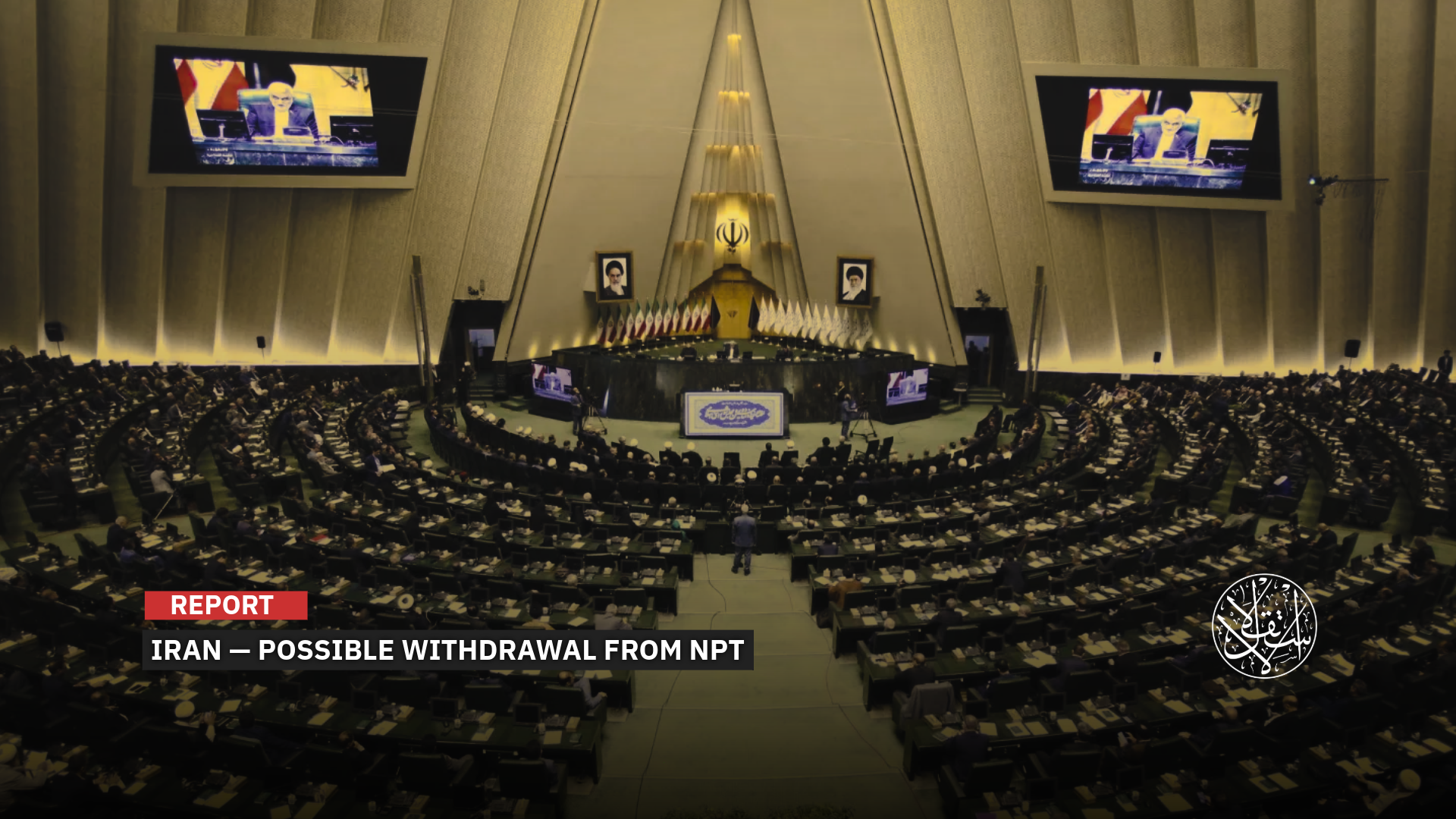
Could Iran consider replacing its fatwa banning the possession and production of nuclear weapons as a form of escalation?
Within 48 hours, four Iranian statements confirmed that Tehran is considering the possibility of withdrawing from the Nuclear Non-Proliferation Treaty (NPT). At the same time, they stressed that the Islamic Republic has not sought and will not seek to acquire nuclear weapons.
The statements came from Tasnim News Agency, the spokesperson of Iran’s Foreign Ministry, and members of the parliamentary National Security and Foreign Policy Committee, including its spokesperson and another member. All emphasized that withdrawal remains under review, arguing that the NPT has not benefited Iran and has not provided protection.
These remarks come as Iran faces an open war launched by the United States and the Israeli Occupation, including strikes on its nuclear facilities and programs, alongside discussions by U.S. President Donald Trump about a potential ground operation to seize Iran’s enriched uranium.
These statements also come as Western think tanks warn that the continued aggression on Iran could push its leadership to seriously consider acquiring a nuclear weapon in response and to abandon the Supreme Leader’s ban on nuclear weapons—especially after his death in U.S.-Israeli airstrikes, which some argue has effectively nullified the fatwa.

What Did They Threaten?
On March 27, 2026, Ebrahim Rezaei, spokesperson for the Iranian parliament’s National Security and Foreign Policy Committee, said that Iran’s continued membership in the NPT no longer makes sense and that the time had come to withdraw.
The following day, March 28, 2026, Tasnim News Agency reported that state institutions were seriously considering withdrawal from the treaty in response to attacks on Iranian nuclear facilities, as well as the positions taken by the International Atomic Energy Agency (IAEA).
It said that several relevant bodies, including parliament, are urgently reviewing the issue and that a growing view within Iran sees no justification for remaining in the treaty.
On March 30, 2026, Iranian Foreign Ministry spokesperson Esmail Baghaei said that parliament is considering the possibility of withdrawal while reiterating that Tehran has not sought and will not seek nuclear weapons.
“What is the benefit of joining a treaty in which bullying parties at the international level not only do not allow us to benefit from its rights but also attack our nuclear facilities?” Baghaei said, adding that Tehran would respect the treaty as long as it is a member.
On the same day, Alaeddin Boroujerdi, a member of parliament’s National Security and Foreign Policy Committee, said that, in light of the U.S.-Israeli aggression on Iran, the country’s continued membership in the NPT no longer makes sense and called for withdrawal.
The SNN TV channel report quoted Boroujerdi as saying that under current conditions there is no justification for Iran’s membership in the treaty and that the prevailing view among MPs is that these events have undermined its value.
“Given the current circumstances, Iran’s membership in the NPT no longer makes sense, and it appears that the prevailing opinion among members of parliament is precisely this: after these events, there is no reason to accept such restrictions [under the NPT-TASS].”
“We are not seeking to build a nuclear bomb, but one cannot simultaneously play by the rules and be subjected to bombing; consequently, the time has come to withdraw from the NPT,” he added.
Prior to these statements, Iran had already signaled the possibility of withdrawal following the first aggression in June 2025, without taking any formal steps.
On June 16, 2025, Iran’s Foreign Ministry said that lawmakers were drafting a bill that could lead Tehran to leave the NPT while reaffirming its official position against developing nuclear weapons, according to Reuters.
“In light of recent developments, we will take an appropriate decision. Government has to enforce parliament bills but such a proposal is just being prepared and we will coordinate in the later stages with parliament,” Baghaei said at the time.
Iran began its nuclear program in the 1950s under Shah Mohammad Reza Pahlavi, with U.S. support, and in 1958 became a member of the IAEA.
In 1968, Tehran signed the NPT and ratified it in 1970. After the 1979 Islamic Revolution, the program was temporarily halted.
However, the Islamic Republic resumed nuclear development in the late 1980s, and since 2003 it has been subject to a fatwa issued by Supreme Leader Ali Khamenei prohibiting nuclear weapons.
The NPT requires the IAEA to provide safeguards and ensure that member states can benefit from nuclear technology for peaceful purposes.
However, Tehran argues that statements by IAEA Director General Rafael Grossi indirectly encourage attacks on its nuclear facilities and justify strikes carried out by the United States and “Israel” without clear condemnation from the agency.
Iran’s Foreign Ministry accused Grossi of making “destructive statements,” which it said amounted to incitement to bomb its facilities.
Deputy Foreign Minister for Legal and International Affairs Kazem Gharibabadi said Grossi has so far done “nothing useful” regarding Iran and that his statements “only further complicate the situation.”
In a post on X, he added that Grossi had said no war could destroy Iran’s nuclear capabilities unless it became a nuclear war, while expressing hope that such a scenario would never happen.
Under Article X of the NPT, member states have the right to withdraw, provided they give three months’ notice to all treaty parties and the UN Security Council, along with reasons deemed to threaten their supreme interests.
So far, only North Korea has invoked this clause, first announcing its withdrawal in 1993 before reversing course and later completing the process after its crisis with the IAEA.

What If Iran Withdraws?
The International Institute for Strategic Studies (IISS) believes that the war on Iran will have far-reaching consequences, not only by hardening Tehran’s position and reducing its willingness to negotiate over its nuclear program in the future, but also by undermining the broader credibility of the global nuclear non-proliferation regime.
In a report issued on March 25, 2026, the IISS said it is unlikely that the U.S.-Israeli war will achieve the desired results for the administration of Donald Trump.
It noted that if the government collapses and internal instability follows, this could lead to a loss of control over Iran’s nuclear materials, increasing the risk of proliferation.
If the leadership survives, which is the more likely scenario, Iran is expected to pull out of future nuclear talks and conclude that the ability to develop nuclear weapons is its only real guarantee of survival.
Pressure on a weaker state, especially when it feels its survival is at stake, often pushes it toward more hardline positions rather than restraint, a path Iran is likely to follow in the coming years.
According to the IISS, Iran may draw two key lessons from this experience: first, that giving up its sovereign right to develop nuclear deterrence by signing the NPT in 1968 was a major strategic mistake; and second, that its long-term nuclear strategy has failed to provide effective deterrence or convince the international community of its commitment not to pursue military nuclear capabilities, despite the political and economic costs it has borne.
The report argues that the damage caused by the recent aggression, which took place amid negotiations, may outweigh any incentives that could have encouraged Tehran to negotiate in good faith.
It also highlights a striking paradox: the United States cooperated with “Israel,” a non-signatory to the treaty, to carry out counter-proliferation strikes against a signatory state engaged in negotiations over its nuclear program.
As a result, future Iranian governments are likely to be more convinced than ever that possessing the capability to produce nuclear weapons is a fundamental safeguard against potential attacks by powerful adversaries.
The report draws a parallel with Ukraine, where there is growing belief that giving up its nuclear program in 1994 without reliable security guarantees left it more vulnerable to external aggression, particularly in its war with Russia.
Amid Western concerns that any Iranian withdrawal from the NPT could lead to a pursuit of nuclear weapons, Tehran has been careful to stress that such a step, if taken, would not necessarily mean moving toward building a nuclear bomb.
It says the aim would instead be to limit what it describes as U.S. and Israeli “espionage” conducted under the cover of inspections by the IAEA, according to Tasnim.

‘Nuclear Fatwa Is Dead’
Iranian statements about the “death of the Supreme Leader’s fatwa,” following his killing in a U.S.-Israeli assassination, have raised concerns in Washington, with media reports viewing them as a possible sign of a shift in Iran’s nuclear strategy.
These concerns were heightened by remarks from Iranian officials suggesting that the assassination of former Supreme Leader Ali Khamenei, who had issued the fatwa banning nuclear weapons, effectively nullifies it and opens the door to a potential move toward developing such weapons.
Egyptian journalist Mohamed Khayal said he asked a senior Iranian official whether the late leader’s fatwa prohibiting the possession and production of nuclear weapons was still in effect or whether it might change in light of the ongoing war.
His question included the possibility that Iran could replace the ban on possessing and manufacturing nuclear weapons, as a form of escalation in response to what it sees as red lines crossed by the United States and “Israel,” with a new ruling permitting their development.
The Iranian official responded decisively, saying that “Israel” and the United States had assassinated the author of the fatwa, and that it was therefore highly likely to be reversed in the coming days.
He added that discussions had already begun within official circles about possibly abandoning the fatwa and replacing it with one that allows the possession of nuclear weapons, in response to the assassination of the Supreme Leader and the ongoing war.
Dr. Fatima Alsmadi, a specialist in Iranian affairs, said that Tehran had previously proposed to Washington, during negotiation rounds, passing a law banning the possession of nuclear weapons in an effort to avoid war.
Alsmadi added in an interview with Khalil al-Anani on YouTube that an official in Iran’s parliament told her Tehran had proposed turning Ali Khamenei’s fatwa into a binding law passed by parliament, effectively criminalizing the possession of nuclear weapons.
On March 29, 2026, Yedioth Ahronoth warned that Iran could accelerate its pursuit of a nuclear weapon after the war, citing what it described as the “death of the nuclear fatwa.”
The paper noted that Tehran has long relied on Khamenei’s religious ban to underscore the peaceful nature of its nuclear program. However, his successor has yet to reaffirm that stance, even as hardline influence grows, calls for acquiring nuclear weapons increase, and rhetoric portraying Iran as a great power intensifies.
“We believe that besides nuclear weapons, other types of weapons of mass destruction, such as chemical and biological weapons, also pose a serious threat to humanity. The Iranian nation [...] feels more than any other nation the danger that is caused by the production and stockpiling of such weapons [...]. We consider the use of such weapons as haram [forbidden] and believe that everyone must make efforts to secure humanity against this great disaster,” according to Khamnei’s fatwa.
This ruling dates back to the mid-1990s, though it was not publicly disclosed until 2003, as part of Iran’s effort to respond to international accusations regarding its nuclear program.
Sina Azodi, an expert on Iran’s nuclear program at George Washington University, told CNN that hardliners in Iran see the current circumstances as an opportunity to reconsider the declared nuclear doctrine.
“One of the reasons they exercised nuclear forbearance was the fear of attacks by Israel and the U.S.,” Azodi said. “But at this point, where they attacked anyway, all bets are off for them.”
According to IAEA, Iran possessed around 10,000 kilograms of enriched uranium before the war, at varying levels of enrichment, most of it low-enriched. However, about 440.9 kilograms were enriched to 60 percent.
This level is close to the roughly 90 percent required for a nuclear weapon, making it relatively quicker to reach that threshold, with quantities potentially sufficient to produce around ten nuclear bombs.
It is believed that a large portion of this uranium is stored beneath nuclear facilities that have been targeted, particularly in Isfahan, raising concerns that it could be retrieved and further enriched at undisclosed sites.
Western reports suggest that if the Iranian government remains intact and these stockpiles are not destroyed, Tehran could accelerate its path toward nuclear capability, either by developing a rudimentary weapon or a so-called “dirty bomb,” which is less complex than advanced nuclear weapons possessed by countries such as the United States and Russia.
Although such devices may not be deliverable by ballistic missiles, they could still cause widespread damage and be used to signal nuclear capability as the government seeks to ensure its survival.

What Happens Next?
In the aftermath of the 12-day U.S.-Israeli war on Iran, the Bulletin of the Atomic Scientists laid out a scenario on June 25, 2025, asking a critical question: what if Iran withdraws from the NPT?
According to the report, such a move would effectively lift the legal constraints on Iran’s possession of nuclear weapons and give Tehran grounds to reject international inspections and safeguards.
It would also make it easier for Iran to rebuild nuclear capabilities damaged by strikes, potentially allowing it to advance a weapons program without international oversight.
The report notes that Iran still retains the technical expertise to manufacture centrifuges and assemble them into operational cascades, along with years of accumulated experience, including covert work linked to nuclear development. This gives Tehran significant flexibility in how it proceeds.
Under these conditions, Iran could establish a covert underground enrichment facility capable of producing large quantities of weapons-grade uranium.
This path would accelerate further if Tehran manages to retain more than 400 kilograms of uranium enriched to 60 percent uranium-235.
The report suggests that Iran may choose to delay an actual decision to build a nuclear weapon until later, once its capabilities are restored. However, triggering withdrawal from the NPT in the near term could expose it to the risk of military escalation.
At the same time, the report warns that Iran’s adversaries would likely interpret withdrawal as a signal of intent to develop nuclear weapons, even if such a conclusion has no clear legal basis and is not necessarily definitive.
In theory, Iran could leave the NPT while continuing a policy of “nuclear hedging,” maintaining the technical capacity to produce a weapon without openly doing so, even as it quietly rebuilds its enrichment program.
The report also notes that Iran’s previous threats to withdraw from the NPT may have been part of negotiation tactics, though they backfired by increasing international pressure at the time.
This time, however, global reactions could be more muted. In the current climate, following the 2025 war and ongoing escalation, the UN Security Council is unlikely to reach a consensus on new sanctions or monitoring measures.
Iran’s partners and nuclear suppliers may also face limited pressure to scale back cooperation.
As a result, the international response may be confined to non-binding calls for Tehran to reconsider, steps that would themselves require agreement among the five permanent members of the Security Council.
Still, the scenario does not rule out unilateral action. Some countries could impose economic sanctions or take other measures, including military options, to pressure Iran.
Sources
- Khamenei's Nuclear Fatwa: A Fiction From The Start
- Iranian parliament calls for withdrawal from NPT in response to US, Israeli aggression
- Iran says lawmakers reviewing option of NPT exit but not seeking bomb
- ‘Nuclear fatwa is dead’: Is Iran now racing toward a bomb after the war?
- War in Iran and the nuclear non-proliferation regime: a perspective from Pakistan
- What if Iran withdraws from the NPT?
- Iran says parliament is preparing bill to leave nuclear non-proliferation treaty
- Guards media calls for Iran to quit nuclear non-proliferation treaty