Why Is France Trying to Return to Syria With Its Intelligence Activity and Militia Support?
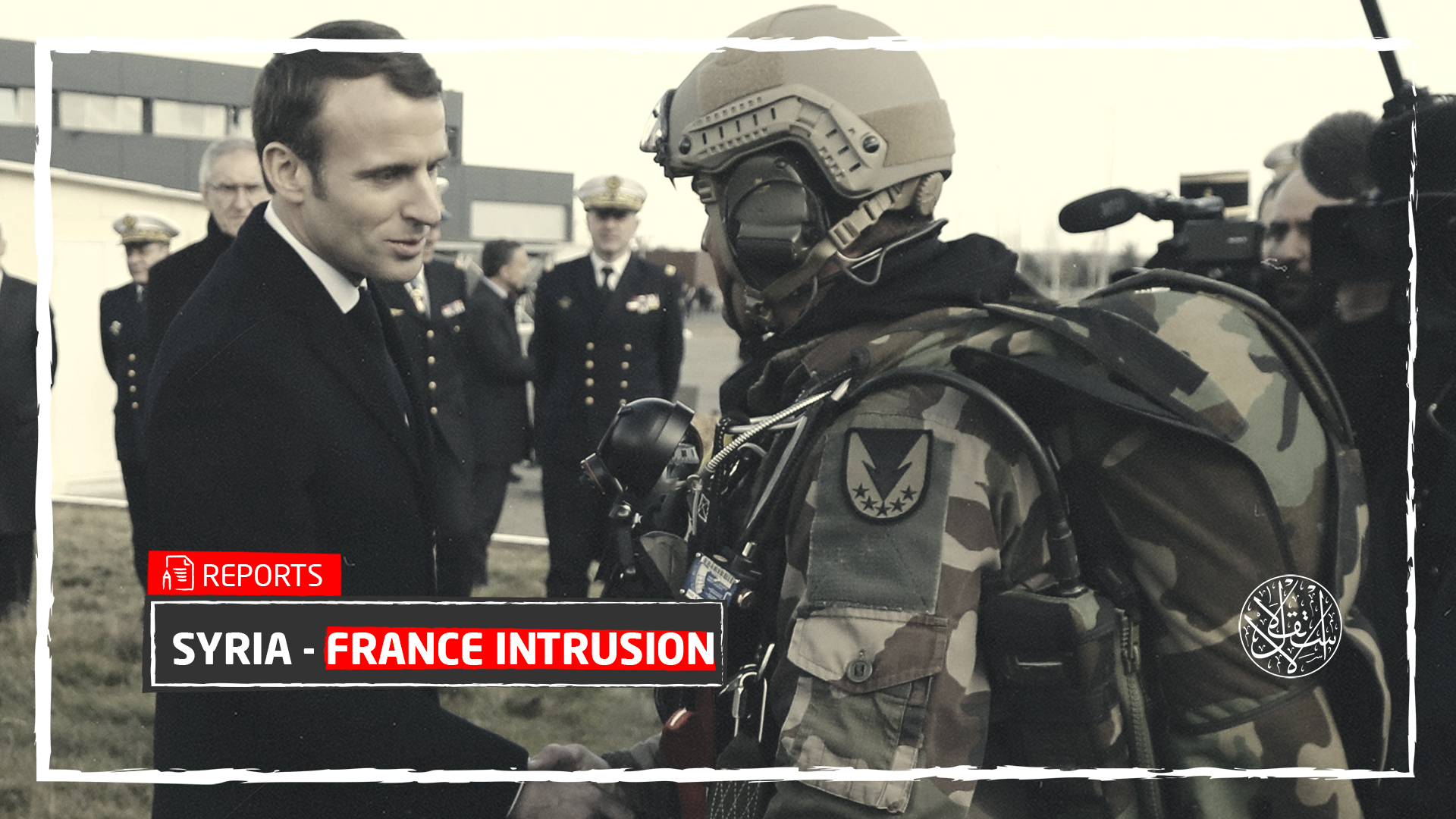
French intelligence is seeking to play a new role in Syria, especially in the northeastern part controlled by the Syrian Democratic Forces (SDF).
The move raised the fears of a new active power in Syria suitable with Paris' desire to find a foothold in light of the fierce international competition over the oil wells.
The French forces redeployed in Syria in 2020, in line with the United States' repositioning in the east of the Euphrates.
It is currently deployed in 4 military sites in Deir ez-Zor, Al-Hasakah, and Al-Raqqa. It also supports US forces at military points and participates in training the "SDF".
The French forces are considered part of the "international coalition" led by the United States, which began in September 2014 its military operations against ISIS in Syria and Iraq.
New Indicators
The French intelligence's attempt to have a new role in Syria comes with Bertrand Togo, who is currently the deputy director of the French military intelligence service, taking over the administration of the service, according to the "Strategic Observatory" report on June 21, 2021.
Togo took the position of commander of the "Euro-Atlantic" battalion before joining Military Intelligence in 2019, and before that he worked for a short period with the then Minister of Defense; Jean-Yves Le Drian in 2012, and also served in the paratrooper "Dragon Brigade", which is jointly deployed by the Special Operations Command and Military Intelligence.
According to the report, Togo has deep experience in the field situations in Syria and Iraq, and wants to establish operations rooms that bring together strategic analysts, specialists in the field of mapping and photo taking, and other experts.
Prior to that, the Elysee Palace invited the political forces in northeastern Syria on April 19, 2021, to visit Paris with the aim of discussing "aspects of the Syrian Issue" and the possibility of meeting French President Emmanuel Macron, following a visit by a French envoy to the SDF-controlled areas.
The French presidential envoy (whose name was not revealed) - who visited northeastern Syria - met in April 2021 with several responsible and invited representatives of the components of the area east of the Euphrates River controlled by the "Syrian Democratic Forces" (SDF).
The French move in the northeast of Syria indicates that Paris is looking for a foothold in the most important region of the country, in light of regional and international competition to consolidate influence there.
In April 2019, French President Emmanuel Macron received a delegation representing the SDF, declaring financial support "to cover humanitarian needs and to ensure the stability of the economic and social situation of cities in Syria," according to a statement issued at the time.

A Pressure Card
Regarding the reasons that push France to find a role in the north-east of Syria, analysts saw that the main goal is Paris' desire to strengthen its influence in that region, which is considered a leverage to Turkey in light of the tense relationship between the two countries.
On April 29, 2021, the Russian newspaper "Nezavisimaya Gazeta" considered that France is trying to defend a "historic right" of influence in Syria by providing support to the "SDF" forces, and playing the role of mediator to address the Kurdish division, in clear contradiction with Turkey's policy.
France continues to support the "SDF" on the one hand, and it is trying to keep the Kurdish National Council "SDF" away from Ankara on the other.
This news comes in conjunction with the consideration by the French Court of Cassation in June 2021 of the case accusing the French cement company “Al Farge” of supporting terrorism and “complicity in crimes against humanity” in Syria, following complaints submitted by the French Ministry of Economy and Finance.
The ministry stated that in 2013 and 2014, the "Al-Farge" group paid about 13 million euros through its branch in Syria, "La farge Cement Syria", to groups, including the "Islamic State" organization.
Political analyst Hassan Al-Nifi said, during press statements on May 1, 2021, that the French interest in northeastern Syria did not appear overnight, but in fact dates back to 2015, since the formation of the Syrian Democratic militia, when France was the supporter of this project.
He added, "But the Americans at that time were able to remove France from the equation through their military coordination with the SDF."
This coordination reached its climax in the coalition, when Washington decided that the Syrian Democratic militia would be its executive arm in the fight against ISIS, according to him.
Al-Nifi continued, "Yet, France did not stay away from the SDF, rather sent 200 soldiers to the Tishreen base south of Manbij, which is controlled by the United States."
France tried to justify the presence of its soldiers there and claimed that they had scientific and practical training missions and not direct combat purposes.
France also believed that its presence in that region should be based on solid steps that begin with the consolidation of the relationship with the popular bases there, which is exactly what France wants through its recent invitation to all the Elysee components, he said.
For his part, political analyst Farid Saadoun, during press statements on April 19, 2021, saw the French interest in the northeast as coming "in the context of Paris' attempts to establish a new relationship with Syria, which has historically been an area of influence for the French."
Saadoun stated "They (the French) feel that they have an opportunity in northeastern Syria, so they are working to help the Kurdish Autonomous Administration and the SDF."
He pointed out that the French approach to the northeast of Syria "cannot be isolated from the tense relationship between Paris and Ankara."
He continued, "The strengthening of French influence in the northeast of Syria is a pressure card on the Turkish side."

Activities and Tasks
French intelligence is based in Syria on the "Al-Raqqa - Al-Hasakah" road on the northern outskirts of Raqqa, and it has been taken as a multi-tasking headquarters.
It is also located in one of the buildings of the former "Raqqa Sugar Factory" and takes it as a base for its operations in the western region east of the Euphrates, according to a report by the Russian "Sputnik" agency on February 12, 2019.
French intelligence activities in Syria focus on tracking groups and organizations.
On February 23, 2019, it spotted the leader of the organization known under the name (Emirate of Timbuktu), and he is the second man in the “Support for Islam and Muslims” group (whose name was not revealed).
He and two of his most prominent aides were murdered in a military operation launched by the French forces.
Among the tasks of the French intelligence is the exchange of information about foreign fighters, as the French intelligence services and their European counterparts tracked the return of waves of fighters to Europe during 2016 and 2017, according to an investigation by Al-Jazeera on September 24, 2018.

Leaked documents from the French intelligence services confirmed that only Turkey was left for those who wanted to escape.
This means that whoever wants to catch up with a country must cross in the opposite direction, that is, through terrain controlled by anti-IS forces, which makes the attempt to escape risky and increases its financial costs.
As part of its mission to track down the fighters, French intelligence revealed, according to the French news channel “BFM” on August 7, 2018, the intention of two people to join the group called “Omar Amsin”, one of the most prominent recruits of French fighters and contributed to attracting about 100 from all over France. .
French intelligence plays a pivotal role in tracking down extremist organizations in the Middle East, and in tracking down the leaders of the Islamic State.
It is also interested in intensifying contacts with the intelligence services in Syria and Iraq for the purpose of exchanging information, according to a report published by the European Center for Counter-Terrorism and Intelligence Studies on September 4, 2019.