Why Did the Wave of Anger Erupt Against Netflix’s Film ‘Perfect Strangers’?
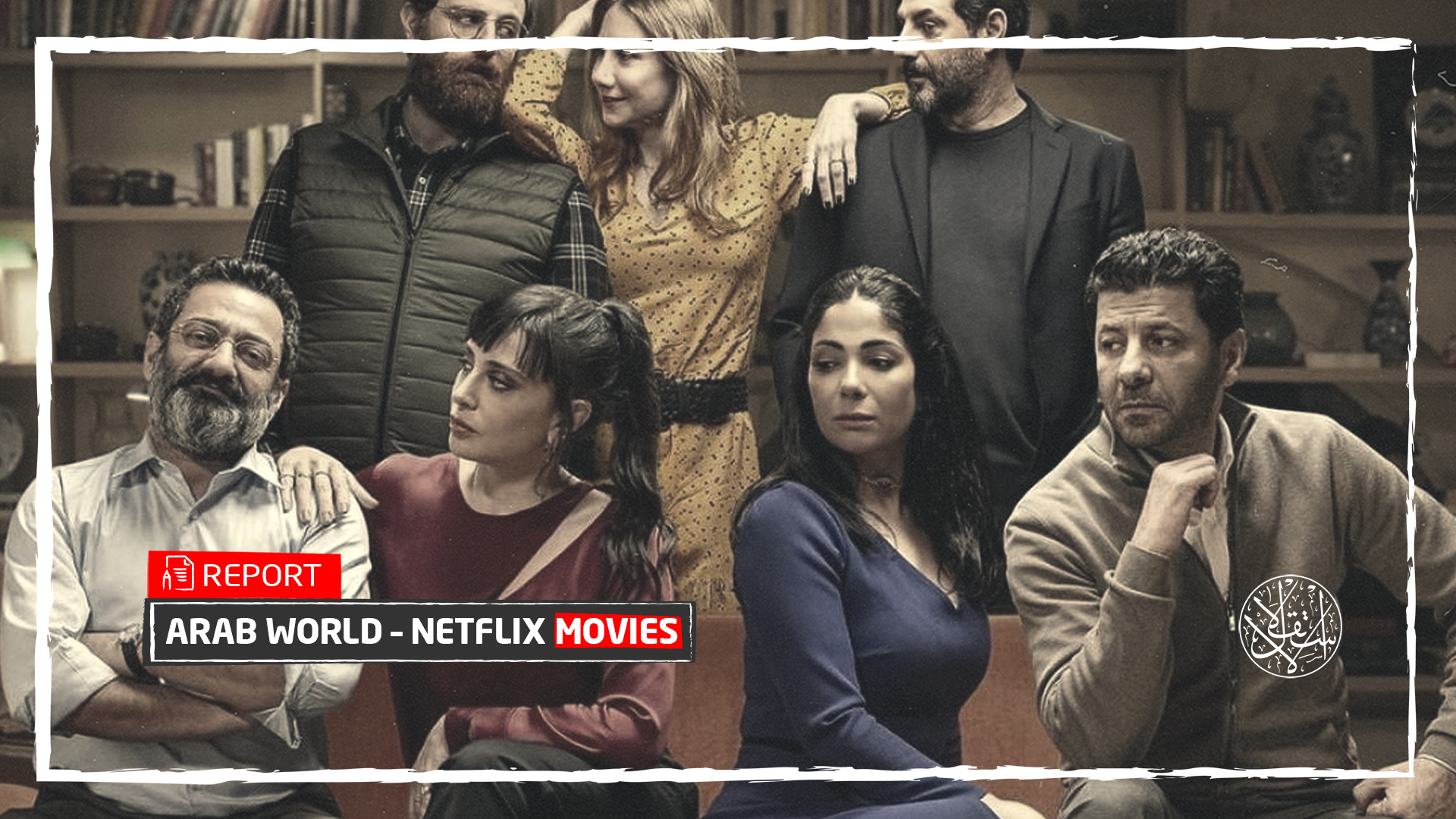
Perfect Strangers Arabic movie (The Dearest Friends), which was broadcast by Netflix, since January 20, 2022, sparked a lot of controversies mixed with anger in the Arab world, due to its promotion of homosexuality and extramarital affairs, which was considered a clear message from this global platform through its first Arabic Production.
The work is the first directorial experience of the Lebanese Wissam Samira, and it is an Arabic version of the Italian movie Perfect Strangers. A group of the Arab world’s stars, such as the Egyptian Mona Zaki, the Jordanian Eyad Nassar, the Lebanese Nadine Labaki, Diamond Abboud, Adel Karam, George Khabbaz, and Fouad Yamin, presented it.
The film has been produced 18 times in many languages in different countries since 2016. Mona Zaki was chosen to be the film hero due to her great fame. The Film events took place in Lebanon, which is the most Arab `open` country.
The film was about the meeting of 7 friends, 3 couples and a single man, for dinner and they engaged in a game so that everyone puts their phones on the table, and everyone sees incoming calls and messages, which reveals many secrets.
Netflix has been presenting works that contradict Islam and the heavenly religions, violate their values, and focus on atheism, homosexuality, and extramarital affairs, in an insistence on provoking the feelings of religious people around the world.
Angry Audience
In light of the film broadcasting, the Arabic language hashtag for the movie, that translates to (#The_Dearest_Friend), topped the list of the most popular Arab hashtags, amid rising anger over the Netflix network. The network is known for promoting in most of its works LGBT practices and pornographic scenes, without taking into account the conservative nature of the Arab region.
The anger raised mostly against Mona Zaki, because her role contained profanity and pornography, in addition to a scene in which she put her underwear clothes to put it in her handbag, before going out to dinner with her husband, in response to the desire of an unknown person spending time together on the Internet.
A fact that observers considered as a shocking and rude scene from an actor who did not resort to acts of temptation even in her artistic beginnings, as well as the alcohol that dominates the majority of the film's scenes.
The state of Arab anger was also focused on the exciting and unacceptable trends the film carried in Arab society.
The work events reveal that an Arab father accepts that his daughter engages in extramarital sex, and a husband allows his wife to talk to her ex-boyfriend about emotional matters, and another discovers that his wife talks about her body and clothes with a virtual person.
Perhaps the attempt to familiarize the audience with the issue of homosexuality and extramarital affairs were the most factors that angered the followers, who strongly criticized the scene of the father blaming his wife, who found a condom in her daughter’s bag, because she searched the bag without her daughter’s permission, instead of facing his daughter.
In addition to the film's attempt to make homosexuality acceptable, this is what appeared in the reaction of the character represented by Eyad Nassar, when he discovered that his friend whom he had known for 20 years was a homosexual, and then invited them to dinner, as if it was normal.
Some observers questioned the originality of copying a foreign film with a different culture, customs and behaviors that are alien to our Arab culture and customs.
For her part, the Egyptian researcher Hoda Jaber criticized the work of Netflix and its promotion of everything that is abnormal in the Arabic language, stressing that: “It brainwashes the minds and direct the society to more to deviation", noting that "the film is stolen as a whole and revolves in a slow, lame and vulgar framework."
She emphasized that the repetition of this type of film legitimizes everything that is illegal and immoral.
For his part, Lebanese-American lawyer Ralph Nader pointed out the difference between the East and the West, stressing that for the West, the film is beautiful, but for the East: "It promotes adultery and immorality, threatens the disintegration of families, and encourages the normalization of homosexuals in our society."
Some considered the film a big failure for Mona Zaki and Eyad Nassar. In response to the critics Mona Zaki, announced via Instagram, that she was pleased with the work and everyone who participated in it.
A number of Arab artists announced their solidarity with her, including Elissa and screenwriter Tamer Habib.
However, her husband, Ahmed Helmy, ignored the controversy and published a picture of his child placing his legs on Helmy's face, commenting: "Wherever I put my head, he puts his legs."
The Egyptian art critic Tarek el-Shennawi described these criticisms as ridiculous, calling on the public to stop "asking the artist to represent himself only."
El-Shennawi told Sky News Arabia on January 23, 2022, that "the artist represents any dramatic character as it is, and the film was subjected to this severe attack due to the presence of Mona Zaki among the heroes of the work, and it would have gone unnoticed without her presence."
However, a statement of Representative Mustafa Bakri, who is close to al-Sisi’s regime, in which he said that, reinforced the state of anger on social media. He said: "The film nurtures homosexuality and marital infidelity, and this contradicts the values and norms of Egyptian society."
Penetrating the Arab World
Netflix was founded as an American entertainment company by Reed Hastings and Marc Randolph on August 29, 1997, in California, and recently penetrated the Egyptian drama, the largest drama in the Arab world, through four productions.
In November 2020, the famous singer Amr Diab announced his return to acting after an absence of 27 years, with an Arabic series from Netflix.
The global network contracted to present a series for the famous doll Abla Fahita in 2020, with its translation into more than 19 languages.
The network announced the participation of the actress Hend Sabry, in her series about Egyptian and Arab women, in 2021.

Netflix produced Arab and Jordanian series, Jinn and Al Rawabi School for Girls in 2019, and its platform showed the Syrian series al-Hiba and al-Kateb.
In September 2020, the Netflix movie Cuties angered Muslims, as the film shows the story of an 11-year-old French Muslim girl of African descent who was forced by her family to wear the veil, which prompted her to rebel and learn to dance in a scandalous way.
On January 20, 2022, the network’s share witnessed a sharp decline of 20%, and CNBC Arabia network said that the slowdown in subscriber growth caused a loss of 45 billion dollars from its market value.
Blow Against Morality
In his comment, the Egyptian media writer and researcher Khaled al-Aswar told Al-Estiklal that this network is looking for more spread for its artistic production that calls for moral or rather immoral values, so it focused on two things, that the film should be produced in the most socially non-conservative Arab country, which is Lebanon.
He added, "The second matter is the network's focus to bring the film's heroine from Egypt to ensure more popularity of deviant behavior patterns, including betrayals and indecent expressions, that are closer to the language of slums, and the call for perversion and nudity."
Al-Aswar added, "Of course, there are many who will advocate freedom of creativity to defend the film. However, far from being a superficial commercial act, it struck a blow to the morals of society, because it conveys ideas wholesale to cause more cracks in the Arab social and moral structure."
He continued: "These same advocates of freedom of creativity keep silent when the authorities in almost all Arab countries ban artistic works involving political taboo, but when it is ‘only’ about religious and social taboo, they claim that there is nothing wrong."
"We all remember in Egypt that the authorities banned the series (People of Alexandria), of the writer Bilal Fadl, one of the figures of June 30," according to al-Aswar.
He expressed his astonishment at the silence of the media outlets, with the exception of Mustafa Bakri regarding the work, which means that it has official tacit approval, and therefore this is the beginning of producing or allowing the promotion of similar works.
What supports this proposition is the announcement by the Syndicate of Acting Professions in Egypt that it will not stand idly by in front of any verbal assault or attempt to intimidate any Egyptian artist as a result of a work of art to which he contributed.
In a statement dated January 24, 2022, it confirmed its support for the artist, Mona Zaki, supporting her against any action of any kind.
The Egyptian artist Moataz al-Swaify said, "Netflix or any platform does not and did not force the viewer to watch its works, they have complete freedom to watch or not."
He explained to Al-Estiklal that "all platforms are not subject to censorship of their works, as the platforms are globally and not for one country, and there is no global censorship law on platforms."