When Drainage Networks Cannot Cope With Winter Rain, What Awaits Gaza?
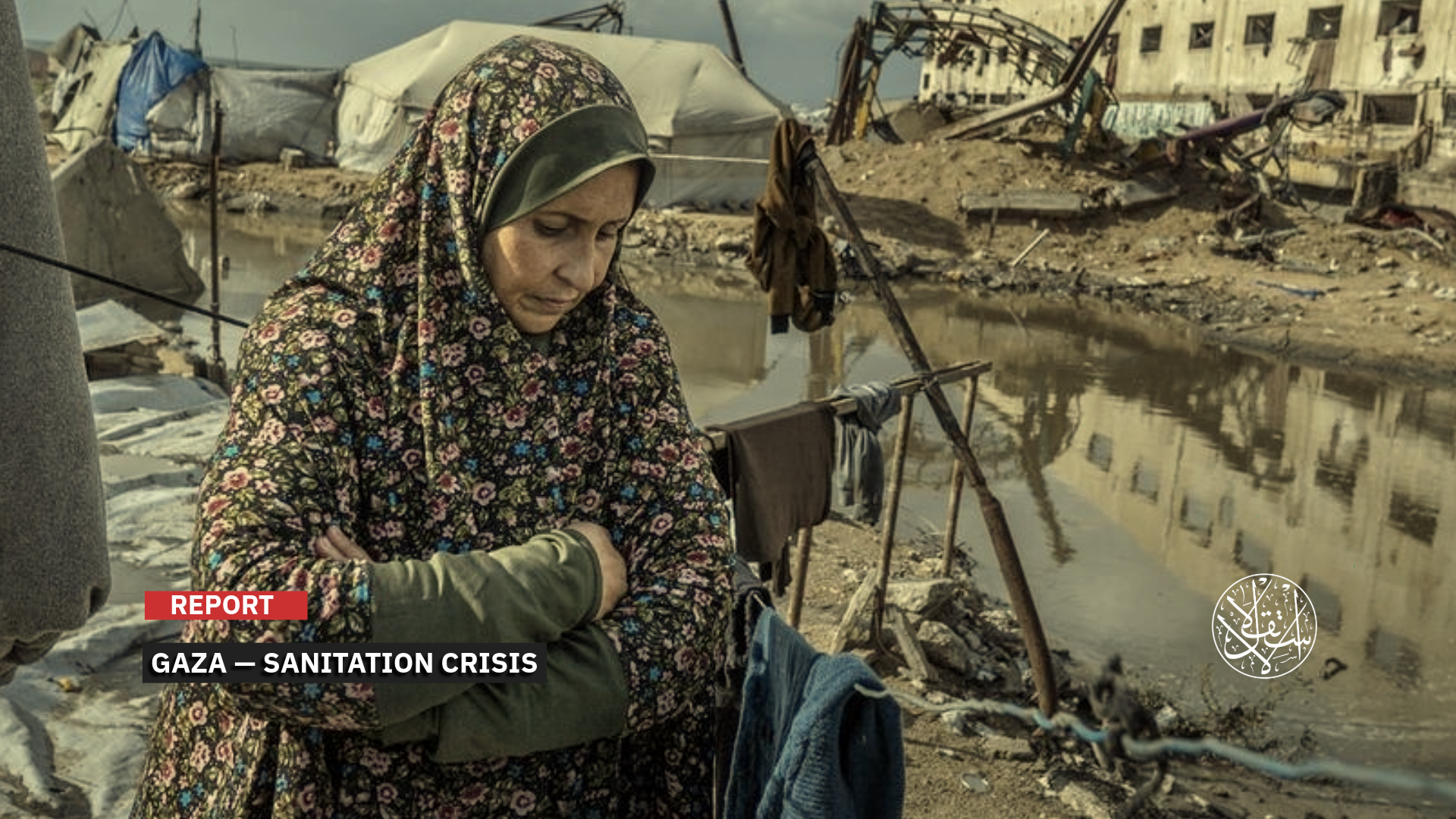
Winter arrives on top of an already existing sewage and pollution crisis in the devastated Gaza Strip.
The Gaza Strip is preparing to enter winter, as Israeli destruction has severely damaged the two systems intended to prevent cities and neighborhoods from flooding: sewage networks and stormwater drainage systems.
Many large treatment and pumping stations have been put out of service, while underground pipelines have been severed.
Meanwhile, sewage has begun accumulating in streets and low-lying areas and seeping into basins and channels originally designed to receive rainwater.
As rainfall approaches, municipalities and the water authority are working to drain sewage from basins, keep selected pumping stations operational, and reconnect major pipelines.
At the same time, hundreds of thousands of displaced people are living in tents and low-lying areas amid the rubble, where rising water levels could push a mixture of sewage and rainwater into areas where they are sheltering.
Winter is arriving on top of an existing pollution and sanitation crisis, as cases linked to contaminated water have increased, while response teams face shortages of pumps, generators, pipes, spare parts, and machinery needed to repair a network that has suffered extensive destruction during Israel’s military campaign in the Gaza Strip.
A Network Destroyed by Israeli Forces
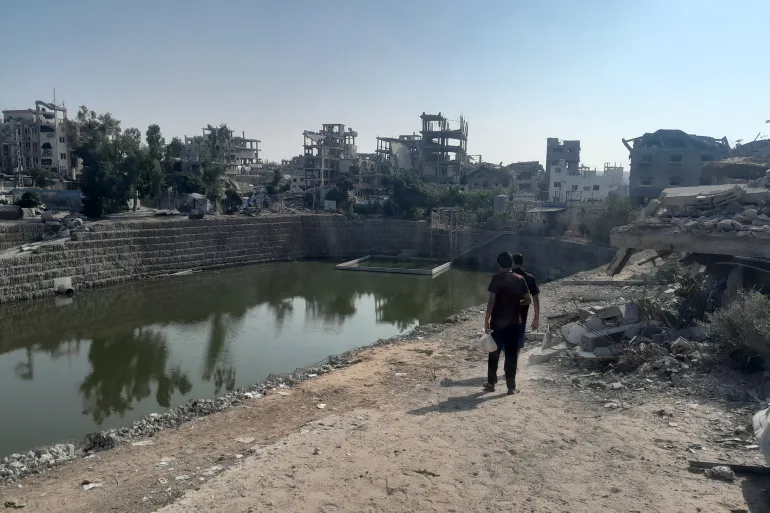
Saeed al-Aklouk, an official responsible for water and sanitation monitoring, said on August 30, 2026, that more than 80 percent of water and sanitation networks in the Gaza Strip had been destroyed, noting that water production capacity had fallen from around 300,000 cubic meters per day to 123,000.
On April 20, 2026, the World Bank, the United Nations, and the European Union published the latest comprehensive technical assessment of damage to Gaza’s water, sanitation, and hygiene sector, covering primarily the cumulative damage recorded through October 2025.
The assessment estimated that 88 percent of above-ground facilities and 76 percent of underground networks had been partially or completely damaged. Direct damage was estimated at around $1.7 billion, while recovery and reconstruction needs were put at approximately $4.24 billion.
Operational figures provide an even clearer picture of the extent of the damage. At the time of the assessment, all six centralized wastewater treatment plants were out of service, while 70 percent of sewage pumping stations were classified as non-operational, and 88 percent of stormwater pumping stations had been damaged.
On December 19, 2024, Human Rights Watch, drawing on satellite imagery, video footage, and interviews with water-sector workers, concluded that Israeli forces had systematically destroyed the solar-panel fields that supplied power to four of Gaza’s six wastewater treatment plants.
The organization said that bulldozer tracks and positions of Israeli forces in several cases indicated that the destruction occurred while the forces controlled the area, describing this as evidence of the deliberate targeting of civilian facilities essential to the survival of the population.
The destruction of water and sanitation facilities was accompanied by disruptions to the means needed to repair what remained operational, amid continued Israeli restrictions on the entry of pumps, chlorine, water tanks, and sanitation supplies. The restrictions also extended to engine oils needed to operate vehicles and pumps.
In Gaza City alone, the municipality included 212,000 linear meters of sewage networks and eight pumping stations in its assessment of war-related damage, along with 21,000 meters of stormwater pipelines and three stormwater collection basins.
Maintenance work has demonstrated the extent to which technical teams have been able to restore operational capacity.
On September 5, the Coastal Municipalities Water Utility, the main operator of water and sanitation facilities in the Gaza Strip, carried out emergency maintenance at the al-Husayna station in Nuseirat, in central Gaza, which serves around 80,000 people.
The work included repairs to the electrical generator, pumps, and pipe manifold. The utility said that shortages of spare parts, materials, and equipment made it extremely difficult to keep the station operating, leaving water and sanitation services for tens of thousands of residents dependent on the teams’ ability to keep old and damaged equipment functioning.
In Khan Younis in southern Gaza, the utility rehabilitated three sewage networks in al-Manshiyya, al-Kasihah, and Abu Shamala.
It said the project aims to increase their capacity to transport sewage to the “minimum possible level under the current circumstances” and prevent wastewater from overflowing into residential neighborhoods.
In western Gaza City, the Sheikh Ajleen wastewater treatment plant underwent work to remove sludge, sand, and rubble, pump out accumulated water, and repair some cracks and control gates as part of a project supported by the United Nations Children’s Fund (UNICEF).
The water utility described these works as a “prelude to restarting the plant.” A UN delegation also visited the facility on September 2 to assess its needs for equipment, spare parts, and materials required for operation.
Sewage in Stormwater Basins
The destruction of treatment and pumping stations and the severing of sewage lines by Israeli forces have pushed wastewater into routes that were not designed to carry it.
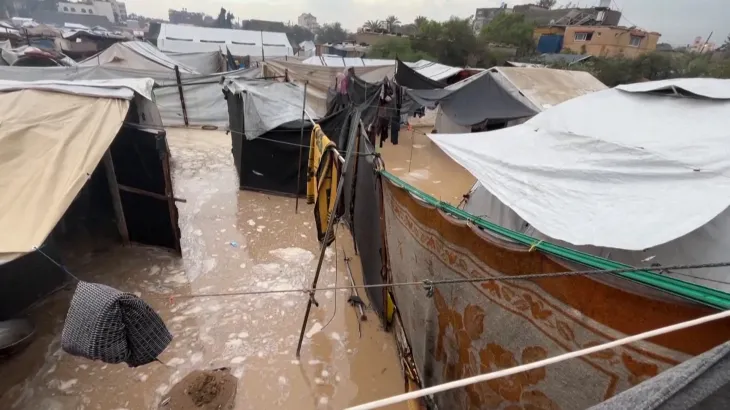
Sewage has accumulated in streets and low-lying areas and entered basins and channels intended for stormwater, while teams in some areas have been forced to discharge it into the sea as an emergency measure.
According to the joint assessment by the World Bank, the United Nations, and the European Union, Gaza’s stormwater basins are becoming increasingly contaminated with untreated wastewater, directly reducing their capacity to receive winter rainfall.
The Sheikh Radwan basin in Gaza City is one of the most prominent documented cases. In September 2024, the municipality informed humanitarian agencies that the basin, originally built to collect rainwater, contained more than 450,000 cubic meters of sewage after parts of the sewage network collapsed and wastewater flowed into it.
The effects of the problem continued into 2026. During August, the Coastal Municipalities Water Utility documented the operation of Sewage Station No. 5, “Al-Baqara,” to divert wastewater from the stormwater infiltration basins in Sheikh Radwan to the station, and then transport it through the sewage network.
The same situation occurred in Gaza City’s Zeitoun neighborhood. At the end of August, the UN Office for the Coordination of Humanitarian Affairs reported that a stormwater basin adjacent to Pumping Station “7B,” covering approximately 5,600 square meters, had been receiving sewage since the beginning of the war. Teams began cleaning the basin in an attempt to partially restore the pumping station.
David Katz, an associate professor of environmental sciences at the University of Haifa, told The Washington Post on September 4, 2026, that shortages of fuel and materials could force organizations operating in Gaza to prioritize supplying residents with water over wastewater treatment.
He noted that Israeli authorities are preventing the entry of equipment needed to repair sewage facilities on the grounds that it is classified as dual-use material. This leaves quantities of wastewater untreated and increases pressure on the network and the coastal environment.
Stormwater basins are entering the rainy season already contaminated with sewage, while the majority of stormwater pumping stations across the Strip have been damaged. As a result, sewage and impaired drainage capacity are converging within the same system.
In Deir al-Balah, the water utility was forced on September 5 to repair a 600-millimeter-diameter sewage line west of Burj al-Gharabli. It then opened a channel through the beach sand toward the sea to prevent wastewater from accumulating and overflowing in the area.
In western Gaza City, teams are currently working to repair 20-inch sewage lines and connect them toward al-Rashid Street and the Beach Pumping Station.
They have been forced to excavate the area more than once because of soil collapses, carrying out the work amid sewage leaks and wastewater accumulation.
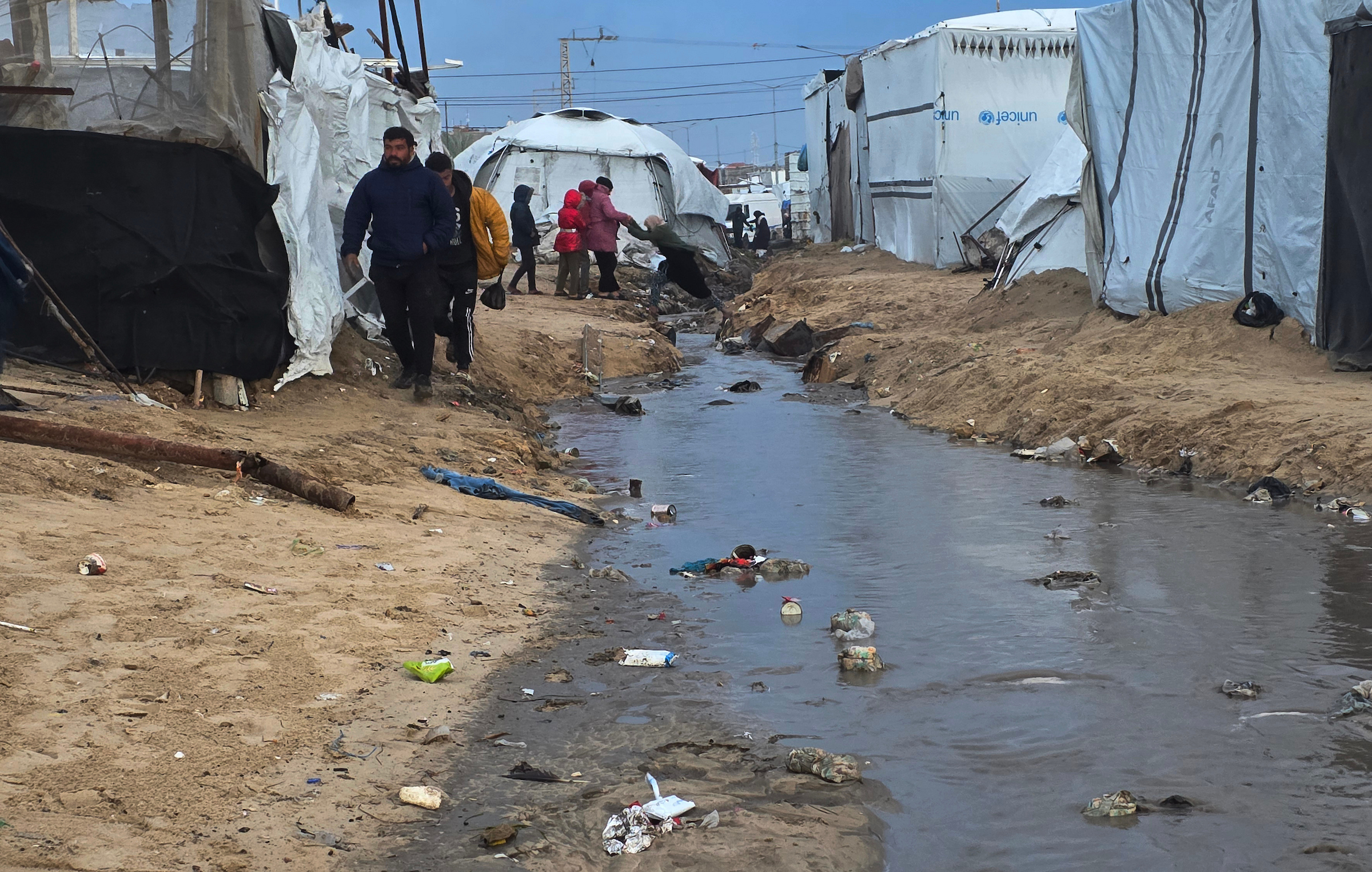
The risk is particularly acute for displaced people in the Tuffah neighborhood. On August 27, Gaza City Municipality inspected a shelter located in a low-lying area housing more than 400 families and warned that the shelters could be flooded.
It called for machinery, maintenance equipment, oils, batteries, and supplies needed to operate stormwater drainage networks.
The experience of last winter offers an indication of the scale of the risk. In December 2025, the International Organization for Migration warned that around 795,000 people living in low-lying or debris-filled areas faced severe flood risks amid inadequate drainage and waste management.
In January 2026, UN agencies estimated that around 850,000 people were at high risk of flooding, while approximately 7,000 tents were damaged or destroyed during one storm.
Flooding and Pollution
Winter arrives amid an ongoing health crisis. In August, cases of acute watery diarrhea exceeded 58,000, while the World Health Organization said the proportion of samples showing microbiological contamination had risen to more than 18 percent, up from less than 6 percent in January.
In early September, the WHO warned that sewage, waste, and contaminated water would be carried by floodwaters into places where residents sleep, cook, and care for their children, while stagnant water provides an additional environment for insects, mold, and bacteria to thrive.
A study published in July 2026 in the Journal of Water and Health, a peer-reviewed scientific journal specializing in water and public health issues, concluded that the collapse of water and sanitation services in Gaza had developed into a public health crisis in which damaged infrastructure intersects with weakened services and limited response capacity.
An earlier study by researchers from Al-Quds University and the Environment Quality Authority found fecal bacterial contamination in a high proportion of water samples collected from public facilities, health centers, and displacement sites in Khan Younis and the central Gaza Strip, along with severe deficiencies in the chlorine levels required for disinfection.
The impact of sewage extends to the coastal aquifer, Gaza’s primary natural source of water, while 77 percent of households, according to the international assessment, rely on water delivered by tankers because of the disruption of water networks.
As sewage spreads through streets and displacement sites, contamination risks extend to water-filling points, household water tanks, and areas surrounding wells.
The direct discharge of wastewater into the sea adds another pathway for pollutants to spread through the coastal environment.
Municipalities and the Coastal Municipalities Water Utility are working to reduce the risks before the rains arrive by maintaining pumps and generators, repairing pipelines, cleaning stations, and opening drainage routes.
However, Israeli restrictions on the entry of equipment, spare parts, and materials needed for treatment leave part of the system’s operational capacity dependent on repairing old equipment and reusing whatever can be salvaged from beneath the rubble.
In January 2026, Oxfam, an international humanitarian and development organization, said its teams and partners had been forced to recover damaged materials from the rubble and reuse them to repair water facilities because of the difficulty of bringing the required equipment into the Gaza Strip.
The effects of the collapse are already visible in displacement camps before winter arrives. Dermatologist Raed Abu Suria said the number of patients presenting with skin diseases directly or indirectly linked to contaminated water, waste, and insects had risen significantly, particularly among children, older people, and residents of shelters.
He told the Palestinian Centre for Human Rights in June that stagnant water and overcrowding increase exposure to mosquitoes, insects, and bacterial infections, while shortages of medicines and medical supplies make treatment more difficult.