Dissolving the Southern Transitional Council or Reshaping It: What Is Happening in Southern Yemen?
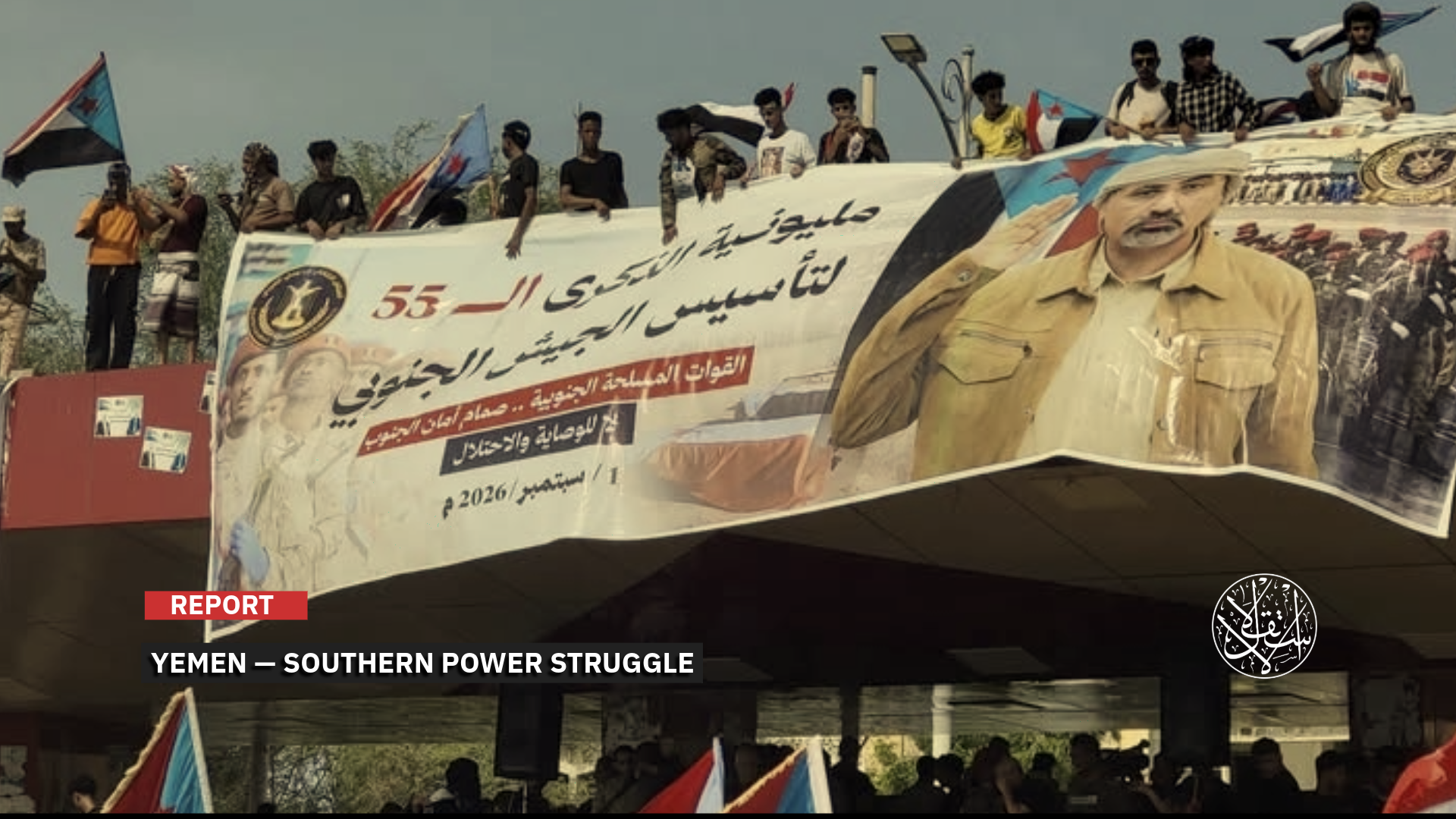
The Southern Transitional Council continued to challenge the government by maintaining its structures and organizational activities despite the decision to dissolve it.
The dissolved Southern Transitional Council (STC) and its supporters have escalated their political and media rhetoric against Saudi Arabia, using events marking the 55th anniversary of the establishment of the southern army in Aden and Mukalla to reject the arrangements being led by Riyadh in the south.
These events raised the level of confrontation from objections to Saudi measures to accusations that the kingdom is exercising “guardianship” and “occupation,” while rejecting any arrangements aimed at targeting forces affiliated with the council or reshaping the political and military landscape in the southern governorates.
The final statement issued on the anniversary described the Saudi military operation in January as an act of “betrayal” and accused Riyadh of seeking to “destroy our southern armed forces and dismantle their units.”
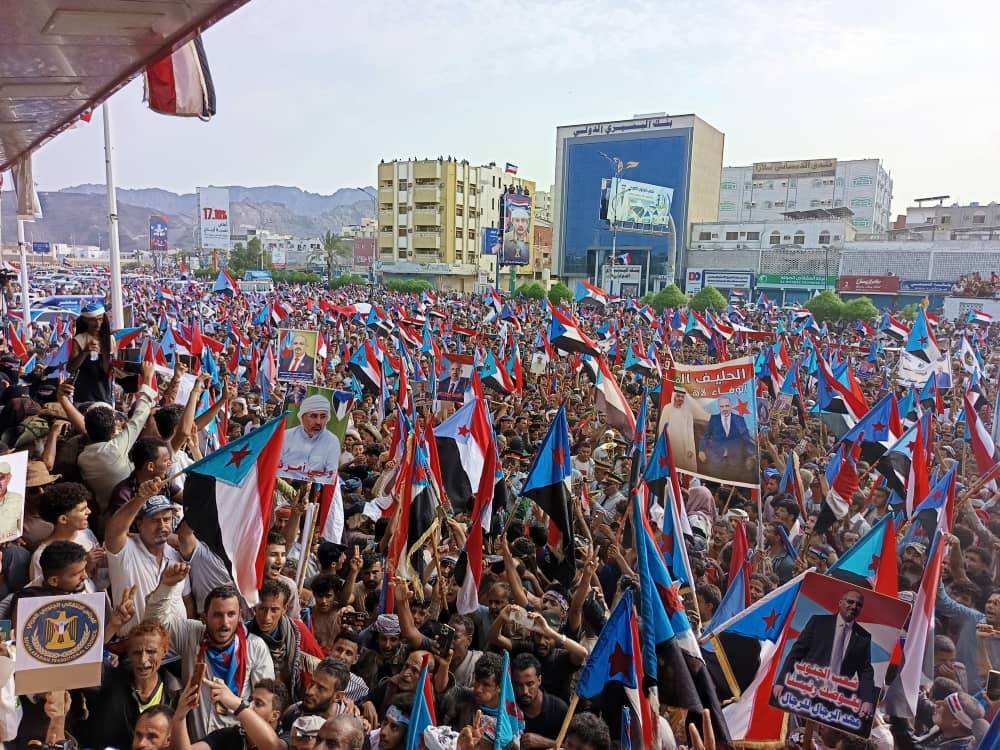
The escalation did not stop at political statements. STC leader Abdul Rab al-Naqeeb also hinted at taking the protests to the center of power in Aden, declaring that “the next mass rally will be at al-Maashiq Palace.”
He described this as “the final warning to the Saudis,” amid rhetoric accusing Riyadh of attempting to restore the legitimacy of Yemen’s political parties and impose “Saudi guardianship” over the south.
Abu Zara’a: Between Riyadh’s Arrangements and the Identity of the South
Amid this escalation, the position of Presidential Leadership Council member and STC deputy chairman Abdul Rahman al-Mahrami, known as “Abu Zara’a”, stood out.
While STC supporters were attacking Saudi Arabia in Aden and al-Mukalla, al-Mahrami wrote from Riyadh, commemorating the anniversary of the establishment of the southern army.
He described it as a “pioneering national military institution” and one of the pillars of the “People’s Democratic Republic of Yemen,” stressing that the building and development of “our southern armed forces” would continue on modern institutional foundations.

The significance of al-Mahrami’s position is heightened by his own standing. He is the commander of the Southern Giants Brigades, a member of the Presidential Leadership Council, and deputy chairman of the Southern Transitional Council. He has also referred to himself as the “Commander-in-Chief of the Southern Armed Forces.”
He comes from a Salafi background shaped through the Dammaj center in Saada, while his military rise was linked to his leadership of UAE-backed forces.
He was appointed to the Presidential Leadership Council in 2022 and, by January 2026, had become one of the key figures Riyadh was relying on to manage the security situation in Aden.
Following the STC’s setback in Hadramawt and al-Mahrah in December 2025, al-Mahrami left Aden for Riyadh and met with Saudi Defense Minister Khalid bin Salman, after having been among those who signed a statement rejecting the Saudi measures.
He was subsequently tasked with maintaining security in Aden and preventing any confrontations inside the city, making him one of the instruments for containing the escalation and preventing it from turning into an armed clash.
Notably, despite his position within the arrangements backed by Riyadh, al-Mahrami’s post did not depart from the broader framework of the increasingly assertive southern rhetoric. Instead, he chose to emphasize the identity of the “southern army” and the need to develop the “Southern Armed Forces.”
This reflects an attempt to distinguish between participation in the Saudi-led arrangements and abandoning the southern political and military structure that constitutes part of his political capital and underpins his position.

Military Mutiny and the Rebuilding of Forces
Despite the announcement of the dissolution of the Southern Transitional Council (STC) on January 9, its activities indicate that it retains the capacity to operate politically and militarily, particularly by keeping its formations outside state institutions and refusing to place them under the Ministry of Defense.
In this context, Defense Line reported on August 3, 2026, that the STC had regrouped fighters and established training camps and drone-operating sites in mountainous areas overlooking the Arabian Sea in eastern Shabwah.
The report also said that weapons and supplies had been moved to the area, while observation posts were established and access to the locations was restricted.
Meanwhile, a source speaking exclusively to al-Mahriah revealed that shipments of modern weapons and military equipment, including drones, had been smuggled into a newly established STC-affiliated camp in the Alkah area between Hadramawt and Shabwah, alongside the deployment of military vehicles and armored vehicles to the camp.
On April 16, the leadership of the so-called Southern Ground Forces announced its rejection of the government’s measures, including the integration of STC forces into the Ministry of Defense.
It affirmed its commitment to orders issued by its own leadership and said it would not act on any orders issued outside that framework.
This was accompanied by the establishment of new military fronts in Abyan–Yafa, Shabwah, and Radfan–Al-Anad–Karish extending toward Bab al-Mandab, as well as Al-Dhalea–Maris. Visits were also made to the fronts to raise combat readiness and reaffirm loyalty to the STC and its political project.
Although the legitimate government began renaming a number of formations affiliated with the STC, these measures amounted to little more than changes in designation, without altering the substance of the forces or actually restructuring and integrating them into the Ministries of Defense and Interior.
Thus, the “Southern Storm Forces” became known as the “Southern Presidential Protection Forces,” the “Security Belt Forces” were renamed the “National Security Forces,” while the “Shabwani Elite” was renamed the “Shabwah Defense Forces.”
Nevertheless, the STC rejected these measures, as did the leadership of the Southern Ground Forces, which also rejected the renaming of STC brigades, arguing that the parties behind the decisions lacked the legal or military authority to take such measures.
As a result, the renaming has so far remained a nominal measure that has neither changed the reality of these formations nor placed them within a unified state military and security structure.
Abu Zaraa al-Mahrami had previously issued directives to keep the Barshid Brigade and the Security Support Battalion within what he called the “Southern Armed Forces,” outside the structure of the Ministry of Defense.
This was viewed as an obstruction to the efforts of the Higher Military Committee, which was tasked with unifying and restructuring the forces and integrating irregular formations into the Ministries of Defense and Interior.

These developments reveal that, on the military front, the STC’s struggle has come to focus on two parallel tracks: resisting the integration of its existing military formations into state institutions, while at the same time working to rebuild and expand this force outside the mechanisms of government and coalition oversight.
For the STC, military power represents its most important asset for maintaining its position as a political actor and ensuring that it possesses leverage to protect its separatist project and defend its position in any future political arrangements.
Accordingly, the announcement of the council’s dissolution has not resulted in the dismantling of its military structure. Instead, it is working to preserve and reproduce it as an independent force, enabling it to maintain its influence and its ability to shape the future of the south.

The STC: A Force That Lost Control but Not Influence
Politically, the STC has continued to challenge the government by maintaining its structures and organizational activities despite the decision to dissolve it, while also continuing its calls for secession.
It has maintained that restoring the southern state within the borders that existed before May 22, 1990 is a “sovereign choice that is not open to compromise,” rejecting any settlements that affect the southern cause. Meanwhile, its bodies in Aden have continued to hold meetings and organize programs of peaceful escalation.
This escalation has evolved into calls for civil disobedience in Aden, including the closure of shops, markets, government and educational institutions, the suspension of work, and disruptions to transportation.
The council has linked these actions to deteriorating public services, salaries, and prices, while directing criticism at the government and the Saudi-led coalition and calling for the rejection of “foreign interference.”
Nevertheless, the STC is no longer in the position it occupied before January. It has lost control of Hadramawt and al-Mahrah, and Aidarus al-Zoubaidi has left the country.
From Riyadh, STC leaders announced the council’s dissolution. Yet al-Zoubaidi has retained a political and popular presence, as well as a network of military and security formations and the ability to exert influence in Aden and other southern governorates, alongside a clear political platform committed to secession.
At the same time, Saudi Arabia has gained greater leverage over funding and salaries, the restructuring of military and security institutions, the appointment of leaders, and the redeployment of forces.
Meanwhile, the geographic space in which the STC operates has narrowed, and differing positions have emerged within its leadership, between a faction rejecting the new Saudi arrangements and another that has accepted participation in them.
Thus, the STC’s challenge is no longer primarily to restore its previous position. Rather, it is to preserve the independence of its political and military decision-making in the face of a Saudi-led process seeking to reintegrate southern forces into the state apparatus and place them under a command structure more closely aligned with Riyadh.

Saudi-Emirati Competition
The UAE’s military withdrawal from Yemen in early 2026 did not bring an end to the influence Abu Dhabi had built up in the south, but it changed its nature and tools.
Influence shifted from a direct military presence to political and local networks that the UAE had established or supported over the years of the war, foremost among them the Southern Transitional Council (STC).
Meanwhile, in recent months, Riyadh has sought to rearrange part of these networks through funding, salaries, changes in leadership, and redeployment through restructuring.
This applies particularly to formations that were historically aligned with Abu Dhabi, such as the Southern Giants Brigades and the National Resistance Forces, which are now closer to the Saudi umbrella in terms of funding and operational ties.
For Saudi Arabia, however, the central challenge lies in the formations directly linked to the STC, which continue to resist full integration into state institutions, leaving part of the military force outside the government chain of command.
The significance of the Emirati legacy also extends beyond the continued existence of specific military formations to a broader network of local relationships and interests that Abu Dhabi built around ports, islands, and maritime routes, particularly in the south and along the western coast.
Accordingly, Saudi-Emirati competition is no longer necessarily about the presence of Emirati forces on the ground, but rather about the future of the forces that emerged under Emirati influence and who has the ability to direct them within the new arrangements.
The events in Hadramawt and al-Mahrah in late 2025 revealed that the dispute had moved beyond a mere division of influence to reflect differing visions for the future of the south. Riyadh is seeking to reshape the political and military landscape under a single umbrella aligned with it, while the remnants of Emirati influence, foremost among them forces linked to the Southern Transitional Council (STC), are attempting to preserve independent centers of power that would enable them to influence this process.
Accordingly, Abu Dhabi appears less able to impose its project directly, but it still retains a legacy of local influence that can be reactivated or leveraged, while Riyadh possesses stronger tools for exercising control and carrying out restructuring.
The conflict has therefore entered a phase that is increasingly defined by a struggle over how to repurpose the Emirati legacy and control the forces that emerged under its influence, rather than a struggle over the continued presence of the UAE itself.
Overall, southern Yemen is likely to remain a potential arena of competition under the current Saudi predominance, but it could witness a return to intense rivalry if Riyadh fails to absorb the Emirati legacy and address local governance challenges.

The STC and the War: Declared Neutrality and Field-Level Convergence
In recent months, the STC has redefined its position on the war with the Houthis. Whereas it previously declared its readiness to participate in liberating the north, it has now emphasized that the ongoing war outside the south is not its war, and that its forces will not be transformed into a combat force operating under the command of the government or the coalition.
This reflects a shift in its priorities from confronting the Houthis as part of a unified Yemeni military project to preserving its forces as the main asset in its political struggle over the future of the south.
However, this declared neutrality does not necessarily mean that there is no communication with the Houthis. In August, Defense Line revealed security and intelligence information indicating that STC-affiliated personnel had received military and ideological training in Sanaa, al-Jawf, and Sa’ada, while forces loyal to the council were being regrouped and drone sites were being established in Shabwah.
The escalation in al-Dhalea on September 9 reveals another aspect of the STC’s position on the war. The incident occurred as Defense Minister Taher al-Aqili arrived at the front to inspect forces fighting the Houthis, while armed men blocked major roads and entrances to the governorate in protest against the visit, in addition to targeting a military vehicle.
The incident is particularly significant because al-Dhalea is one of the STC’s main strongholds and the birthplace of its chairman, Aidarus al-Zoubaidi.
This suggests that the council’s position is not limited to refusing to participate in the war in the north, but extends to rejecting the subordination of forces and areas under its influence to the government’s military command.
Accordingly, the most dangerous scenario is not necessarily the STC entering into an openly declared alliance with the Houthis, but rather the emergence of selective security or field-level cooperation driven by a shared interest in weakening the government and the coalition, and in keeping the south outside the northern war in order to strengthen its negotiating position vis-à-vis the legitimate government and the coalition.
At the same time, the STC remains cautious about turning these points of convergence into an overt political alliance, because doing so would undermine its image as a southern force opposed to the Houthis and give its adversaries, particularly Saudi Arabia and the government, a stronger justification for stripping it of any political or military legitimacy.
Its current interest therefore appears to be closer to keeping the war raging away from its areas, benefiting from the attrition of the legitimate government and the coalition, while maintaining channels of communication that could be used if the balance of the conflict changes.

Where Is Southern Yemen Headed?
Current indications suggest that the south is heading toward a prolonged period of realigning the balance of power rather than a definitive resolution of the conflict.
Saudi Arabia has succeeded in changing the military and political equation that existed before January and is now better positioned to control funding and redistribute forces and leadership, but it has not yet been able to end the STC’s political and popular presence or close the file on the southern cause.
Here, the importance of the south–south dialogue that Riyadh sought to convene becomes clear, as it was intended to serve as the political track running parallel to the military restructuring.
Riyadh called for an inclusive conference bringing together the various southern components to discuss solutions to the southern cause. However, the dialogue stalled and was postponed, with no clarity over when or in what format it might resume.
This reveals one of the limitations of the Saudi approach: Riyadh can redistribute power and impose new military arrangements, but it cannot by itself resolve an issue that extends beyond the STC and involves multiple southern forces and components.
Therefore, reshaping the south cannot depend solely on integrating forces and restructuring state institutions. It also requires a political framework capable of accommodating the diversity of southern visions and preventing the conflict from shifting from a confrontation with the STC to competition among the various components over who represents the southern cause.
In this context, political containment and gradual reintegration appear to be the least costly path for Saudi Arabia, through incorporating some southern forces and leaders into state institutions while simultaneously relaunching a more inclusive southern dialogue.
By contrast, continued obstruction of the political process could leave the south in a state of open attrition, with protests liable to escalate and public services, economic conditions, and the southern cause being used as tools to pressure the government and Riyadh.
The most dangerous scenario remains the possibility that the dispute could shift from a struggle over influence and restructuring into a confrontation within the anti-Houthi camp, particularly if the restructuring of forces is accompanied by forced changes in command positions or if a political settlement is imposed without sufficient southern consensus.
It is true that Saudi Arabia is in a stronger position than the STC, but it is not in a position to eliminate the southern cause or reshape the south on its own. Rebalancing the balance of power can impose a new reality, but it cannot by itself produce a sustainable political settlement.
Thus, the greatest risk lies not so much in the STC returning to its previous position as in its transformation into an independent military force capable of obstructing state arrangements and using armed power as a bargaining chip in shaping the future of the south.
Accordingly, the south appears to be heading toward a prolonged period of realignment and competition over influence unless military restructuring is accompanied by a political process capable of containing southern divisions within a more stable settlement.