The Devastation of Gaza and the West Bank: Are Palestinians Bearing the Cost of Netanyahu's Failure in Iran and Lebanon?
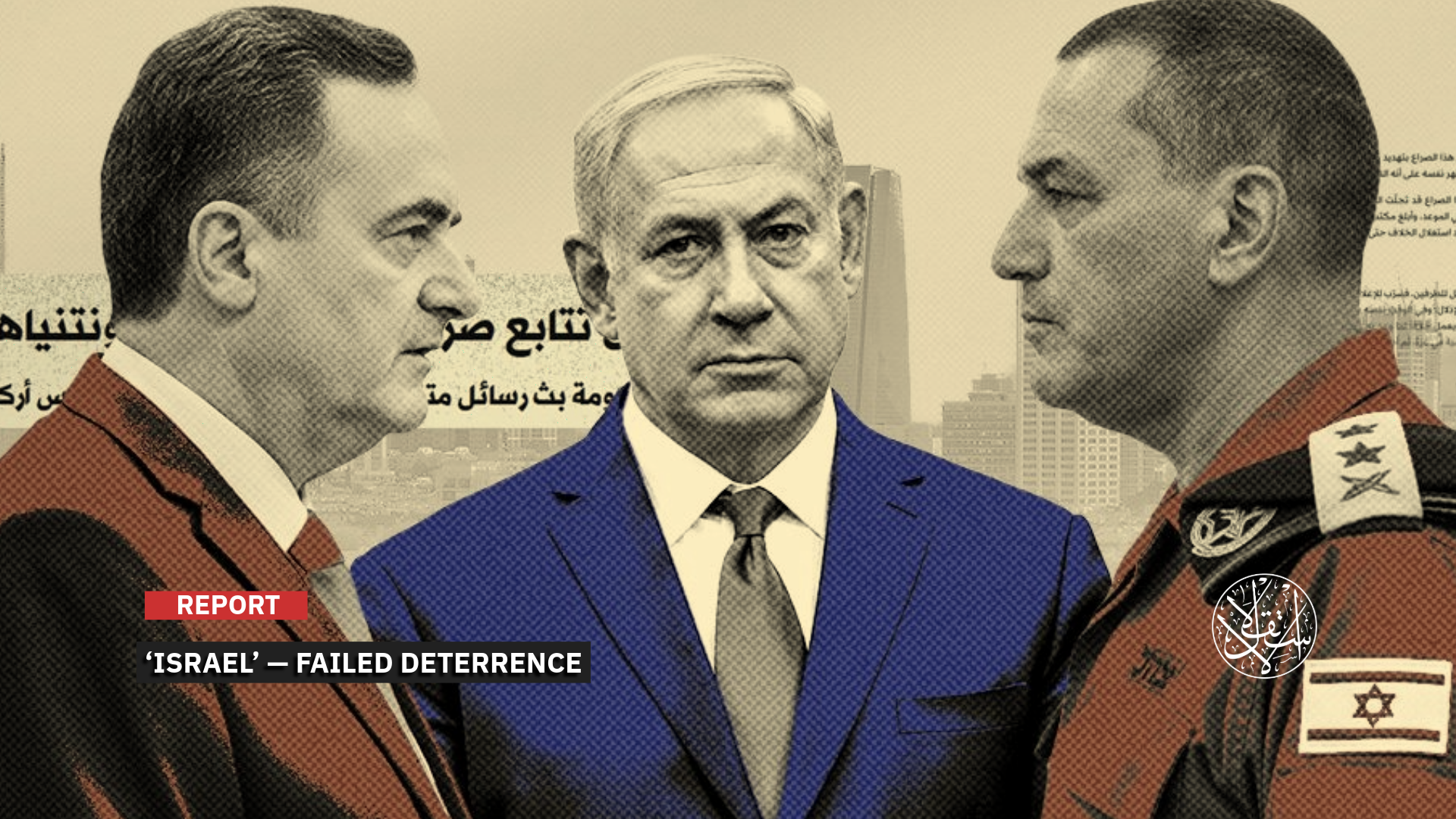
Gaza has become the battleground where “Israel” is seeking to rebuild its deterrence.
As “Israel” has struggled to achieve its declared objectives in both Iran and Lebanon, and has been compelled to accept a cessation of military operations, it has escalated the pace of its operations in the Gaza Strip and the West Bank.
This has included expanding its territorial control inside Gaza to between 60 and 70 percent, according to statements by Israeli Prime Minister Benjamin Netanyahu, while continuing military airstrikes, killings, destruction, and settlement expansion.
This simultaneous escalation in Gaza and the West Bank raises questions about whether Netanyahu is seeking to compensate for the setbacks he encountered on other fronts by securing gains in the Palestinian arena, effectively making Palestinians pay the price for “Israel's” failure to impose new strategic equations in Iran and Lebanon.
It also raises the question of whether Gaza has become the arena through which “Israel” is attempting to restore its deterrence and recover the political and military gains it failed to achieve elsewhere, or whether the current campaign forms part of a broader Israeli strategy aimed at redrawing the map of the conflict and creating new realities on the ground, both in the Gaza Strip and the West Bank.
Meanwhile, mediators appear far from exerting meaningful pressure on “Israel” to halt its military operations or curb its territorial expansion.
Information circulating about the ongoing negotiations between the mediators and the leadership of the Palestinian resistance in Gaza, together with efforts associated with former United Nations envoy Nickolay Mladenov, suggests that pressure is being directed primarily at the Palestinian side, particularly Hamas, including proposals related to disarmament, even as “Israel” continues its military operations and expands its control on the ground.

Expanding Killing and Occupation
Unlike what occurred on the Lebanese front, where understandings linked to the U.S.-Iran agreement contributed to bringing the Israeli offensive to a halt, “Israel's” war machine has not ceased targeting the Gaza Strip since the ceasefire agreement came into effect on October 11, 2025.
The Israeli military has continued its bombardment, destruction, land-clearing operations, and ground incursions, while the mediators guaranteeing the agreement have failed to take any effective action to stop these violations or compel “Israel” to abide by its terms.
In the months following the ceasefire, the number of Palestinians killed has risen to more than 1,012, while over 3,208 others have been injured.
This has been accompanied by a series of targeted killings of senior Hamas leaders and members of their families.
As a result, the overall toll from “Israel's” military campaign, which has continued since October 2023, has surpassed 73,000 Palestinians killed and more than 173,000 wounded, in addition to the widespread destruction of infrastructure and residential areas across the Gaza Strip.
“Israel” also took advantage of the region's preoccupation with developments related to the confrontation with Iran and the subsequent regional understandings to intensify its military operations in Gaza.
Whenever the war encountered a political setback or came under mounting international pressure, Israeli Prime Minister Benjamin Netanyahu moved quickly to escalate attacks on the Strip, using the battlefield situation to expand the territory under Israeli military control and impose new facts on the ground.
In this context, “Israel” has continued expanding what is known as the "Yellow Line," which demarcates the boundaries of areas under Israeli military control inside the Gaza Strip.
While these areas accounted for about 53 percent of the Strip at the start of the ceasefire's implementation, they have gradually expanded to more than 60 percent, in what critics describe as a clear violation of the agreement.
The expansion did not stop there. Israeli media reports revealed that Netanyahu instructed the military to increase its control to approximately 70 percent of the Gaza Strip, effectively confining the Palestinian population to a narrow, densely populated coastal strip, amid growing concerns that this reality could serve as a precursor to plans for the forced displacement of Palestinians.
Alongside the expansion of its territorial control, “Israel” has continued its policy of targeted killings against Hamas's military leadership.
Since the ceasefire took effect, “Israel” has announced the killing of several of the movement's most senior commanders, including Izz al-Din al-Haddad, commander of Hamas's Gaza Brigade, who was killed in an airstrike that targeted his home and also claimed the lives of several members of his family, as well as Mohammed Odeh, head of the movement's Military Intelligence Authority, who was killed in an airstrike on the al-Rimal neighborhood of Gaza City.
Other airstrikes killed Izz al-Din Bak, commander of the North Gaza Brigade, and Imad Aslim, deputy commander of the Gaza City Brigade, along with a number of their aides.
“Israel” also continued targeting dozens of field commanders and military operatives despite the ceasefire agreement remaining in force, reflecting its determination to keep degrading Hamas's leadership and military structure.
Following the assassination of a large number of Hamas's senior political and military leaders since the outbreak of the war in October 2023, the movement has undergone a broad restructuring of its leadership hierarchy.
The list of leaders whose deaths “Israel” has announced includes prominent figures such as Yahya Sinwar, Mohammed Deif, Mohammed Sinwar, Marwan Issa, Raed Saad, Ahmed al-Ghandour, Ayman Nofal, Rafeh Salameh, Mohammed Shabana, Raed Thabet, Ghazi Abu Tamaa, Ayman Siam, and other military commanders who formed the backbone of Hamas's military wing over the past several years.
Alongside its military operations, field reports indicated that the Israeli military has continued gradually altering the boundaries of areas under its control inside the Gaza Strip.
The U.S.-based news website Drop Site reported on June 17, 2026, citing testimonies from Gaza residents, that Israeli forces have continued moving the concrete barriers and field markers that delineate the boundaries of the so-called "Yellow Line," effectively expanding the occupied areas incrementally. According to the report, anyone approaching these boundaries is subjected to gunfire or directly targeted.
Since the ceasefire entered into force, Israeli Occupation Forces have carried out almost daily violations, including killings, airstrikes, land-clearing operations, and the expansion of military-controlled areas.
“Israel” has also significantly reduced the volume of humanitarian aid that was supposed to enter Gaza under the terms of the agreement, while continuing to impose strict restrictions on the movement of people and goods in parallel with the seizure of additional territory.
In this context, Palestinian political writer and analyst Ahmed al-Tanani said that the image presented to the world suggests that a ceasefire is in place, whereas the reality on the ground reveals that the offensive continues in multiple forms.
He explained that “Israel” has pursued a policy of gradual escalation that includes daily killings near the front lines, expanding military-controlled areas, continuing targeted assassinations, bombing inhabited homes, and forcing residents to evacuate entire neighborhoods before they are attacked, including areas located outside the officially declared military zones.
This approach has not been confined to the Gaza Strip. It has also extended to the West Bank, where “Israel” has intensified house demolitions, expanded settlement activity, and asserted control over areas that had previously been under the jurisdiction of the Palestinian Authority.
“Israel” has also taken practical steps to undermine what remains of previous peace agreements by strengthening its military and civilian control over a number of Palestinian cities and towns, in what observers view as part of a broader project aimed at imposing Israeli sovereignty over expanding parts of the West Bank.
With international and regional mediators preoccupied with other issues, and with global attention to the Palestinian cause declining compared with other regional conflict zones, Gaza and the West Bank appear to be the areas most vulnerable to further military and political pressure.
Observers believe that the Israeli government has found in the Palestinian arena the easiest space in which to achieve military and political gains, at a time when it has faced constraints and challenges on other regional fronts.
Rather than moving toward de-escalation or a return to political processes, developments on the ground indicate the continuation of a policy aimed at imposing new realities.
“Israel” has expanded the scope of its control in Gaza, southern Lebanon, and parts of Syrian territory, while Netanyahu and senior security and military officials have stated that these areas will remain within what they call "security zones" for an extended period. This position reflects a growing trend toward entrenching occupation and redrawing the maps of influence and control across the region.

Setbacks in Lebanon and Iran
Amid declining public support for Israeli Prime Minister Benjamin Netanyahu and growing threats to his political future, analysts and observers warn that he may resort to escalating the war and expanding the scope of occupation in Palestinian territories as a way to compensate for his failures in Lebanon and Iran, while maintaining the cohesion of his far-right coalition, which is itself facing increasing domestic pressure.
They argue that Palestinians may pay a heavy price for the strategic failures suffered by the Israeli government on more than one regional front, as the Israeli leadership increasingly moves toward expanding military occupation and imposing new realities on the ground as a means of settling internal political scores and ensuring its hold on power.
Several Israeli analysts do not rule out the possibility that Netanyahu, as he approaches the end of his political career and amid the prospect of new elections, could take reckless steps in the Gaza Strip or the West Bank, particularly given the growing calls within his government to fully occupy Gaza and impose direct military rule over it, or to accelerate annexation projects and impose Israeli sovereignty over large parts of the West Bank.
In this context, Israeli analyst Uri Misgav warned, in an article published by Haaretz on June 18, 2026, of the danger of the current stage Netanyahu is facing, arguing that the real risk lies in his willingness to drag “Israel” toward catastrophic choices in order to avoid the consequences of the next phase.
Misgav said Netanyahu may be prepared to push the country toward highly dangerous scenarios before leaving the political scene, adding that the price of the October 7 wars and their consequences will ultimately be paid at the ballot box. This, he argued, could push Netanyahu to try to postpone that reckoning or circumvent it by maintaining a state of war and tension for as long as possible.
The Israeli writer noted that among the possible scenarios is the potential to push the West Bank toward a new uprising by escalating settler violence, inflaming tensions in Hebron's Old City and around the Ibrahimi Mosque, as well as keeping fronts of tension open in Gaza and Lebanon and possibly embarking on new military adventures against Iran.
Some observers compare these approaches to what is known in military literature as "the last offensive", attempts by political and military leaders approaching failure or defeat to alter the balance of power or delay political collapse.
Palestinian researcher Ramzy Baroud offered a different reading of the motives behind “Israel's” escalation, arguing that historical experience has shown that “Israel” often seeks to compensate for setbacks on one front by escalating on another front that carries lower political and military costs.
In an article published by the U.S. website Common Dreams on June 19, 2026, Baroud argued that Palestinians could once again become the weakest link, bearing the consequences of the political and military failures Netanyahu faces both domestically and regionally.
He explained that the Israeli prime minister has succeeded in recent years in turning a state of perpetual war into a central tool for maintaining his political survival. This has been reflected in the continued military operations in Gaza, ongoing tensions along the Lebanese border, and the open confrontation with Iran, pushing the entire region toward repeated crises.
The report noted that Netanyahu is currently facing one of the most fragile periods of his political career, amid growing criticism inside and outside “Israel” over the outcomes of recent wars.
It also cited former Israeli officials who have openly acknowledged failures in “Israel's” strategy on several fronts, including former Justice Minister Haim Ramon, who said that “Israel” achieved no decisive victory in Lebanon, Iran, or in its confrontation with Hamas.
Observers believe this situation has given far-right ministers within the government greater room to advance their political agendas, taking advantage of Netanyahu's continued dependence on their support to keep his coalition in power.
At the forefront of these figures are National Security Minister Itamar Ben-Gvir and Finance Minister Bezalel Smotrich, who are pushing for more hardline policies toward Palestinians, both in the Gaza Strip and the West Bank.
In this context, Smotrich has proposed plans aimed at annexing around 82 percent of the occupied West Bank, a move observers see as reflecting the transition of annexation projects from political rhetoric to practical implementation on the ground.
Israeli reports, including one published by TheMarker magazine, also revealed that Smotrich has in recent months redirected large financial allocations to settlements and settlement councils in an effort to establish new realities before any potential change in “Israel's” political landscape.
According to these reports, the allocations included increased budgets for settlement projects and programs described as promoting "Jewish identity," amounting to hundreds of millions of shekels.
Critics of the government view these measures as part of an accelerating process to impose a new demographic and political reality in the occupied Palestinian territories.
In light of these developments, a number of analysts believe that the ongoing Israeli escalation in Gaza and the West Bank cannot be separated from the political crisis facing Netanyahu and his government, nor from efforts by the Israeli right to use the current moment to entrench annexation and settlement projects, taking advantage of international focus on other regional crises and the decline in external pressure on “Israel” compared with previous periods.

Where Are the Mediators?
Despite the passage of months since the Gaza ceasefire agreement came into effect in October 2025, “Israel” has faced no serious political or diplomatic consequences for its continued violations of the agreement.
On the contrary, developments on the ground indicate that the violations have gradually escalated, whether through bombardments, assassinations, or the expansion of areas under military control inside the Strip, while Palestinian parties accuse international and regional mediators of being unable to compel “Israel” to fulfill its obligations.
Observers argue that the Israeli government has not treated the ceasefire as an end to the war, but rather as a temporary phase within a broader strategy whose political and military objectives remain unchanged. International reports indicate that “Tel Aviv” has continued policies of displacement, tightening restrictions on the ground, and the seizure of additional territory, without the agreement producing any tangible change in “Israel's” military conduct.
Meanwhile, Arab mediators are facing growing criticism over what Palestinians describe as the absence of any practical measures to halt Israeli violations, with their efforts limited to political statements and condemnations that have failed to deter “Israel” or compel it to respect the terms of the agreement.
At the same time, leaks and reports have emerged regarding the nature of the ongoing negotiations between the mediators and Hamas's leadership, amid accusations that pressure has been focused more heavily on the Palestinian side in an effort to push it toward further concessions, rather than pressuring “Israel” to implement what was previously agreed upon.
Palestinian negotiators accuse Israeli Prime Minister Benjamin Netanyahu, along with officials linked to what is known as the Peace Council under the administration of U.S. President Donald Trump, of attempting to bypass the original ceasefire agreement reached in October 2025 and introduce a new negotiating framework that makes the complete disarmament of the Palestinian resistance a precondition for implementing the remaining provisions of the agreement.
Palestinian sources familiar with the matter told Al-Estiklal newspaper that the repeated talk of "positive atmospheres" during the rounds of negotiations held by the Hamas delegation in Cairo does not necessarily reflect the reality of what is taking place behind closed doors.
The sources explained that the talks witnessed significant pressure being exerted on the Palestinian delegation, most notably by the U.S. administration's representative.
However, the movement refused to respond to demands concerning the weapons of the resistance, prompting mediators to revise some proposals more than once.
According to the same sources, the Palestinian delegation, headed by Khalil al-Hayya, showed flexibility on several humanitarian, administrative, and political issues, but maintained its refusal to discuss the disarmament of the resistance or relinquish the Palestinians' right to defend themselves.
The delegation also demanded that mediators compel “Israel” to implement the first phase of the signed agreement before moving on to discuss other issues.
In the same context, writer Ezz al-Din Dweidar quoted Palestinian sources as speaking of "serious pressure and threats" being exerted on the Palestinian negotiating delegation in Cairo, alongside the continuation of bombardment and assassinations inside Gaza, in an attempt to push the resistance toward concessions related to weapons and its military structure.
Dweidar, citing a source he described as having direct knowledge of the matter, said that the resistance had informed mediators of its willingness to show flexibility on various issues related to alleviating the suffering of civilians and improving humanitarian conditions, but it categorically rejected any discussion involving the surrender of weapons or the abandonment of its military capabilities.
Some political analyses link the continuation of Israeli assassinations to the ongoing negotiations, with proponents of this view arguing that targeting a number of the movement's military and political leaders is part of efforts to influence decision-making within the resistance and force it to make concessions during the talks.
In this context, the assassination of several figures associated with the movement's leadership has sparked widespread debate over the timing of these operations and their political objectives.
Palestinian media outlets and sources have also circulated reports alleging that some leaders faced indirect pressure during negotiation rounds, amid the movement's continued adherence to its core positions.
However, other accounts have emerged denying that some mediators exerted direct pressure on the Palestinian delegation.
Egyptian journalist Mohamed Khayal, who specializes in Palestinian affairs, quoted Hamas leader in Gaza Khalil al-Hayya as affirming that the Egyptian mediator does not pressure Palestinian negotiators to accept specific amendments or concessions.
Rather, he said, Egypt works to bridge differences and seek compromise formulas that can help reach workable understandings.
According to Khayal's account, al-Hayya also expressed his appreciation for Egypt's role in managing the negotiations, emphasizing that any differences in views over certain negotiating details stem from differing assessments of how to achieve Palestinian interests, rather than from attempts to impose conditions or dictate terms to the resistance.
As negotiations continue and efforts to reach a final agreement remain stalled, questions remain over the mediators’ ability to play a more effective role in ensuring that all parties fulfill their obligations, and whether political pressure in the future will be directed toward the party with greater military power, or whether it will continue to focus on the Palestinian side, which has been facing an ongoing war for nearly three years.
Deceptive Negotiations
Palestinian resistance leaders spoke to the U.S. website Drop Site on June 22, 2026, about what they described as "deceptive negotiations" and ongoing pressure aimed at extracting the disarmament of the Palestinian resistance in the Gaza Strip.
U.S. journalist Jeremy Scahill quoted senior figures from Hamas and Islamic Jihad as saying that “Israel”, with the backing of what is known as the "Trump Peace Council," is seeking to impose new conditions that the Palestinian resistance has never agreed to, foremost among them the disarmament of the factions, while Israeli Occupation Forces continue to occupy large areas of the Gaza Strip and violate the ceasefire agreement on a daily basis.
The Palestinian leaders said that the "Peace Council" established by the administration of U.S. President Donald Trump had unilaterally rewritten the ceasefire agreement in an attempt to impose new political and security realities on the Palestinians and force them to abandon their national liberation project, thereby entrenching Israeli dominance over the future of the Strip.
According to these sources, Hamas officials have been summoned since mid-March 2026 to a series of meetings attended by U.S. officials, regional mediators, and the figure known as the "High Representative for Gaza," appointed by the Trump administration.
During these meetings, the movement faced sustained pressure to agree to disarm, accompanied by warnings that a large-scale Israeli offensive could resume if it refused.
Despite these pressures, Palestinian leaders stressed that such efforts would not succeed, asserting that any attempt to impose political surrender on the resistance would ultimately lead to a renewed armed confrontation.
Senior Hamas official Osama Hamdan said that "Israel's objective is not limited to occupying the Gaza Strip, but extends to ending the Palestinian presence there." He added that “Israel” seeks to send a message to Palestinians that they have no future on their land and that their only option is to leave.
Muhammad al-Hindi, one of the most prominent leaders of Islamic Jihad, acknowledged that the humanitarian and living conditions in Gaza are extremely difficult amid continued killing and destruction. However, he stressed that “Israel” has not achieved a decisive victory and that the conflict remains unresolved.
He added that the weapons of the resistance "do not belong to the Palestinian factions to be negotiated over or surrendered, but rather are the weapons of the Palestinian people in a phase of national liberation."
He emphasized that any discussion of this issue could only take place within a comprehensive political framework addressing the future of the Palestinian cause.
He also noted that the official Palestinian resistance position calls for the full implementation of the first phase of the ceasefire agreement before moving on to any discussions regarding the second phase or other political and security issues.
The facts indicate that the issue of disarmament was not part of the first-phase agreement signed in October 2025, which was limited to a ceasefire, prisoner exchanges, the opening of crossings, the delivery of humanitarian aid, and initial steps toward reconstruction.
Major political and security issues were deferred to later stages, negotiations on which have not officially begun to date.
Nevertheless, the United States and “Israel” have continued promoting a narrative that Hamas agreed to new conditions related to disarmament, a claim the movement has repeatedly denied, insisting that it remains committed to the original terms of the agreement, which was itself brokered by Washington.

Trump’s Envoy: An Obstacle in the Negotiations
Palestinian sources close to the negotiating delegation told Al-Estiklal that U.S. envoy Nickolay Mladenov, who plays a central role in what is known as the "Gaza Peace Council," has become one of the main obstacles to advancing the negotiations, due to what they describe as his full adoption of the Israeli position and his attempts to impose new proposals that go beyond what had previously been agreed.
The sources said that Mladenov is focusing primarily on the issue of the resistance's weapons and military tunnels, despite the fact that these issues were postponed to the second phase of the agreement, while “Israel” has yet to fulfill its obligations related to the first phase.
In April 2026, Mladenov presented Hamas with what became known as the "15-point roadmap," which included explicit conditions linking the reconstruction of the Gaza Strip and the withdrawal of Israeli Occupation Forces to the disarmament of the Palestinian resistance.
Hamas viewed the document as an attempt to directly adopt Israeli conditions and described it in an official statement as a "suspicious attempt" to entrench the demands of the occupation under a political and diplomatic cover.
During a round of negotiations held in Cairo in early May 2026, Mladenov exerted significant pressure on the movement's delegation to approve disarmament arrangements, according to Palestinian negotiators who spoke to Drop Site.
However, the Palestinian delegation maintained its position rejecting any discussion of this issue before the completion of the implementation of the agreement's first phase.
In contrast, Hamas's chief negotiator Khalil al-Hayya reiterated the movement's position that any discussion regarding the future of the resistance's weapons must be part of a comprehensive political process leading to an end to the occupation and the establishment of an independent Palestinian state, rather than serving as a precondition for ending the war or rebuilding the Strip.
Al-Hayya stressed that the movement is prepared to move on to discussions of the details of the second phase once “Israel” fully commits to implementing the provisions of the first phase.
He emphasized that circumventing signed agreements and attempting to impose new conditions would only further complicate the situation and prolong the crisis.
Sources
- In Campaign to Seize More of Gaza, Israel Expands Attacks on Palestinians Near the “Yellow Line”
- Palestinians May Pay the Price for Netanyahu’s Defeat in Iran
- Israel Is in the Dangerous Twilight Days of Netanyahu’s Rule
- “The Occupation’s Conditions”: Trump’s Board of Peace Demands That Hamas Surrender to Netanyahu’s Gaza Agenda
- Netanyahu Directs Israeli Forces to Expand Gaza Control to 70 Percent
- With Documents… Al-Sharq Al-Awsat Tracks Mladenov’s Key Points and Amendments to Hamas and the Factions’ Response [Arabic]