Syrian Displaced Begin Returning Home—But Why Is the Process So Slow?

Organizations are running campaigns to tear down the camps and put an end to this suffering.
Scenes of Syrians returning from displacement camps near the Turkish border to their hometowns—once abandoned due to war—continue to unfold, as many see it as a symbol of “complete victory” following the fall of the country’s tyrant.
Since the collapse of Bashar al-Assad’s regime on December 8, 2024, local organizations have launched several initiatives encouraging displaced families to return to the cities and villages they were forced to flee after the Assad military campaign began in 2011.

‘A Dignified Return’
Initiatives to support displaced Syrians’ return have carried powerful humanitarian and social messages, especially for those who haven’t set foot in their villages for 13 years.
Slogans like “Hope of the Returnees,” “Return is a Right,” “A Dignified Return,” “Honorable Comeback,” and “The Soul Reunited with the Body” reflect the deep emotional and symbolic significance of this moment.
These initiatives have also funded the restoration of key healthcare and public service facilities in war-torn areas to make it easier for displaced families in northern Syrian camps to go back home.
Before Assad’s fall, around five million displaced people lived in northwest Syria—mostly in makeshift camps scattered across Idlib and Aleppo’s countryside. Over 1,900 camps housed them, built from tents, wooden planks, or caravans—temporary shelters lacking the basics of stability.
For years, these displaced communities endured freezing winters and scorching summers, with limited access to food, clean water, and medical care. The situation worsened in early 2024 as international aid to the region dropped by over 90%, leading to severe shortages in food and basic services.
With the fall of the Assad regime, many displaced families tore down their tents and dismantled the makeshift homes—sending a clear message that the painful chapter of displacement had come to an end.
According to the UNHCR, over one million internally displaced Syrians have returned to their towns and villages since the fall of Assad’s regime. Around 400,000 Syrians have come back from neighboring countries—bringing the total number of returnees to more than 1.4 million.
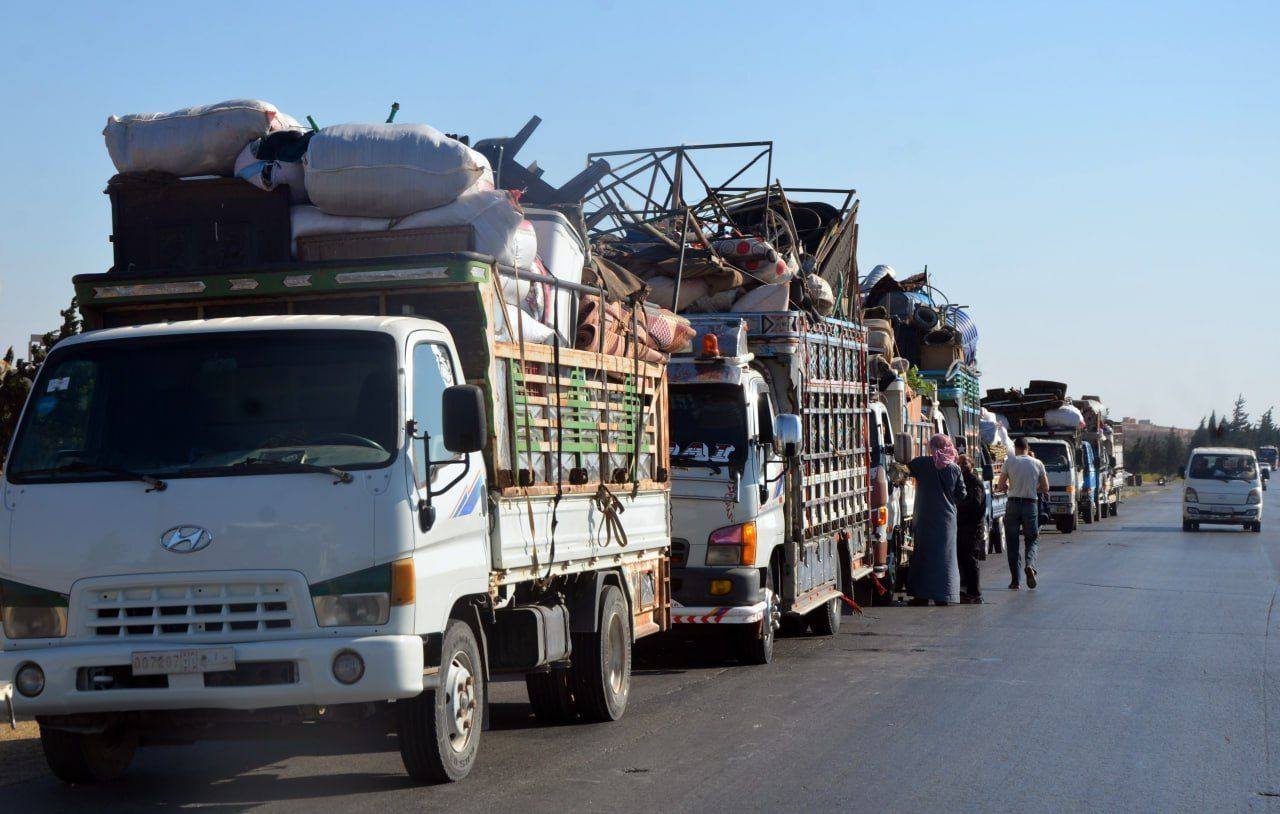
As part of the “A Dignified Return 3” campaign, 90 displaced families have returned from northern Syrian camps to their hometown of al-Treimseh in the Hama countryside, with support from the government and humanitarian organizations.
Campaign coordinator and convoy supervisor, Suhail Jumaa, told the local newspaper al-Watan on June 3, 2025, that the convoy included around 90 families—totaling 508 individuals—who left the Li’ Ajlikom camp in Qah, rural Idlib, and returned to al-Treimseh.
Despite the town’s severe devastation from relentless bombardment by the former Assad regime, these families chose to come back to rebuild their lives. Jumaa stressed that the returnees are in urgent need of emergency relief to meet even the most basic needs, as well as financial support to restore homes that were partially or completely destroyed.
Around 100 more displaced families also returned to Khan Sheikhoun in southern Idlib at the end of May 2025, as part of the “The Soul Reunited with the Body” campaign. They came from displacement camps in northern Idlib, after nearly five years away from their homes.
The campaign organizers stated that a generous benefactor covered the transportation costs for these families, under the banner “Eid Is More Joyful in Khan Sheikhoun.”
This marks the fifth convoy organized by the campaign, which aims to ease the burden of transportation for displaced families who continue to struggle under harsh living conditions.
Since March 2025, with the arrival of warmer weather, dozens of convoys have been transporting displaced families back to their original towns and cities across various Syrian provinces.

Tearing Down the Last Tent
Across northern Syrian camps, the number of displaced residents is clearly shrinking, with many tents and humble shelters now abandoned.
Near the village of Qah, close to the Turkish border in Idlib province, one camp is gradually emptying out. Aerial footage shows dozens of tents left standing—but without a single occupant inside.
Videos have spread widely, capturing displaced people leaving the camps and announcing their return to their hometowns.
In a powerful moment on May 17, 2025, a displaced man in one northern Syrian camp tore down his tent, then shouted, “Finally, we are free from displacement and exile. Burn in hell, Assad; the country without Assad.”
Despite the absence of electricity and running water, many displaced families still prefer to return to their destroyed homes—even if it means covering them with plastic sheets.
“We have triumphed and want to return to our lands and ruined homes for good, because we never chose this fate,” said Nasser Obeid, who has been displaced for 13 years and currently lives in the Karama camp north of Idlib.
Obeid, a school teacher who decided to return to his hometown of Treimseh in the Hama countryside, added, “Enough of displacement [..] today we go back to our homes, even if only stone by stone, because return is a right, and we have been waiting for this day for years.”
“Many returning displaced families have pitched tents atop the rubble of their destroyed houses as a first step toward rebuilding—even if only temporarily,” he told Al-Estiklal.
“The extensive destruction of homes and infrastructure, along with the loss of basic services like electricity and sewage systems, continues to hinder the return process.”
“Once it’s declared that the destroyed villages in Syria are livable again, it will signal the tearing down of the last tent in northern Syria,” the teacher added.
Rehabilitation Efforts Underway
Despite the beginning of residents’ return, extensive destruction remains a major obstacle to family stability and slows the overall return process.
Beyond the devastation caused by the fallen Assad regime across Syrian cities and towns, the lack of services and the absence of functioning infrastructure present additional challenges to stability and resettlement.
Following Assad’s fall, the Syrian Civil Defense—known as the White Helmets—launched the “Hope of Returnees” campaign on December 3, 2024. Its goal is to facilitate displaced people’s return by clearing war remnants such as mines and unexploded ordnance, and reopening blocked roads.
These efforts aim to create a safer environment for returnees, while providing emergency medical and basic health services.
Meanwhile, many local Syrian organizations have intensified support campaigns focused on reviving destroyed areas by restoring essential services, repairing schools, and rehabilitating water wells.
They also work on rebuilding mosques, equipping health centers, and helping returnees resume farming and work, according to Firas Mansour, Director of Operations of the Emergency Response Team in Syria, in a video statement on June 2, 2025.
“We are working to bring displaced families from northern Syrian camps back to their towns and villages. We will dismantle all camps and erase this suffering,” he said.
Damascus is relying on the support of its allies and the international community to launch economic recovery and reconstruction efforts—especially following announcements by Washington and the European Union to lift sanctions that had been in place for years.
Lifting these sanctions is expected to accelerate the rehabilitation of infrastructure such as roads, hospitals, and schools across Syrian cities.
This momentum is further supported by Arab countries ready to provide urgent funding to boost the economy and stabilize security, while the United Nations estimates the cost of reconstruction at over $400 billion.
On April 27, 2025, Saudi Arabia and Qatar announced they had cleared Syria’s outstanding debts to the World Bank, totaling about $15 million.
This debt repayment opens the door for the World Bank to approve support projects for Syria, particularly in reconstruction and economic recovery.
On May 8, 2025, Qatar pledged a grant of $29 million per month for three months, renewable, to help cover part of the current payroll costs for government employees.
Sources
- 100 Families Return to Khan Sheikhoun in Rural Idlib as Part of the “The Soul Reunited With the Body” Convoys [Arabic]
- Displaced Families Continue to Return From Camps in Northern Syria to Their Villages and Towns [Arabic]
- A Syrian Man Tears Down His Displacement Tent, Happy to Return Home [Arabic]
- Statement From the White Helmets [Arabic]