New Headquarters for the Israeli Liaison Office in Rabat Sparks Outrage: What’s the Story?
“These relations will remain outside the bounds of legitimacy.”
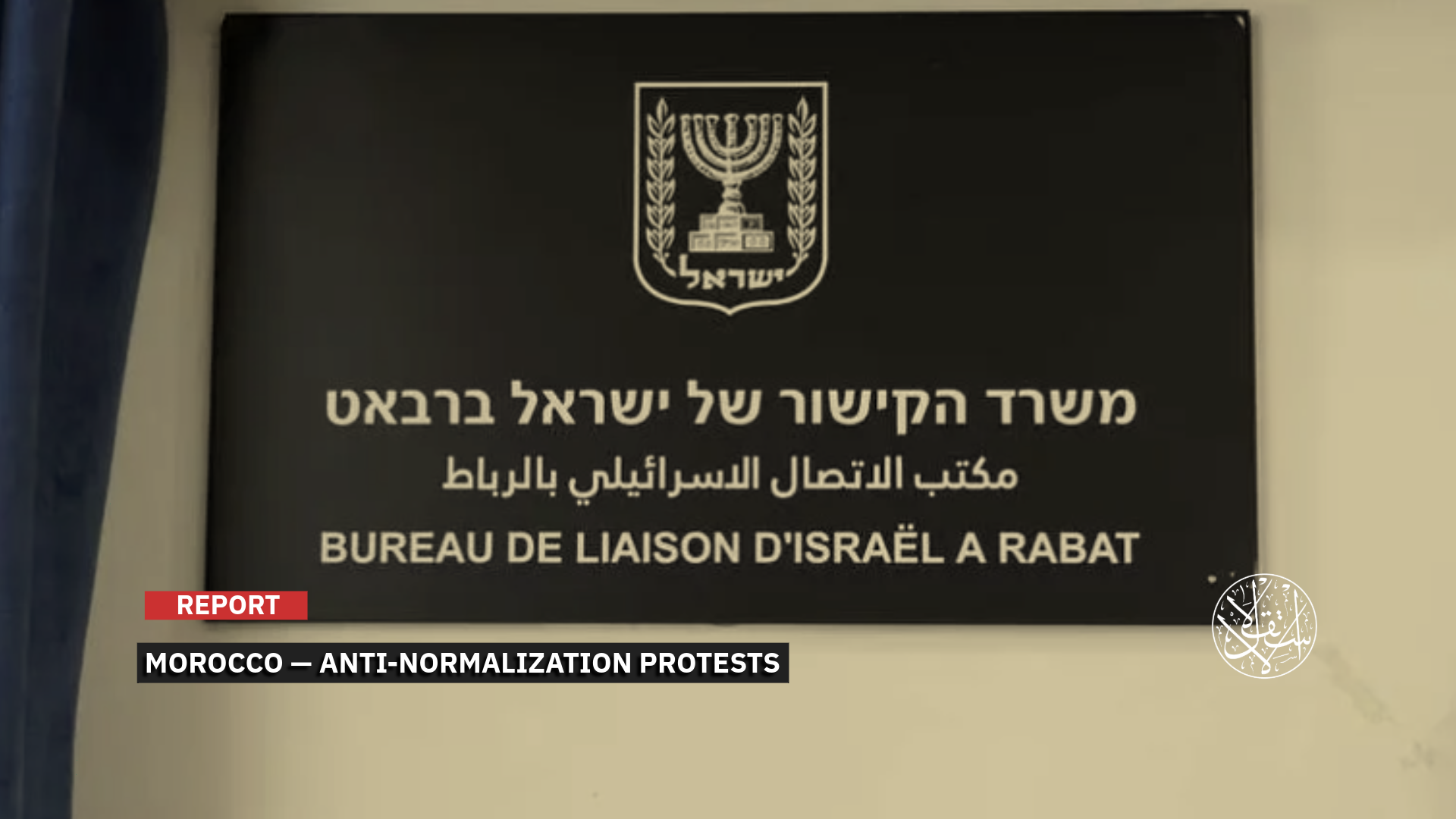
A wave of discontent and protests in Morocco over the opening of the new headquarters of the Israeli Liaison Office in Rabat continues, driven not only by the timing, amid the ongoing genocide in the Gaza Strip, but also by the location chosen by the Israeli entity for the office, a site with major and deeply sensitive historical and symbolic significance.
The opening, which took place on August 12, 2026, was accompanied by a heavy security presence around the building, along with private security personnel, as a number of employees began arriving at the new headquarters in the early hours of the day.
According to on-the-ground observations by several local media outlets, the Israeli flag could be seen inside the building, although it appeared largely obscured from view from the outside and was mounted at a low height.
The new Israeli Liaison Office is located on Mehdi Ben Barka Street in the Souissi district of Rabat, after leaving its previous premises on al-Nakheel Street in the Hay Riad district.

The Symbolism of the Location
The name Mehdi Ben Barka carries profound significance in Morocco’s political memory, going beyond the fact that he was one of the country’s historic figures.
He was one of the most prominent figures of the national movement, and his name was also associated with liberation movements and opposition to colonialism and imperialism across the countries of the Third World.
In October 1965, Ben Barka disappeared in the French capital, Paris, under mysterious circumstances. The case remained open for decades, raising numerous questions about the parties involved in his abduction and his ultimate fate.
Various reports and investigations have also pointed to the possible involvement of intelligence agencies in the case, including “Israel’s” Mossad, while his family continues to demand that the truth about his fate be revealed.
In this regard, university professor and human rights activist Latifa Bouhssini criticized the relocation of the Israeli Liaison Office in Rabat to a street bearing Mehdi Ben Barka’s name, saying that the move represents a provocation to Moroccans’ feelings, amid continued popular opposition to normalization with “Israel”.
According to the local website Lakome on August 14, Bouhssini said that Ben Barka was among those who recognized at an early stage the danger of imperialism and its relationship with Zionism, adding that placing the Israeli Liaison Office on a street bearing his name “will certainly have consequences.”
Addressing the authorities, she said, “You normalized relations with the greatest enemy of the nation, and established relations dominated by oligarchic financial interests, from which you profit in ways that feed your bank accounts. Today, you pay no heed to our rejection, our protests, our indignation and our anger, while you boast of your friendship with the vilest thing humanity has ever produced.”
She continued, “Be certain that the day will come when they will cast you aside and throw you into the dustbin of history once they have achieved their objectives. Be certain, too, that sooner or later, future generations will mobilize to wash away the filth that has clung to our public spaces and streets, and will renew the mobilizing force needed to reclaim our sovereignty over our national decisions and over our beloved homeland.”
The university professor went on, “Do not rejoice or celebrate. This land that gave birth to Mohammed bin Abd el-Krim al-Khattabi, Sheikh Ma al-Aynayn, Zerktouni, Sheikh al-Islam, and Mehdi Ben Barka is a fertile land, capable of producing generations that will stand up for and defend their land, their homeland, their citizenship, their rights, and their freedoms.”
She added, “We will never abandon our homeland or our symbols. The land belongs to us, not to your Zionist friends; the homeland belongs to us, not to the scum of humanity, the genocidal perpetrators, the killers, the war criminals.”
Bouhssini concluded by stressing that the memory of Mehdi Ben Barka remains alive, saying that “the pathetic and despicable attempts” will not be able to erase it.
Hassan Bennajeh, a leading member of the Justice and Charity movement, said that “opening the lair of the criminal entity on Mehdi Ben Barka Street in the capital Rabat is a scene that reflects the utmost contempt for the conscience of the nation and the pulse of the street.”
In a Facebook post on August 14, Bennajeh stressed that “what happened serves to reinforce a glaring truth: the systematic continuation of defying the free will of the people, who have repeatedly and unanimously affirmed their absolute rejection of all forms of normalization with the criminal entity and its bloody record, replete with crimes against humanity.”
He believes that “choosing this particular address carries deeply negative symbolism and a dark history. The entity whose office is being opened is itself accused of participating in the first assassination of the national symbol Mehdi Ben Barka, making the opening of this lair on the street named after him tantamount to a second assassination of him.”
Bennajeh argued that “this provocative step will only make the Moroccan people more determined to uphold their principled historic position rejecting normalization, in loyalty to the blood of the martyrs and the sacrifices of the resistance, and in defense of the dignity of national symbols.”
A Miserable Step
Aziz Hanawi, Secretary-General of the Moroccan Observatory Against Normalization, reaffirmed the observatory’s condemnation of this move, which he said reflects the continuation and furthering of normalization with the criminal, terrorist Zionist entity, despite the massacres and mass killings committed against the Palestinian people.
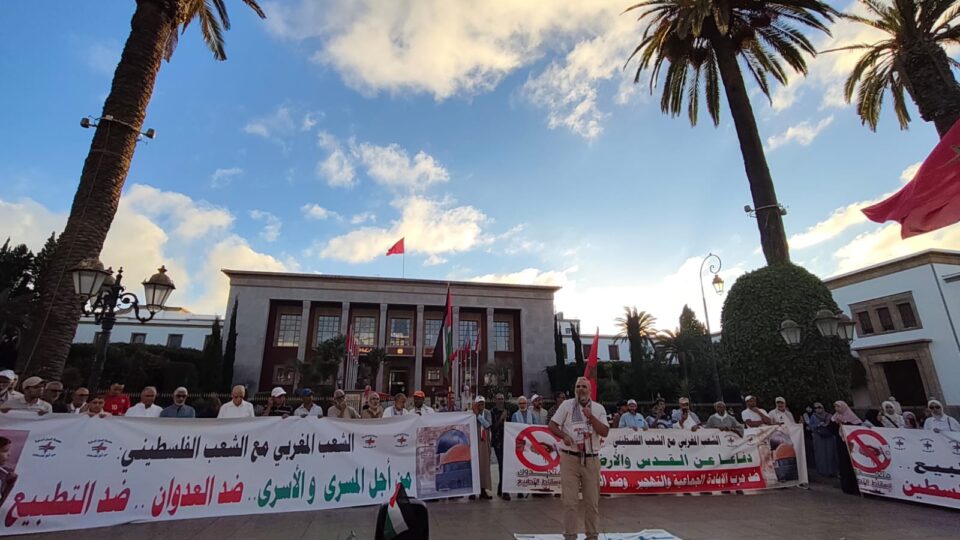
Hanawi told Al-Estiklal that the Moroccan people have taken to the streets in large numbers, using various forms of protest and across cities and public squares, for years, to reject normalization. Nevertheless, the Zionist Liaison Office in Rabat continues to operate, and a new headquarters, larger than its predecessor, has now been opened.
He said the opening represents “a pathetic step rejected by the Moroccan people and one that cannot be allowed to pass.”
Hanawi also addressed the position of the Israeli flag inside the headquarters, saying that the office “was unable to raise the Israeli Zionist flag high above the building’s corner or flagpole, but instead placed it low.”
He stressed that this carries symbolic significance, saying that lowering the flag of the so-called Zionist Liaison Office signifies that it is an office whose status has been stolen and smuggled into the Moroccan public sphere, and that Moroccans will absolutely not accept it.
Hanawi reiterated that what are referred to as the “peace principles” on which the normalization process was based no longer exist. These included “the two-state solution, East Jerusalem, the right of return, and so on.”
He argued that the Israeli occupation has worked to dismantle these principles through its policies and official positions, as well as through the genocidal war it is waging in the Gaza Strip, its policy of displacement and killing in the West Bank, its destruction of Al-Aqsa Mosque, and the temporal and spatial division of the holy mosque.
The Wrong Path
Abdelhafid Sriti, coordinator of the National Action Group for Palestine, expressed his absolute rejection of the opening of the Israeli Liaison Office in Rabat, saying that the priority under the current circumstances should be to sever relations with “Israel”, rather than reactivate channels of normalization.
Sriti told Al-Estiklal, “What is required of Moroccan officials, amid the genocidal war being waged by the criminal Zionist army, is to completely sever relations, not reopen a new liaison office for these people.”
He affirmed that the group’s position on normalization is “firm, principled, and ongoing,” consisting of a demand for Morocco to immediately halt normalization and sever all forms of relations with “these criminals.”
He argued that the continuation of “Israel’s” war against the Palestinians makes reopening the liaison office a step in the wrong direction, stressing that what is required is to take practical measures against the Israeli occupation, rather than strengthen relations with it.
Sriti cited positions adopted by European countries toward “Israel”, saying that a number of them have begun imposing many obstacles and restrictions on it, based on their commitment to what they drafted and signed within the framework of the “Rome Statute.”
In this context, he pointed out that Israeli Prime Minister Benjamin Netanyahu and former Defense Minister Yoav Gallant are officially wanted by the International Criminal Court, saying that these developments require a reassessment of the nature of relations with “Israel”.
Sriti also highlighted Spain’s position, saying, “We have seen how it has refrained from allowing ships loaded with live ammunition and munitions used to kill children and women in Palestine to pass through.”
He called for attention to “the positive images and positions coming from Europe and from other countries,” saying that “what is required today is to put an end to this enemy’s continued excesses by severing relations and imposing strict sanctions on it across all forms of dealings.”
Illegitimate Relations
In this context, the Moroccan Authority for the Support of the Nation’s Causes affirmed that opening the Israeli Liaison Office in Rabat is “a crime and a betrayal, a rejected step, and a provocation to the feelings of the Moroccan people.”
In a statement of condemnation issued on August 14, the authority said that the opening, which entrenches the path of normalization with the occupation, ignores the firmly established popular position in support of the Palestinian cause, which has always been regarded as a national and humanitarian cause of particular importance to Moroccans.
It warned that opening the “Israeli liaison lair in Rabat” cannot be separated from a broader political context seeking to expand the circle of normalization, at a time when Israeli crimes and violations against the Palestinian people are escalating, making continued pursuit of this path unacceptable morally, politically, and popularly.
The statement called for “putting an end to the process of normalization, reversing all of its steps and manifestations, and preventing further Zionist penetration of Moroccan society.”
It also called for a clear political and diplomatic position that supports the rights of the Palestinian people and condemns the violations and crimes committed against them.
It urged the Moroccan people, as well as all civil and political forces and organizations, to remain vigilant and engage in peaceful mobilization to confront the course of normalization and express popular rejection of all forms of Zionist penetration.
Writer and novelist Driss el Ganbouri, meanwhile, said that the reopening of the Israeli Liaison Office in Rabat, as a culmination of official normalization between Morocco and “Israel”, comes at a sensitive time, as the occupation continues its genocide and starvation of the Palestinian people.
In a post on his Facebook account on August 14, el Ganbouri stressed that the opening also comes amid the occupation’s repudiation of all international agreements and the ceasefire agreement, which the entity did not respect and whose purpose, he said, was merely to take the rifle out of the hands of the Palestinian.
The Moroccan writer noted that the security measures that accompanied the opening of the new office showed that Moroccan-Israeli relations are “abnormal relations rejected by Moroccans, but imposed on Morocco.”
He continued, saying that they are “relations that will remain outside the bounds of legitimacy as long as the Zionist entity continues its brutal crimes, which will of course not stop as long as the Palestinian is stripped of his rifle.”
Morocco had signed a tripartite agreement involving Rabat, Washington, and “Israel” on December 22, 2020. Under the agreement, Morocco obtained official recognition from the United States of its sovereignty over all of its southern territories (the Western Sahara region).
In return, the agreement announced the immediate resumption of full official contacts and diplomatic relations between Morocco and “Israel”, authorized direct flights between Morocco and “Israel” for passengers and tourists, and established joint working groups to cooperate in various fields.
Since the start of “Israel’s” war of extermination in Gaza in October 2023, various Moroccan cities have witnessed popular demonstrations and marches rejecting normalization and calling for a severing of relations with “Israel”. The city of Rabat has also witnessed numerous million-person marches calling for the same demand.
Moroccan experts and observers have warned of the risks posed by the continued Israeli penetration into the country’s institutions and vital sectors, particularly in investment, technology, water, agriculture, the economy, military manufacturing, scientific research, and other areas.