Hundreds of Thousands Remain Missing: Syria Faces the Task of Determining the Fate of the Disappeared
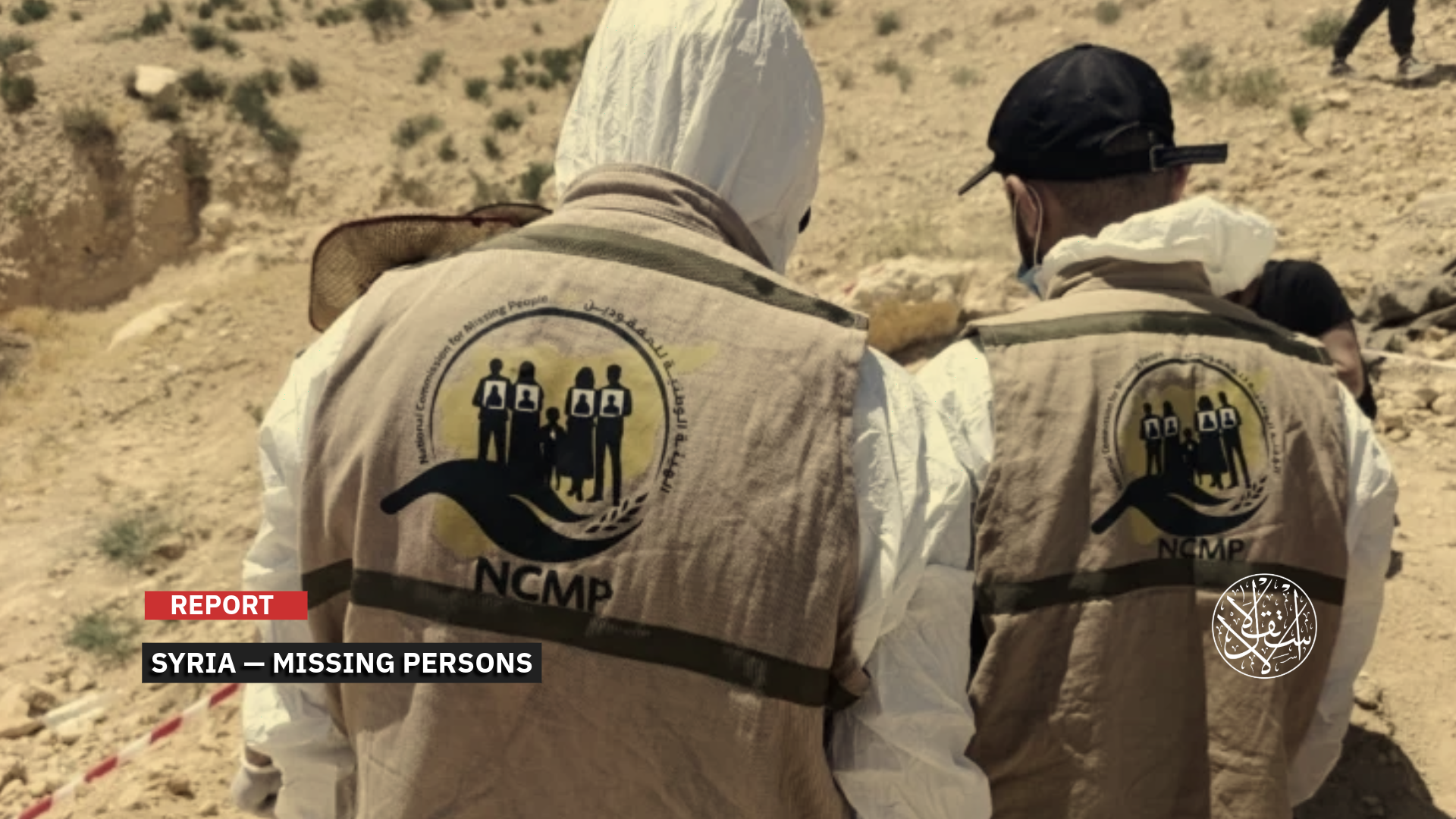
The priority at present is to locate the sites, protect them, and document them.
After years during which the fate of thousands of missing Syrians remained unknown, Syria today faces a challenge that goes beyond simply recovering remains or compiling the names of those who have disappeared.
It extends to building a comprehensive national system capable of uncovering the truth, determining the fate of the missing, and safeguarding the rights of their families.
Since the fall of Bashar al-Assad’s regime, the fate of hundreds of thousands of Syrians who were forcibly disappeared over decades of authoritarian security rule and during the years of systematic repression that followed the outbreak of the revolution has become a national and humanitarian responsibility, as well as a fundamental right of families to know the truth about what happened to their loved ones and obtain long-awaited answers.

Missing Persons in Syria
The issue of missing persons is one of the most complex and sensitive files in Syria, particularly as thousands of cases of enforced disappearance still require the collection of information and documentation concerning those who have disappeared, efforts to determine their fate, and the provision of clear answers to their families.
The issue is also closely linked to transitional justice efforts, truth-seeking, and the criminalization of enforced disappearance as a distinct crime, in addition to the need for independent and transparent investigations to uncover the circumstances surrounding cases of disappearance and establish responsibility for them.
Anwar Majni, legal adviser to Syria’s National Authority for the Forcibly Disappeared, confirmed on August 30, 2026, that the authority continues to search for the fate of missing persons, uncover the truth, and determine the circumstances of their disappearance, including in cases where their families have information indicating that they have died.
In an interview with the official Syrian news channel al-Ikhbariah, Majni explained that the authority considers a missing-person case to remain open unless the person’s fate has been established. He noted that its duty continues to involve searching, determining the person’s fate, recovering their remains in cases of death, and returning them to their family.
Majni noted that civil society organizations have played a role in documenting cases of disappearance over the past years, most notably the Syrian Network for Human Rights.
He explained that the registration of missing-person cases is now exclusively handled by the National Authority for Missing Persons, as the official national body responsible for the issue.
He said the authority will draw on the work of organizations and the data they have documented over the past years, coordinating with them to enter this information into the system launched by the authority, follow up on cases with families, and verify information related to the disappearances.
Majni pointed out that the authority has not yet begun opening mass graves, explaining that doing so requires preparing personnel, forensic experts, facilities for storing human remains, and DNA analysis laboratories.
He revealed that the authority has so far responded to 194 reports of potential mass graves. Teams affiliated with the authority, in cooperation with other bodies, particularly the Ministry of Interior, are responsible for examining remains discovered during excavation or construction work and taking steps to protect the sites.
He added that, in parallel, the authority has established a map of mass graves, although it remains incomplete, and has made it possible to report mass graves through its platform, with the aim of developing the map and protecting sites from tampering or destruction, in preparation for opening them once the necessary preparations are complete.
According to the latest update by the Syrian Network for Human Rights, issued on August 30, 2026, at least 177,021 people remain forcibly disappeared since March 2011, including 4,536 children and 8,984 women.
This figure is limited to cases of enforced disappearance and does not include all categories of missing persons in Syria.
However, moving from documenting cases to systematic efforts to determine the fate of the disappeared represents a right of both victims and their families to know the truth about what happened to those who disappeared, their fate, and where they are.
This is particularly important given that tens of thousands of Syrian families have been unable for more than 14 years to learn the fate of their relatives, hold burial ceremonies for them, obtain reliable death certificates, or settle inheritance cases and other legal matters related to them.
The concept of a victim includes the disappeared person, their relatives, and anyone who has suffered direct harm as a result of the disappearance.
United Nations General Assembly Resolution 60/147 of 2005 also recognizes five forms of reparation: restitution, compensation, rehabilitation, satisfaction, and guarantees of non-repetition.

A National Process
Within this context, Fadel Abdulghany, director of the Syrian Network for Human Rights, stressed that the main problem today is not Syria’s lack of capacity to address the issue of missing persons, but rather the significant mismatch between the scale of the issue and the specialized national capacity available to address it scientifically and on a large scale.
Abdulghany added that “there is some expertise, institutions, and facilities in Syria that exist in a partial form, but the available data do not yet allow us to describe them as a fully integrated national human identification system.”
“We are facing a long-term national process, not limited operations to recover remains that can be handled using the conventional capabilities currently available in forensic medicine,” he said.
Abdulghany believes that strengthening the capacity of the National Authority for Missing Persons requires seven interconnected priorities.
He explained that the first priority is to “conduct a comprehensive national assessment of forensic and medico-legal capabilities.”
“Before expanding remains-recovery operations, the authority should have an accurate picture of the number of forensic doctors, forensic anthropology and archaeology experts, genetics and DNA specialists, morgue technicians, as well as laboratory capabilities and the actual capacity of remains repositories in each governorate,” he said.
“What is needed here is not simply a count of personnel and buildings, but an assessment of actual operational capacity: how many cases can be examined, preserved, and analyzed each year? And where are the main bottlenecks?” he continued.
He noted, “This step will enable us to determine the available capabilities so that we can actually build upon them. The International Committee of the Red Cross has supported the identification center in Damascus and the forensic medicine center in Deir ez-Zor, while technical support for forensic medicine centers continued throughout 2026. However, the existence of these facilities does not, in itself, mean that there is a unified national network capable of handling the expected volume of human remains.”
Second, according to Abdul Ghany, Syria must “build a national human identification system and avoid reducing the issue to a DNA laboratory, particularly because there is a widespread misconception that places excessive emphasis on DNA.”
He explained that “DNA is an extremely important tool, but it cannot replace forensic medicine, anthropology, forensic archaeology, and ante-mortem data.”
“Investigations into unlawful deaths require reliable identification based on comparing ante-mortem data with post-mortem data. This includes physical characteristics, medical and dental records, injuries and surgical procedures, personal belongings, fingerprints, information about the location where the body was found, in addition to DNA,” he continued.
Therefore, “the goal should be to establish an integrated identification system in which the DNA laboratory is one component, rather than reducing the entire system to it,” according to Abdulghany.
Abdulghany also stressed the need to “establish a national infrastructure for the preservation and examination of human remains.” He explained that “a large-scale remains-recovery program should not begin in the absence of sufficient capacity to receive, preserve, and examine the remains in a manner that prevents commingling, deterioration, or the loss of evidence associated with them.”
“What is needed, in my view, is the establishment of a national reference center for human identification and a high-quality genetic laboratory, alongside qualified regional centers capable of receiving and preserving remains, conducting their initial examination, and linking their findings to the national system,” he added.
He also emphasized the need to “prioritize building a multidisciplinary Syrian workforce,” explaining that “equipment can be purchased within a limited period, but specialized expertise cannot be developed at the same speed.”
He said Syria needs “forensic doctors, experts in forensic anthropology and archaeology, forensic genetics specialists, and specialists in the management of burial and remains sites and data.”
He added, “For this reason, work should proceed along two parallel tracks: bringing in international teams and experts to work alongside Syrian personnel in the short term, while simultaneously establishing Syrian training and university and professional specialization programs capable of building sustainable capacity over the coming years.”
He stressed that “the model of international cooperation should be based on transferring knowledge and building the national institution, rather than perpetuating a permanent dependence on foreign expertise.”

Practical Mechanisms
The National Authority for the Forcibly Disappeared continues to provide practical mechanisms that give families a starting point in their search for their missing loved ones.
To this end, on August 30, 2026, on the occasion of the International Day of the Victims of Enforced Disappearances, the National Authority for the Forcibly Disappeared launched the national “Athar” program for reporting missing and forcibly disappeared persons in the Syrian Arab Republic.
The authority said in a press statement at the time that the launch of the program was part of its national efforts to determine the fate of all missing and forcibly disappeared persons in Syria.
It explained that the program provides families with an easy and secure means of reporting their missing relatives and registering information about them, either through the “Athar” mobile application or via the authority’s website.
The authority designated technical-support numbers for different governorates and regions to facilitate the registration process, with the aim of answering families’ inquiries, helping them create accounts, and assisting them in completing their reports.
Here, Abdulghany stresses the need to “establish an integrated national system for ante-mortem and post-mortem data,” describing this as “one of the most important priorities.”
“The launch of the Athar program is an important step because it lays the groundwork for building a unified national registry of missing persons,” he said. “However, the true value of this registry will emerge when it becomes capable of linking the information provided by families about a person before their disappearance with information obtained from prisons, civil registries, hospitals, cemeteries, human remains, and forensic examinations.”
He also stressed the need to “adopt a phased policy for mass graves based on protection and assessment before excavation.”
Abdulghany believes that “the priority at the current stage is to identify sites, protect them from tampering, construction, or looting, document them, assess the risks threatening each site, and then prioritize excavation operations according to those priorities and the technical capacity available.”
“This does not mean suspending all excavation operations. There may be urgent cases in which remains are at risk of deterioration, removal, or tampering, requiring immediate intervention,” he added.
“However, the systematic expansion of grave excavations must be linked to the availability of an integrated chain of procedures that begins with scene management, proceeds through the recovery, preservation, examination, and identification of remains, and ends with their return to the family,” he explained.
He noted that this “is consistent with the requirements of the Minnesota Protocol regarding the use of specialized archaeological methods to recover buried remains and preserve their evidentiary context.”
Abdulghany also highlighted the importance of “combining the humanitarian and judicial functions without conflating them,” explaining that “the primary objective is to determine the fate of the missing person, enable their family to know the truth, and recover their remains if their death is established. However, mass graves and human remains may also constitute evidence of killings, torture, enforced disappearance, and international crimes.”
Therefore, according to Abdulghany, “documentation, recovery, and preservation procedures must safeguard the evidentiary value of the remains and the site, as well as maintain the chain of custody, so that this evidence can be used in court in the future.”
“At the same time, a family’s access to the truth should not be conditional on criminal prosecution in every case. Humanitarian search efforts and criminal investigations are complementary tracks, but they are not identical,” he continued.
Abdulghany went on to say, “The approach I believe is appropriate at this stage is that the priority should not be to open the largest possible number of graves, but rather to build the capacity that ensures that opening a grave actually leads to determining the person’s fate.”
Accordingly, the proper sequence can be summarized in four rules:
No large-scale recovery of human remains without sufficient capacity to preserve and examine them.
No identification without integrating ante-mortem and post-mortem data.
No reliance on DNA without a national reference database and a reliable system for matching and protecting data.
And no final notification to a family of a person’s identity except on the basis of a scientifically reliable degree of certainty.