How the AfD’s Landslide Victory in the Saxony-Anhalt Elections Sparked Concern Across Europe
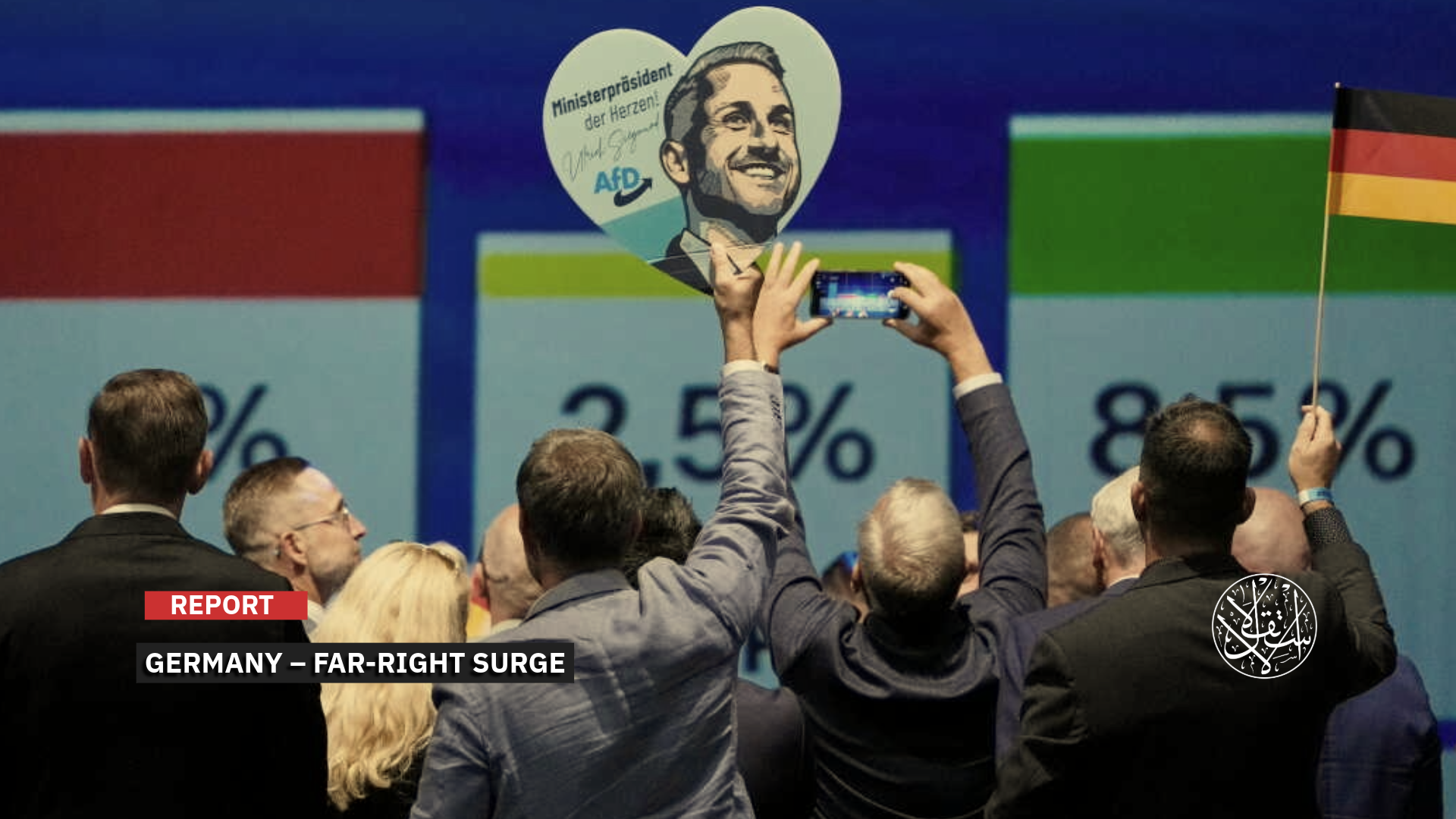
“Alarm across Europe after the far right’s historic German victory.”
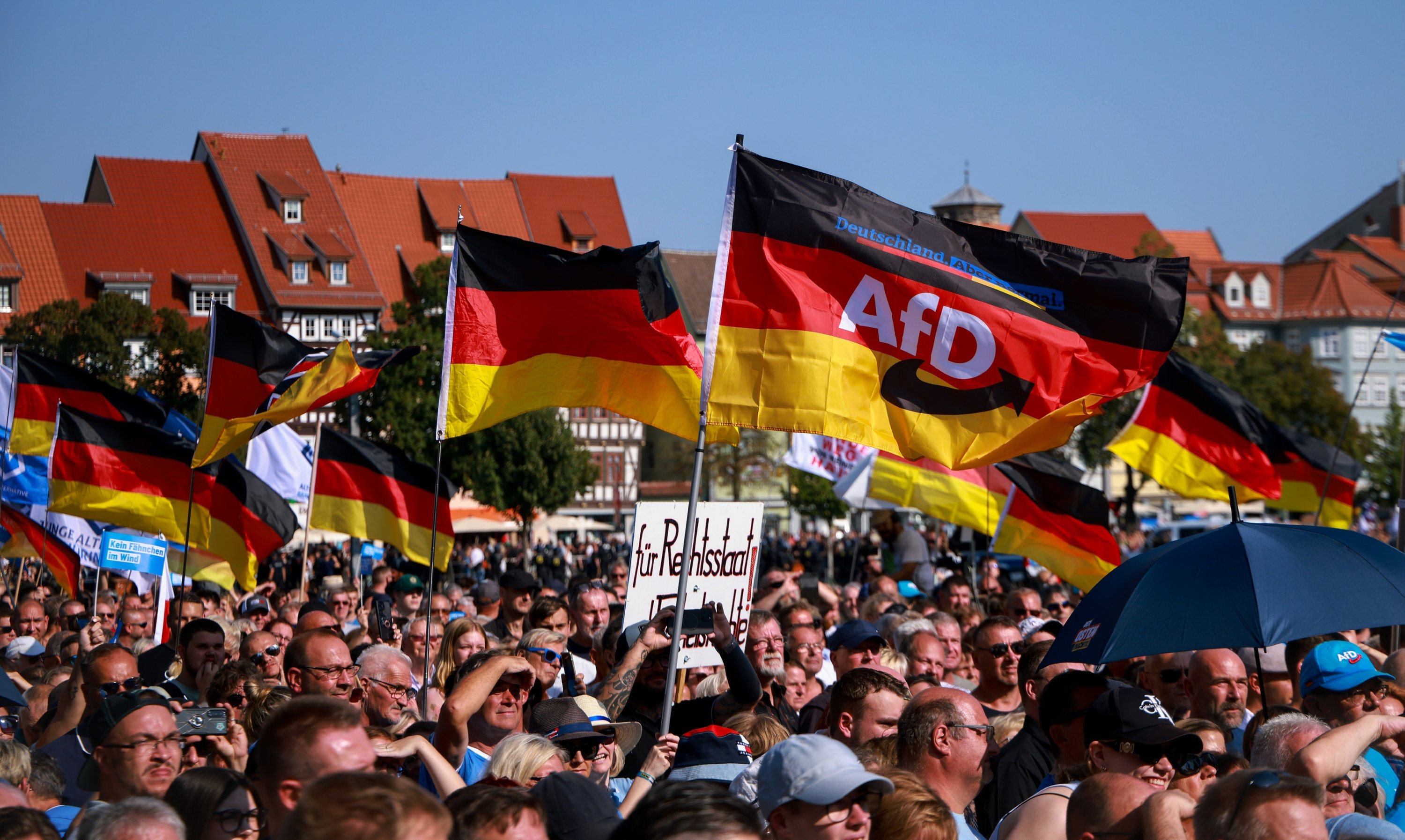
The elections in the state of Saxony-Anhalt (in the country's east) have thrust the Alternative for Germany (AfD) party back to the forefront of the European political landscape, as the far-right party achieved its best-ever result in a state-level election since its inception.
This result carries significance far beyond the state's borders, coming as Europe prepares for a series of crucial elections next year; presidential elections are approaching in France, while Italy and Spain are gearing up for legislative elections.
An analysis published by The New York Times warned that the AfD's win could pave the way for further gains by the far-right across Europe. This comes at a time when right-wing populist and hardline parties are surging in opinion polls, driven by growing public discontent over immigration, the rising cost of living, and sluggish economic performance.
For the first time since the Nazi era, a German state is on the verge of being led by a far-right figure; local leader Ulrich Siegmund could assume the role of state premier if the hard-left BSW party decides to support him or abstain during the vote.
German politician Friedrich Merz expressed deep shock following his party's defeat in the September 6, 2026, vote, stating: "This is the most severe electoral defeat the Christian Democratic Union (CDU) has suffered in 28 years. Naturally, there will be repercussions."

Far-Right Victory
Far-right winds have swept across Europe once again, originating in Germany, where the Alternative for Germany (AfD) party achieved a resounding victory in the state elections of Saxony-Anhalt. This places the party in a strong position to lead a state government for the first time since 1945.
The anti-immigration, pro-Russia party secured 44% of the vote. Meanwhile, the Christian Democratic Union (CDU)—led by Friedrich Merz and heading the ruling coalition in Berlin—collapsed to 17.2%, while the Social Democratic Party (SPD), the coalition's junior partner, garnered only 9.3%.
Despite the far-right party's major victory, its path to power will not be easy, as all other parties have pledged not to form an alliance with it.
However, a hint from a new, small far-left party—the "Wagenknecht Party"—that it would not block the AfD’s path to power could prove crucial for the far-right party as it seeks to lead the state.
The state parliament must now convene within 30 days of the election to vote on the state's head of government. Ulrich Siegmund, the rising star of the AfD who led it to this victory, stated that he would reach out to all parties to propose a governing coalition, despite Alternative for Germany knowing in advance that the response would be negative.
Conversely, the other parties could collectively form a government, though this would be difficult given the refusal of the Christian Democratic Union (CDU)—led by Friedrich Merz—to ally with the far-left Die Linke party.
Furthermore, such an alliance could trigger internal party rebellion and significant divisions.
Many within Merz’s party objected to the idea of a party leading the government when it secured no more than 17 percent of the vote.
As for the 35-year-old Ulrich Siegmund —who delivered the AfD’s biggest victory to date—he insists he will not lead a minority government.
He maintains that he wants to lead a stable, majority-backed government, even if that requires holding fresh elections.
Under the law, parliament must vote to elect a head of government; a candidate requires a majority in the first and second rounds, but in the third round, the candidate with the most votes wins.
If the Sahra Wagenknecht Alliance (BSW) abstains from voting—as its leader has indicated—Siegmund could win the premiership and form a minority government.
However, governing would be challenging, as he would need to secure a majority to pass any legislation.
The far-right party’s agenda aligns with that of the populist BSW in many areas, such as immigration policy and support for restoring relations with Russia. However, it remains unclear to what extent the AfD’s more extreme policies—such as segregating foreign and immigrant-background students from German students into special classes—enjoy public support.
The party’s platform includes hardline pledges regarding asylum policies and the facilitation of deportations, while human rights organizations fear this rhetoric could fuel a rise in racism and street-level attacks against foreigners.
Although foreigners make up less than eight percent of the state's population, immigration has emerged as a pivotal election issue.
European Agenda
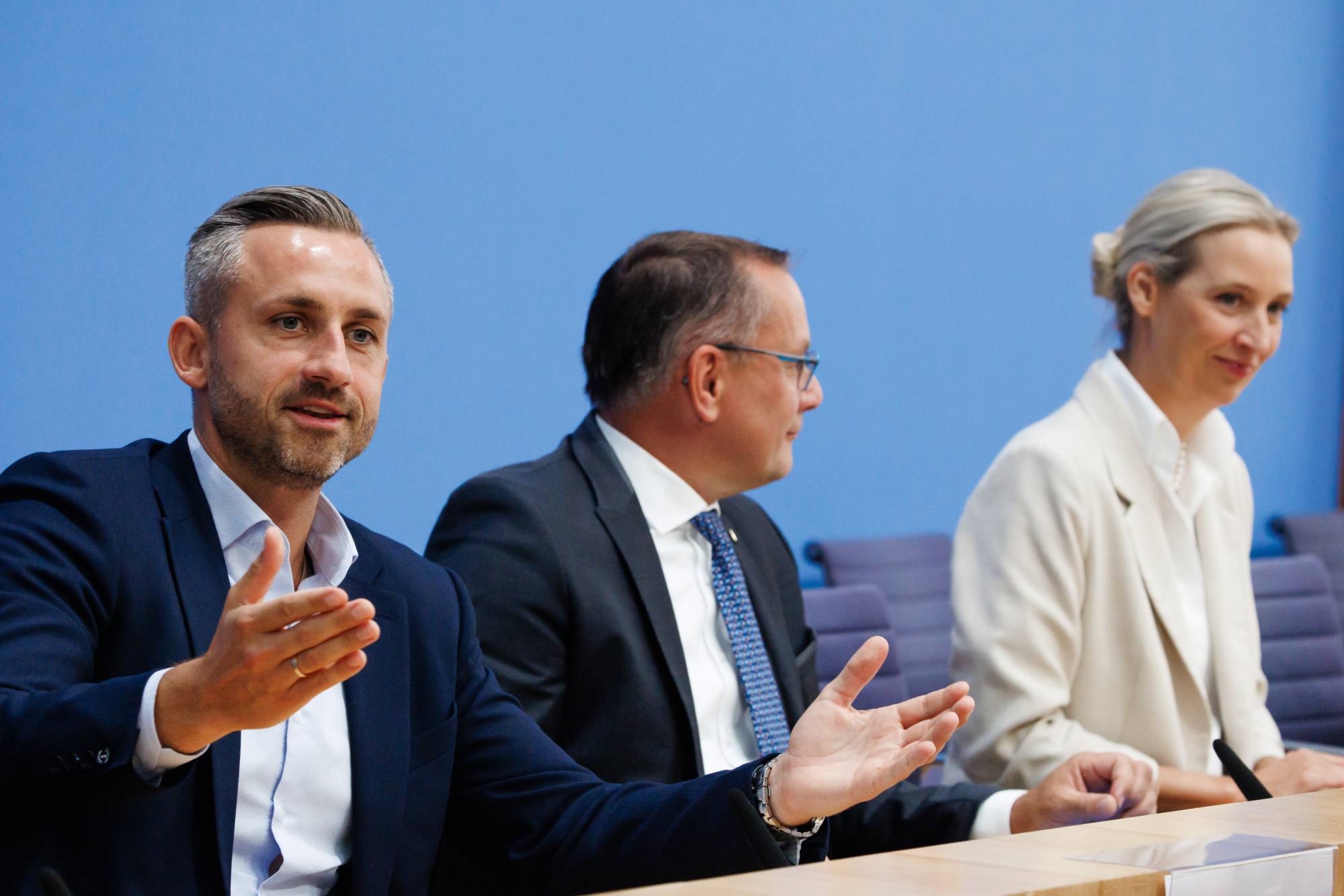
The landslide victory achieved by the AfD has resonated beyond Germany’s borders, sparking mixed reactions across European capitals—particularly as major EU nations prepare for crucial elections next year.
For his part, the Spanish Prime Minister viewed the far-right victory in Saxony-Anhalt as a defeat for the traditional right, warning against the spread of extremism across Europe and the globe.
Meanwhile, French Finance Minister Roland Lescure described the event as a deeply worrying signal, noting that it reflects a rising wave of populism worldwide.
Italy’s foreign minister, Antonio Tajani, described the election result as “terrible news … because it concerns a political force that is antithetical to liberal and western values”.
Poland’s prime minister, Donald Tusk, said: “Only idiots or traitors can rejoice at the triumph of the AfD in Germany.”
Far-right leaders in Spain and Portugal also hailed the AfD’s win. Santiago Abascal, of the Spanish Vox party, called it a “spectacular result that represents great hope for Germany and Europe”, while André Ventura, of the Chega party in Portugal, praised a “historic victory”.
Observers believe the repercussions of this victory will quickly spread to Europe’s neighborhood, bolstering the standing of far-right parties currently on the rise in France, Britain, Austria, Sweden, and Hungary.
In this context, René Aust, head of the AfD delegation in the European Parliament, stated: "This result is not an anomaly; rather, it is a signal to the rest of Germany and to Europe as a whole."
He added: "We are on track to become the strongest party in the country, and I am certain we will double our number of seats in the European Parliament after the next elections."
Conversely, Andreas Schwab (Germany/European People's Party) sought to downplay the defeat, noting that Saxony-Anhalt is merely one of Germany's 16 federal states and that the AfD holds no real influence in Berlin, where the governing coalition enjoys a comfortable majority.
He argued that the impact of these elections on Brussels would be limited to pushing an agenda of simplifying European procedures, reducing bureaucracy, and focusing the European budget on national priorities.
Svenja Hahn (Germany/Renew Europe) concurred, stating: "We will only be able to maintain a democratic majority in 2029 by achieving economic growth and prosperity, and by easing the regulatory burden on citizens and businesses."
However, many observers view this result as sounding an alarm across Europe—not only due to its implications for the German political landscape, but because the "Grand Coalition" model, which endured for decades and served as the backbone of European political consensus, is beginning to falter.
Since the inception of the European Parliament, the alliance between the European People's Party (center-right) and the Socialists and Democrats group (center-left)—sometimes supported by Renew Europe (centrist)—has formed the cornerstone of decision-making in Brussels.
In August 2026, the "Europe Elects" organization projected that, for the first time, these three centrist forces would fail to secure an absolute majority if European Parliament elections were held today.
Within the European Parliament, Manfred Weber, leader of the European People's Party, has adopted a flexible approach to forming majorities, occasionally relying on votes from the far-right on specific issues.
While this strategy has strengthened his negotiating position, shifting from ad-hoc agreements to a permanent alliance would mean redrawing the EU's power dynamics.
Thus far, Weber insists on ruling out any organized cooperation with the far-right, despite the desire of some parties within his bloc to do so.
Tough Test
The rise of the right is not limited to Germany; France, Italy, Poland, Spain, Estonia, Greece, Finland, Malta, and Slovenia are all set to hold crucial national elections in 2027.
In France, the far-right National Rally, led by Marine Le Pen, is leading in opinion polls, while the ruling political center faces a difficult test as the presidential election approaches.
These elections will reshape the European political landscape ahead of the 2029 European Parliament elections—which could be the first to deny traditional parties a governing majority. In Spain, the right-wing Vox party stands a strong chance of joining the next government following its alliance with the People's Party to govern several regions—a model some seek to replicate in Brussels.
In Italy, Giorgia Meloni steered her coalition toward the center, making her European bloc (ECR) more palatable; however, it now faces competition from a new right-wing force led by former General Roberto Vannacci.
Yet, a common thread among many of these parties is hostility toward immigration and fierce nationalist rhetoric—precisely what alarms the European Union.
Brussels maintains that Europe requires a united front on various issues, ranging from countering pressure exerted by Donald Trump to protecting European companies from markets being flooded with Chinese goods.
Security officials argue that European nations must remain cohesive to halt Russia in Ukraine; failure to do so could embolden the Kremlin to push further, potentially targeting NATO members such as the Baltic states.
Observers believe that the AfD's rise may increase pressure on Europe's traditional political establishment, though it does not necessarily signal an immediate shift in the balance of power across the continent.
The rise of the far right is not inevitable; other elections have demonstrated that such parties can lose ground when they fail to govern effectively or are plagued by internal crises.
In Hungary, the Fidesz party—led by Prime Minister Viktor Orban—lost power after 16 years, amidst criticism regarding corruption, economic performance, and relations with the European Union.
In Britain, the rise of the Reform Party has faced setbacks due to financial woes, ideological rifts, and internal crises—most recently concerning potential foreign funding for the party.