How Trump Launched a New Approach to US Policy Toward Africa
“Trump has cut USAID funding to most African countries, resulting in the termination of 5,341 foreign aid projects.”
“Everything under President Donald Trump is subject to review and evaluation,” said US Secretary of State Marco Rubio two months ago, indicating that Washington may review its political, economic, and military relations with everyone, including Africa.
The Trump administration is currently adopting a different approach to the African continent. This approach differs not only from the strategy adopted by the previous Democratic administration led by Joe Biden, but also from the vision Trump himself sought to implement in his first term.
Trump's slogan (trade, not aid) is gradually taking shape on the African continent. After beginning his second term in the White House with increased tariffs and an immediate cut in development aid, the US president is promoting transactional diplomacy focused on African resources.
Earlier this year, Trump announced the cutting of U.S. Agency for International Development (USAID) funding in most African countries, resulting in the termination of 5,341 foreign aid projects.
Meanwhile, top of mind for African leaders is whether Congress will reauthorize the African Growth and Opportunity Act (AGOA), the duty-free trade agreement for sub-Saharan African countries that is set to expire September 30.
Geopolitical Role
US President Donald Trump's neglect of Africa during his first term contributed to the expansion of the influence of US competitors in Africa, particularly China and Russia.
Trump did not visit Africa during his first years in office and spoke negatively of Africa, describing it as a burden on the US economy and military.
Therefore, Trump withdrew US forces from Somalia and other bases in Africa in 2018.
However, during Biden's presidency, Africa posed significant challenges for Washington, represented by the emergence of a strong geopolitical role for the African continent, especially following the Russian invasion of Ukraine.
The majority of African countries had refused to vote in favor of US draft resolutions in the UN Security Council and General Assembly.
Despite US threats and intimidation, African leaders participated with the Russian President at a Russia-Africa summit in July 2023, attended by 49 delegations from a total of 52 African countries.
Most African countries, such as Mali, Burkina Faso, and Niger, expelled French forces, replacing them with strong military ties with Russian forces.
Niger also refused to extend the presence of US forces. The last US soldier left Niamey on September 17, 2024.
Subsequently, numerous demonstrations erupted in Niamey praising Russian President Vladimir Putin, not to mention the construction of numerous Russian military bases across Africa.
For years, Russia has relied on the port of Conakry in Guinea to transport its military equipment.
However, it has recently turned its attention to Togo to compensate for its weak logistics lines and use it as a platform to project its naval power in the Atlantic, in direct challenge to the United States and NATO.
On July 22, Russia and Togo ratified a military cooperation agreement, including arms exchanges, training, and joint exercises.
As for China, it maintained its position as Africa's largest trading partner for 16 consecutive years by the end of 2024, at the expense of the U.S. and the EU.
According to the Brookings Institution, as of 2023, China was the largest trading partner for 52 of the 54 African countries, compared to just 18 in 2003.
Trade between Africa and China reached approximately $296 billion, benefiting from its non-interference in the internal affairs of African countries and its focus on trade and investment. China is also the largest investor in Africa.
In a report published on July 14, Democrats on the Senate Foreign Relations Committee warned of the decline of American soft power under Trump, favoring China.
They lamented the decline of the U.S. in all areas of engagement in Africa, from diplomacy to economic development, including health and humanitarian aid.
It's worth noting that China has launched an extensive military training program in Africa, emulating the American model, while Russian mercenaries are increasingly present in North, West, and Central Africa as key security partners.
Trump's Strategy
Despite all these challenges, the U.S. has historic opportunities to make political, economic, and military gains in Africa.
Trump's success in concluding a peace agreement between Rwanda and the Democratic Republic of Congo on June 27 gave American companies preferential access to mineral resources vital to the technology industries, which are abundant in Congo.
Days before the signing, Massad Boulos was the most senior U.S. official at the U.S. Africa Business Summit in Angola, touting $2.5 billion in deals and commitments signed at the conference.
The spread of terrorism has created a need for American intelligence and information support for African militaries after ISIS and al-Qaeda overran large swaths of West Africa and the Sahel.
Washington’s influence in the G20 and G7 also allows it to maintain its position in the competition with China and Russia over the heart of Africa, where countries have achieved high levels of economic growth, becoming known as the African Tigers.
Trump's new Africa strategy is based on a series of paths, most notably reducing military commitments in Africa.
Trump opposes extensive US participation in peacekeeping forces in Africa and the construction of large military bases in the African desert, as was the case in the past.
He also adopts a vision based on burden sharing through training and empowering local forces and armies in African countries friendly to Washington.
The White House believes this is the best model for building sustainable military relations while avoiding imposing military and financial burdens and costs on American taxpayers.
As part of burden-sharing, the US administration has begun evaluating the performance of US Africa Command (AFRICOM), according to a statement by US Africa Command Commander General Michael Langley last May.
This US shift comes amid the refusal of several African countries to work with AFRICOM, such as Niger, which expelled AFRICOM from two bases that housed drone bases used in counterterrorism operations.
Therefore, the Pentagon is considering merging AFRICOM with US European Command (EUCOM) to reduce costs, despite the objections of Gen. Langley and several members of the Senate Armed Services Committee.
From the US perspective, burden-sharing is achieved by African governments allocating more funds to train their national armies and purchase US weapons, while Washington helps build African intelligence capabilities.
On the other hand, the Trump administration is not inclined to conclude multilateral deals in Africa, seeking only direct bilateral agreements or narrowly focused multilateral ones.
In addition, the new US strategy toward African countries is based on a complete departure from political conditionality, which was based on cooperation only with countries that implement Western-style democracy.
Republican US policymakers argue that Washington's political, not commercial, conditions have pushed African countries into the arms of China and Russia.

Negotiating Pressure
Under Joe Biden, the U.S. pledged significant economic support to Africa, amounting to approximately $5.5 billion.
Washington has also invested billions of dollars in African infrastructure projects, such as the Lobito Corridor, which connects East and West Africa via railways.
However, what Trump recently proposed to African countries is that Washington obtain rare earth minerals in exchange for American information, intelligence, and military support for Africans, as well as economic deals.
Through this strategy, the U.S. achieves two goals: the first is to weaken Russian and Chinese influence, and the second is to achieve gains for the American economy in light of Africa's vast resources.
Africa produces approximately 70% of the world's cobalt, 60% of its manganese, and 90% of the platinum used in precision industries.
Through these economic resources, Africa is no longer merely a development arena; it has become a strategic pivot in the global economic security equation.
Securing a portion of Washington's rare earth needs will reduce the negotiating pressure Beijing exerts on Washington in trade negotiations.
Therefore, the new American vision is based on trade deals rather than the previous pattern of aid.
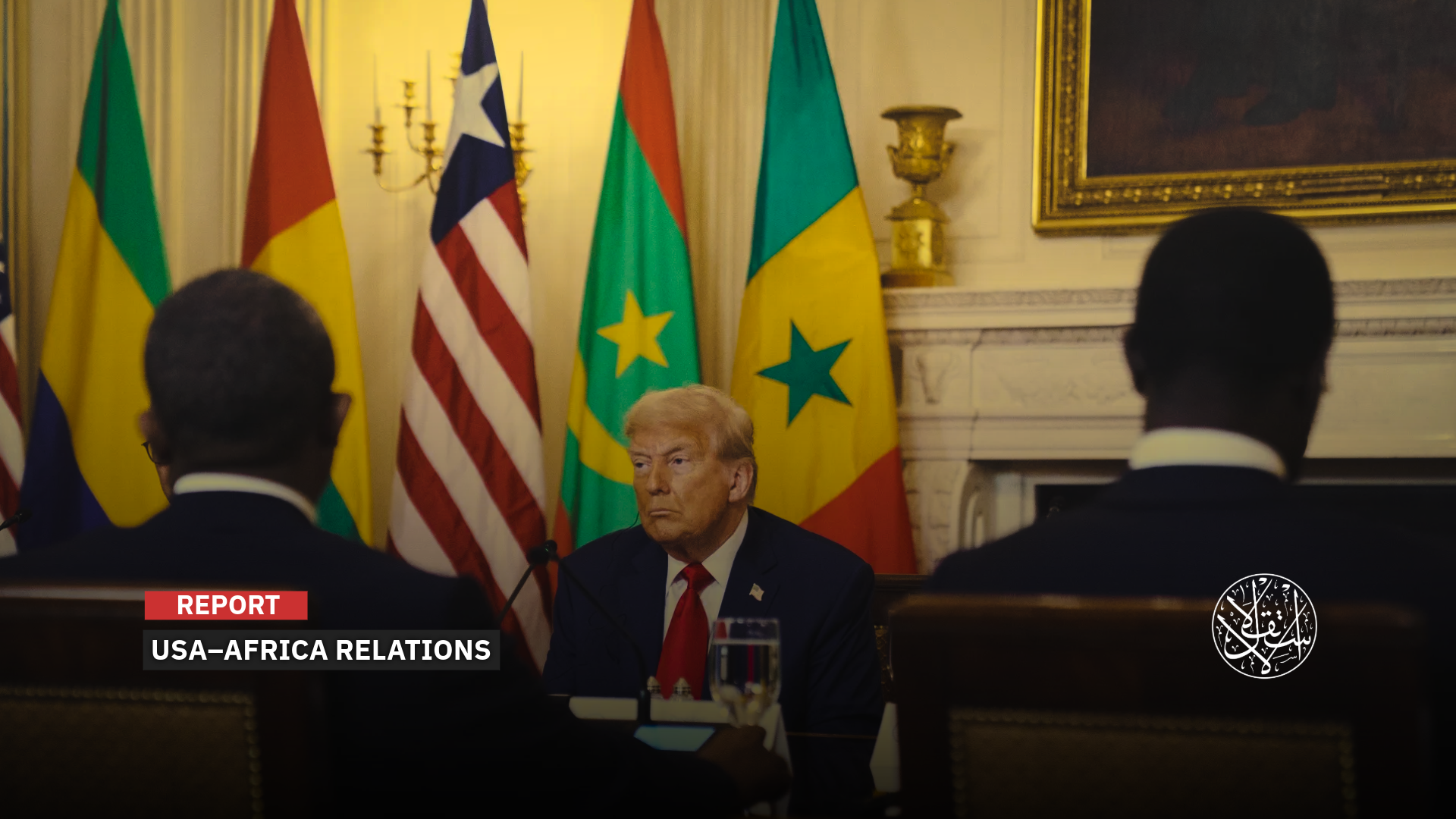
Despite the agreement to hold the US-Africa Summit next September in New York City, the White House, in an urgent move, convened an emergency summit between July 9 and 11 bringing together five West African countries: Mauritania, Senegal, Guinea-Bissau, Gabon, and Liberia.
These five countries are described as regions rich in both opportunities and challenges.
At a time when terrorist groups are on the rise in the countries of West Africa's Sahel, these five countries share two key characteristics: vast mineral reserves and advanced Atlantic port infrastructure.
These five countries also form a coastal belt that provides the raw materials and logistical access necessary for large-scale investment.
Establishing a foothold in the West African Sahel will not only provide the United States with a gateway to broader continental influence, but will also create an Atlantic space stretching from Morocco to Angola.
There is no doubt that Trump's rhetoric and new approach have been well-received by Africans.
The five African leaders attending the Washington summit expressed their interest in a balanced partnership with the U.S., focused on investing in their economies, particularly in raw material processing and infrastructure projects.

Between diplomatic mediation and targeted investments, the US administration continues to strengthen its influence on the African continent, setting its sights beyond basic minerals.
A report published by the French magazine Jeune Afrique stated that Trump's sights are now set on African oil.
Days after Trump's special advisor for Africa, Massad Boulos, toured North Africa at the end of July, the US oil giant ExxonMobil signed an oil exploration contract in Libya.
In Côte d'Ivoire, the United States also committed to investing $5.1 billion in the energy sector.
Various agreements were signed last May with American companies, including one to build a new 170,000-barrel-per-day oil refinery to boost the capacity of the Societe de Refineries Ivoirien (SIR).
In Nigeria, Angola, Algeria, and Namibia, American demand for African oil is growing with a series of exploration and production agreements signed in recent weeks.
Sources
- At Trump’s recent summit, the US talked trade. But West Africa wants security first [Study]
- Patronizing Attitude and Furious Backlash: How Trump Insulted the Leaders of Five African Nations
- After critical minerals, Donald Trump eyes African oil [French]
- Trump’s surprise focus on Africa wins cheers mixed with fears