Significant Shift: How the American Dream Has Changed

“For some Americans, the world outside America offers even better prospects.”
In its 250th year, the United States faces a reality unlike anything it has known before.
“The fact is, the American dream is dead—but if I win, I will bring it back bigger and better and stronger than ever before,” Donald Trump declared as he announced his bid for President.
Nevertheless, the anti-immigrant rhetoric that formed the basis of Donald Trump’s 2016 and 2024 presidential campaigns, and which reached its peak today with the start of mass deportations, sent a clear message: “The American dream is no longer open to everyone.”
But what is striking is not only the tightening of immigration laws and the deportation of undocumented immigrants, but also the increasing number of Americans themselves who are choosing to leave their country and live abroad.
Some believe this is merely a passing trend, but what is happening, according to observers, is the drawing of new boundaries for the American dream, making its realization more difficult, and perhaps impossible, for certain segments of the population.
Changing Reality
For over a century, the United States was the top destination for immigrants worldwide, earning the moniker ‘the land of opportunity and dreams’, attracting millions seeking a better life. However, this landscape has recently begun to shift dramatically.
In 2025, the United States recorded negative net migration for the first time since the Great Depression of the 1930s, with emigration exceeding immigration.
This indicator reflects a profound shift in how Americans themselves view their future within their own country, according to a report published by The Wall Street Journal.
The Brookings Institution estimates that the United States lost approximately 150,000 more people than it gained in 2025.
Meanwhile, the number of immigrants declined to between 2.6 and 2.7 million, compared to roughly 6 million in 2023.
According to data from more than 50 countries, at least 180,000 Americans moved to 15 countries for which data is available in a single year, with the number expected to rise as more statistics become available.
There is no definitive figure for the number of Americans living abroad, but estimates suggest it ranges between 4 and 9 million. Nearly half of them reside in Europe, with approximately 1.6 million Americans living in Mexico, over 325,000 in the United Kingdom, and more than 250,000 in Canada.
Requests to renounce US citizenship surged by 48% in 2024, while Americans also set record highs for British and Irish citizenship applications, with nearly 40,000 Americans acquiring Irish citizenship in a single year.
Europe has emerged as the top destination for American immigrants, driven by a multitude of economic and social factors.
In Portugal, the number of American residents has increased by more than 500% since the COVID-19 pandemic.
In Spain and the Netherlands, the number of American residents has nearly doubled in the past decade, while Ireland welcomed 10,000 Americans in 2025 alone, double the number from the previous year.
In Lisbon, English is now widely spoken in some neighborhoods, and one in 15 residents of Dublin’s Grand Canal Dock area was born in the United States.
In 2025, Germany saw more Americans immigrate there than Germans immigrated to the United States, a paradox reflecting a shift in traditional migration patterns.

Complex Reasons
The White House maintains that the US economy is strong and that current policies have helped control immigration and attract wealthy individuals to settle in the country.
However, interviews conducted by The Wall Street Journal with Americans living abroad revealed a complex set of reasons that drive them to leave their homeland, including economic, social, and political factors.
The high cost of living, especially housing and healthcare, is one of the most prominent reasons.
The cost of medical treatment in the United States is among the highest in the world, while European countries offer healthcare services at a much lower cost or within public healthcare systems.
As for retirees, their savings allow them to enjoy a much higher standard of living in countries like Portugal or Spain compared to the United States.
According to new research from Investopedia, it now costs about $5 million for a family of four to own a home, raise two kids, send them to college, and retire comfortably.
The rise of online work has also facilitated the migration of Americans. Many retain their high-paying jobs in the US while living in a less expensive country.
This model has allowed Americans to take advantage of currency differences and lower living costs, significantly improving their quality of life.
Many Americans cite the sharp political polarization as a major factor in their decision to leave, particularly after the re-election of President Donald Trump.
Some commentators have dubbed the phenomenon of Americans leaving the country the ‘Donald rush’, referring to the surge in migration during his presidency.
Researcher Caitlin Joyce said this phenomenon undermines the idea of American exceptionalism, adding that many Americans are discovering that life in Europe offers greater social and political stability.
Some Americans feel unsafe due to higher rates of crime and gun violence compared to European countries, where these phenomena are less prevalent. For families, safety is one of the most important factors in choosing where to live.
Migration isn't limited to workers; it also includes students and retirees. More than 100,000 American students are currently studying abroad, taking advantage of lower tuition costs compared to American universities.
Many retirees are also moving to countries like Mexico in search of cheaper healthcare and lower living costs.
The United States has long been the world's largest recipient of immigrants, but today it faces a different reality, with some of its citizens finding that better opportunities lie elsewhere.
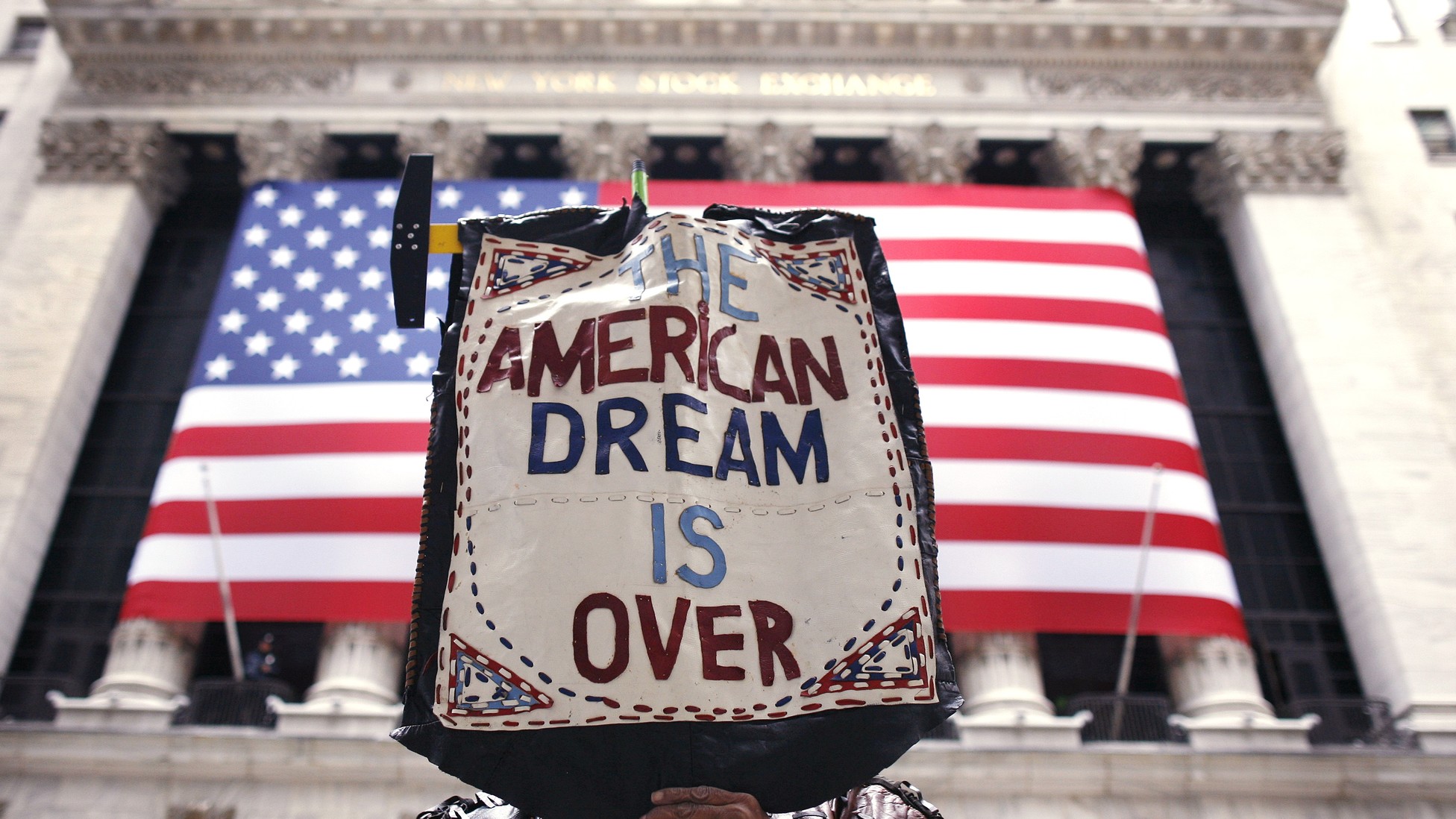
Significant Shift
In a recent Ipsos survey, nearly half of Americans said that “The American Dream isn’t attainable for someone like me.”
In response to the statement “In America, if you work hard, you will succeed no matter what,” only a little over half of Americans agreed.
Over the past few years, a number of different organizations have studied the term American Dream as a national goal.
The results of these studies indicate that during the 1990s and early 2000s, a period of great prosperity in the United States, a growing number of people acknowledged losing faith in the American Dream.
Thomas Jefferson conceived the American Dream as each citizen’s right to the pursuit of life, liberty and the pursuit of happiness.
The existence of the American Dream has not helped most racial minorities and lower-class citizens throughout history to achieve greater equality and social influence.
On the contrary, some have considered it a nightmare, especially since the structure of American wealth reinforces the idea of class divisions that favor privileged groups.
The opportunity to live the American dream is much less widely shared today than it was several decades ago.
While 90% of the children born in 1940 ended up in higher ranks of the income distribution than their parents, only 40% of those born in 1980 have done so.
While the United States remains an attractive destination for millions around the world, a growing segment of Americans seems to be reassessing the concept of the American Dream. This dream is no longer tied to living within the United States, but rather to the ability to leave it.
Although the American economy remains the largest in the world, and despite the continued influx of immigrants, this phenomenon indicates a significant shift. The United States is no longer the only option for achieving a better life.
While it was once considered the land of opportunity, the world today is full of other opportunities, and perhaps, for some Americans, the world outside America offers even better prospects.