U.S.-Israeli War on Iran: How Has It Deepened Divisions Within the Western Alliance?
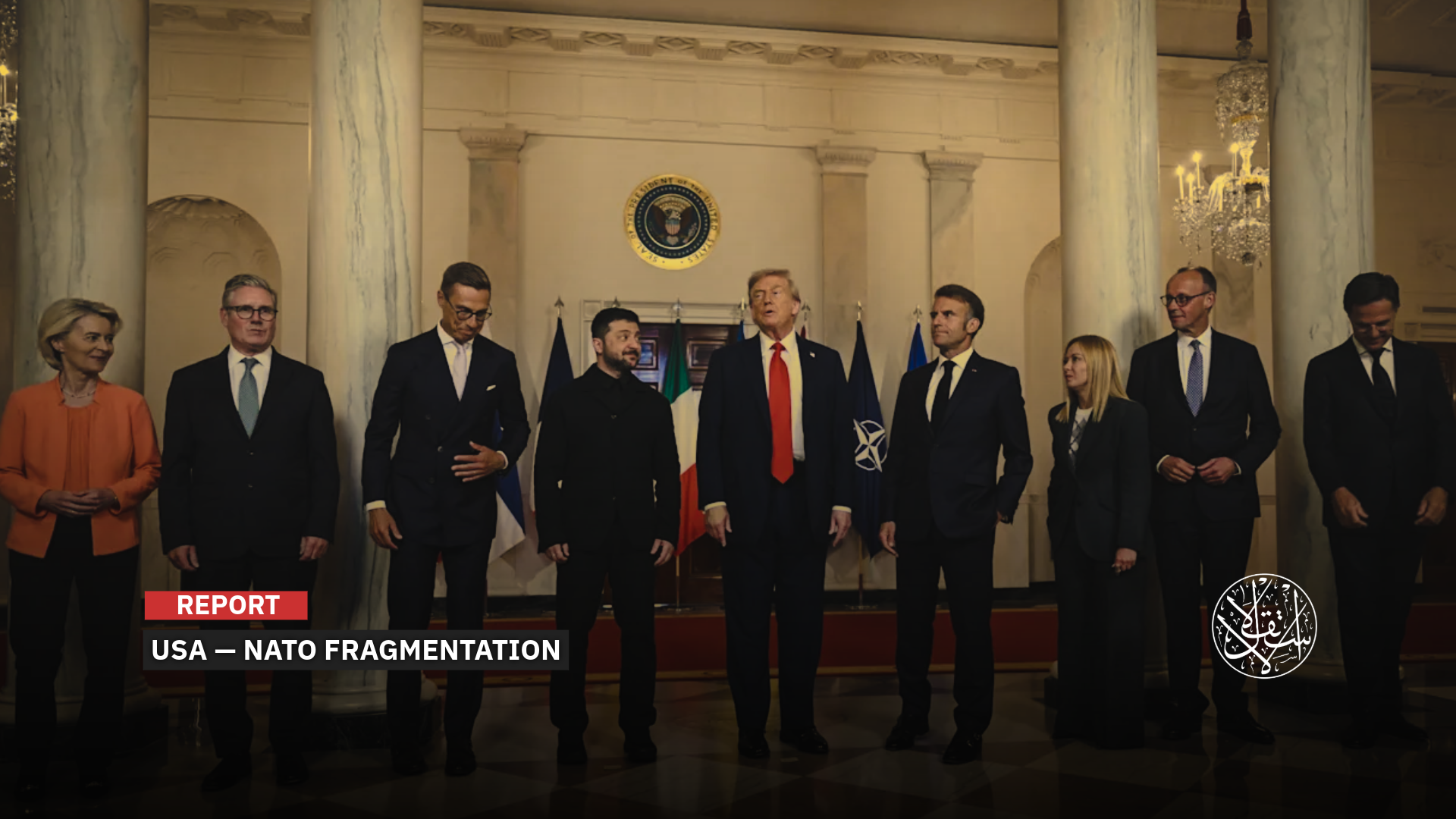
European governments were angered by Washington’s failure to consult them before carrying out strikes against Iran.
After ongoing disagreements between the U.S. administration and several of its Western allies over the war in Ukraine, President Donald Trump’s tariffs, and his military ventures, such as his insistence on acquiring Greenland from Denmark, the deepest rift in the alliance has emerged over the war on Iran.
The issue went beyond some Western allies deeming the war “illegal.” It extended to a series of concrete actions, including refusing to allow U.S. aircraft to operate from their territory, denying the use of their military bases, and declining to participate in American plans to control the Strait of Hormuz.
A month into the joint U.S.-Israeli war against Iran, divisions within the Western alliance have continued to widen, while European countries have grown less willing to bear the costs of escalation.
This contrasts with Washington’s insistence that allies share the burden or face the consequences of their stance.
Signs of a deepening rift, approaching a possible split, were further reinforced by President Trump’s remarks in an interview with The Telegraph in early April 2026, in which he said, “I am seriously considering withdrawing the United States from NATO after its members refused to engage in the war on Iran.”
Deepening the Divisions
The war on Iran, led by the United States to advance an Israeli agenda that conflicts with the interests of Washington’s European allies, has deepened divisions within the Western camp between European countries, other NATO members, and the United States.
The war exposed a structural flaw in the alliance, as U.S. and Israeli interventions have imposed significant risks on European allies, ranging from economic disruptions to security threats, making transatlantic divisions deeply entrenched.
European governments were angered by Washington’s failure to consult them before carrying out strikes against Iran, in addition to the U.S. administration’s lack of a clear and coherent strategy in the region, and the continued pressure exerted by President Donald Trump to draw them into the conflict, according to a report by GLOBSEC published on March 25, 2026.
Europeans were further frustrated by Washington, which enjoys energy self-sufficiency, dragging the continent into a cycle of energy and security risks, particularly as natural gas prices rose by 40 percent and oil prices surged due to the closure of the Strait of Hormuz.
They also criticized the designation of their countries as “legitimate targets” by Iran within the Western camp that attacked Tehran, especially following strikes on NATO-linked assets, such as a French base in the UAE, and Trump’s attempts to entangle the alliance in a conflict that had not been formally initiated.
Despite agreement on broad objectives, such as preventing Iran from becoming a nuclear state, the U.S.-Israeli war revealed clear signs of fragmentation within the Western alliance over Washington’s military approach, in contrast to the diplomatic solutions favored by Europe.
This rift reflects differing security priorities between the two sides, as the United States views Iran as a global strategic threat, while Europe focuses on migration, energy, and regional stability, assessing that the war has increased the threats it faces.
Western reports summarize the core of the crisis as a fundamental divergence in approaches to managing the war on Iran between the United States and Europe, rather than a disagreement over strategic objectives.
While Washington tends to rely on maximum pressure tools, including military threats, European powers prefer to preserve diplomatic and containment pathways, driven by domestic economic and security considerations.
According to Politico in early April 2026, Trump’s escalating attacks on Britain, Spain, and France confirm a fundamental fracture in the transatlantic alliance, reflecting deep differences in strategic visions for confronting Iran.

Signs of Fragmentation
The dispute arose over Washington’s efforts to draw Europe and NATO into the war under the pretext of protecting the Strait of Hormuz, alongside repeated European positions rejecting the legitimacy of the war and opposing the use of U.S. military bases. This has further deepened fractures within the Western alliance and exposed a widening transatlantic divide.
Spain barred U.S. aircraft from using or departing from its bases, with its government declaring its “total opposition” to the U.S.-Israeli attacks on Iran and announcing the closure of its airspace to planes involved in the war.
Spanish Defense Minister Margarita Robles stated that Spanish airspace would not be used for any operations related to the war in Iran, reaffirming Madrid’s commitment to international legitimacy, as emphasized by Prime Minister Pedro Sanchez.
Italy also refused to allow U.S. military aircraft to land at the Sigonella Air Base in Sicily before heading to the Middle East, due to Washington’s failure to obtain prior authorization from Rome and consult Italian military leadership, according to Corriere della Sera and sources cited by Reuters on March 30, 2026.
Italian Defense Minister Guido Crosetto said he “cannot sleep” because of the potential consequences of the war for his country, particularly regarding the economy and energy markets, according to Calibre.
France denied overflight rights to aircraft heading to “Israel”. Alice Rufo stated that any NATO operations in the Strait of Hormuz would constitute a violation of international law, heightening tensions in Paris’s relations with Washington and “Tel Aviv”.
This European stance prompted daily hostile remarks from U.S. President Donald Trump toward his allies, warning that the United States would not assist them, as he believed they had failed him.
He said, “If France or others want fuel through the Strait of Hormuz, they should go there and get it themselves.”
On his platform, Truth Social, Trump wrote, “The Country of France wouldn’t let planes headed to Israel, loaded up with military supplies, fly over French territory. France has been VERY UNHELPFUL.”
In an interview with The Telegraph in early April 2026, Trump attacked British Prime Minister Keir Starmer for refusing to participate in the war, saying, “You don’t even have a navy. You’re too old and had aircraft carriers that didn’t work.” When asked about increasing defense spending, he added, “He can do whatever he wants — it doesn’t matter. All Starmer wants is costly windmills that are driving your energy prices through the roof.”
Trump continued to direct insults at European leaders, particularly Starmer, whom he said was “not Winston Churchill,” expressing disappointment over his stance on the war on Iran and accusing him of moving too slowly to adjust his position before later allowing strikes to be launched from British bases.
In a broader message to European countries, the U.S. president added, “You'll have to start learning how to fight for yourself, the USA won't be there to help you anymore, just like you weren't there for us.”
The rift also extended to relations with “Israel”, which decided to halt arms purchases from France after Paris refused to allow aircraft carrying U.S. munitions for the war on Iran to pass through its airspace.
According to Israel’s Channel 12, the French decision to block U.S. overflights en route to “Israel” sparked anger and frustration among officials in “Tel Aviv” and Washington.

NATO’s Disintegration
On March 25, 2026, amid a series of growing disagreements between the United States and its Western allies, U.S. President Donald Trump was asked about the possibility of a full withdrawal from NATO.
Trump said it was necessary to “reconsider the United States’ relationship with the alliance,” without giving a definitive answer on a complete withdrawal.
However, he expressed strong dissatisfaction with what he described as NATO’s “embarrassing failure” to mobilize military support for one of the most significant operations of his presidency, namely the war against Iran.
As some European countries continued to refuse to allow the United States to use their military bases for attacks on Iran, Trump returned in early April 2026 with sharper remarks, stating that he was “seriously considering withdrawing the United States from NATO” after the alliance declined to engage in the U.S.-Israeli war on Iran, a move reflecting an unprecedented escalation and a clear strain in relations with European allies.
According to The Telegraph, Trump described the alliance as a “paper tiger,” suggesting that the issue of U.S. withdrawal from the defense pact had gone “beyond reconsideration,” indicating his growing belief that the alliance had lost its value. He added, “was never swayed by NATO. I always knew they were a paper tiger.”
Trump framed his position by arguing that Western allies had refused to meet his requests to join the war, asserting that their participation should have been automatic, just as the United States supported Ukraine, “Ukraine wasn’t our problem. It was a test, and we were there for them, and we would always have been there for them. They weren’t there for us.”
On March 19, 2026, Trump had already described European NATO allies as “cowards” for refusing to join a force he sought to assemble to forcibly open the Strait of Hormuz, adding that the alliance without the United States is a “paper tiger.”
Following Trump’s remarks, the United Kingdom announced that it had allowed the United States to use its military bases to carry out strikes on Iranian sites targeting ships in the Strait of Hormuz.
U.S. Secretary of State Marco Rubio also weighed in on the future of relations with Western allies, stating that NATO had become like a “one-way street,” criticizing some allied countries for refusing to grant the United States access to their military bases.
In an interview with Fox News on March 31, 2026, Rubio said Washington might have to “reassess” its membership in the alliance after the war ends, adding, “So I think there’s no doubt, unfortunately, that after this conflict is concluded, we are going to have to reexamine that relationship. We’re going to have to reexamine the value of NATO for our country. Ultimately, that’s a decision for the president to make.”

A Pay-To-Participate Alliance
A report by the European network Euronews on March 30, 2026, stated that U.S. President Donald Trump is considering restructuring NATO, including penalizing member states that do not meet the defense spending levels he demands.
Prominent figures within the U.S. administration are pushing toward adopting a “pay-to-participate” model, which could strip some allies of influence over alliance decisions, including those related to war.
This could open the door to unprecedented tensions with European allies, particularly amid escalating disputes over defense burdens and approaches to crises in the Middle East.
Euronews, citing sources close to Trump, also reported that he is considering withdrawing U.S. troops from Germany, an option he had previously raised since returning to power last year.
Under this vision, countries that do not meet a defense spending target of 5% of their GDP could be denied voting rights on key issues within the alliance, including decisions related to war.
This move is part of a broader set of plans the president is considering after some NATO allies refused to send naval forces to help reopen the Strait of Hormuz.
NATO members had previously committed to spending at least 2% of their GDP on defense following pressure from Trump in 2018 to increase military funding.
However, the new proposal raises the threshold to 5%, a goal that NATO Secretary-General Mark Rutte said would require leaders to develop clear plans to achieve it at a summit to be held in Turkiye in 2026.
This proposal could exclude countries that fail to meet the new spending level, such as the United Kingdom, which spends around 2%, along with 13 other countries, potentially increasing tensions with U.S. European partners.
However, implementing such changes would require unanimous agreement among all alliance members, which appears unlikely given expected opposition from several states.
Trump’s request for NATO to participate in the war on Iran has raised questions about the activation of Article 5 of the alliance’s charter, which states that “an attack on one member is an attack on all.”
It is worth noting that this article has been invoked only once, following the September 11, 2001 attacks, which led to the war in Afghanistan that resulted in the deaths of more than 1,100 non-U.S. NATO soldiers, including 457 British troops.
However, this article applies only in cases where a member state is directly attacked, which does not apply to the current war, which began with joint U.S.-Israeli strikes against Iran on February 28, 2026, according to Euronews.
Politico reported in its early April 2026 issue that President Trump’s anger at NATO allies has had the unintended effect of uniting them against him.
The magazine noted that this anger stemmed from member states’ refusal to join the U.S.-Israeli war against Iran, prompting European defense leaders and officials to hedge against the risk of a U.S. withdrawal from NATO, which has been the cornerstone of European security since its founding in 1949.
The report added that this crisis has led European leaders to discuss ways to respond to Trump’s threats of withdrawal and to explore available options should he follow through.
It also noted that some countries have begun considering expanding their own defense and security arrangements to bypass what they described as “paralyzed” NATO institutions in the event of a complete breakdown.
A European diplomat was quoted as saying, “NATO is paralyzed, they cannot even hold effective meetings,” while another EU official stressed that “it is very clear that NATO is already falling apart,” adding, “We cannot wait until it completely collapses, Europe must urgently strengthen its defense independently.”
Thus, Trump’s threats appear not only to have created tensions between Washington and its allies but also to have tied the fate of the alliance itself to the future of U.S. policy at a time of growing security and energy risks in the Middle East, particularly amid the war on Iran and the risks surrounding the Strait of Hormuz.