How Has ‘Israel’ Turned the Military Judiciary Into a Shield for Killing Palestinians?
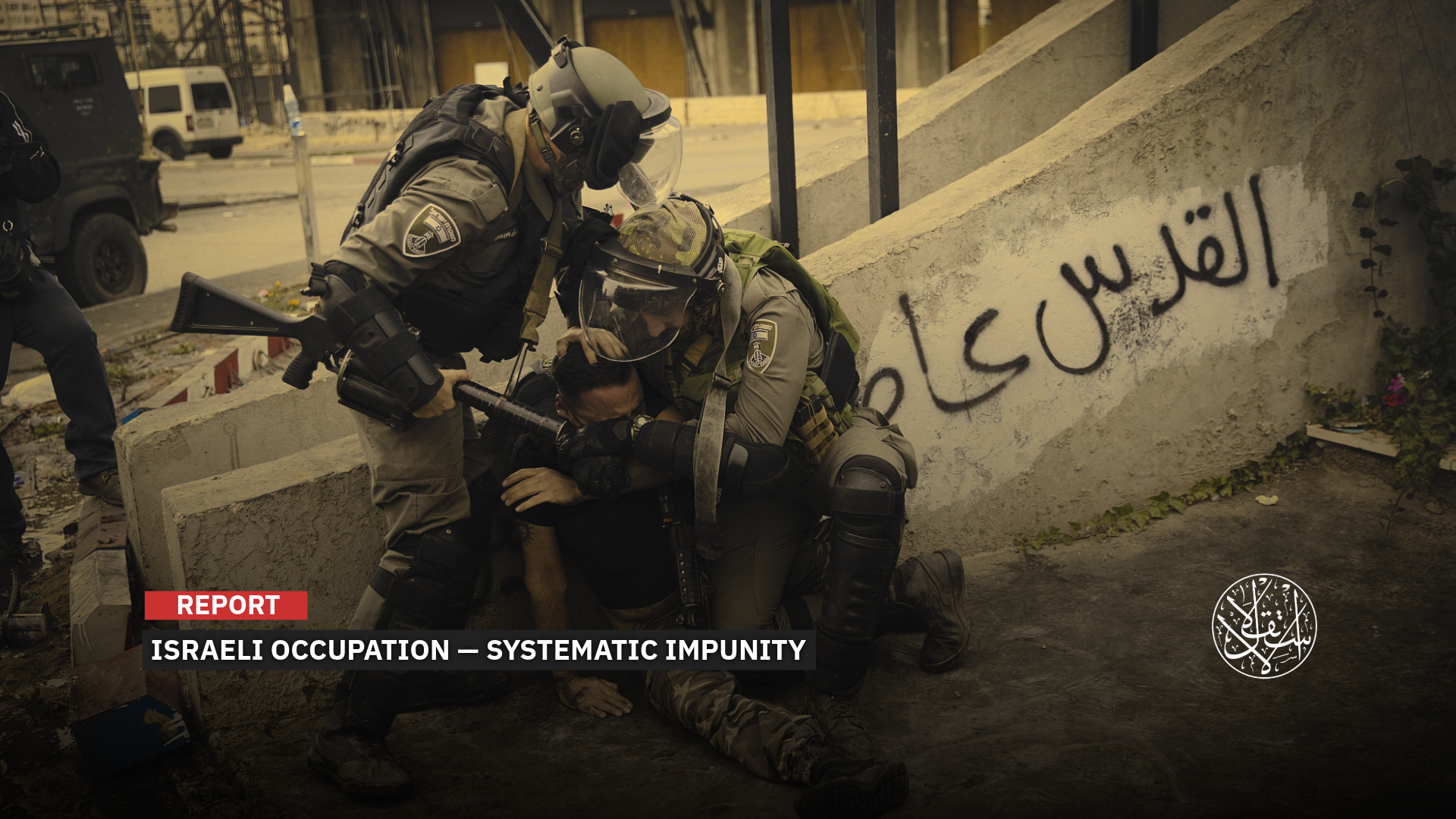
The Defense Minister affirmed that the role of the military legal system is to “protect soldiers.”
On March 12, 2026, Israeli Military Attorney General Itai Ofir dropped charges against five reserve soldiers accused of torturing and raping a Palestinian detainee at the "Sde Teiman" detention center, a year after the incident was revealed.
This case, which drew both Israeli and international attention, is not an isolated incident but reflects a glaring pattern within the Israeli military judicial system, where investigations are conducted internally, proceed slowly, and typically end with the soldiers’ acquittal or the imposition of symbolic penalties.
The question remains whether the Israeli judicial system fails to hold soldiers accountable due to structural weaknesses, or if it is fundamentally designed to produce systematic immunity for soldiers when the victim is Palestinian.
Recurring Pattern
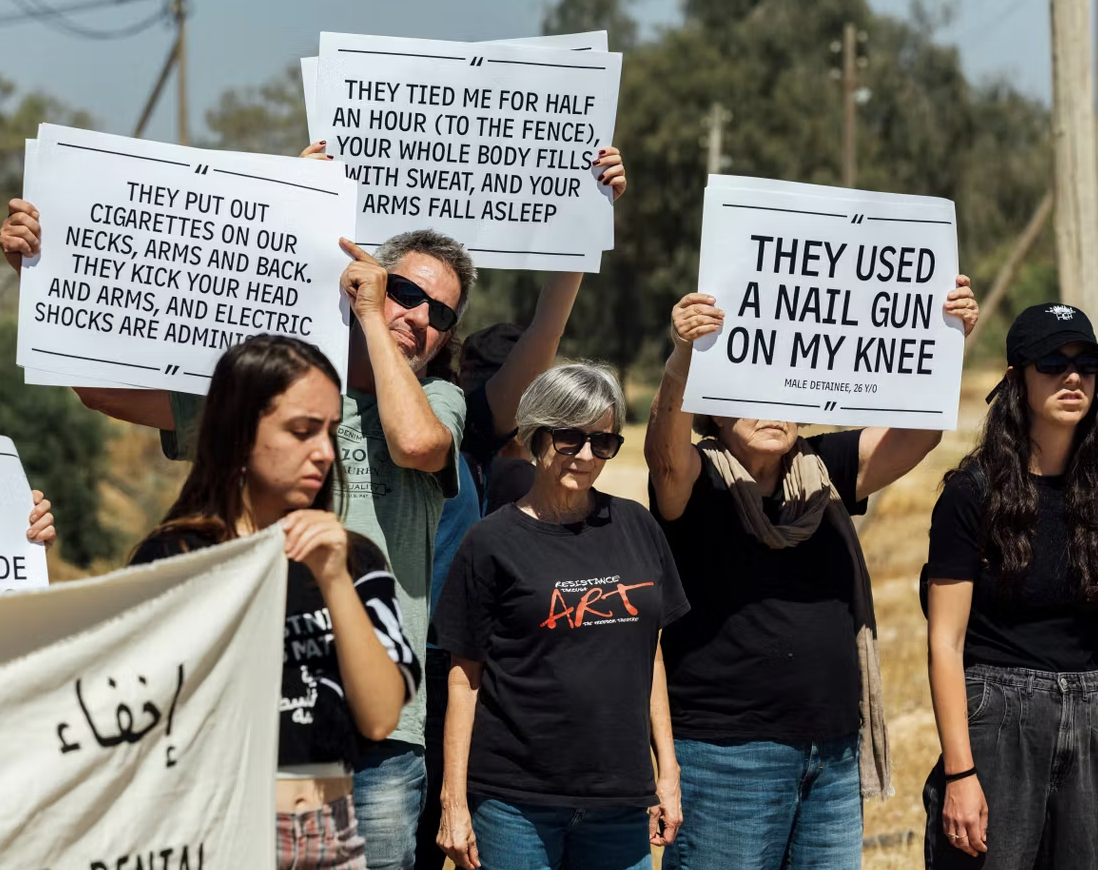
In July 2024, surveillance cameras inside the "Sde Teiman" detention center in southern occupied territories captured footage of five reserve soldiers dragging a Palestinian detainee into a corner of the hall and assaulting and raping him with a sharp object, causing internal injuries that required emergency surgery.
In February 2025, the military prosecution filed charges against the soldiers for “severe violence” and “stabbing in the buttocks with a sharp object,” before the new Attorney General dropped the indictment, citing “procedural difficulties” due to incomplete transfer of information and the detainee’s return to Gaza, which made him unable to testify.
Israeli Defense Minister Israel Katz described the trial as “born in sin” and praised the dismissal of charges, stating that the role of the military legal system is to “protect soldiers who fight monsters,” not to safeguard the rights of Palestinian detainees.
Far-right Finance Minister Bezalel Smotrich affirmed that the decision shows the new military prosecutor is “the right man,” reflecting how members of Benjamin Netanyahu’s government view the military prosecution as a “shield” for soldiers rather than a tool of justice.
Palestinian and Israeli human rights organizations strongly criticized the decision.
The Palestinian Prisoners’ Advocacy Center called the case closure “a clear attempt to cover up torture and sexual assault,” warning that it sets a dangerous precedent for impunity.
This was not an isolated case. In January 2022, Israeli Occupation Forces arrested 78-year-old Palestinian-American Omar As’ad in the village of Jaljulia (Ramallah district), restrained him, and left him outdoors until he was found dead hours later.
The military prosecution concluded there was no causal link between the assault and his death and decided not to press charges, only disciplining two officers and reprimanding the battalion commander.
After the killing, the Israeli human rights organization Yesh Din reported that the army received 1,260 complaints against soldiers from 2017 to 2021, of which only 248 were investigated and 11 led to indictments, a 0.87 percent chance of reaching trial. Even in these few cases, sentences were notably lenient.
For example, in March 2019, a soldier killed Palestinians Alaa Ghayadha and Ahmad Manasra near Bethlehem, mistakenly believing they were throwing stones when they were helping an injured person.
Manasra was killed and Ghayadha seriously injured; the military court approved a deal in December 2020 giving the soldier three months of unpaid community service with suspended execution and a demotion to private.
In October 2019, a sniper from the Givati Brigade admitted to firing without orders during Gaza’s “Great Return” marches, killing 15-year-old child Othman Halles, and was sentenced to one month of military duty and a rank reduction.
In November 2018, a soldier who killed an unarmed Palestinian fisherman was sentenced to 45 days of community service under a plea deal for negligence, which the Israeli human rights organization B’Tselem described as “an example of a legal system designed to protect perpetrators, not victims.”
Among the most prominent cases was the killing of Palestinian-American journalist Shireen Abu Akleh in May 2022, who was shot in the head while covering the Israeli military aggression on Jenin.
A military investigation in September 2022 concluded that the bullet “most likely” came from Israeli fire but found no criminal suspicion to prevent opening a police investigation, while Amnesty International confirmed that Israeli authorities did not open a criminal investigation or press charges.

Manufacturing Immunity
Regarding investigative mechanisms and procedures, complaints against soldiers are referred to the Military Police Investigations Unit, which is known for negligence and failing to collect field evidence.
Investigators rely almost entirely on soldiers’ statements, which are often gathered months after the incident, without any genuine attempt to obtain physical evidence or independent testimonies, according to B’Tselem.
After the investigation is closed, cases move to the Military Operations Prosecution, the body that decides whether to open a criminal investigation or close the file.
B’Tselem notes that the prosecution assumes soldiers’ accounts are truthful and closes many cases citing “lack of guilt” or because the incidents occurred in a “combat context,” granting soldiers broad immunity.
It is also rare for the prosecution to hold officers or commanders accountable, as it focuses on lower-ranking personnel while exempting higher-level decisions and policies.
Data obtained by Yesh Din shows that of 2,427 complaints filed by Palestinians between 2016 and 2024, only 552 investigations (22.7 percent) were opened, and only two or three cases were referred to trial (0.9 percent).
The average time to decide to open an investigation was 213 days, and for cases involving deaths, it reached 304 days, with 45 percent of complaints taking between two and five years to process.
Deliberate delays practically undermine investigations, as soldiers complete their service or evidence is lost.
Another problem is the complexity of filing complaints, as Palestinians cannot approach the Military Police directly and must rely on human rights organizations or lawyers, which limits access to justice and reduces the number of complaints.
Even in cases under investigation, terms like “abuse of authority to the point of endangering life” are used instead of charges of premeditated murder, ensuring lighter sentences, according to an investigation by +972 magazine.
Military judges typically impose short sentences or community service, justifying this with “complex” or “operational” circumstances, sending a clear message that killing Palestinians is not considered a serious crime by the military judiciary, according to the Times of Israel.
As a result of this judicial design, a culture of impunity has deepened, investigation rates have declined, and lenient sentences are issued, except in war situations.
B’Tselem concludes that the judicial system does not investigate orders or higher-level policies or leadership responsibility, focusing on soldiers as individuals to create the appearance of accountability while absolving the policymakers and decision-makers.
This allows “Israel” to promote a “self-investigation” narrative to the international community, preventing intervention by the International Criminal Court.
Custom-Tailored
This raises a fundamental question: does the Israeli military judiciary suffer from structural incapacity to hold soldiers accountable, or is it functioning exactly as designed?
Statements by the Defense Minister that the role of the prosecution is to “protect soldiers,” and former Prime Minister Benjamin Netanyahu’s assertion that the state must “pursue its enemies, not its fighters,” reflect an official perspective that holding soldiers accountable is considered a threat.
The decision to drop the “Sde Teiman” charges amid the war on Iran illustrates how “Israel” uses security pretexts to justify closing investigations and suggests that the Israeli judicial system exploits emergency conditions to avoid accountability.
Military investigative units and the prosecution are part of the same institution they are supposed to oversee. According to B’Tselem, investigations are conducted under the prosecution’s supervision from the start, allowing it to guide questioning and close cases under the pretext of “lack of evidence.”
The absence of independent or civilian oversight makes achieving justice impossible when the army serves as both defendant and judge.
Human rights reports indicate that the unspoken purpose of this system is to provide “Israel” with a pretext before the International Criminal Court, claiming the existence of an “effective judicial system,” while the data show it functions as a cover for impunity.
Mohammed Emad, Director of Legal Affairs and Policy at Skyline International Human Rights Organization, stated that “the recent Sde Teiman case is a drop in a long sea of Occupation soldiers evading prosecution for serious international law violations.”
He explained to Al-Estiklal, “Israel” usually has two objectives when opening investigations into soldier misconduct or serious crimes: first, to present itself as a lawful state that rejects violations in front of the international community.
Second, to evade ICC prosecution in certain cases, as the Court does not consider matters already addressed by domestic courts.
“The ICC typically intervenes in major cases of serious international crimes, such as genocide, war crimes, and crimes against humanity, as we have seen in Gaza,” he added.
He noted that for individual cases involving a soldier, even if the behavior is repeated, the military judiciary usually claims the soldier was tried domestically and punished, with sentences ranging from a few months to over a year, often released after six to nine months.
Emad highlighted that “Israel and its soldiers continue to violate human rights, and the recent decisions to bring some individuals to trial are meant to create an image of accountability that does not truly exist, improving appearances before the world.”
The danger lies in sending a message to soldiers that they enjoy immunity, entrenching a culture of killing and torture without fear of punishment.
For Palestinians, the military judiciary thus becomes another tool of oppression, forcing them to seek justice in a system that criminalizes them by default or refuses to acknowledge their existence.