From Attracting Investment to Poaching Skilled Workers: How the Saudi Decision Ignited Race with Egypt

The real threat isn’t the loss of one or two workers, but the migration of a category of workers that constitutes the very backbone of Egyptian industry.
The industrial battle in the region is no longer waged through factories or investments alone. It is now being decided by a far rarer and more consequential factor: skilled technical labor.
When Saudi Arabia announced on December 17, 2025, the abolition of fees imposed on foreign workers in its industrial facilities, the move was not simply intended to ease accounting burdens. It ignited a new economic confrontation in the Middle East.
Egypt’s Enterprise economic newsletter described the decision on December 26, 2025, as shifting competition between Cairo and Riyadh from attracting investment to a struggle over technical talent.
This was not merely a media characterization, but a signal of a profound shift in the logic of regional economic competition.
The Saudi decision came at a time when Egypt’s industrial sector is suffering from accumulated structural pressures, raising a pivotal question: will this move weaken Egypt’s industrial base by drawing away skilled technicians, or will it generate a corrective dynamic that ultimately strengthens the domestic market?
This Saudi shift derives much of its significance from its sensitive timing. Egypt enters this phase while grappling with structural bottlenecks in the macroeconomy, mounting pressure on the currency, and a sustained erosion of real wages.
Saudi Arabia, by contrast, is approaching this moment from a very different position, buoyed by expanding financial, investment, and logistical capacity, and by an overarching project to reshape its productive base under Vision 2030.
Between these two trajectories, the Egyptian technician is being transformed from a local factor of production into a coveted target in a regional labor market thrown wide open to competition.
Although the Saudi Ministry of Commerce has formally stated that the removal of fees on foreign labor is intended to support the growth of small and medium-sized industrial enterprises and ease their financial burdens, a broader reading suggests the decision goes further.
It effectively redefines the cost structure of industrial production in the kingdom, not only through inputs such as energy and finance, but through labor itself.
Once fees on foreign workers are lifted, the recruitment of overseas technicians, particularly from countries with long industrial experience such as Egypt, becomes a more economically attractive and lower-risk option.

Human Expertise
In this context, the Egyptian technician does not appear as a marginal option. Egyptian industry, among the oldest in the Arab world, has accumulated human expertise that is difficult to replace quickly, particularly in sectors such as food processing, textiles, chemicals, petroleum, pharmaceuticals, and building materials.
These skills were forged in a harsh operating environment marked by chronic shortages of finance, volatile energy prices, and weak supply chains.
The result has been a technician who is highly adaptable and adept at resolving day-to-day operational problems.
Egypt has also long been distinguished by the sheer scale of its labor force, with vast numerical gaps compared with other countries in the region.
According to the official press release on the results of the 2024 annual Labor Force Survey issued by the Central Agency for Public Mobilization and Statistics, the number of employed persons in Egypt reached approximately 29.928 million in 2024.
Yet these accumulated advantages have collided in recent years with an effective collapse in the purchasing power of wages inside Egypt.
While a specialized technician in Egypt typically earns between 15,000 and 35,000 Egyptian pounds per month, noting that 35,000 pounds is roughly equivalent to 2,800 Saudi riyals, their counterpart in Saudi Arabia earns between 6,000 and 12,000 riyals.
That translates into several times the Egyptian wage when converted into local currency, at an exchange rate of 12.70 Egyptian pounds to the riyal, in addition to benefits such as housing, medical insurance, travel tickets, and end-of-service bonuses.
The Egyptian researcher Mohamed Maher argues that the wide wage gap between Egypt and Saudi Arabia does not simply reflect differences in income levels.
At its core, it exposes a sharp divergence in monetary stability and in the ability of local wages to keep pace with the relentless rise in living costs.
This, he says, makes technicians far more sensitive to any external offer that promises higher income and greater financial stability, particularly in Saudi Arabia, which is relatively close to Egypt both geographically and socially, and shares deep religious and cultural ties.
In comments to Al-Estiklal, Maher explained that Saudi Arabia’s decision to abolish fees on foreign labor has doubled the impact of this gap, because it gives Saudi factories greater room to balance cost against return.
Resources that were previously allocated to government fees on foreign workers can now be redirected toward higher wages or additional benefits.
This, he noted, significantly increases the appeal of Saudi offers to Egyptian technicians, especially in the absence of credible signs of a rapid improvement in wage levels within the Egyptian market.
Maher warned that the real danger does not lie in the loss of one or two workers, but in the potential departure of a group that constitutes the backbone of industry.
A technician, he stressed, is not merely an executor of specific tasks, but a carrier of accumulated operational knowledge that underpins product quality and continuity in any factory.
He cautioned that the continued outflow of skilled technicians from the local labor market exposes Egyptian factories, particularly medium-sized and state-owned ones, to direct risks, including declining productivity, disrupted production lines, and higher rates of waste and mechanical failure.
“All of this,” he concluded, “comes in addition to the erosion of the ability to comply with export quality standards, which ultimately threatens the competitiveness of Egyptian industry over the medium and long term.”
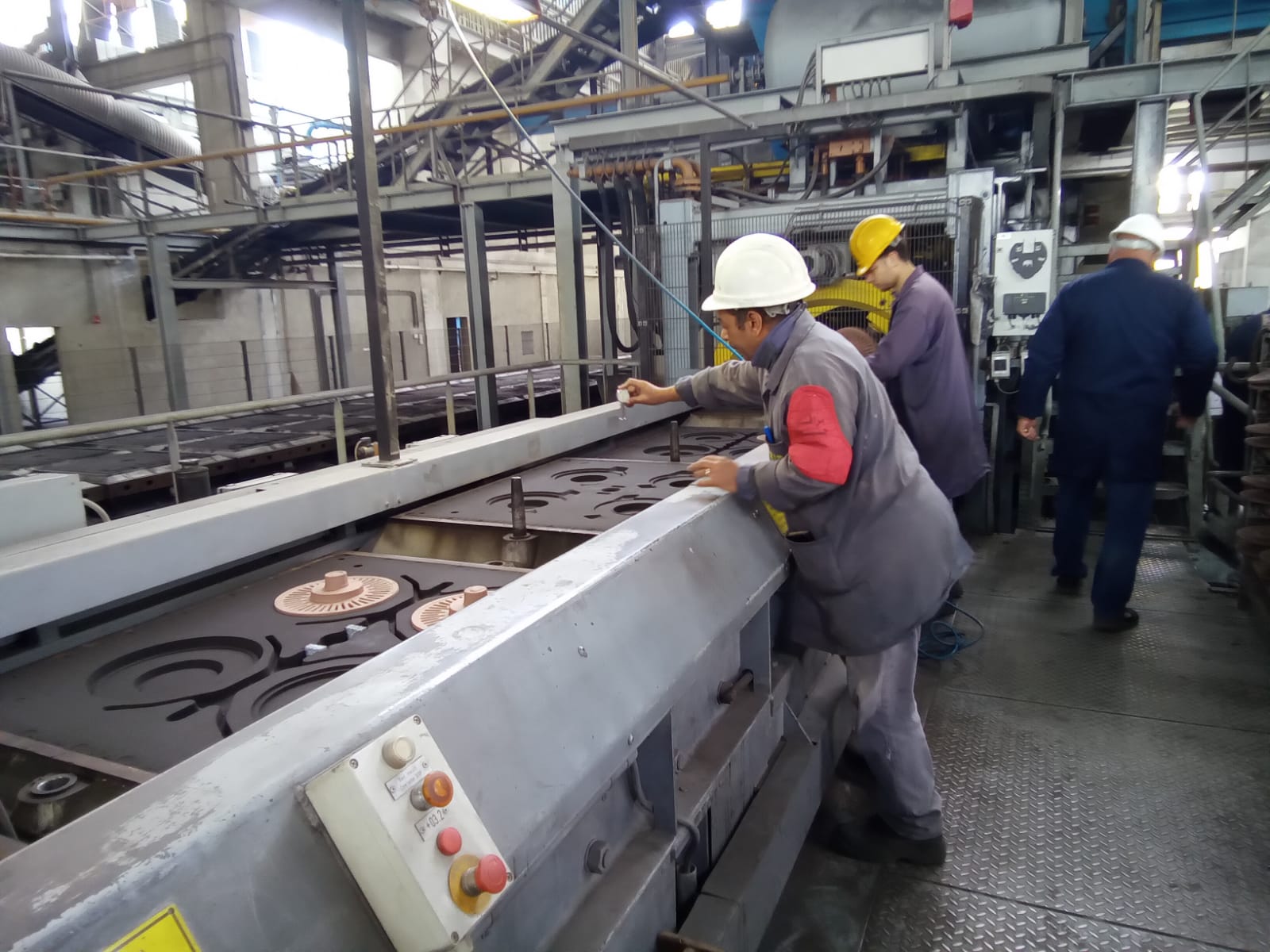
Enterprise therefore warns that Egyptian factories are facing a stark binary choice: either to improve working conditions and wage structures, or to lose their technicians to the Saudi market.
In practice, however, this choice appears more theoretical than real. Rising energy costs, tight financing conditions, and higher raw material prices have all squeezed manufacturers, limiting their ability to deliver rapid wage improvements without eroding profit margins or even undermining their capacity to survive.
Enterprise notes that this human drain does not occur in a single dramatic wave, but unfolds cumulatively, making it difficult to detect in its early stages.
The departure of a relatively small number of experienced technicians may not immediately register in official data, but it creates operational bottlenecks inside factories and leads to the loss of tacit knowledge that cannot be replaced through short-term training.
Over time, this erosion weakens domestic production chains and constrains the ability to expand industrial capacity or attract new investment.
Remittances
At the same time, some official bodies, including the Ministry of Manpower and the Ministry of Emigration and Egyptian Expatriates’ Affairs, have framed labor migration as a potential economic gain through remittances.
An increase in the number of Egyptians working abroad would, under this logic, translate into larger inflows of foreign currency, something Egypt urgently needs amid its ongoing balance-of-payments crisis.
Yet this reasoning overlooks a fundamental distinction, between remittances as a form of consumption income, and industrial human capital as a long-term engine of development. However large they become, remittances cannot compensate for the loss of domestic productive capacity, nor can they close the manufacturing gap.
This argument is reinforced by comments from Mohamed El-Beheiry, a board member of the Federation of Egyptian Industries, who has warned that relying on low wages as a competitive advantage for Egyptian industry is approaching its end.
With regional labor markets opening up and the cost of mobility falling, the technician is no longer confined to a single geography, but has become part of a cross-border competitive market.
While some observers argue that constraints such as the sponsorship system and weak labor protections may curb the rush of Egyptian technicians toward Saudi Arabia, economic realities point in the opposite direction.
Living cost pressures, currency stability, and the wide wage gap are pushing workers to accept conditions abroad that they would reject at home, in exchange for higher pay and a greater ability to save.

The Battle for Talent
In the final analysis, the Saudi decision cannot be understood in isolation from the emerging struggle over talent in the region. It represents an extension of a deeper shift in the structure of Arab industrial competition itself.
Saudi Arabia is entering this contest from a position of effective industrial dominance. Manufacturing value-added data show it leading Arab economies by a wide margin.
In 2024, the kingdom’s industrial output reached around $192.7 billion, more than three times Egypt’s roughly $54 billion in the same year, according to World Bank Data.
This advantage rests primarily on the weight of petrochemicals, metals, and refined petroleum products, sectors that form the backbone of Gulf industrialization, even as Riyadh accelerates its push to build a non-oil industrial base under Vision 2030.
Egypt, by contrast, faces a more complex challenge, one that goes beyond the size or diversity of its industrial base to the question of whether it can retain its industrial human capital.
An industrial sector that employs roughly four million workers in manufacturing is entering the skills contest from a fragile position, amid eroding real wages, mounting pressures from financing and energy costs, and a widening gap between domestic returns and regional offers.
Unless this challenge is turned into an opportunity to restructure wage policies, improve working conditions, and link productivity more closely to incentives, Egyptian industry risks a silent drain.
One measured not only by the number of technicians who leave, but by the loss of accumulated knowledge and operational expertise they take with them, weakening production chains and undermining long-term competitiveness.
Sources
- Saudi Arabia abolishes fees on foreign workers in industrial facilities, what does this mean? [Arabic]
- Riyadh just opened a new front in its war for talent: poaching factory workers from Egypt
- A Saudi decision that tempts Egyptians, will Riyadh strip Cairo’s factories of their technicians? [Arabic]
- Why do Egyptians travel to Saudi Arabia, and what share of Egyptians were working abroad in 2024? [Arabic]
- Saudi Arabia – Manufacturing, Value Added
- Arab Republic of Egypt – Annual Labor Force Survey Bulletin 2024 [Arabic]
- Why did Saudi Arabia abolish fees on foreign labor in factories? A reading of the economic gains [Arabic]