From Appeasement to Blackmail: How the Houthis Transformed Into a Regional Threat to Saudi Arabia
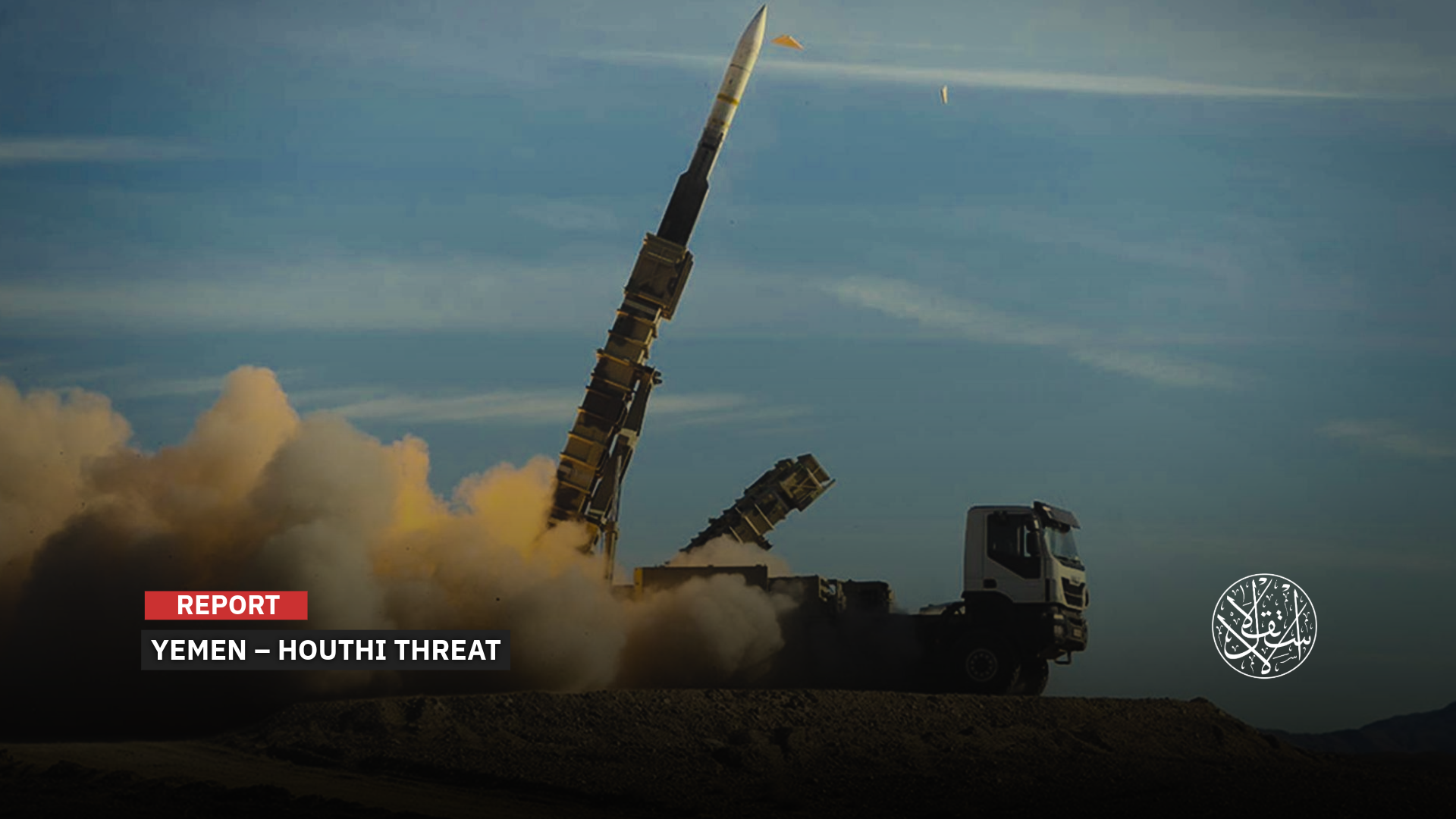
“The truce between Riyadh and the Houthis remained, for years, a cold peace governed by pragmatism.”
In January 2024, prominent Saudi journalist Abdulrahman Al-Rashed wrote an article in Asharq Al-Awsat newspaper titled: “The Houthis Are No Longer a Saudi Problem.”
In his article, he presented an approach reflecting a shift in Saudi thinking, stating that Riyadh has maintained its new relationship with the Houthis and the peace initiative that ended the cross-border war.
“The Houthis have made considerable progress in the Yemeni-Yemeni reconciliation project. For the Saudis and Yemenis, the world is not about Gaza, because they have their own war, and ending the fighting and disputes is the priority,” he said.
“In the Yemen war, Saudi Arabia confronted the Houthis in defense of itself, the stability of Yemen, regional security, and the protection of navigation in the Red Sea. Today, Riyadh's option is to maintain its relationship with the Houthis and then secure maritime navigation, which has become an international issue,” he added.
He pointed out that “through de-escalation and political engagement, Riyadh has gambled on the Houthis' ability to transform from a transnational military actor into a party that can be accommodated within a less confrontational regional balance of power, even while indirect channels of communication with Iran continue.”
However, recent events have painted a more complex picture. A report published by The Times of Israel on March 31 indicated that Houthi spokespeople had warned that the group might target Gulf states, including Saudi Arabia and the UAE, if Iran's energy facilities were attacked or the war escalated.
This comes despite the Houthis' consideration of their complex relationship with Saudi Arabia, which currently compels them to avoid opening a direct front with Riyadh.
This contradiction reveals that Houthi behavior is not governed solely by internal Yemeni considerations, but rather is shaped within a broader network of strategic alliances, where the relationship with Iran takes precedence over all others.
More importantly, the Saudi approach, as reflected in Al-Rashed's analysis, appeared more focused on risk management than addressing the root causes.
Riyadh sought to reduce the cost of the threat and postpone it, without dismantling its deep-seated sources, which are linked to the nature of the relationship between the Houthis and Iran.
This explains why the Houthis could, at a certain point, shift from being a partner in de-escalation to a tool of regional pressure, without this being considered a contradiction in its internal logic.
Therefore, relying on bilateral peace agreements or interim understandings, without addressing the structural dimension of the Houthis' relationship with Iran, remains a limited and potentially reversible gamble at the first serious regional test.
This also reveals a miscalculation in the previous Saudi approach, which tended to interpret Houthi behavior from a pragmatic, short-sighted perspective, without sufficiently grasping the depth of the Houthis' strategic dependence on Tehran.

Hostile ِApproach
Participation in the conflict allows the Houthis to highlight three things: First, that they remain an active player. From Iran's regional axis.
Second, they aim to raise the economic cost of the war by highlighting the threat to the Red Sea.
Third, they seek to improve their political standing in Yemen by pressuring the Saudi side and hinting at the possibility of targeting it in the course of the Iranian war to extract concessions.
In this context came the speech of the Houthi leader on the occasion of the so-called National Day of Steadfastness on March 26, in which he escalated his rhetoric against Riyadh, calling on it to review its policies and abandon what he described as its hostile approach, while accusing it of being linked to the American and Israeli agendas.
In parallel, Mahdi al-Mashat, head of the Houthi group's Supreme Political Council, threatened to end the state of neither war nor peace, warning against the continued Saudi procrastination in implementing the requirements of the roadmap, and emphasizing that his group is determined to achieve its demands, foremost among them the payment of salaries and the lifting of the blockade.
This rhetoric reflects the Houthis' shift from a position of seeking de-escalation to an actor that employs regional escalation as a tool for reimposing their conditions, making the path to understandings with Saudi Arabia contingent on their ability to balance military pressure with political leverage.
The Houthis are using their involvement in regional tensions alongside Iran as a dual pressure tactic: on the one hand, they are strengthening their position within the regional conflict equation, and on the other hand, they are sending veiled threats to Riyadh that continued failure to implement the understandings could push them to escalate the confrontation.
In reality, the truce between Riyadh and the Houthis remained, for years, a cold peace governed by pragmatism. However, the renewed missile launches from Sana'a towards Israel constituted a qualitative shift. It was not merely an act of solidarity with Iran, but a blow to the fragile understandings that had taken years to build.
In this context, Saudi Arabia finds itself facing a classic dilemma: how can it buy stability from an armed actor that employs geopolitical blackmail as a primary bargaining chip?
The Houthis are demanding enormous sums, including approximately $13.8 billion in back pay up to the end of 2024, in addition to other compensations, reflecting a high political and financial cost for any potential settlement.
Conversely, the stalled Yemeni roadmap has placed the group in a domestic legitimacy crisis, making engagement in regional escalation a pragmatic option: a tool to garner domestic support and a means of exerting pressure on Riyadh, which fears the collapse of its diplomatic gains.
Statements by Mohammed Mansour, the Houthi government's deputy information minister, confirm that their involvement in the war will not remain merely symbolic but will extend to issues of the blockade and economic resources, reflecting a clear overlap between the local agenda and regional stakes.
This overlap, linked to the group's positioning within the axis of resistance, makes Saudi Arabia's security vulnerable to decisions that extend beyond the Yemeni context.
Yemen's slide back into open conflict poses a direct threat to Riyadh's regional stability strategy, in an environment that demands stable neighbors, not sources of cross-border threats.

Strategic Threat
The Houthis' escalating behavior toward Riyadh can be seen as an indirect consequence of the flawed Saudi approach to managing the Yemeni conflict.
Saudi policies that weakened traditional allies—most notably the Yemeni Congregation for Reform (Islah Party)—contributed to creating a political and military vacuum that the Houthis gradually filled.
While the capabilities of the forces aligned with the legitimate government have diminished, the Houthi group has managed to consolidate its control and develop its fighting capabilities, benefiting from Iranian support, to the point where it now possesses a cross-border deterrent capability. This has transformed it from a local actor into a direct strategic threat to Saudi Arabia.
In this context, Saleh al-Jabwani, former Minister of Transport in the legitimate government, offered a critical diagnosis of the problem, revealing that the issue is not that Saudi Arabia is blind to what is happening in Yemen, but rather that it interprets it through a lens that reduces the complexity to superficial phenomena and treats the active forces as bargaining chips.
“Saudi Arabia’s deeper mistake lies not only in the nature of its tools but also in its management of alliances,” he added.
“Since the launch of Operation Decisive Storm, Saudi Arabia has had genuine allies within the legitimate government structure—social and political forces deeply rooted in Yemeni society that formed the backbone of the legitimate government,” he said.
Instead of strengthening these forces, they were weakened, even allowed to be attacked and neutralized, in exchange for direct or indirect involvement in policies that align with the Emirati project in the south. This project has worked to dismantle the legitimacy of the government and build parallel entities.
Thus, Saudi Arabia found itself in a stark paradox: weakening its natural allies, while simultaneously attempting to win over its adversaries. The result was that it succeeded in weakening its ally but failed to win over its adversary.
Accordingly, it can be said that Riyadh has shifted from attempting to manage a crisis to managing a threat, as a result of a series of decisions that have weakened its own instruments within Yemen.
Instead of containing or dismantling the Houthi threat in its early stages, the policies pursued have contributed to expanding its scope and complicating its structure, making it more intertwined with regional dynamics and less amenable to containment.
More dangerously, this style of governance has not only weakened allies but has also indirectly contributed to reshaping the very nature of the threat.

In other words, the Houthis are no longer merely a challenge that can be contained; they have become an actor capable of imposing deterrent and coercive measures that extend beyond Yemen's borders.
Therefore, any genuine course correction requires a radical overhaul that goes beyond the tools used and extends to the very structure of the political vision.
Without this, Saudi Arabia will remain in a reactive position, while the Houthis continue to exploit their relative advantage to impose their conditions and consolidate their position as a growing regional threat.
Thus, Riyadh faces a complex dilemma today: managing a growing threat amid the decline of its allies and its adversary's increasingly effective strategy of escalation and blackmail.
In short, the Saudi predicament in Yemen is no longer solely a product of the Houthis' strength, but rather a direct consequence of flawed conflict management and alliance-building policies.
This has led to the erosion of Saudi Arabia's domestic influence, while the Houthis have risen as a powerful actor capable of both deterrence and blackmail, backed by strong Iranian support.
Sources
- The Houthis are no longer a Saudi problem [Arabic]
- Israeli newspaper: The Houthi group is balancing between escalation and de-escalation [Arabic]
- Yemen’s Houthis coordinate with Iran, but retain independence, despite war
- The Houthi group calls on the Saudi regime to reconsider its actions and cease its hostility towards the Yemeni people [Arabic]
- A peace hanging on Tehran's trigger: The Saudi truce in the face of Houthi geopolitical blackmail [Arabic]
- Has Saudi Arabia still not understood Yemen? [Arabic]