For These Reasons the Council of Europe Has Retracted Its Campaign to Defend the Right of Women to Wear the Hijab
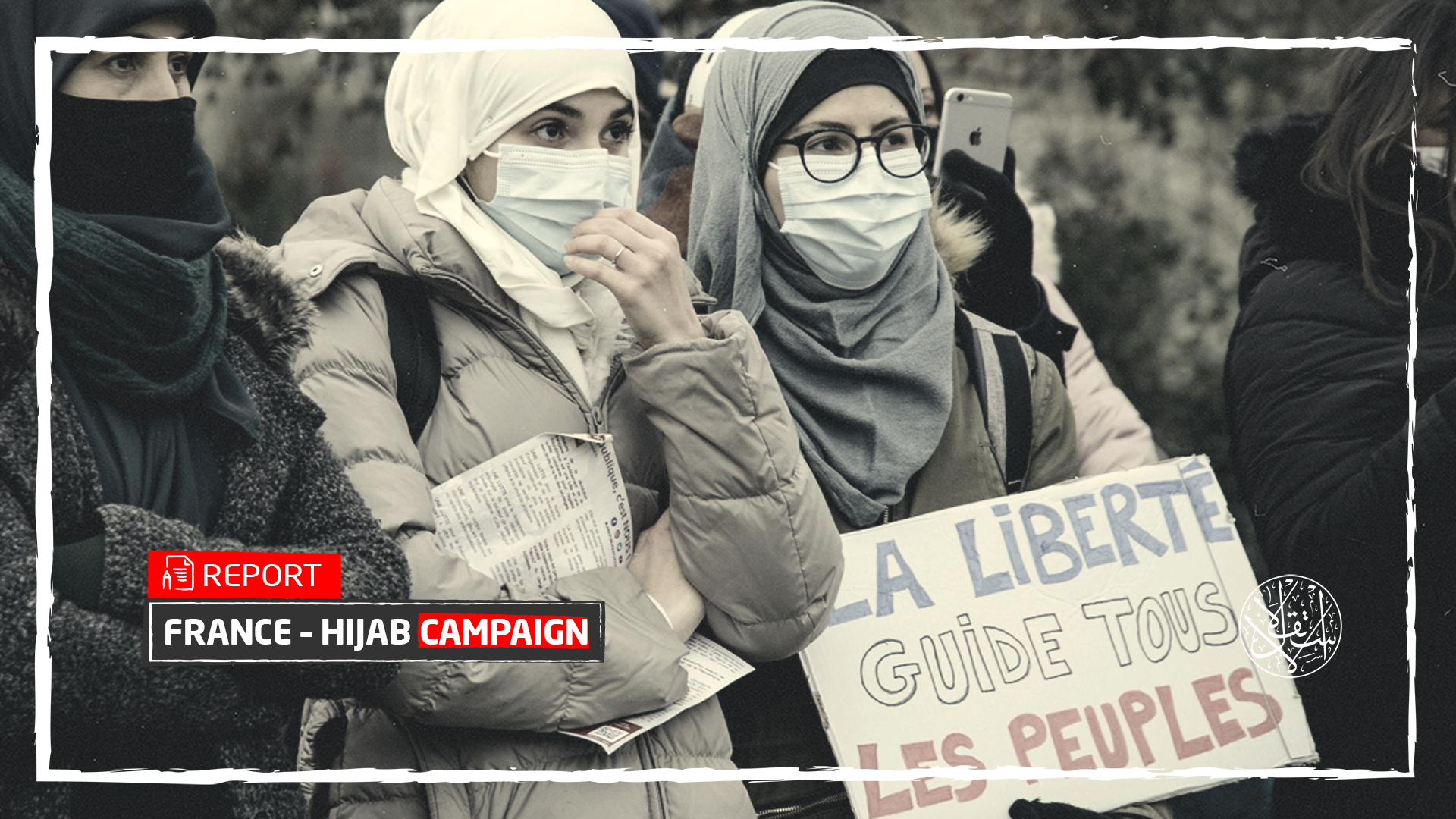
A campaign entitled “My Headscarf is My Choice,” which was led by the Council of Europe in the context of combating discrimination against veiled women, that included all European countries, has raised a sensation on social media in Europe, especially in France.
However, the French authorities thwarted the campaign calling for the hijab to be considered among the freedoms guaranteed by law, after it also launched a counter-campaign led by French politicians who are known to be hostile to Muslims, which forced the campaign organizers to stop it and think of new alternatives.
Observers believe that the campaign coincided with the high level of political debate in France with the approach of the Elysee elections, which made it a high value case for political bidding between the French political parties and hostility contrary to the French values based on freedom, equality and fraternity as codified in its slogans.
���� New clip promoted by Council of Europe:
— Expat in Poland ���� (@BasedPoland2) November 2, 2021
"Beauty is in diversity
As freedom is in hijab"
You have an idea about "EU values" now. pic.twitter.com/TYaORsXo2u
‘Freedom is in Hijab’
On October 28, the Council of Europe organization launched a campaign defending veiled women against discrimination, it published pictures that included phrases such as "freedom is in hijab,” and “my headscarf is my choice.”
The campaign also raised a slogan that appeared on its advertising picture, which stated: “How boring the world would be if we all became the same; celebrate diversity and respect the hijab.”
The Council of Europe, the largest human rights organization in Europe, is headquartered in Strasbourg, it is concerned with the rule of law and human and social rights in the European continent, it was established after the end of World War II, and includes dozens of countries from inside and outside the Union.
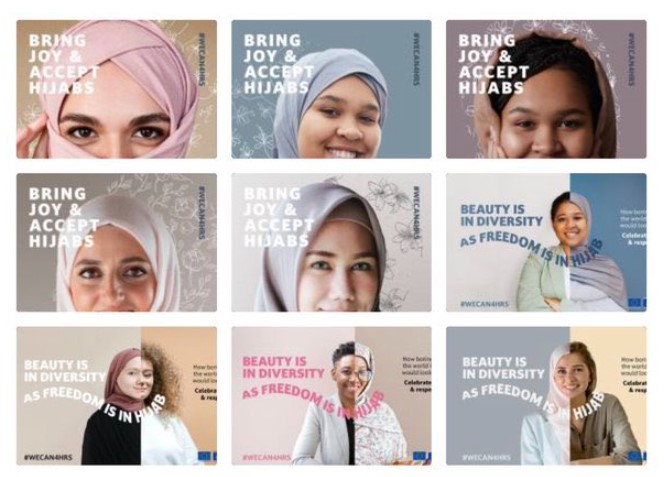
While the “Freedom is in Hijab” campaign passed in the 27 countries of the European Union under normal circumstances; the situation in France was completely different, and even shocking, as it sparked widespread controversy.
This made the campaign organizers face the inevitability of withdrawing it from circulation on November 02, because of the pressure exerted on it by the French government.
It seems that what intrigued the French was the phrase in the campaign video: “Beauty is in diversity, as is freedom in wearing the hijab.” Given that France is the only European country that has banned women from wearing the hijab in public places since 2011.
Following the cancellation of the campaign, the Council of Europe Twitter account deleted the tweets it had posted in this context.
In an attempt to calm this controversy, the Council of Europe said in a statement that it, “We withdrew the tweets promoting the campaign after the negative reaction to it, and we are considering presenting the project in a different way.”
“The campaign was part of a joint project with the European Union to combat discrimination, raising awareness about the importance of difference and the need to respect diversity and combat hate speech,” the organization indicated.
“The campaign images reflected the individual statements made by the participants in one of the project's workshops, it does not necessarily represent the position of the Council of Europe or its Secretary-General,” the council explained.
On the other hand, the European Commission, which financed the media campaign of the Council of Europe, emphasized that “women should be allowed to wear whatever they want under the laws of the countries in which they live.”
However, some young Muslim women who wear the hijab have made it clear by posting many tweets on Twitter that, “The political backlash of those who claim to represent or protect concepts such as freedom, equality and liberty, their disrespect shows diversity and the right to choose what to wear in France.”
:format(jpeg)/arc-anglerfish-tgam-prod-tgam.s3.amazonaws.com/public/MNVFRJDG4JG6RFUO74HMAZSDBI.jpg)
Political Exploitation
Claiming to encourage and promote the hijab, the French government, along with many far-right political figures in France, opposed the European media campaign that considers the hijab as part of women's freedom.
In turn, the Minister of State for Youth in France, Sarah Al-Hairy, considered in televised statements that: “Encouraging the wearing of the hijab as part of the identification process is a position that is completely at odds with secular-oriented French values.”
“We condemn this state, and France informed the Council of Europe of its rejection of this campaign, and it was canceled,” the Minister continued.
In this context, the former French Minister of Women's Rights, Laurence Rossignol, posted on Twitter, saying that “freedom is in the hijab, which means promoting it.”
What is remarkable about the case is that some political figures known for their moderation have also condemned the European campaign in support of the hijab, like Michel Barnier, the former European chief Brexit negotiator, who is seeking a nomination from the traditional right to run in the presidential election.
Barnier described the initiative as “inappropriate,” and said: “The hijab is not a tool for women’s freedom, it is the opposite,” as he claimed.
The position of Valerie Pecresse, mayor of the Paris region, another candidate for the traditional right, was no different in the campaign, “this hijab is not a symbol of freedom, but a symbol of submission,” Pecresse said.
In turn, the mayor of Nice, Eric Ciotti, considered the European campaign as “a promotion for the Islamic hijab .”

However, the biggest exploitation of the European campaign was the share of the far-right-wing competitors against Islam and immigration, who seek to oust President Emmanuel Macron in next year's elections, and who are strongly against wearing the hijab in public.
On her part, presidential candidate Marine Le Pen said: “The European campaign is scandalous and inappropriate.”
It is noteworthy that Le Pen had previously promised, in the event of her success in the elections, to issue a law prohibiting the wearing of the hijab in all public places in the country.
Likewise, the would-be French presidential candidate, Eric Zemmour, described the Council of Europe initiative as “an advertising jihad.”
It is noteworthy that Zemmour is known for his hostility towards Muslims in general, he had previously promised that if he became president, he would ban newborns in France from being named after Muhammad.
It is noteworthy that France is among the strictest European countries towards the hijab, it is forbidden to wear it at work as well as in schools, the fight against the hijab in France also has political dimensions, and politicians, especially from the far-right, are exploiting it in their current electoral campaigns.

‘Colonial Mentality’
This is not the first time that the French authorities have adopted mistreatment of the Muslim community, the same is true in other European countries, especially since the restrictions on Muslims are escalating in parallel with the rise of the far-right-wing.
On October 2, 2020, French President Emmanuel Macron presented his plan to combat what he called “separatist tendencies,” within the law Promoting the Values of the Republic.
However, the discussion later began to take a different turn, as the attempt to integrate Muslims and monitor the funding channels of associations and mosques, to fight the hijab and further legal restrictions on it.
Macron has also previously expressed his belief that the hijab is incompatible with French ideals, where the ban on the niqab and hijab was justified as a means of empowering women.
However, observers believe that this is based on the anti-Islam rhetoric, which is deeply rooted in French society and government.

The British newspaper, The Independent, had revealed in a report that France's campaigns against the hijab actually began in February 2004, when the French National Assembly passed a law prohibiting schoolgirls and government servants from wearing any sign or wearing any clothing that ostensibly shows religious affiliation.
Only several German states that had banned teachers from wearing the hijab in September 2003 preceded it in this step.
In 2011, France became the first country in the world to ban women from wearing any kind of face covering in public, the ban on the niqab at that time raised many questions about France's position on its Muslim citizens.
In 2014, the European Court of Human Rights approved the French law banning the niqab, it emphasized that France does not violate the privacy law of its Muslim citizens and their freedom of expression and belief.
In 2016, several French coastal cities banned the burkini - a full-body bathing suit - on beaches.
According to the British newspaper report, a large part of this racist French policy and anti-Islam mentality is due to France's imperialist legacy. France had previously occupied many Muslim countries in Africa and the Middle East during the twentieth century and worked to separate religion and the Arabic language from public affairs, this colonial mentality did not fade with the passage of time; rather, it formed the roots of Islamophobia that characterizes the trends of the French state in the current period.
It is worth noting that the integration of the Muslim community into French society has become an increasingly prominent political issue in recent years.