Emergency Beyond the Law: How Saied Turned Tunisia into a Permanent State of Exception
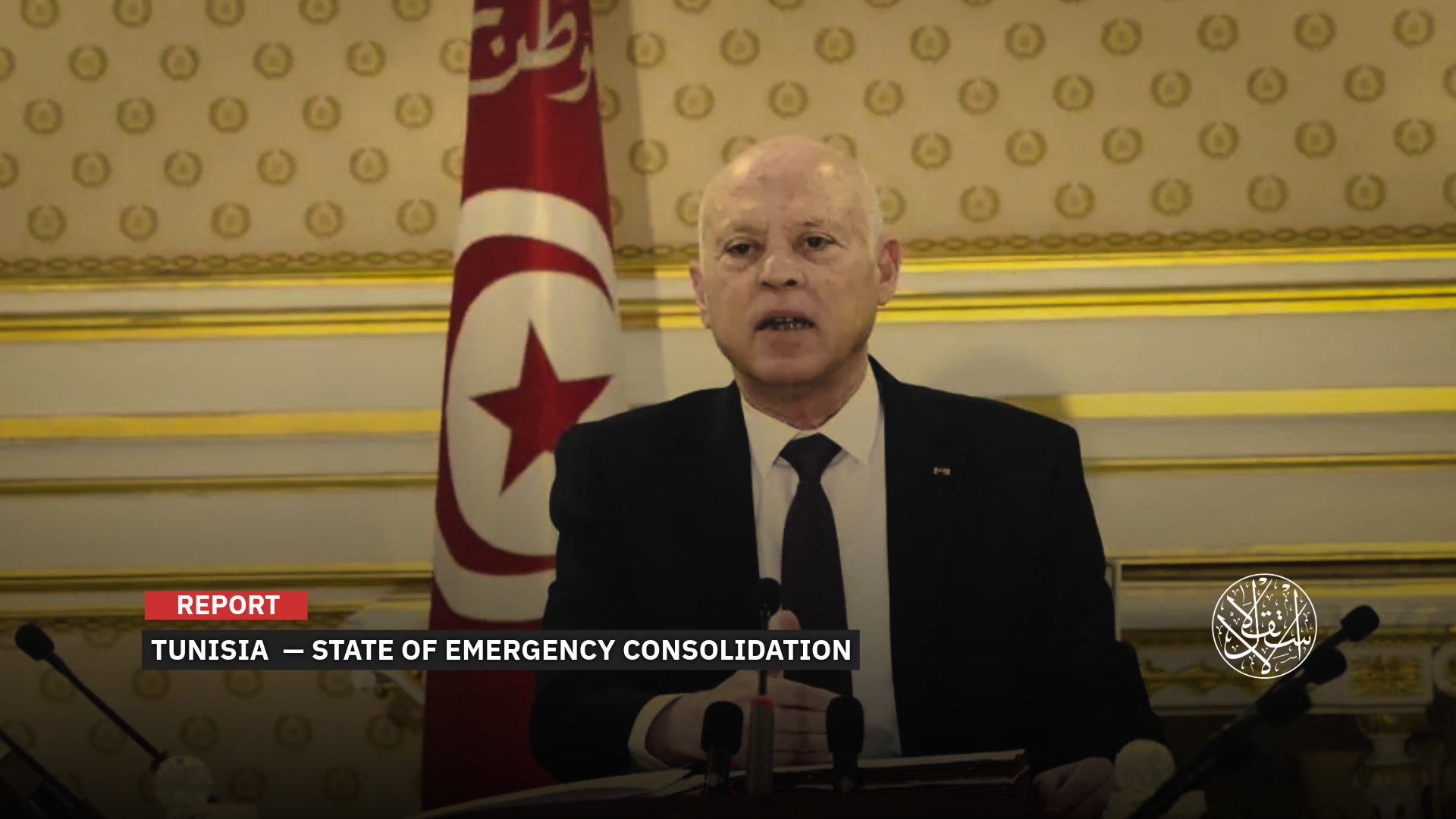
Tunisia has remained under a state of emergency continuously since 2015.
For nearly a decade, Tunisia has remained under a state of emergency in the absence of convincing justifications. This situation has enabled the authorities to broaden restrictions on public freedoms, tighten pressure on opponents, ban protests, and imprison dozens of people.
In the latest step along this path, President Kais Saied issued a new decree in late December 2025 extending the state of emergency until the end of January 2026.
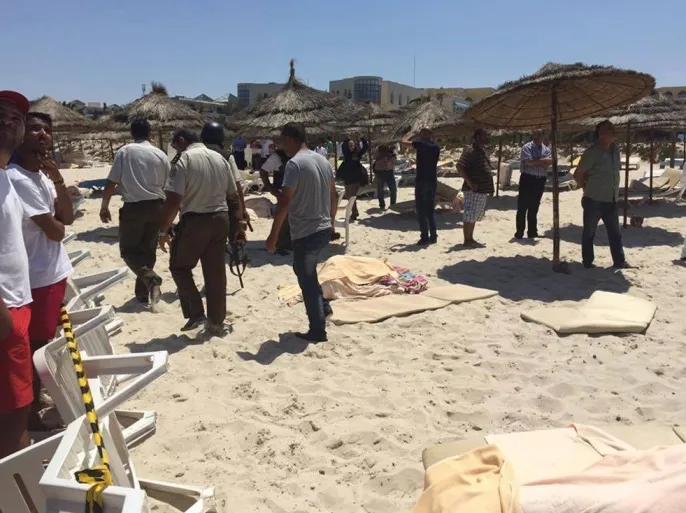
This extension comes as part of an uninterrupted series of renewals of the state of emergency, first declared after deadly attacks in 2015, when an armed assault on a tourist resort in the eastern city of Sousse killed 38 foreign tourists.
Since then, Tunisia has remained under a near-continuous state of emergency, renewed periodically under the pretext of combating terrorism and confronting what authorities describe as an “imminent threat,” despite a decline in security risks and relative stability, raising widespread questions about the motives for maintaining the measure and its continued political use.
Flimsy Pretexts
Since Kais Saied assumed power, and later staged a coup against the constitution through what he termed “any measures necessitated” on July 25, 2021.
According to Human Rights Watch, “The president suspended parliament even though Article 80 requires parliament to be in a state of “continuous session throughout such a period” and prohibits the president from “dissolving” it.”
He claimed his move was intended to “in case of an “imminent threat jeopardizing the nation, and the country’s security and independence.”
Saied quickly moved to entrench one-man rule, a shift that undermined democratic gains achieved after the 2011 revolution.
In this context, the prolonged state of emergency has become a central tool for consolidating his grip on the state and sidelining political opponents.
Since 2021, dozens of house arrest and travel ban orders have been imposed without judicial warrants on political figures, judges, and activists, under direct instructions from the Interior Ministry, drawing on the sweeping powers granted by the state of emergency.
Saied’s repeated renewals of the state of emergency rely on a presidential decree issued in 1978 under former President Habib Bourguiba, which remains in force to this day.
The decree grants the Interior Ministry extraordinary powers under the pretext of safeguarding public security and order.
These powers include banning public gatherings, protests, and strikes deemed threatening to security or public order, imposing nighttime curfews in specific areas, carrying out raids and searches without judicial authorization, imposing strict oversight on media outlets and social media platforms, and placing individuals under house arrest.
Human Rights Watch has described these measures as arbitrary and politically motivated, noting that they intensified significantly following Saied’s exceptional moves.
According to the organization, at least 50 Tunisians were placed under house arrest in the first months after the July 2021 decisions, including former officials, three members of parliament, and several judges, while dozens of others were barred from traveling abroad.
Saied justified these measures as necessary to purge the country of corruption and traitors, using the state of emergency to legitimize the detention of prominent opponents outside normal judicial frameworks.
Among them were Noureddine Bhiri, a former justice minister and deputy leader of the Ennahda movement, and Fathi Baldi, a former Interior Ministry official.
According to Human Rights Watch, both men were taken by plainclothes security officers near their homes to undisclosed detention sites, without any judicial authorization.
Hours later, the Interior Ministry announced that they had been placed under house arrest as a “preventive measure required to preserve public security,” citing Article 5 of the 1978 emergency decree.
Salsabil Chellali, the organization’s Tunisia office director, said the exceptional measures granted under the emergency decree are being exploited arbitrarily and without judicial oversight, opening the door to secret detentions.
Chellali warned that these violations undermine the authority of the judiciary and threaten the rule of law, stressing that the authorities are using the state of emergency as cover to bypass basic legal safeguards.

Practical Translation
In parallel, Kais Saied has continued to entrench his dominance over the executive and legislative branches. In 2022, he pushed through a new constitution that expanded presidential powers at the expense of parliament and the judiciary, a move that marked a fundamental shift in the nature of the political system.
That same year, he dismissed 57 judges in a single move, citing their alleged lack of loyalty and their reluctance to issue rulings he sought to see enforced.
The decision stripped the judiciary of what remained of its independence and deepened its subordination to the executive branch.
This authoritarian turn has translated into a sweeping crackdown targeting a broad spectrum of political opposition. Since early 2023, the authorities have launched waves of arrests that have ensnared party leaders, former lawmakers, lawyers, activists, and even business figures, under vague charges such as “conspiring against state security” or “terrorism.”
These accusations often lack concrete evidence and are pursued through judicial processes marred by arbitrariness and the absence of fair trial standards.
Human Rights Watch documented that by early 2025, at least 50 people were behind bars for political reasons or simply for exercising their basic rights, a figure that later rose further.
During the second half of 2025, Tunisia witnessed a series of trials widely described as harsh. In late November 2025, courts handed down prison sentences of up to 45 years against around 40 politicians, businesspeople, and lawyers in the case known in the media as the “state security conspiracy.”
Among those sentenced in recent months was Abir Moussi, leader of the Free Destourian Party, who received a 12-year prison term, alongside opposition figures Chaima Issa, sentenced to 20 years, and Ahmed Nejib Chebbi, sentenced to 12 years.
Rached Ghannouchi, leader of the Ennahda movement and speaker of the parliament dissolved by Saied, aged 84, has also been jailed on charges of “conspiring against state security,” and faces cumulative sentences that could reach 42 years.
The clampdown has not been limited to political figures, but has extended to civil society and journalists. Since mid-2023, the authorities have intensified their campaign against independent media outlets and civic organizations.
In May 2023, more than 10 journalists, lawyers, and human rights defenders were arrested over the course of several days. Human Rights Watch described the campaign as an attempt to “dismantle democratic institutions in Tunisia, undermine judicial independence, and silence freedom of expression and the press.”
Civil society organizations have faced a particularly dangerous escalation in the second half of 2025, marked by direct targeting of independent associations.
Courts issued rulings suspending the activities of 14 nongovernmental organizations within just four months, citing allegations of foreign funding or administrative violations.
Entrenchment of Authority
Against the backdrop of unprecedented political repression, coupled with a continuing deterioration in living conditions, Tunisia saw a marked surge in popular protests toward the end of 2025, reflecting growing social and political anger.
The authorities responded to the latest wave of peaceful demonstrations with a mix of official disregard and on-the-ground repression.
While President Kais Saied publicly downplayed the protests and continued to question their motives, security and judicial bodies pressed ahead with pursuing activists who took part in them and targeting their organizers.
On November 29, during a protest organized by women’s rights groups to denounce what they described as unjust court rulings, police arrested political activist Chaima Issa while she was participating in the demonstration.
Charges such as “violating the state of emergency” and “endangering public security” have also been used to open legal cases against a number of protest organizers in different governorates, on the grounds that the demonstrations lacked legal authorization.
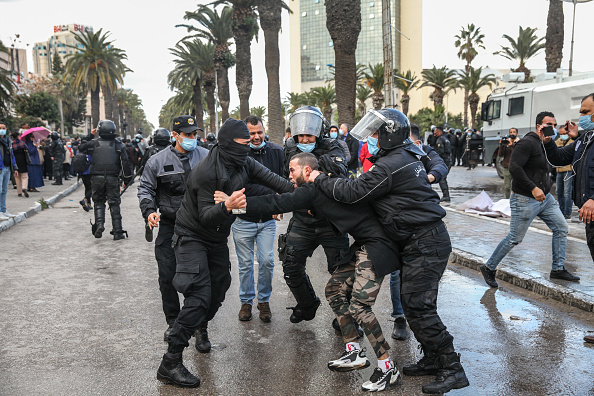
Security forces have not hesitated to use excessive force to disperse protesters. Demonstrations were met with violence, including physical assaults on demonstrators and the brief detention of some participants, in what was widely seen as an intimidation tactic aimed at deterring future mobilization.
As 2026 begins, Saied continues to cling to the state of emergency, which has become one of the central pillars of his rule, providing what he presents as a “legal” cover for continued one-man governance and a tighter grip on opponents.
The latest extension of the state of emergency followed an earlier move by Saied to renew it for a full year in January 2025, in a clear breach of the 1978 decree that stipulates emergency measures may be extended only for periods of up to 30 days, renewable within a maximum overall limit of six months.
Observers say Saied is using the state of emergency and other exceptional measures as a safety valve for remaining in power, particularly as political, economic, and social crises deepen across the country.
The measure grants him extraordinary powers to shut down any mass mobilization or genuine political competition, under the pretext of preserving security and public order.
At the same time, it sends an implicit message that the country continues to face ongoing “threats” that justify maintaining an iron grip, whether those threats are framed as genuine security risks or as political opponents portrayed as dangers to the state.
In this context, Tunisian journalist Ziad Mezghani said the current authorities are unable to offer a clear or convincing justification for the repeated renewal of the state of emergency.
Speaking to Al Estiklal, Mezghani said the current security situation is fundamentally different from earlier periods when the state of emergency was declared after the 2011 revolution, as well as from the years marked by deadly terrorist attacks, some of which targeted sovereign institutions in the heart of the capital.
He added that one of the most striking aspects of the situation is Saied’s own past stance on the decree governing the state of emergency before he came to power.
According to Mezghani, Saied had previously described the decree as illegal and unconstitutional, particularly because of its association in Tunisia’s collective memory with painful events, when the late President Habib Bourguiba’s regime used it to crush labor protests in January 1978.
Mezghani said the extension of the state of emergency at this stage cannot be separated from the rise of unstructured social unrest, fueled by a range of factors, foremost among them unemployment and growing local demands.
He also argued that the move must be understood within the context of politically organized actions by opposition forces and an accelerating wave of labor strikes, especially as the Tunisian General Labor Union moves closer to carrying out a nationwide general strike at the end of January.
Sources
- State of emergency extended in Tunisia, 10 years on
- Tunisia: Severe restrictions on liberty and movement latest symptoms of repressive emergency law
- One Year Later, Tunisia’s President Has Reversed Nearly a Decade of Democratic Gains
- Tunisia: President’s Repressive Policies Abrogate Rights
- Tunisian opposition joins forces in protest against President Saied
- Tunisia’s Growing Protests Open a Door for Low-Cost U.S. Initiatives