Dodging Accountability: Has Akhannouch Exited Morocco’s Political Back Door?
“Akhannouch’s image has faded.”
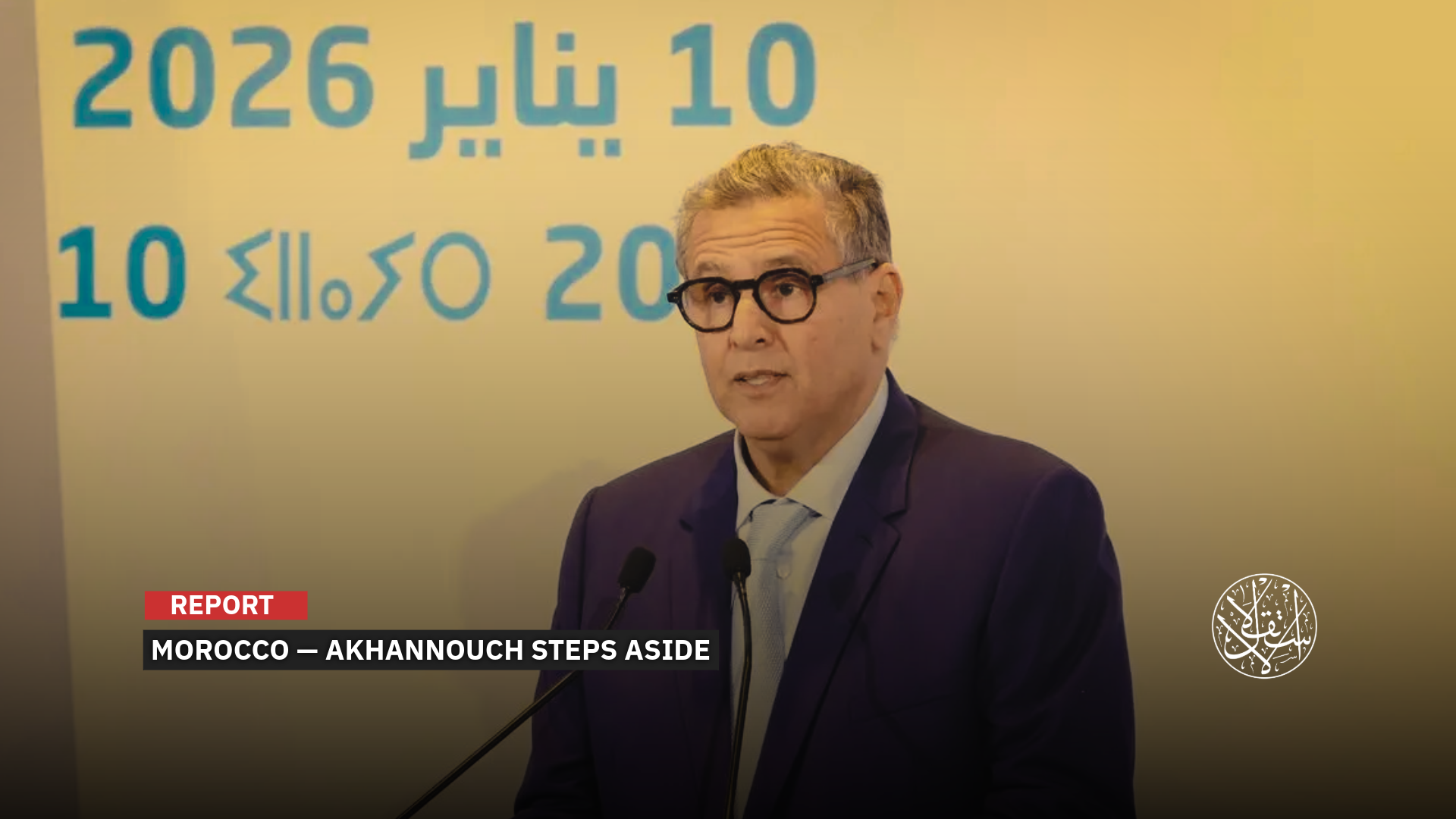
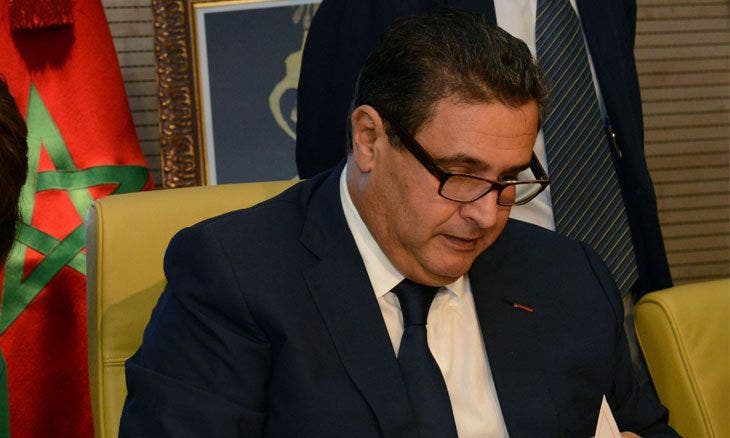
In a surprising move that sparked widespread debate in Morocco, Aziz Akhannouch, head of the National Rally of Independents (RNI) and prime minister, announced he would step down from leading the party ahead of the 2026 elections.
During a press conference on January 11, 2026, Akhannouch said he would not seek a third term as party leader at the upcoming eighth national conference scheduled for February 7.
“This is the best time to pass the torch, and no one should exceed two terms; leadership is not an inheritance,” he said.
“I have fulfilled my duty, and the party is undergoing deep development, and everyone acknowledges that it dominates the national political scene. This is a personal conviction; I will not run for a third term.”
Akhannouch led his party to victory in the 2021 parliamentary elections, became prime minister, and was re-elected as party head for a second term in 2022.
A Sudden Decision
Analysts offered competing readings of Akhannouch’s decision to step away from the helm of RNI, which leads Morocco’s governing coalition. Some argue that the same force that brought him to power in 2016 is now pushing him aside, both as party leader and, by extension, from leading the next government should his party top the 2026 elections, on the view that he has become politically spent.
Akhannouch first assumed the party leadership at an extraordinary congress in 2016, following the resignation of Salaheddine Mezouar after poor results in the October 7, 2016, parliamentary elections.
Others link the withdrawal to an attempt to salvage the party’s damaged image after repeated protests against its policies, as well as Akhannouch’s own conviction that he would be unable to secure a second term as head of government.
Political science professor Ismail Hammoudi described the move as sudden, noting that just one day before announcing he would step down from leading the party in the upcoming elections, Akhannouch had chaired the party’s National Council and gave no indication he was considering resignation.
“Neither ministers nor party leaders signaled any impending decision to step aside. Instead, discussions focused on the possibility of extending the mandates of party bodies beyond the next elections, expected in the final quarter of 2026,” Hammoudi told Al-Estiklal.
On January 10, 2026, Akhannouch announced the activation of party bylaws allowing for the extension of expired mandates during an election year to ensure continuity and avoid institutional paralysis, even though those mandates, including his own as party leader, were due to expire in March.
Hammoudi said the abruptness of the decision was underscored by the absence of a preparatory committee for the conference and the failure to launch local and regional conferences to elect delegates, organizational steps that should have begun well in advance, particularly since the conference was scheduled for February 2026.
He added that the decision stunned the RNI, especially given that Akhannouch had addressed the National Council just a day earlier about achievements and preparations for winning the next elections.
According to Hammoudi, Akhannouch used the sudden resignation to manufacture a political moment documenting a departure that would have been expected had the party held its regular national conference in the coming months, given that he had already completed his second term as party leader.
Younes Maskin, news director at The Voice (Sawt al-Maghrib), argued that the state had effectively played a “red card” to push Akhannouch aside as part of its arrangements for the next phase.
In an editorial titled “Akhannouch Is Fired,” Maskin said the prime minister experienced something akin to an early expulsion, only hours after addressing the party’s National Council while promising extensions for party bodies.
In real democracies, he added, the leader of the ruling party doesn’t step aside before the vote. He runs, defends his record, and lives with the voters’ verdict.
Announcing withdrawal before the vote, and in such haste, should not be read as humility or self-sacrifice, but as an attempt to escape a moment of reckoning.
He concluded that what happened was a full-fledged ousting: a leader who, on Saturday afternoon, was speaking confidently about extensions and promising a statement to cement continuity, only to wake up Sunday morning forced to walk it all back, override his own party institutions, and hurriedly open the door to an extraordinary council ahead of the scheduled one.
Public Anger
Akhannouch’s sudden exit sparked questions about the motives behind a move that came out of nowhere, especially as both public expectations and his own statements had signaled the ruling party was on track for another electoral win.
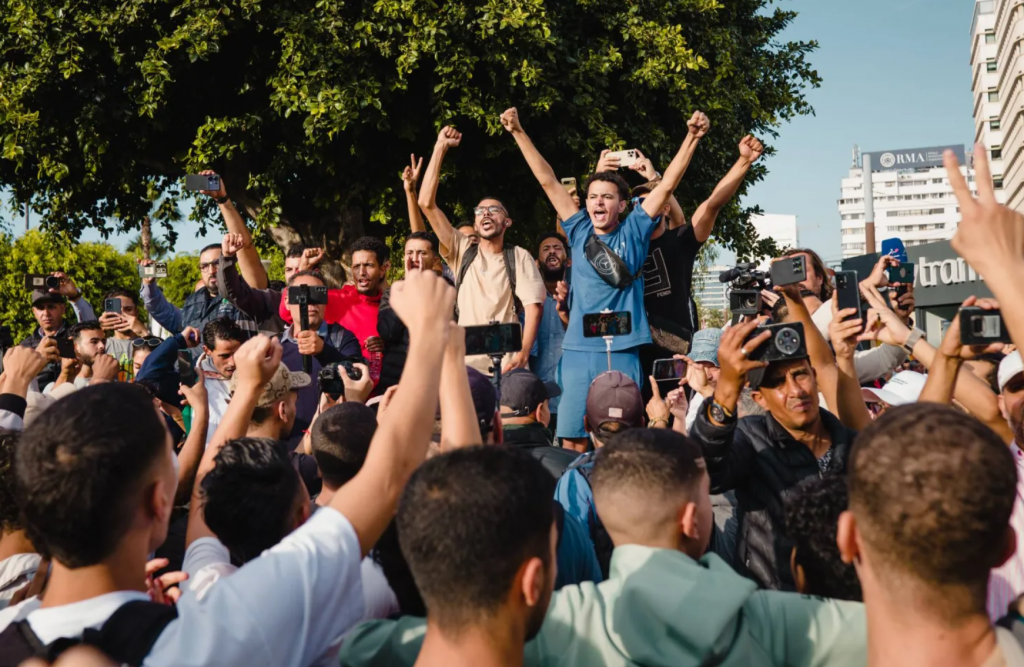
Hassan Bouyakhf, editor-in-chief of the local outlet Tiqa TV, attributed the move to the sharp erosion of Akhannouch’s political image during his term in office, as he became a focal point of public anger, from recent protests organized by the Gen Z movement to broader waves of demonstrations across Morocco.
In an editorial titled “Akhannouch Is the Headline, Not the Story,” Bouyakhf said Akhannouch’s image has faded due to its association with files that sparked intense political controversy, chief among them allegations of conflicts of interest centered on government contracts awarded to companies he owns or is linked to.
Politicians and observers pointed in particular to what they described as conflicts of interest in the Casablanca-Settat Desalination Project, awarded to a consortium including Spain’s Acciona, Green of Africa, and Afriquia Gaz, a subsidiary of the Akwa Group owned by Akhannouch.
Bouyakhf argued that, as a result, it would be a grave mistake to bet on Akhannouch as a symbol, a force, or a communications engine during election campaigns, or as a candidate to lead the 2026–2030 government.
He suggested that Akhannouch’s retreat from the party scene and the effort to deflect public anger away from the government and the RNI may be among the goals of the party’s current organizational maneuvering.
Journalist Mourad Borja argued that Akhannouch’s withdrawal goes far beyond a routine organizational move or a personal decision framed as political wisdom or renewal by some sympathizers.
Borja said the decision marks the first clear—if belated and muddled—admission of the failure of a governance model sold to Moroccans in 2021: the “successful businessman” who would run government like a corporation, guided by numbers rather than politics, management over social conflict, under the banner of a technocratic administration.
In a Facebook post on January 16, he added that the withdrawal was meant to relieve pressure on a front that had been completely spent—the RNI—which he described as never having been a true political party, but rather an electoral and managerial tool that served its purpose before losing its effectiveness.
“When a tool loses its effectiveness,” Borja concluded, “it isn’t refurbished morally; it’s replaced with a cheaper alternative.”
Borja argued that Akhannouch’s decision didn’t happen in a vacuum but within a tense social and political climate shaped by a new generation of protesters working outside traditional channels and speaking in a more direct, confrontational tone.
He concluded that when three forces collide—a restless youth challenging traditional authority, a scandal exposing serious conflicts of interest, and a government unable to channel public anger or offer a clear path forward—the state acts to safeguard stability, not protect any one individual.
In recent months, Akhannouch has hit particularly rough patches, most notably when members of the Gen Z movement sent a letter to King Mohammed VI demanding his resignation and the removal of his government, citing its failure to uphold Moroccans’ constitutional rights and address their social demands.
‘A New Rule’
While many analysts have framed Akhannouch’s decision to step aside as the result of him becoming a “burned card,” no longer able to function as a symbol, a political force, or an electoral engine for a second term, political science professor Abderrahim el-Alam suggested that Morocco may be following an unwritten rule: prime ministers simply don’t serve two consecutive terms.
Speaking to Al-Estiklal, el-Alam noted that despite the victory of the Socialist Union of Popular Forces (USFP) in the 2002 elections, Abderrahmane Youssoufi did not lead a second government. The same scenario unfolded after the Justice and Development Party (PJD) won the 2016 elections, when Abdelilah Benkirane ultimately did not remain prime minister following the political deadlock known as the “blockage.”
In March 2017, King Mohammed VI intervened to end that deadlock, appointing Saad Dine Elotmani, then the party’s second-in-command, as prime minister in place of Benkirane.
El-Alam argued that, to avoid a similar embarrassment, Akhannouch chose to leave the ship before being forced off, assuming his party were to finish first in the next elections.
He added that the RNI is unlikely to top the upcoming vote, as political actors once aligned with Akhannouch have begun packing their bags and looking elsewhere, particularly after he announced he would not seek another term.
Warning that the party’s leadership is living in what he described as a “denial of reality,” el-Alam said governing parties often convince themselves they are headed for another mandate.
He compared the situation of Akhannouch’s RNI to the PJD in the 2021 elections, which clung to a “state of denial” right up until the results were announced, despite all signs pointing to its decline. In that election, the party plunged dramatically, dropping from 125 seats in the lower house to just 13.
Journalist Younes Dafkir noted that the general, unwritten rule emerging from political practice seems to be that the office of prime minister does not allow consecutive terms.
Dafkir added in a Facebook post on January 28 that regardless of who holds the office—whether from the left, from Islamist movements, or from what he described as the state establishment—the rule remains the same: one term is enough.