How Islamophobia in Austria Became Systematic Policy
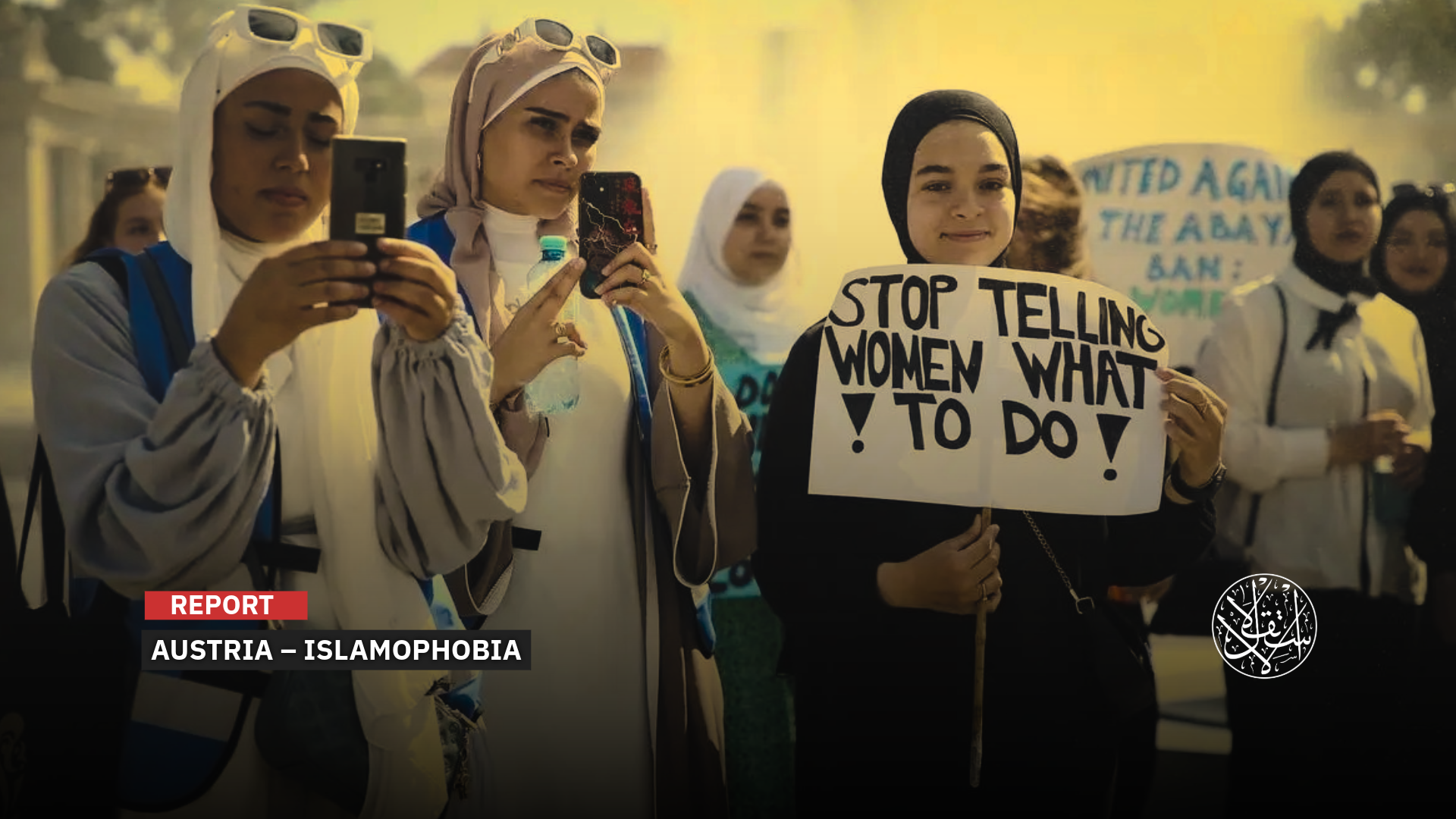
“The hijab ban is not an isolated incident but rather part of a broader trend of rising Islamophobia in Austria.”
Austria’s recent decision to maintain the ban on headscarves for girls in primary schools continues to spark controversy, raising crucial questions about religious freedom, social integration, and rising Islamophobia.
While supporters claim the ban is a signal against political Islam, critics argue it is a discriminatory measure that violates the constitutional rights of Austrian citizens.
By targeting Muslim girls and restricting their religious expression, the hijab ban creates a two-tiered system of citizenship, in which Muslims are treated as second-class citizens.
Muslims make up approximately 8.3% of Austria’s population and are an integral part of the country’s social and economic fabric.
However, they often face significant challenges, including discrimination, prejudice, and Islamophobia.
Studies have shown that Muslims in Austria suffer from higher unemployment rates, lower levels of education, and limited access to social services.
Negative stereotypes and biased media coverage contribute to creating a climate of fear and mistrust, making it difficult for Muslims to fully integrate into society.
Negative Discourse
Turkish writer and academic Mustafa Berat Keskin believes that Islamophobia in Austria is no longer a passing social phenomenon, but has transformed into a systematic policy managed with meticulous tools.
According to his analysis, this approach is fueled by organized campaigns backed by regional pressure networks, most notably the UAE, which has become involved in several European issues related to curtailing the Muslim presence and distorting its image.
In an article published in the Turkish newspaper Star, Keskin explained that the ongoing debate in Austria about so-called political Islam is being used as a pretext to impose strict measures that affect the daily lives of Muslims.
These measures range from issues of hijab and social assistance to educational policies and family reunification.
The writer pointed out that immigration, integration, and coexistence in Austria are no longer presented as procedural social issues, but have become closely linked to security concerns, political campaigns, and the problems of Austrian society.
He noted that what is known as the Austrian Integration Index constitutes the core of this hardline approach.
He explained that this index, a periodic opinion poll commissioned by the Austrian Integration Fund, not only measures public opinion trends but also serves as a tool for shaping them.
He pointed out that the results are often presented to the public in conjunction with sensitive government decisions concerning immigration and integration, thus granting those decisions a degree of prior public legitimacy.
He quoted public opinion researcher Peter Hajek, who oversaw the most recent poll published in December 2025 in cooperation with the Ministry of Integration, as saying that these opinions have remained relatively unchanged for years.
According to the poll results, approximately 15% of respondents are categorically opposed to immigration, while others accept it only under strict conditions.
However, the author considered the most alarming aspect to be the stark contrast in Austrian society's view of coexistence with different groups of immigrants.
Coexistence with Ukrainians enjoys a positive 24-point difference, while the situation is completely reversed when it comes to Muslims, where the difference reaches -41 points.
This contradiction reveals that the problem is not immigration itself, but rather the identity of the immigrant, and that Muslims have become the central target of negative discourse.

Political Exploitation
The study also showed that the most prominent concerns of public opinion in Austria are the cost of living, followed by healthcare and social welfare issues, then immigration and integration, with political Islam coming in fourth place. Keskin saw this as an indication that this concept has become a major source of societal anxiety.
The author pointed out that the survey also revealed widespread public support for stricter policies, with 86% of participants supporting reducing social assistance for those who do not comply with integration requirements, while about 80% believe that such assistance should only be granted after the integration process is complete.
Furthermore, 73% support banning the hijab, and 68% welcome imposing restrictions on family reunification.
The author considered these figures evidence of widespread societal acceptance of measures that infringe upon fundamental rights and freedoms.
The author concluded that these figures reflect a societal normalization of discriminatory policies, which have been gradually marketed through a discourse of fear and security.
He asserted that the ruling Austrian People's Party (OVP) has been the most vocal exploiter of this data for political gain, using the integration survey results in its social media campaigns.
The party posted on Instagram: “Did you know? Two-thirds of people find it difficult to live with Muslims,” concluding with the statement, “Integration is not an option, it's a necessity.”
He explained that this rhetoric provoked strong reactions from opposition forces.
Finance Minister Markus Marterbauer and Vienna Mayor Michael Ludwig criticized the OVP's practices.
The Social Democratic Party's youth wing went even further, filing a lawsuit against the OVP and Integration Minister Claudia Plakolm, accusing them of inciting hatred against Muslims, thus taking the political debate to the courts.
This development is linked to the growing Emirati role in supporting campaigns against political Islam in Europe, through funding research centers, influencing security discourse, and building partnerships with right-wing and conservative parties.
Some writers have argued that Austria has become a model for how this rhetoric can be transformed into state policy that legitimizes discrimination in the name of security and integration.
He concluded that what Austria is experiencing is not an isolated case, but rather part of a broader, carefully orchestrated European wave, where fears are being cultivated, statistics are being manipulated, and Muslims are being redefined as a security challenge.
Amid this wave, regional powers—most notably the UAE—are seeking to export their battle against political Islam to Western capitals, even at the cost of undermining the values of pluralism and human rights that Europe has long championed.
Unconstitutional Ban
Austria has undergone transformations that have somewhat altered its political landscape. Jorg Haider became one of the most successful far-right leaders, promoting his party, the Austrian Freedom Party, by exploiting and encouraging anti-immigrant sentiment in the country.
After Islamophobia became politically pervasive in Austria, the Freedom Party's anti-Muslim policies were gradually adopted and implemented by the center-right Austrian People's Party.
The People’s Party began implementing a long list of anti-Muslim policies that it appeared to have borrowed from Haider and others whom it considered dangerous extremists.
Under the leadership of the Austrian People’s Party, mosques were closed, hijab were banned in many educational institutions, and plans were drawn up to eventually ban them for university students and civil servants.
In December 2025, the Austrian parliament passed a bill banning headscarves in schools for girls under the age of 14, a move described by human rights organizations and experts as discriminatory and exacerbating societal divisions.
The bill was adopted by an overwhelming majority, with only the opposition Green Party voting against it, despite warnings that it was unconstitutional and targeted Muslims.
The ban includes all forms of headscarves on school grounds and will come into full effect at the start of the new school year in September, as explained by Integration Minister Plakolm during the bill's presentation.
However, a preparatory phase begins this month, during which the new rules will be explained to teachers and students. No penalties will be imposed for violations, but in cases of repeated offenses, parents could face fines ranging from €150 to €800.
The government defended the measure as a way to empower girls and protect them from oppression.
According to the government, approximately 12,000 girls and teenagers will be affected by the new law, based on estimates derived from a 2020 study that indicated around 3,000 girls under the age of 14 were wearing headscarves.
The FPO has called for a complete ban on headscarves in all schools and a law banning political Islam, further marginalizing and demonizing the Muslim community.

In contrast, Amnesty International stated that the law constitutes blatant discrimination against Muslim girls and described it as an expression of Islamophobia.
Experts have suggested that it could be seen as discriminating against Islam and placing children in an uncomfortable position.
In this context, the Islamic Community in Austria stated that it categorically rejects all forms of coercion and affirmed its intention to challenge the law before the Constitutional Court.
This controversy is reminiscent of the 2019 ban on the hijab in Austrian primary schools, which was subsequently struck down by the Constitutional Court as discriminatory and unconstitutional.
A recent report by the Austrian NGO SOS Mitmensch highlighted the FPO leader Herbert Kickl portraying modern-day Austria as a nightmarish place, using darkened imagery to depict Muslims and Black people as threats.