Clashes in Libya's Capital: Civil War Revival or Move Toward Military Unity?

A dispute between the head of the Support Apparatus and the commander of Brigade 444 has sparked clashes in the Libyan capital.
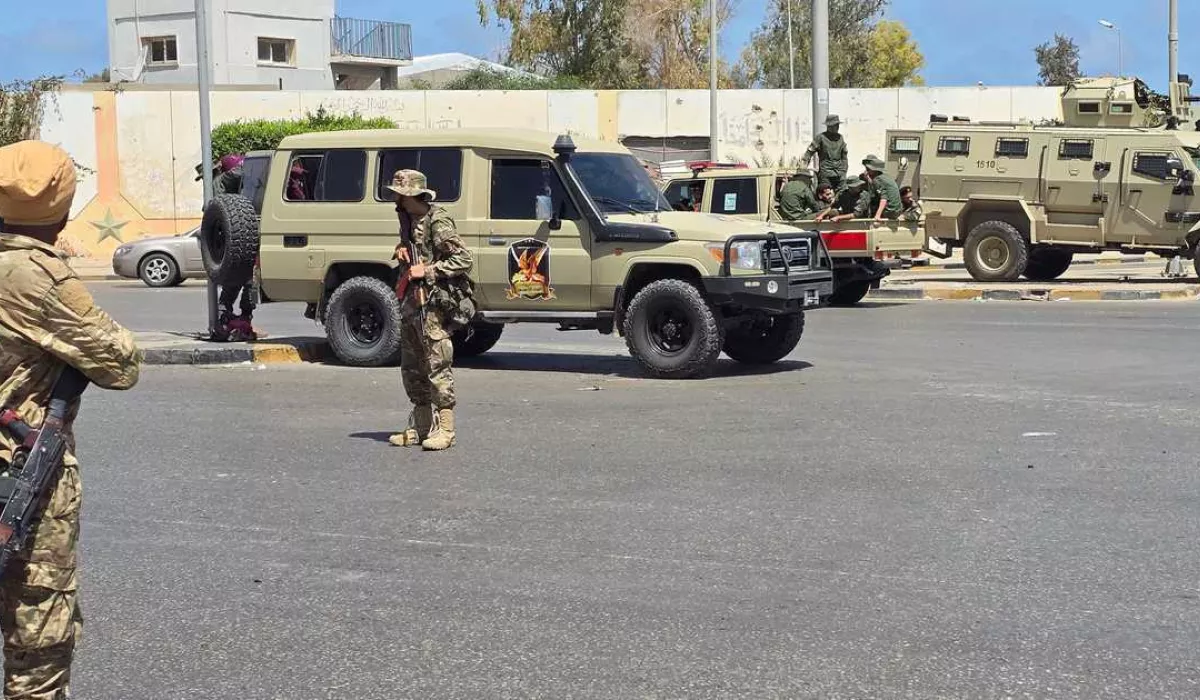
In a scene that underscores the ongoing military complexities in Tripoli since the fall of Muammar Gaddafi in 2011—marked by the proliferation of multiple armed factions unlike the unified forces of Khalifa Haftar in eastern Libya—the capital witnessed a fresh outbreak of violence and deadly clashes.
The fighting chiefly erupted between two groups claiming to defend Tripoli: the “444 Combat Brigade,” aligned with the Ministry of Defence under Prime Minister Abdulhamid AlDabaiba, and the “Stability Support Apparatus,” a militia loyal to the Presidential Council.
The clashes stemmed from a long-standing rivalry between Abdul Ghani al-Kikli, known as "Gheniwa," commander of the Stability Support Apparatus, and Mahmoud Hamza, leader of the 444 Combat Brigade.
The two factions had clashed before, but this time al-Kikli was killed—either in a premeditated ambush or during the fighting, according to differing accounts.
His death appears to be part of a calculated and prearranged move, Libyan sources familiar with the matter told Al-Estiklal, aimed at eliminating rebellious militias opposing the government’s authority and ensuring the formation of a unified army in Tripoli capable of confronting the insurgent Khalifa Haftar, should the conflict between east and west persist.
The timing of these security and military shifts to curtail al-Kikli’s influence coincided with ongoing UN-led efforts to establish a new political and security framework in Libya.
This includes a roadmap for the next phase, featuring the formation of a new government and upcoming elections.
What Happened?
According to multiple Libyan sources speaking to Al-Estiklal, the situation in Tripoli can be summarized as follows:
After the fall of Gaddafi, a variety of militias and tribal armed groups emerged—some formed by former revolutionaries who fought in the 2011 uprising.
These groups also resisted Khalifa Haftar’s forces during his attempted takeover of Tripoli in the 2019-2020 Battle of the Volcano of Anger.
However, following the Battle of the Volcano of Anger and the Libyan Government of National Accord’s decision to organize and integrate all militias into the national army under state authority, some militia warlords refused to disband their groups, unwilling to relinquish their influence and privileges.
To avert a civil war, these militias were effectively legalized under different names, designated as “apparatuses” such as the “Deterrence Apparatus” and the “Stability Support Apparatus,” through presidential decrees. Yet, over time, they grew increasingly powerful, imposing their will by force on state affairs.
The militias became, at least nominally, subordinate to the Presidential Council and received their funding through it, under the authority of the commander-in-chief of the armed forces. Yet in practice, they remained loyal to their own leaders rather than the state.
One of the most prominent of these rebellious militias is the Stability Support Apparatus, led in Tripoli by Abdul Ghani al-Kikli, known as “Gheniwa.”
Al-Kikli was previously imprisoned during the Gaddafi era on criminal charges, and his forces have been accused of engaging in acts of intimidation and looting.
On May 6, 2025, armed men from Gneiwa’s faction stormed the state telecommunications company, extorting its director into signing contracts with shell companies linked to the militia leader.
The incident escalated when the director was shot in the foot—marking the peak of the group’s brazen criminal activity.
The Tripoli-based government intervened to restore order, demanding that Gheniwa hand over those responsible for the attack on the company director.
A deadline was set—but he refused. Officials noted a worrying mobilization of loyalist forces arriving from Misrata, signaling possible escalation.
On May 13, 2025, Gheniwa was summoned for talks at the Tikbali military base in the capital. He arrived flanked by ten of his bodyguards.
During the meeting, tensions flared, and the negotiations quickly descended into heated exchanges.
The verbal spat quickly escalated into an armed clash between the guards, leaving Gheniwa and all ten of his bodyguards dead, along with three senior Libyan army officers who had been present at the meeting.
Observers and political insiders in Libya were quick to suggest the incident had been premeditated—an orchestrated move to forcibly neutralize Gheniwa.
Their suspicions were reinforced by what followed: a pre-positioned show of force by the Ministry of Defence and police, and the swift imposition of a citywide curfew.
It began with Gheniwa’s militia, but the broader aim was far more ambitious: to dismantle all the armed groups that had once been legitimised in post-2011 Tripoli, only to later go rogue. The ultimate objective—bringing all weapons and military authority under a unified national command in the capital.
Following fierce clashes concentrated in the Salah al-Din and Abu Salim districts, forces from the 444th and 111th brigades successfully took control of the Stability Support Apparatus’s headquarters.
The army moved swiftly to assert control, with the Stability Support militia losing the bulk of its strongholds across the capital. Within just three hours, military forces had quelled the unrest, dismantled the militia’s presence in Tripoli, and brought an end to its grip over the Abu Salim district.
The Era of Militias is Over
Following the cessation of clashes, Libyan Prime Minister Abdulhamid AlDabaiba announced on May 13, 2025 that the Ministries of Interior and Defence had successfully restored security in the capital, Tripoli.
He described the events as “a decisive step towards dismantling irregular armed groups and affirming the principle that there is no place in Libya but for state institutions, and no authority but that of the law”—a statement widely read as confirmation that the operation had been carefully orchestrated in advance.
In a meeting with Major General Mahmoud Hamza, commander of the 444th Combat Brigade, Interior Minister Imad Trabelsi, Deputy Defence Minister Abdul Salam Zubi, and the head of military intelligence, Prime Minister Abdulhamid AlDabaiba underscored that “the era of parallel security apparatuses is over.”
“There is no place in Libya but for legitimate institutions—the army and the police alone,” he declared. “No armed entity operating outside the Ministry of Defence and the Libyan Army shall be granted legitimacy. No exceptions.”
On May 13, 2025, Prime Minister Abdulhamid AlDabaiba issued a series of decisive decrees aimed at asserting state authority and re-establishing the rule of law.
He stressed that there would be no room henceforth for chaos or violations, declaring that all security responsibilities fall strictly within the remit of the state’s official institutions.
Will Civil War Break Out?
Following the clashes — which have now erupted twice — a pressing question has emerged: will AlDabaiba’s plan succeed in reining in the myriad militias operating in Tripoli and pave the way for unifying the country and holding elections?
Or will the continued existence and armament of these groups, coupled with fears of foreign interference, plunge Libya back into civil conflict and further complicate the already volatile military and political landscape in the capital — and the country at large — where each lull in fighting has so far proven to be only temporary?
“While the killing of al-Kikli — known as Gheniwa— triggered border clashes, with loyalist militias mobilising to avenge his death and the capital sustaining damage amid exchanges of fire, the Ministry of Defence ultimately asserted control,” a Libyan journalist and analyst told Al-Estiklal, speaking on condition of anonymity. “That swift response likely reduced the risk of a full-blown civil war,” he added.
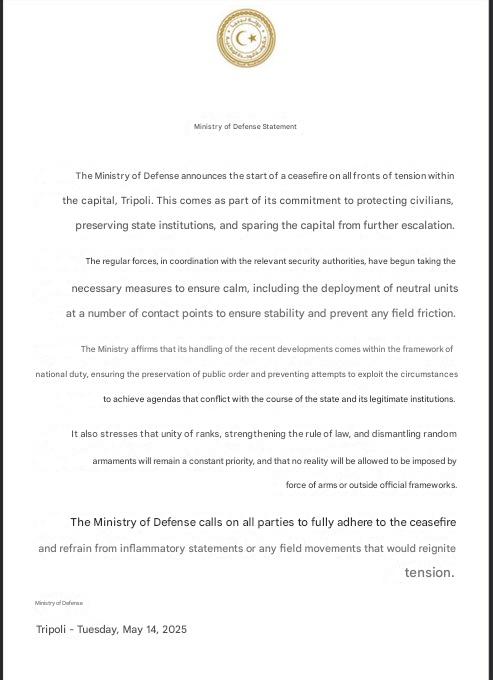
Despite the defence ministry's declaration of a ceasefire and deployment of forces to restore order, sporadic clashes persisted in the western and southern outskirts of the capital, as armed groups from outside Tripoli hostile to AlDabaiba's government began to mobilize.
An official from the interior ministry acknowledged “urban warfare” and “intermittent clashes with light and medium weaponry within residential areas,” adding that heavy arms were being used to target rival factions’ military sites.
Meanwhile, protests erupted across parts of the city — some calling for AlDabaiba’s ousting, others rallying in support of his government.
Presidential Intervention
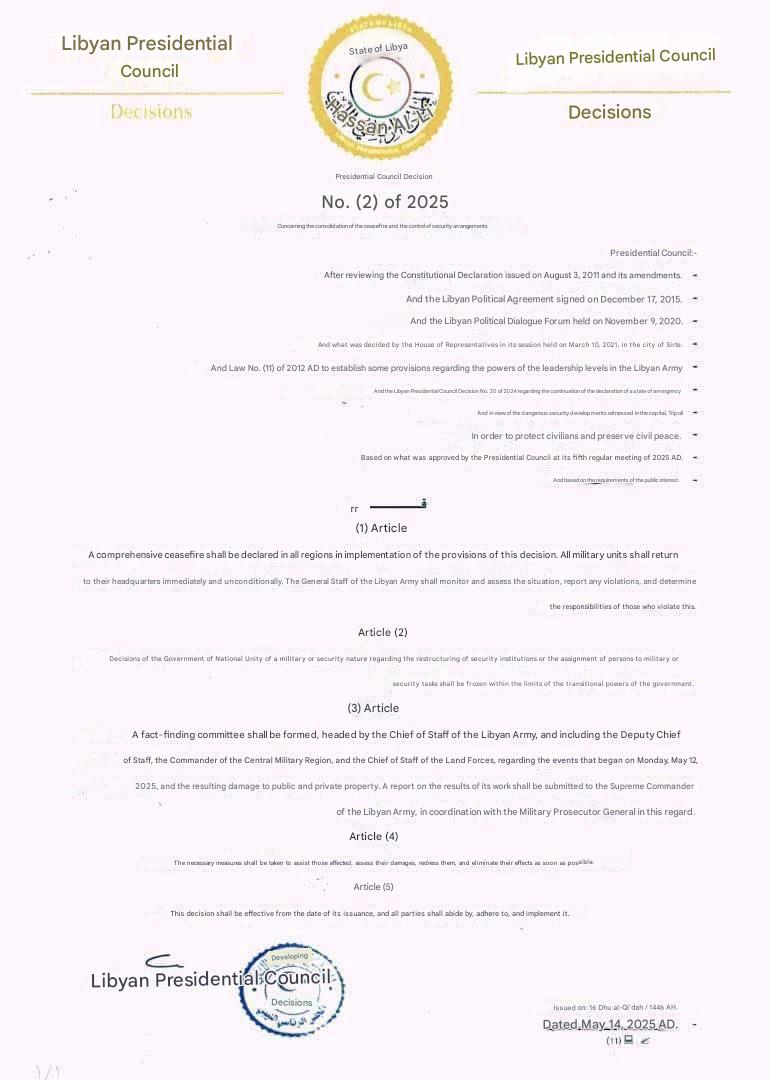
The most significant development came with the Presidential Council’s outright rejection of AlDabaiba’s decisions, freezing all measures issued by the Tripoli government and imposing a comprehensive ceasefire across all regions. The council also ordered every military unit to return immediately to its barracks.
Issuing the directive in its capacity as the supreme commander of the Libyan army, the Presidential Council justified the suspension of AlDabaiba’s orders by stating they involved “restructuring security institutions and appointing individuals to military or security roles—powers that exceed the transitional government’s remit.”
The security apparatus targeted by the government’s decisions is closely linked to figures allied with Abdul Ghani al-Kikli, who helped them secure sensitive positions.
Among them is Osama Talish, head of the Facilities and Installations Security Authority, responsible for safeguarding government buildings.
Also implicated is Lotfi al-Harari, who led the Internal Security Agency. Both were key aides to al-Kikli in commanding his forces and are believed to have fled Tripoli.
The Libyan journalist believes that the protests staged by Gheniwa’s supporters, calling for the removal of AlDabaiba’s government and met with a security crackdown, only served to heighten tensions—prompting the Presidential Council to intervene in an attempt to ease the situation.
This was especially pressing as Mohamed al-Menfi had just emerged from a political battle with the Libyan House of Representatives, according to a previous report by Al-Estiklal.
What’s Haftar’s Role?
Khalifa Haftar and his forces play no direct role in the fighting within Tripoli. However, both he and the UAE are believed to encourage and exploit internal conflicts in the capital, seeking to fuel divisions that ensure his army remains the dominant power.
With his eyes firmly set on Tripoli—and having launched two failed offensives on the city in 2019 and 2021—Haftar continues to bide his time, recently repositioning a small number of troops near the capital in anticipation of future opportunities.
Heavy military vehicles loyal to Haftar have been moved from Benghazi to Sirte, while large convoys crossing the Ras Lanuf checkpoint were seen heading westwards near the capital, in what witnesses describe as preparations for a possible sudden assault.
Sources told Al-Estiklal that the AlDabaiba government anticipated Haftar would seek to exploit the unrest in Tripoli by mobilizing certain forces to sow further chaos—especially given the presence of sleeper cells loyal to him in az-Zawiya and Tarhuna.
It is also reported that a key driver behind AlDabaiba’s push to dismantle armed militias in the west was intelligence suggesting Haftar’s attempt to supply weapons, reportedly sourced from North Korea and China, to militias in the region.
This move appeared aimed at establishing a military foothold in the area under AlDabaiba’s control.
Haftar’s manoeuvres reportedly unsettled AlDabaiba, prompting him to hold intensive meetings with the interior ministry and military officials to coordinate a military campaign targeting all armed militias opposing his rule in the west.
Eliminating Haftar’s proxies, it is believed, would force the warlord to the negotiating table, creating a political climate conducive to restarting talks on Libya’s elections and advancing a new political roadmap amid the ongoing divide between east and west.
However, Libyan analysts and journalists on social media have dismissed the circulating images and videos purporting to show Haftar’s forces moving towards western Libya and Tripoli as propaganda spread by pro-Rajma factions, insisting there is no basis to these claims.
They stressed that Haftar’s militias are currently facing internal tensions and instability, with the Cyrenaica region simmering with unrest that could spiral out of control.
In addition, Haftar’s forces have been rocked by the scandal surrounding the alleged torture of parliamentarian Ibrahim al-Dersi, exposing the authoritarian nature of Haftar’s regime.
On May 13, 2025, the French intelligence outlet Africa Intelligence reported that the International Criminal Court may take legal action against those involved among Haftar’s supporters following al-Dersi’s revelations, with prosecutor Karim Khan potentially issuing arrest warrants against them.
Future Expectations
The significance of these developments lies in the fact that since the 2011 uprising, Tripoli has never been governed by a unified military or civilian authority.
Instead, the capital remained subject to fragile power balances among militias that divided control over ministries, ports, security agencies, and banks.
This fragmentation weakened the city and fueled the ambitions of militia leader Haftar and his foreign backers.
Several attempts have been made to unify the military institution in the west, but all have failed, as each militia leader continued to operate as a shadow ruler over their territory, often wielding authority that at times surpassed that of the prime minister himself.
This prompted AlDabaiba to bolster the 444 Brigade and allied forces in western Libya—some linked to the city of Misrata—with the aim of reshaping the military balance of power within the capital. The killing or assassination of Gheniwa was a clear “message” to the remaining militias.
“The grip of Tripoli’s traditional warlords has been broken, ushering in a new reality that sidelines those who see continued chaos as a source of wealth and power,” Libyan sources told Al-Estiklal.
Libyan affairs journalist Alaa Farouk wrote that the recent events in Tripoli were planned as far back as Ramadan last year (April 2025), aiming to target armed groups operating outside the control of AlDabaiba’s government.
On Facebook, citing a “Libyan security source,” he confirmed that the forces involved in the operation included Misrata brigades, led by the 63rd Brigade, alongside units from Zintan, the Interior Ministry forces, law enforcement, and the 111th and 444th brigades.
He explained that Abdul Ghani Al-Kikli, head of the Support and Stability Apparatus, was a primary target due to his financial expansion and external connections.
Tensions had escalated between Al-Kikli and AlDabaiba’s government over control of key financial institutions, including oil and telecommunications.
Farouk therefore described the entire operation as “aimed at reshaping the military landscape in Tripoli.”
According to reports, Gheniwa, through his men, protected influence that extended to the Central Bank, the Libyan Foreign Bank, and even the National Oil Corporation. Thus, control over Tripoli equates to control over both money and power.
For this reason, Libyan journalist Imad Fathi predicts that with the fall of Gheniwa and the collapse of the Deterrence Apparatus, significant changes are likely at both the local and international levels.
He anticipates shifts in ministerial positions, security agencies, and the integration of previously disbanded armed factions into the ministries of interior and defence.
However, Libyan observers fear that the presidential council’s decision to overturn AlDabaiba’s security restructurings could allow these militias to regroup and reignite clashes, threatening Libya’s fragile stability and derailing plans for elections and the formation of a new government.
Some analysts argue that AlDabaiba’s actions were aimed at undermining the recommendations of the international advisory committee, which called for the formation of a unified government—including his own resignation.
Another camp believes that, following the presidential council’s pushback, AlDabaiba now faces a stark choice: either resign or enter into direct confrontation—raising fears that Haftar may exploit the turmoil to attempt a third assault on the capital.
Yet a third perspective suggests there is no deep rift between AlDabaiba and al-Menfi, viewing the latter’s decisions as a means to defuse tensions among supporters of the slain Gheniwa and prevent further clashes.
In this reading, Al-Menfi’s moves aim for de-escalation rather than escalation, while AlDabaiba remains the dominant force having already secured control.
Who is the Slain ‘Gheniwa’?
Abdul Ghani al-Kikli emerged as one of the most prominent figures to rise from Libya’s chaotic post-revolution landscape.
He built his power through intricate alliances and capitalised on the state’s legalization of his security apparatus, transforming it into a tool of armed influence rather than one bound by law.
Evolving from militia commander to a formidable political and economic powerbroker, al-Kikli established control over vital sectors such as oil, telecommunications, and electricity, embedding loyalists in key positions of authority.
Known as "Gheniwa," al-Kikli adeptly navigated the delicate balance between Libya’s fragile state institutions and powerful militias, leveraging his stronghold in Abu Salim—one of the most densely populated and heavily armed districts in Tripoli.

As a result, the "Stability Support Apparatus" evolved into one of the largest armed formations in Tripoli, wielding extensive influence through a vast network of fighters, weaponry, and camps concentrated in the Abu Salim district, with its reach extending into both western and eastern parts of the city.
He also managed numerous private prisons and carried out a variety of security operations, with his name repeatedly appearing in UN experts’ reports documenting widespread abuses, including involvement in illegal migration networks.
For this reason, analysts have described the events in Tripoli as a "surgical operation to extend state authority" and eliminate one of the most prominent and powerful militia leaders.