Algerian Government’s Party Law Amendments Ignite Widespread Splits: What’s the Story?
“The problem was never the number of parties, but the way they were stripped of meaning.”
Amid doubts over its “controlling” motives, the Algerian government has submitted its party law to parliament for discussion and approval, framing the move as a purely reformist step.
After the cabinet approved the draft on December 28, 2025, it is expected to follow the usual legislative process in the National People’s Assembly, the lower house of parliament, where it will be amended, debated, and eventually voted on.
The draft has drawn opposition criticism for the strict limits it imposes on political formations, including the possibility of dissolving a party if it fails to participate in two consecutive elections, effectively removing the “boycott” as a political option.
Changing the Leadership
The so-called “Draft Revision of the Organic Law on Political Parties” is presented as a key tool for streamlining and rationalizing political practice, representing a major shift in how party pluralism is managed in Algeria.
Spanning 96 articles, the draft lays out a complex procedural framework, making the survival of political entities contingent on a set of administrative, financial, and electoral obligations described as unprecedented in their severity and rigor.
The law seeks to narrow the political landscape by imposing strict standards for presence and representation. Parties must operate in half of the country’s 69 provinces, recruit 600 delegates for their congresses, and register hundreds of members in each administrative district—requirements few parties can realistically meet.
It also sets detailed rules for selecting leadership bodies and their terms, limiting the presidency or secretary-general role to five years, renewable once, without extending similar limits to other leadership structures.
The draft bars anyone responsible for “exploiting national constants that led to past tragedies, or exploiting religion, identity, or language,” or anyone linked to individuals or entities listed in the national terrorism register, from founding or joining a party, participating in its leadership, or enrolling as a member.
The proposed revisions focus on several areas, including digitizing party management through a ministry platform to simplify registration and approval, improving transparency in party administration, and ensuring equal treatment for all parties.
Among the most debated provisions is Article 42, which limits party leadership to two consecutive terms. Under this rule, leaders who have held office for more than ten years must step down.
This primarily affects Louisa Hanoune, secretary-general of the Workers’ Party (PT) since the late 1990s, who continues to wield significant political influence, and Abdallah Djaballah, head of the Justice and Development Front, who has led the party since 2012 after previously heading two others, the Islamic Renaissance Movement (Ennahda) and the Movement for National Reform (el-Islah), since the early 1990s.
The Voice of the People Party (Sawt Echaab), which holds three parliamentary seats and has been led by Lamine Ousmani since its founding in 2012, will also be required to change its leadership, along with smaller, underrepresented parties such as the al-Rashid Governance Front Party led by Issa Belhadi, the Algerian National Front under Moussa Touati, the Islamic Renaissance Movement headed by Mohamed Douibi, the Civil Concord Movement, and Ahd 54.
These weaker parties are expected to struggle under the new law. If approved in its current form, parliament would give them six months to implement the required structural and organizational changes.
Several Points of Contention
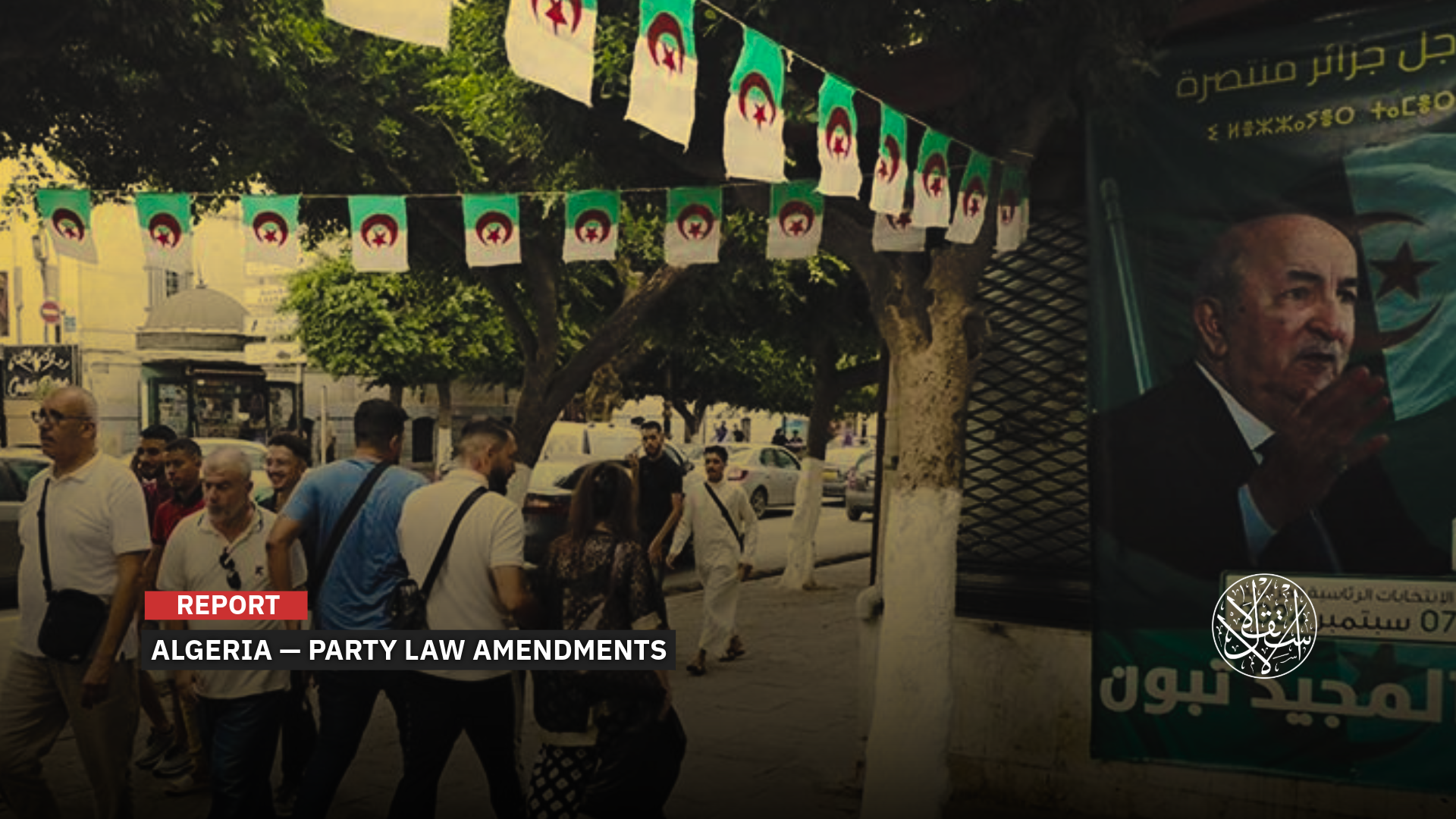
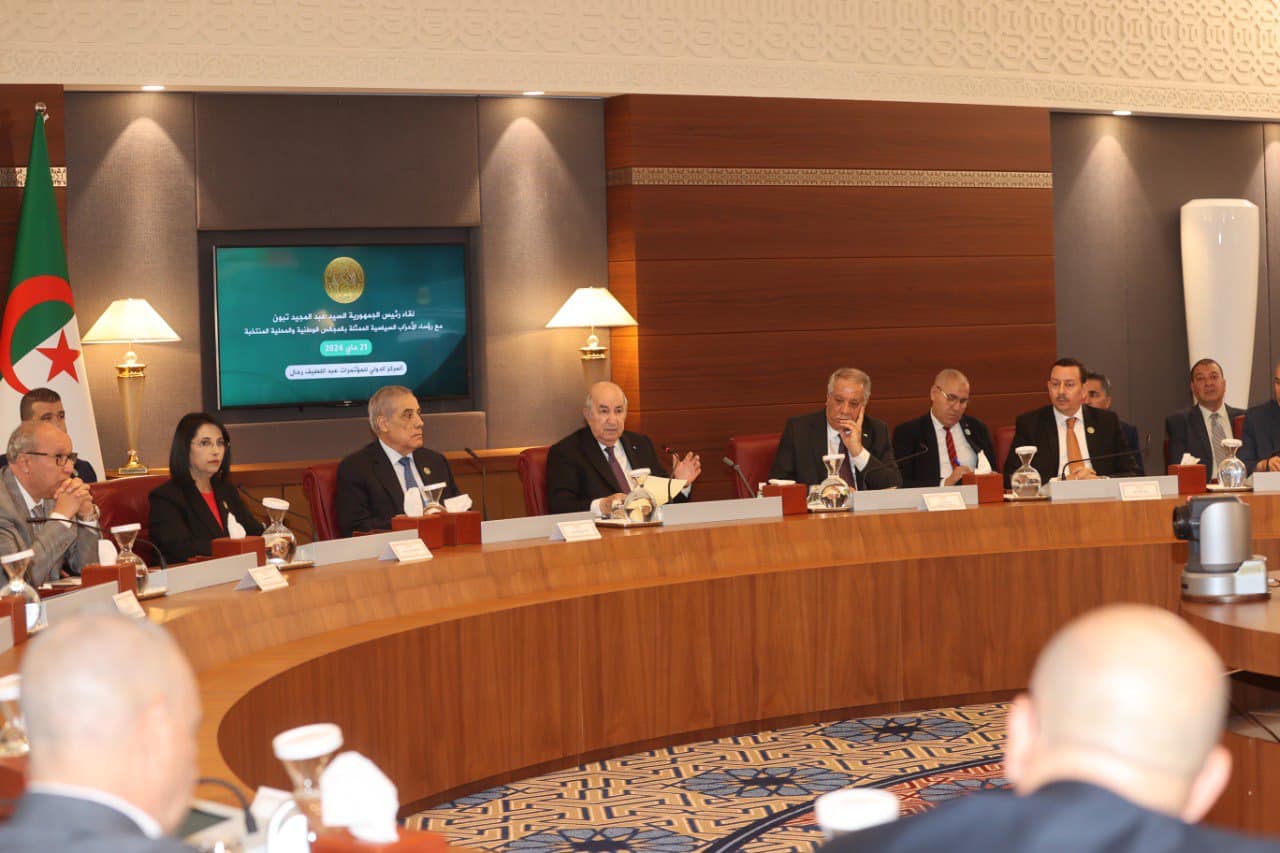
Analysts and media outlets have focused on the problems raised by the draft law, particularly the restrictions it places on the formation of parties and the way it appears to favor large parties aligned with President Abdelmadjid Tebboune’s authority.
In an analysis published on January 10, 2026, the local outlet Awras said that while the draft affirms Algerians’ right to party pluralism, it has sparked widespread concern across political circles.
The outlet noted that the text creates the impression of granting the administration powerful legal tools to tighten its grip on the party landscape.
Such measures, it added, risk reducing pluralism to little more than organizations registered with the Interior Ministry, with no real capacity to offer political alternatives or facilitate a genuine transfer of power.
University professor Djamal Dou argued that the sustained pressure on party life in Algeria makes abolishing political parties altogether the most practical outcome under the current political order.
In a Facebook post on January 7, Dou said Algeria has little in the way of genuine party or political life. What remains, he added, are presidential elections every five years, followed by the appointment of a small legislative body whose role is largely advisory and technical in implementing presidential policies.
Such an approach would save the state vast sums of money. “This could save the state a fortune. In practice, I don’t think political, economic, or social performance would change much—if anything, it might even be better than the current situation, or at least easier on the treasury.”
The professor at el-Oued University added that he did not believe the public at large would object. “Most people wouldn’t care much,” he said, “because they wouldn’t notice the difference.”
Algerian academic Abdallah Houadef linked the amendments to the party law to the 2026 elections and to parallel changes to the electoral law governing them.
In a Facebook post on December 30, Houadef noted that Algeria’s election law is revised, in whole or in part, roughly once every five years, usually ahead of legislative and local elections, citing a pattern that stretches across 1989, 1990, 1991, 1997, 2007, 2012, 2016, 2021, and now 2026.
“The party law sees revisions on a roughly ten-year cycle,” he noted, pointing out that this pattern matches the constitution’s regular updates, occurring about every six years since 1989.
“In theory, the authorities seem well insulated against any scenario in which a single political force or an opposition alliance could take power. Successive legislative measures have firmly shut the door to any unwelcome surprises.”
Houadef added, however, that decision-makers continue to tighten controls, as if they do not fully trust the existing legal safeguards or fear their defenses could crumble in the face of unpredictable political winds.
Supportive Voices
In contrast, the outlet Aljazair Alyoum argued that the draft’s provision allowing a party to be dissolved in court if it fails to field candidates in two consecutive elections marks “a step reflecting the authorities’ desire to tie a party’s legal existence to its actual political activity.”
According to an analysis published on January 6, 2026, the measure is intended to put an end to the phenomenon of “paper parties” that exist in name only, without fulfilling their constitutional role of mobilizing citizens or contributing meaningfully to democratic governance.
The outlet said the draft law outlines a new phase in Algeria’s party life, built on transparency, legal discipline, and responsible political practice, while assigning clear responsibilities to parties and elected officials toward voters and the state.
Journalist Djamal Fninech echoed this view in an analysis published by Ultra Algeria on January 6, arguing that the reform introduces strict integrity rules rooted in anti-corruption legislation. These include tighter oversight of party financing and resource management to reinforce transparency and combat corruption in political life.
On funding, the outlet highlighted Article 92, which establishes what it described as a deterrent penalty against foreign interference. The provision mandates prison sentences of five to ten years, along with fines, for any party official who receives funding or support from a foreign source, directly or indirectly.
The draft, the outlet argued, fits within the government’s broader vision of meeting state commitments to restore ethical standards in political life and to make a clean break with past practices that plagued party management.
It also aims to raise political performance by embedding principles of governance and transparency, transforming parties from temporary groupings into effective constitutional institutions that contribute to participatory democracy.
The law does not treat the right to form a party as a purely procedural matter but links it to the logistical capacity to organize and mobilize citizens, signaling a move away from the era of “microscopic parties.”
The effort, the outlet concluded, seeks to build a political landscape made up of strong entities with genuine popular support and national reach, bringing an end to fragmented political efforts and chronic organizational weakness.
Process and Perspectives
Political researcher Nesrine Jaafar said the idea to amend the law first emerged through a series of consultations led by the presidency, with input from an adviser to President Abdelmadjid Tebboune.
“These consultations covered the local and legislative elections expected in the second half of 2026, the laws governing them, and the party law itself, which plays a crucial role,” Jaafar told Al-Estiklal.
“Since taking office in 2019, Tebboune has overseen repeated attempts to amend the party law, with multiple drafts circulating before the presidency released its first working document in early 2025 detailing the proposed changes,” she added.
According to Jaafar, parties submitted their comments and proposed amendments, but the presidency seemed dissatisfied with the response.
Still, she said, the consultations were a positive step in hearing parties’ views on the law that governs them, as long as their feedback is genuinely considered.
Jaafar noted that the draft introduces sweeping changes to the framework governing party life, with the previous amendment dating back to 2012. The current proposal limits party leadership terms to two mandates.
She said the measure has split the political class between those who believe it will inject new faces into party leadership and those who see it as undue state interference, arguing that party members should be free to choose their leaders.
Debate has also centered on the provision barring any organic or functional links between parties and trade unions, a contentious issue that Jaafar believes the authorities may ultimately reconsider in light of party feedback.
More broadly, she argued, Algerian parties suffer from a marked decline in performance, driven by internal factors such as leadership structures, management practices, and political positions.
She added that broader conditions in Algeria also play a role, suggesting there may be an official inclination to elevate civil society at the expense of political parties.
Seen differently, Algerian political activist Djamel Soualah argued that the crisis facing parties has little to do with legal texts and everything to do with the current political environment, in which qualified figures are pushed out of public life and elites are sidelined.
In a Facebook post on January 6, Soualah said this reality has exhausted citizens and driven widespread disengagement, underscoring that the problem lies not in the laws themselves but in those who control and apply them.
He argued that the authorities are acting as if the flaw lies in the law itself, rather than in those who have seized politics and reduced it to a hollow function without a vision. Changing legal articles, he said, will not restore public trust. “In reality, laws have never been an obstacle for those with political will, nor a safeguard against those who lack it.”
Soualah added that the problem was never the number of parties, but the way they were stripped of meaning and turned into electoral props, summoned when needed and shelved afterward.
He stressed that public and electoral disengagement did not come out of nowhere but is the natural outcome of politics conducted without real representation, a parliament used as a rubber stamp, and parties that are either domesticated or pushed aside.
Algeria, Soualah concluded, does not need a new party law. It needs a new kind of politics, one built on an open public space, genuine representation, and citizens who are active participants rather than silent bystanders. Without that, he warned, the country will keep changing laws and harvesting disengagement.