A Global Ideological Campaign: How Elon Musk Is Courting Europe’s Far Right

“Musk has recently backed populist-right politicians in Europe in increasingly clear terms.”
US billionaire Elon Musk has shown a desire to play a political role not only in Washington, but perhaps he wanted it with a global flavor, beyond the borders of his country to the major influential countries in Europe.
Earlier, Elon Musk expressed backing for other anti-immigration forces across Europe, including the Alternative for Germany party (AfD), the UK’s Reform party, and Italy’s prime minister, Giorgia Meloni.
Musk's new steps in the domestic and foreign political arena have made observers talk about a role for him in governing the United States in the coming period, which prompted Trump to contradict those expectations.
Germany's Savior
Elon Musk, founder of SpaceX and Tesla and owner of X, recently announced his support for a far-right German political party, which sparked widespread controversy and re-shed light on his growing influence and interference not only in American politics, but also in the internal affairs of European countries.
In an opinion piece he wrote for the German newspaper Welt am Sonntag and published online on December 28, the US billionaire announced his support for the Alternative for Germany party (AfD).
Shortly after the piece was published online, the editor of the opinion section, Eva Marie Kogel, used the US tech mogul’s own platform to post on X that she had submitted her resignation.
Musk made clear in his article, published in German by the leading newspaper of the Axel Springer media group, that the AfD is the last spark of hope for the country.
He also said that he believes the far-right party has the right positions on economic recovery, energy and migration crises, adding that he sees the party as committed to what he calls political realism.
Musk recently suggested that only the anti-immigration AfD party can save Germany, calling for support for the party of Alice Weidel, the candidate for the federal election for chancellor.
Musk’s comment came on an English-language video of a 24-year-old German far-right influencer named Naomi Seibt.
In the short clip, Seibt criticised the leader of the conservative Christian Democrats (CDU), Friedrich Merz, who polls suggest is the next chancellor, and praised Argentina's liberal president, Javier Milei.
Musk's post, which has been viewed more than 50 million times, comes at a critical time, as Germany holds snap elections on February 23, after Scholz's three-party coalition collapsed in November.
Musk argued that his significant investments in Germany give him the right to speak out about Europe’s largest economy.
Last year, Musk also expressed his support for the AfD, when he attacked the German government’s handling of illegal immigration.
In turn, Musk’s endorsement of the party drew a quick response from Alice Weidel, the AfD’s front-runner in the upcoming elections. “Yes! You're perfectly right,” she said in a post on X.
Politicians have seen Musk's comments as interference in the German elections, given that he will play an active role in the government of US President-elect Donald Trump, as well as his significant role in guiding Public opinion through his platform (X).
Musk had demanded that Scholz resign from his position immediately, following the Magdeburg hit-and-run incident, and described him as an incompetent fool.
Scholz seemed unmoved, saying that freedom of speech also applies to billionaires, but concerns about Musk's political influence are growing sharply, not only in Germany.
The German health minister, Karl Lauterbach, called Musk’s decision to wade into the German political debate weeks before the snap election undignified and highly problematic, and called for authorities to keep a close eye on the goings-on on X.
The German former MEP Elmar Brok dismissed Musk’s comment as “the world domination fantasies of the American tech kings.”

Global Politics
Germany isn’t the only country Musk has been eyeing. The billionaire met with UK right-wing populist Nigel Farage at Trump’s Mar-a-Lago resort in Florida, and apparently wants to pump $100 million into the coffers of the UK’s Reform Party.
Previously, Musk spoke to Hungarian Prime Minister Viktor Orban, also at Mar-a-Lago, to discuss the war in Ukraine, especially since Orban refuses to deliver weapons to Kyiv and has a good relationship with Russian President Vladimir Putin.
Finally, Musk’s strong friendship with Italia’s PM Giorgia Meloni has come to the fore. He met her in Italy after her election victory two years ago.
Last month, Musk called for the dismissal of Italian judges who questioned the legality of the government’s measures to prevent irregular migration.
Musk also offered his support to Italy's Deputy Prime Minister Matteo Salvini, leader of the anti-immigration League party, after he was accused of illegally refusing to allow a migrant boat to dock five years ago (a court in Palermo later acquitted Salvini).
In light of the new alliance between Trump and Musk, Elmar Brok, a foreign policy expert for the Christian Democratic Union (CDU), expressed his concerns about Musk’s interference in European politics.
“A handful of the richest people in the world want to reshape global politics in their favor, and now there will also be interference in the German elections,” he said.
Andreas Rodder, a historian and professor at the Johannes Gutenberg University Mainz, advised calm, noting that Musk is behaving toward Germany in the same way that many German politicians are toward the United States.
Democrats in the United States, and even some Republicans, have been sounding the alarm, pointing to Musk’s significant influence over Trump, according to the New York Times.
In turn, Democratic Sen. Chris Murphy called Musk an out-of-touch billionaire running the incoming Trump Administration who enthusiastically supports the neo-Nazi party in Germany.
Former Republican Rep. Adam Kinzinger, an outspoken Trump critic, slammed Musk as a drug-addled billionaire who thinks he runs the world.
Musk's Influence
X (formerly Twitter) has been under fire since Elon Musk bought it in late 2022 for an estimated $44 billion.
The primary goal of the purchase was to dedicate the platform to free speech and lift the previous administration’s restrictions on tweets.
Musk has gradually shifted his platform toward the political right, increasingly throwing his support behind far-right causes across Europe.
Musk has repeatedly fought online with the UK Labour government, accusing it of using tough tactics to go after people who used X to spread misinformation after anti-immigrant riots erupted across Britain last summer, following a stabbing incident.
After Prime Minister Keir Starmer activated an emergency plan to ease pressure on overcrowded prisons, under which defendants can be held longer in cells until prison space becomes available, Musk wrote: “The UK is turning into a police state.”
Earlier, Musk wrote on his platform that civil war was inevitable, in response to a post blaming the violent protests on the effects of mass immigration and open borders.
Some have characterized Musk’s criticism of the UK government’s handling of the riots as foreign interference in the affairs of an independent state.
Others have seen Musk as seeking revenge on left-wing parties and liberals for their support of a culture he blames for pushing his son to become transgender.
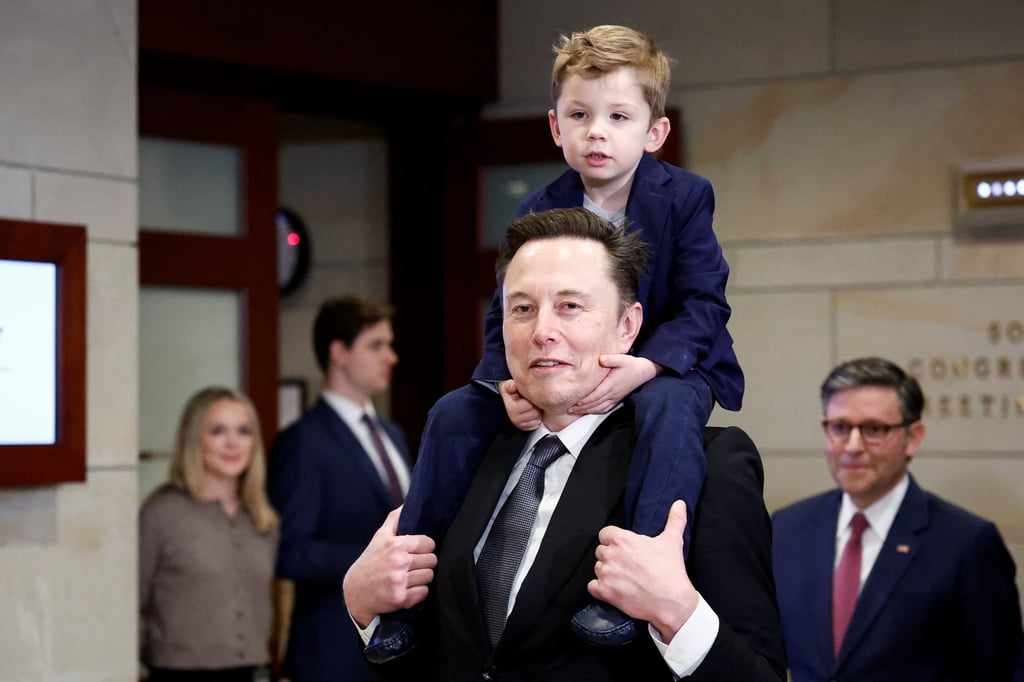
On the other hand, Musk's influence has increased significantly internally in American politics, and he has been described as ‘the co-president’, while some have mocked his growing influence to the point of describing Musk as ‘the president’ and Donald Trump as his vice president.
The National Interest magazine said that Trump's team is trying to control the repercussions of the famous billionaire's exaggerated appearance, especially after Musk threatened Republican members of Congress, and his posts led to the failure of a temporary spending bill that would have guaranteed funding for the federal government until March 14, giving the impression that Musk's influence has begun to outpace Trump himself.
NBC News described Musk's actions as an example of how he can use his influence and his social media platform to influence the policies that Trump will follow in his second term.
It is noteworthy that the American billionaire had spent more than a quarter of a billion dollars to support Trump's election as President of the United States.
After winning the presidential race, Trump decided to reward his ally Musk by appointing him as the official responsible for the Department of Government Efficiency, a new position aimed at reducing government spending and increasing its efficiency.