U.S. Envoy Sets Tough Conditions for Forming Iraq’s New Government: Where Is the Country Headed?

U.S. visits take place amid consultations on forming Iraq’s government.
As the decisive moment approaches in deliberations over the formation of Iraq’s government following the parliamentary elections held on November 11, 2025, visits by American officials to Baghdad have intensified, raising questions about the aims of these movements and their connection to the new government file.
Amid widespread anticipation over the announcement of a cabinet, the Shiite Coordination Framework, holding around 187 parliamentary seats, has yet to agree on a single candidate for prime minister, with both Mohammed Shia’ al-Sudani and Nouri al-Maliki remaining the leading contenders for the position, among a list of roughly ten names.
Intense Visits
Baghdad saw a flurry of American visits in the space of a single week, with Deputy Secretary of State Michael R. Rigas and President Biden’s envoy to Syria and Lebanon, Tom Barrack, making back-to-back trips, followed by Iraq envoy Mark Savage’s arrival in mid-December 2025.
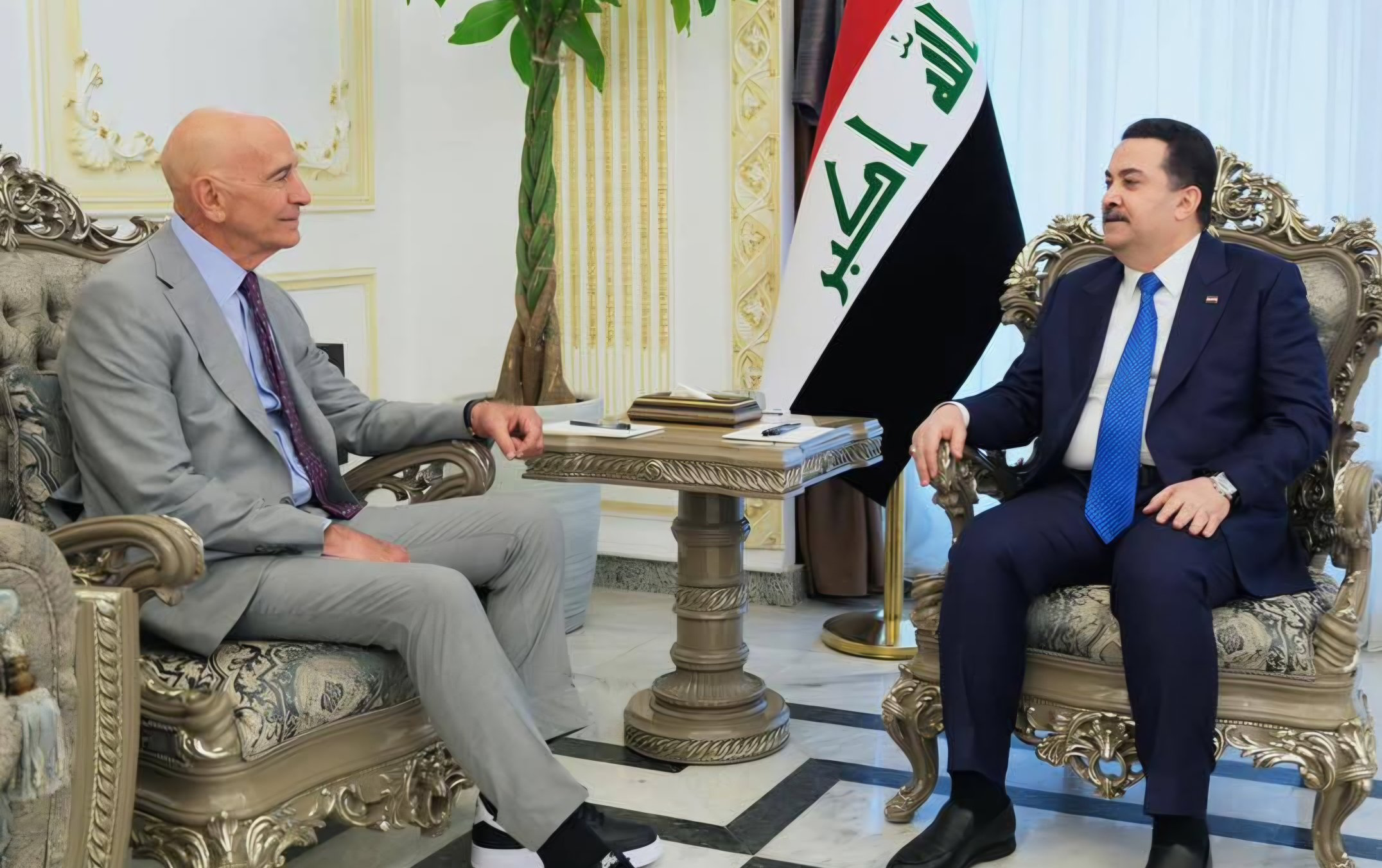
On December 1, Deputy Secretary of State Michael Rigas arrived in Baghdad and met the following day with Iraq’s Deputy Prime Minister and Foreign Minister, Fuad Hussein.
According to a statement from the Iraqi Foreign Ministry, the meeting focused on ways to strengthen bilateral relations and pursue joint cooperation across political, economic, and security sectors.
Hussein emphasized the need to ease regional tensions, reviewing developments in the post-election political movement, and stressed the importance of swiftly forming a federal government within constitutional deadlines, while maintaining a balance among political forces to ensure the democratic process runs smoothly.
He also highlighted ongoing coordination between Baghdad and Washington, particularly on economic, infrastructure, and investment issues, which could support development and encourage the return of American companies to Iraq.
Rigas praised Iraq’s progress in stability and security, reaffirmed Washington’s support for government efforts, and underscored the importance of continuing regional and international coordination to address economic, political, and security challenges.
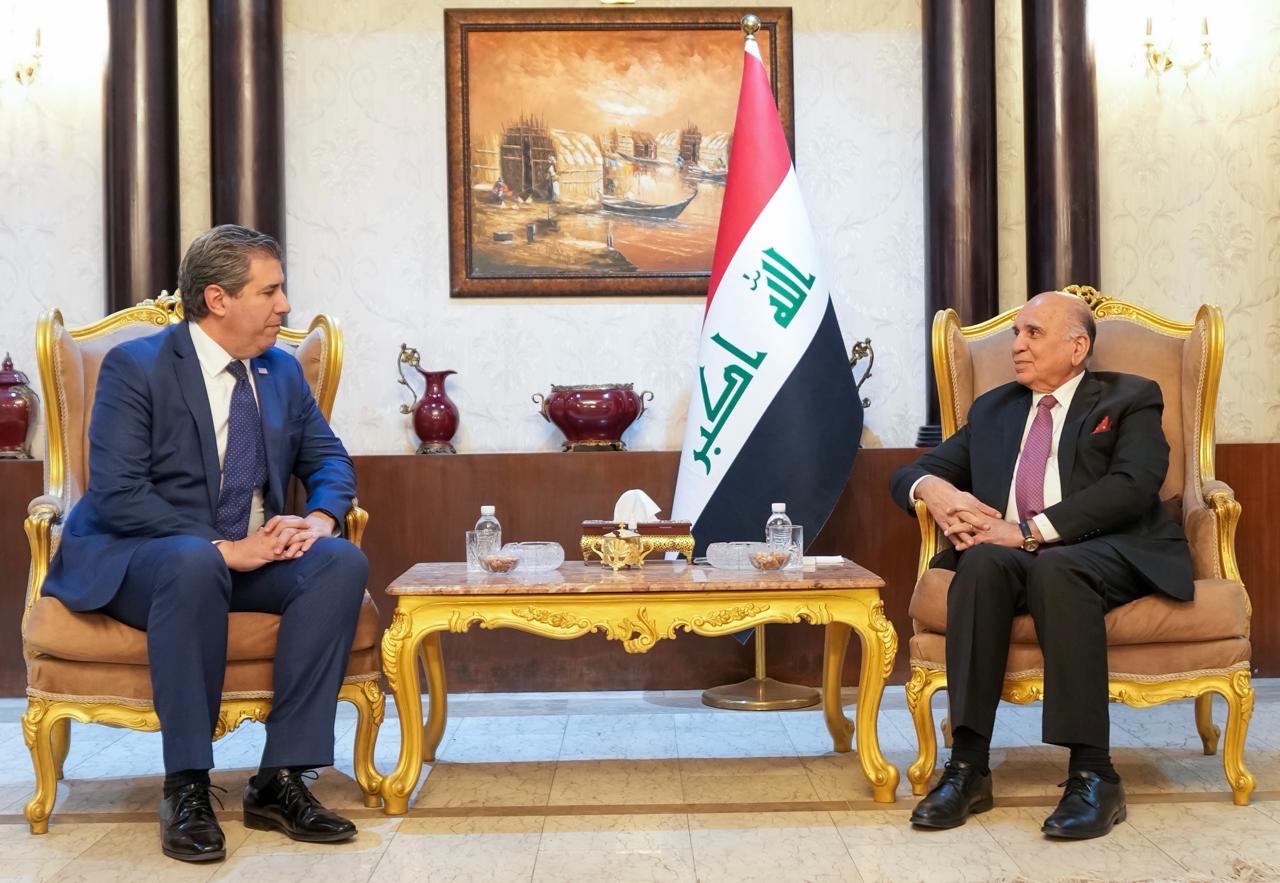
Prior to this visit, President Biden’s special envoy to Syria and Lebanon, Tom Barrack, arrived in Baghdad unexpectedly on November 30, where he met with Prime Minister Mohammed Shia’ al-Sudani.
Barrack did not issue a statement detailing the visit, but he reposted a statement from al-Sudani’s office, which said the two sides discussed practical ways for Iraq to continue supporting Syria’s stability, security, prosperity, and economic recovery, in a manner that would positively affect Iraq’s own stability.
Al-Sudani’s office added that the meeting reviewed mutual perspectives on preventing further escalation in the region, supporting diplomatic efforts to resolve disputes, and guiding the region toward cooperation, economic growth, and long-term stability.
However, local media provided additional details about the meeting. They reported that Barrack informed Iraqi leadership that “Israel” would continue its operations until Hezbollah was disarmed, and that if Iran-backed factions, notably Kata’ib Hezbollah, entered the confrontation, “Israel” would target them without U.S. intervention.
Iraqi broadcaster UTV, citing an unnamed source who attended the meeting, reported on December 1 that the American envoy stressed the need to restrain the factions and halt any support benefiting Hezbollah in Lebanon, warning that “neutrality is not a request, it is a condition.”
American Messages
Regarding the significance of Tom Barrack’s visit to Iraq, Iraqi writer and analyst Munqith Dagher argued that the meeting between Barrack and Prime Minister Mohammed Shia’ al-Sudani was far from routine, both in terms of timing and setting, as it took place over a working lunch rather than at an official negotiation table, reflecting a different character to the messages exchanged and the broader dimensions of the visit.
In a post on X on November 30, Dagher noted that the visit came at a sensitive moment, coinciding with Deputy Secretary of State Michael Rigas’s trip to Baghdad and preceding the arrival of President Biden’s special envoy to Iraq, Mark Savaya, giving the visit a deeper political significance that went beyond mere protocol.
On its importance, Dagher suggested that Tom Barrack has assumed a central role in shaping Washington’s policy toward the region, akin to the role played by U.S. envoy Brett McGurk during the previous Biden administration.
Dagher did not rule out the possibility that the meeting also touched on Iraq’s role in upcoming regional arrangements, not only because of its influential geopolitical position, but also due to its balanced network of relations across the region, particularly with Iran, a dynamic that gives Baghdad special weight in U.S. calculations.
Iraqi researcher Nawal al-Moussawi suggested that Tom Barrack met with Prime Minister Mohammed Shia’ Al-Sudani carrying clear American messages, consistent with those he delivered during his mission in Lebanon.
She argued that the timing of the meeting reflects the sensitivity of the current regional moment, as well as the urgent need for Iraq to preserve the independence of its political decision-making and maintain internal stability.
In a post on X on November 30, al-Moussawi wrote that U.S. pressure on the Coordination Framework forces had reached its highest level, noting that Barrack’s meeting with al-Sudani “speaks for itself without ambiguity,” a reference to the weight of the political messages conveyed and Washington’s stakes in the outcome of Iraq’s new government formation process.
In the same context, Iraqi political analyst Firas Elias outlined several reasons behind Tom Barrack’s visit to Baghdad, noting that a key purpose was to explore Iraq’s role in stabilizing Syria, a role Washington views as part of broader efforts to revive Baghdad’s position as a mediator or key player in the Syrian file.
In a post on X on December 1, Elias explained that the visit came amid wide-ranging regional shifts, including the ongoing calm between Syria and “Israel,” escalating pressures amid the possibility of a new war in Lebanon, and the process of reshuffling regional alliances, all of which make securing Iraq’s position in these equations a U.S. priority.
He added that one of the main motivations for the visit is that Iraq is seen in Washington as a “key” to regional stability, connecting the Syrian, Lebanese, and Iraqi files within a single approach that the United States views as a way to limit any potential escalation.
Regarding why Iraq was singled out for this visit, Elias noted that Baghdad serves as a “natural bridge” between Syria and Lebanon, sharing a direct border with Syria and hosting armed factions directly affected by developments in Lebanon, making Iraq’s role pivotal in preventing the Israeli attacks on Lebanon from spilling over into Iraq or its factions.
He also pointed out that Iraq is undergoing an extremely sensitive political phase following the parliamentary elections and amid the ongoing process of forming a new government, a context that, from the perspective of the U.S. administration, provides Washington with an opportunity to recalibrate regional influence and balances starting from Baghdad.
Conditions and Threats
Regarding the connection between visits by American officials to Baghdad and the formation of Iraq’s next government, Iraqi affairs researcher Latif al-Mahdawi said that the United States has set clear conditions for the incoming cabinet, foremost among them the exclusion of any figures affiliated with armed factions.
Al-Mahdawi told Al-Estiklal in a special interview that these conditions are accompanied by implicit threats of the return or escalation of economic sanctions on Iraq, particularly in the economic sphere, should the Coordination Framework fail to align with the American vision.
He noted that U.S. positions remain cautious and ambiguous, especially given that President Donald Trump’s envoy to Iraq, Mark Savaya, has yet to begin his mission despite more than 40 days having passed since his appointment, relying solely on posting his views on X.
In his latest post on November 29, Savaya described Iraq as standing at a decisive crossroads, between two options: either confining weapons outside official institutions, or returning to a “vortex of complexity,” emphasizing that removing arms from politics is a fundamental condition for achieving stability.
“Today, the world views Iraq as a country capable of playing a larger and more influential role in the region, provided that the issue of weapons outside state control is fully resolved and the prestige of official institutions is protected.”
“No economy can grow, and no international partnership can succeed, in an environment where politics is intertwined with unofficial power. Iraq now has a historic opportunity to close this chapter and reinforce its image as a state built on the rule of law, not the power of weapons.”
“Equally important is establishing the principle of the separation of powers, respecting constitutional frameworks, and preventing interference that could disrupt political decision-making or weaken the state's independence. Strong nations are built when the executive, legislative, and judicial branches operate within their defined boundaries and are held accountable through clear legal mechanisms, not through pressure or influence centers,” he added.
U.S. envoy Mark Savaya emphasized that Iraq now stands at a decisive crossroads, either moving toward building independent institutions capable of enforcing the law and attracting investment, or returning to the cycle of complexity that has burdened everyone over the past years.
“What is needed today is support for the country's path, respect for the constitution, reinforcement of the separation of powers, and a firm commitment coupled with concrete action to keep weapons out of politics. This is the path to building a strong Iraq that earns the world's respect,” he concluded.
In a related development, with several political forces holding armed wings within the Coordination Framework winning roughly 80 seats in parliament, Iraqi Foreign Minister Fuad Hussein told a television interview on December 1 that “Washington has informed Baghdad that it will not engage with armed groups subject to sanctions.”
Sources
- Barrack Arrives with Warning Message… Analyst: Al-Sudani Acceptable to U.S. Except on One Issue [Arabic]
- Deputy Prime Minister and Foreign Minister Fuad Hussein Receives U.S. Deputy Secretary of State Michael Regas [Arabic]
- (Document) Shiites 187 Seats, Sunnis 77, Kurds 56 in Iraqi Parliamentary Election Results [Arabic]