Tucker Carlson: The U.S. Right-Wing Star Who Broke Taboos on Relations With Israeli Occupation
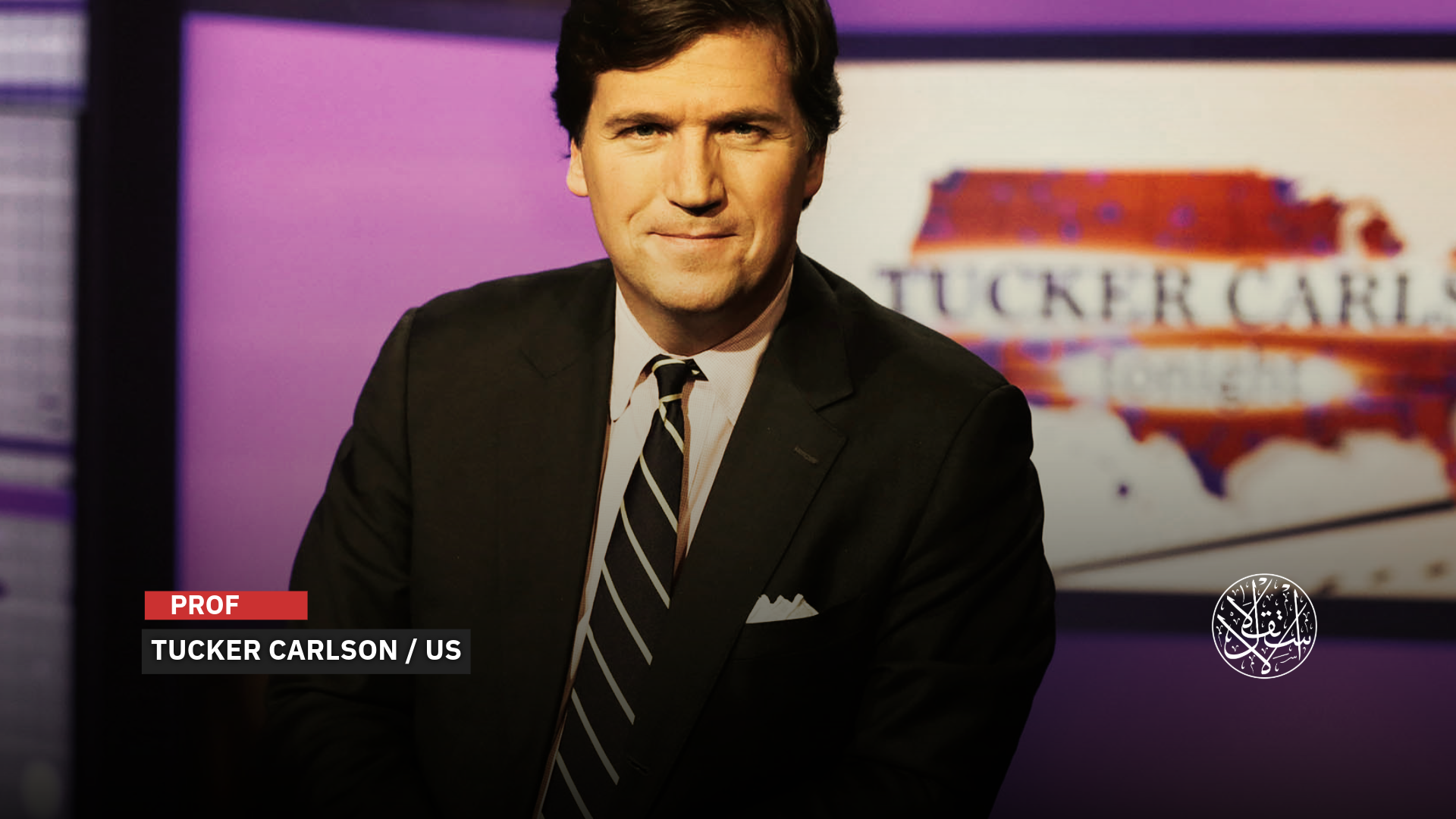
Carlson departed from U.S. right-wing long-standing reflex of unwavering support for “Israel.”
Over the past two years, Tucker Carlson, the American right-wing media figure and host of one of the United States’ most prominent political podcasts, has become a symbol of a striking shift within the conservative right after breaking what were long treated as taboos surrounding the relationship with “Tel Aviv.”
Carlson has moved from rhetoric that largely aligned with the traditional pro-Israeli Occupation mood in American politics to a sharply critical tone, questioning Israeli narratives about the war on Gaza and attacking the idea of unconditional U.S. support.
This shift has ignited a deep split within Republican ranks and the evangelical movement between those who see him as a bold “America First” voice willing to cross red lines and those who accuse him of sliding into anti-”Israel” rhetoric, seeking to tarnish his image through allegations tied to funding or foreign influence.
How Carlson Changed Course
For years in conservative media, Tucker Carlson rarely strayed from the Republican consensus of staunch support for the Israeli Occupation. On the contrary, he routinely criticized Democratic politicians for what he portrayed as insufficient enthusiasm for backing Tel Aviv and consistently attacked voices on the progressive left who spoke out in defense of Palestinians.
The outbreak of the Israeli war on Gaza (2023–2025), however, marked a sharp turning point in Carlson’s rhetoric toward the Israeli Occupation. He adopted a stance opposed to its aggression on the Strip, advancing a narrative largely unfamiliar within the American right-wing media ecosystem.
Carlson accused the Israeli Occupation government, led by Benjamin Netanyahu, of embracing a logic that treats everyone living in Gaza as “terrorists by birth,” including women and children—describing this worldview as “un-Western” and “un-Christian” and fundamentally incompatible with the values of Western civilization.
He also launched a direct attack on evangelical Christian leaders in the United States who justified “Israel’s” genocide on Gaza and the killing of civilians, arguing that their positions stand in contradiction to Christian teachings themselves.
In one episode, Carlson asked angrily, “If a man commits a crime, do we kill his kids? I don’t care if it’s in Minneapolis or Gaza City. No, we don’t.”
With these remarks, Carlson clearly departed from the American right’s traditional approach of total alignment with “Israel,” edging closer to the language of Palestinian rights advocates—a discourse that for years had been largely confined to progressive circles.
Further controversy followed comments Carlson made about Islam in December 2025, when he accused “Israel” of orchestrating propaganda campaigns against Muslims inside the United States.
Hatred of Muslims, he said, is just another classic psychological operation led by the Israeli government, designed to cement the idea that “Israel’s” enemies are automatically America’s enemies.
He added that he did not know a single person who had been killed by what he called “radical Islam” over the past 24 years, reaffirming his rejection of what he termed “hatred of Muslims” and calling for individuals to be judged as individuals, not as members of groups defined by religious or cultural identity.
These shifts triggered fierce anger among Carlson’s former allies within the conservative movement. The prominent right-wing broadcaster Erick Erickson, for example, moved quickly to attack him, claiming that Carlson had become an “ally” of Hamas and was promoting the propaganda of “antisemites on American campuses.”
Republican congressman Dan Crenshaw of Texas also went after Carlson on X, arguing that he was now standing with America’s enemies and stabbing its allies in the back.
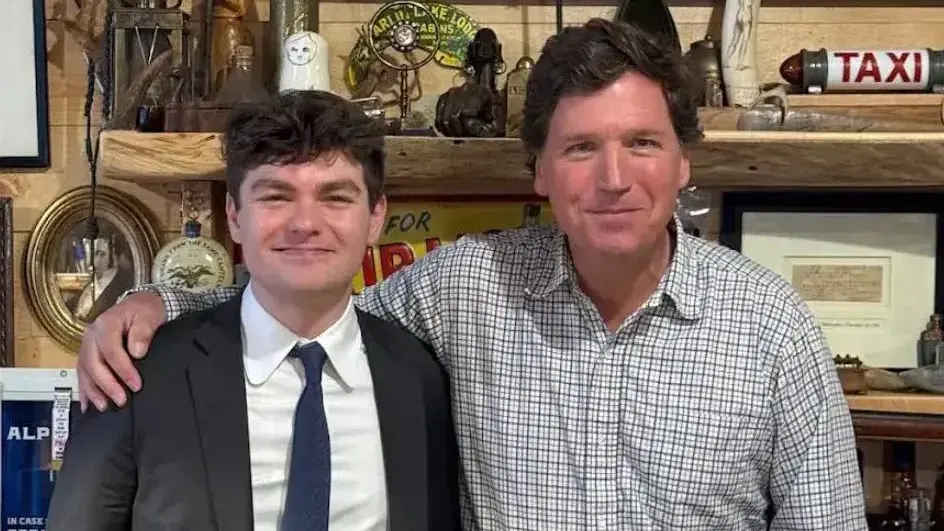
For his part, Republican senator Ted Cruz sharply criticized Carlson for recently hosting figures he described as “extremist and anti-Jewish,” such as the American political activist Nick Fuentes. Cruz said that any media figure who sits silently while someone praises Nazi leader Adolf Hitler and denies the Holocaust is a coward and complicit in evil, a remark aimed squarely at Carlson.
Ben Shapiro, the political commentator and one of the most prominent pro-”Israel” voices in the United States, likewise launched a blistering attack on his former colleague, calling Carlson’s decision to host Fuentes a moral stupidity and evidence of collapsing standards.
As a result, Carlson has found himself largely isolated from broad segments of the pro-”Israel” American right, even as his shift has been met with notable approval from supporters of Palestinian rights—particularly among younger Americans, who have led widespread student protests on university campuses against “Israel’s” genocide on Gaza.
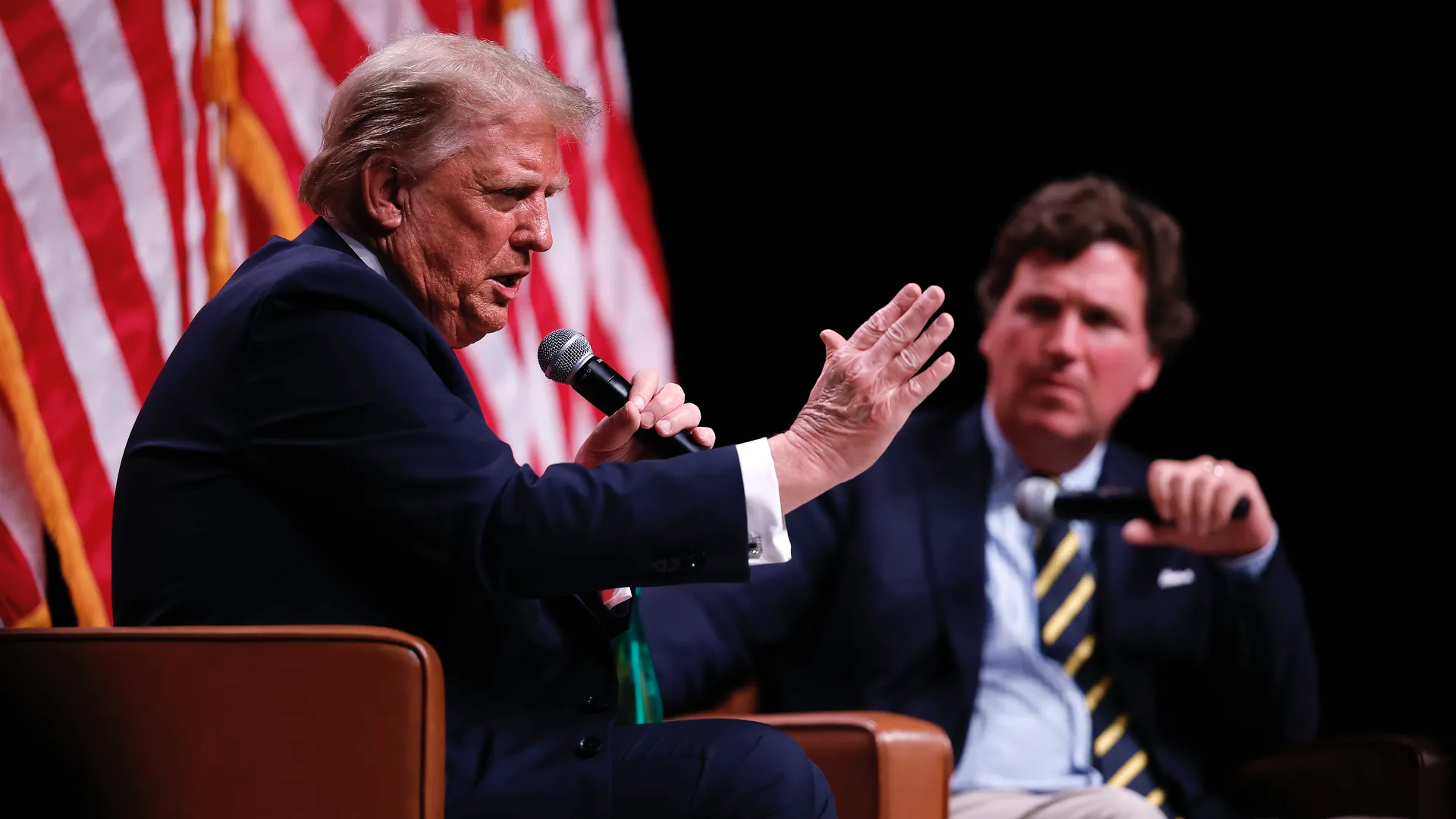
Who Is He?
Tucker Carlson was born in 1969 in San Francisco, California, into a conservative American family. His father, Richard Carlson, held an executive position at Voice of America before later moving into diplomatic service.
Carlson began his career in print journalism after earning a degree in history in 1991, then shifted in the 1990s to television, hosting political talk shows on CNN and MSNBC.
In his early media years, Carlson embraced the traditional positions of the American right. He supported U.S. military interventions in the Middle East, including the invasion of Iraq, a stance he would later acknowledge and regret.
During that period, he was also known for his open defense of Christian Zionism as part of his conservative worldview, frequently praising evangelical leaders supportive of “Israel,” among them Mike Huckabee, the former governor of Arkansas and the current U.S. ambassador to Tel Aviv.
In 2009, Carlson joined Fox News as a political commentator before being given his own prime-time show in 2016, at a moment that coincided with the rise of right-wing populism in the United States.
The program quickly became a major success, drawing more than four million viewers per night and giving Carlson a powerful platform to promote hardline right-wing views and nationalist conservative arguments that increasingly edged toward the far right.
During this phase, he adopted rhetoric defending what became known as “white identity” within American society, launched fierce attacks on immigration, and promoted multiple conspiracy theories—helping move ideas once considered fringe into the center of the country’s political and media landscape.
Despite repeated criticism for spreading misinformation and stoking hateful rhetoric, the show maintained its broad popularity and deep influence over large segments of the audience, including President Donald Trump, who is known to be a regular viewer.
Carlson’s time at Fox News, however, was marked by internal crises and mounting tensions, which reached a peak in April 2023 when the network abruptly announced the cancellation of his show despite its strong ratings.
The decision followed a massive legal settlement of $787 million, which Fox News was forced to pay in a defamation lawsuit accusing the network and several of its hosts—including Carlson—of spreading false claims about fraud in the 2020 U.S. presidential election won by Joe Biden.
The move sent shockwaves through media and political circles, particularly amid reports suggesting the decision was not solely tied to the legal case but also to accumulated disputes between Carlson and the network’s conservative leadership, which had come to see some of his positions and rhetoric as a political and commercial liability.
After leaving Fox News, Carlson moved quickly in the summer of 2023 to capitalize on his wide fame, launching his own digital show online. Within a short period, he became one of the most prominent political hosts on social media platforms in the United States, with new episodes racking up millions of views as he benefited from freedom from traditional editorial constraints.
His media profile was further boosted by a 2023 interview with Russian President Vladimir Putin—the first such interview by an American journalist since the outbreak of the war in Ukraine.
During this phase, Carlson enjoyed a wide margin of independence in expressing his views, openly criticizing Washington’s foreign policy, including U.S. support for Ukraine in its war with Russia and the unconditional backing of “Israel” during its aggression on the Gaza Strip.
Today, Carlson is regarded as one of the most influential media figures in the United States, backed by a vast audience. He has more than nine million followers on X, while his episodes attract millions of views, making him one of the most powerful voices shaping the contemporary American right-wing discourse.
Breaking the Taboos
Tucker Carlson’s new positions have drawn wide attention in “Israel,” where they were met with angry reactions from officials and Hebrew-language media that quickly branded him an extremist and an “antisemite”—a familiar charge frequently deployed by Tel Aviv against critics of its policies.
In late October 2025, The Times of Israel published a lengthy report on Carlson’s interview with the right-wing activist Nick Fuentes, arguing that it revealed a striking alignment with the arguments of Holocaust deniers and anti-”Israel” figures. The paper also noted that Carlson had maintained close ties to circles around U.S. President Donald Trump, despite his shift into “a vociferous critic of Israel” and his role in helping platform “Holocaust revisionists.”
The Jerusalem Post, for its part, warned of Carlson’s discourse gaining traction within the Republican base, describing his hosting of Fuentes as an attempt to whitewash antisemitism.
In the United States, the Anti-Defamation League (ADL) and other Jewish organizations launched attacks on Carlson’s recent remarks, accusing him of recycling historical antisemitic conspiracy theories.
Jewish Journal also accused Carlson of showing contempt for Christian Zionists and promoting what it described as a “dangerous allegation” that “Israel” had deliberately bombed churches and killed Christians in Gaza.
During the Israeli aggression on the Strip, Israeli Occupation forces bombed all three churches in Gaza—the Church of Saint Porphyrius, the Holy Family Church, and the Baptist Church—killing 23 Christians directly, while others died due to shortages of medicine and food, bringing the total number of Christian victims to 44.
Despite these facts, the outlet argued that Carlson’s framing amounted to a revival of an antisemitic myth that historically accuses Jews of killing Christians, albeit under a new guise.
The official Israeli response was swift. Prime Minister Benjamin Netanyahu described Carlson as defending the Hamas narrative during a private briefing with a U.S. figure close to conservative circles. Netanyahu insisted that “Israel” would continue to “defend itself” and Western civilization against terrorism and malicious propaganda, an indirect reference to the American broadcaster’s remarks.
Carlson, however, said in November 2025 that the real enemy of Western civilization is not Muslims, or Jews, or Black people, or any religious or ethnic group—but Benjamin Netanyahu, who presents himself as a defender of Western values while today standing as one of their greatest threats.
The repercussions of Carlson’s positions did not stop at “Israel” or the American domestic scene. In March 2025, he conducted an exclusive interview in Doha with Qatari Prime minister Mohammed bin Abdulrahman Al Thani, broadcast on his digital platforms, triggering a new wave of controversy.
Critics accused Carlson of promoting Qatar’s pro-Palestinian narrative, while far-right activist Laura Loomer quickly claimed that he was paid by Muslims against America and “Israel” to serve a political agenda, alleging he received $200,000 to arrange the interview—an accusation Carlson categorically denied.
At the Doha Forum, Carlson further escalated his rhetoric, calling for a reassessment of the U.S. alliance with “Israel” and for reducing its priority in favor of strengthening partnerships with Gulf states such as Qatar and Saudi Arabia.
Relations with the Gulf, he argued, offer clear benefits to the United States, unlike “Israel,” which he described as a country with no resources and no real geostrategic value for America, contending that the alliance has become a net cost and a losing proposition for Americans, with little to show in return.
Sources
- Tucker Carlson
- Tucker Carlson discusses ‘these Zionist Jews’ with avowed antisemite Nick Fuentes
- Turning Point USA held its AmericaFest conference. Here’s what happened
- Tucker Carlson went after Israel — and his fellow conservatives are furious
- Tucker Carlson Claims Israel Is a Burden on the US. It Reveals Profound Strategic Ignorance