Rampant Racism, Absent Services: U.S. World Cup Tipped as a Candidate for the Worst Ever
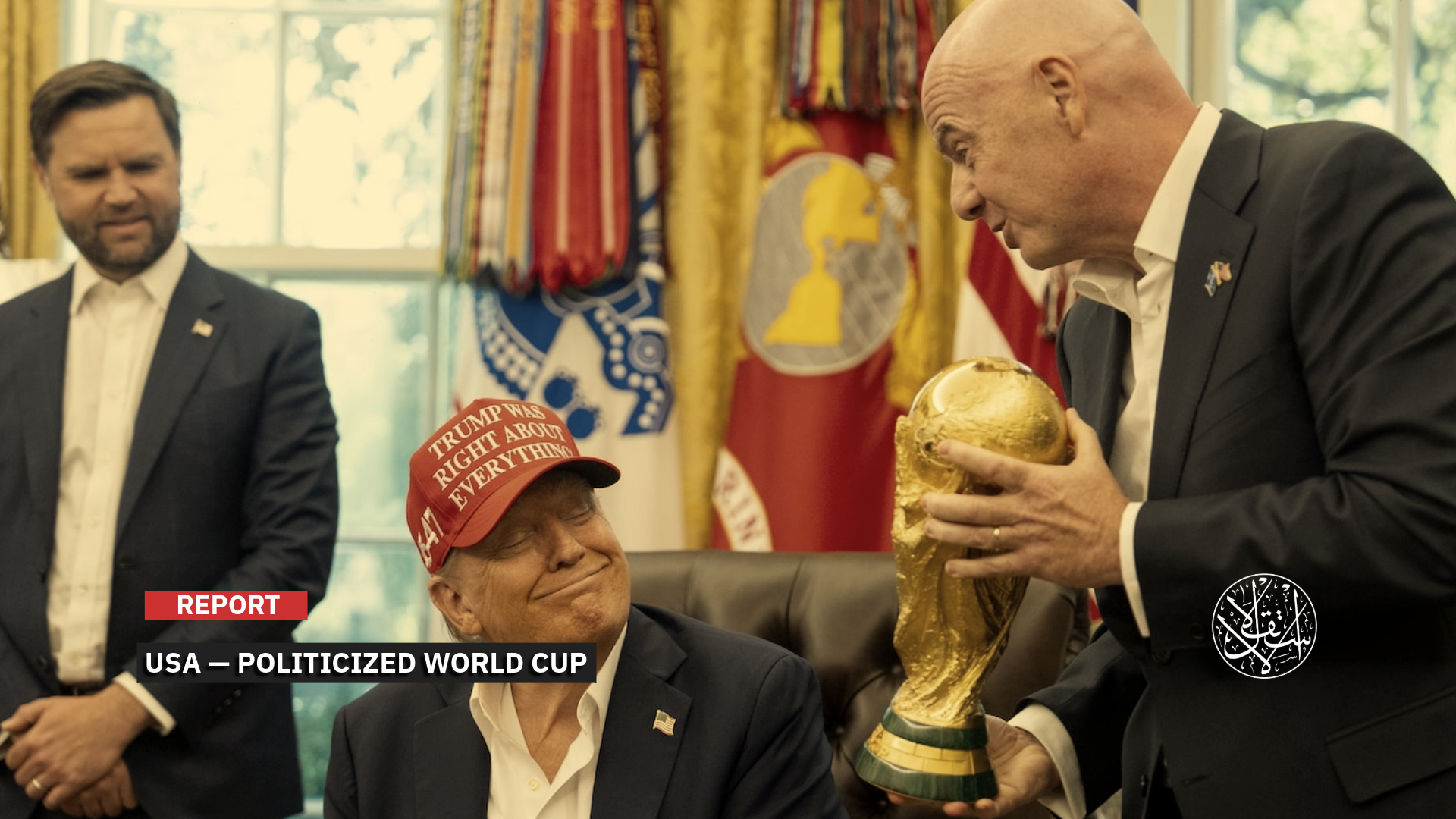
FIFA's political engagement has reached its peak.
Refusing entry to certain national teams, barring referees from entering the country, subjecting players to hours-long interrogations, conducting humiliating searches of sports delegations, and restricting ticket access for fans from specific countries, all amid organizational chaos that accompanied the preparatory matches.
These are some of the features of the “American World Cup,” which the administration of President Donald Trump has turned from a sporting event eagerly awaited by millions every four years into an arena for political, social, and racial tensions.
The measures affected citizens of several Arab and Muslim-majority countries, including Iran, Somalia, Iraq, Senegal, and Indonesia, triggering widespread anger.
This has revived comparisons with the 2022 FIFA World Cup in Qatar, which received broad praise for its organization and the ease of movement for fans, despite what critics described as racist Western campaigns targeting the tournament at the time.
International and sports media reports have documented a series of incidents that exposed the intertwining of politics and sports in the United States and sparked dissatisfaction among teams, referees, players, and fans.

Targeting Iran
No sooner had the missile and artillery conflict between the United States, alongside “Israel”, and Iran subsided than the war shifted to the World Cup stadiums through a series of hostile measures targeting Iranian players and fans.
The United States has become the first World Cup host nation to refuse to host a qualified national team, namely Iran, after Washington officially informed FIFA that it would not allow the Iranian national team to be hosted on its territory during the tournament.
This is despite the fact that all three of Iran’s scheduled matches are set to take place in the United States. FIFA’s World Cup hosting regulations also require governments to provide guarantees regarding visas, immigration, accommodation, and entry procedures for tournament participants.
However, according to the article, FIFA has backed away from these requirements for the American World Cup, allegedly because of the close personal relationship between its Swiss-Italian president, Gianni Infantino, and U.S. President Donald Trump.
Under the U.S. restrictions and the prohibition on staying in the country, the Iranian national team established its entire training camp in Tijuana, Mexico. The team will only be allowed to enter the United States on match days and must return to Mexico immediately afterward, a situation that, according to critics, places a significant burden on the players and creates an uneven playing field compared with other teams.
On match days, the players will cross the border to compete in Los Angeles or Seattle before returning to Mexico the same night. They will have no permanent training camp, hotel, or overnight accommodations in the United States.
No national team in football history has ever faced such a logistical challenge at a World Cup. The Iranian team reportedly relocated its base from Tucson, Arizona, to Tijuana, Mexico, because of the conflict involving the United States, “Israel”, and Tehran.
Iran’s ambassador to Mexico, Abolfazl Pasandideh, told reporters that Washington had required his country's team to enter U.S. territory in the morning and "leave on the same day" for each of the three matches it would play there.
The U.S. State Department had reportedly issued a decision allowing the Iranian team to enter the United States for a single day to play each match before returning to Mexico.
The British broadcaster BBC, in a report dated June 7, 2026, described the Iranian team's situation, including the alleged refusal by the United States to grant visas to 16 members of the coaching staff while limiting visas to Iranian national team stars because they had completed military service in Iran's armed forces, as "political interference in sport."
The report stated that this would be the first time in World Cup history that a host nation had welcomed a team from a country with which it was at war, noting that requiring Iran's team to enter and leave the United States on the same day would be extremely exhausting.
Iran's opening match at the 2026 World Cup is scheduled to take place in Los Angeles on June 15 against New Zealand, followed by another match in Los Angeles against Belgium and a match in Seattle against Egypt.
Reminding the Killers of their Crime
In what appeared to be a response to Washington's injection of politics into sport, members of Iran's national team deliberately wore commemorative badges honoring 168 girls who were killed in an alleged U.S. airstrike on a girls' school, an incident that, according to the article, passed without sanctions or compensation.
The Iranian delegation wore chest badges and gold-colored pins bearing the number "168," representing the number of girls said to have been killed in the deadly missile strike on an elementary school in the city of Minab in southern Iran.
The Iranian national team had previously commemorated the attack before a friendly match in March 2026 in Antalya, Turkiye, when players carried pink and purple school backpacks, symbolizing the deceased girls, during the national anthem.
Iran and the United States could potentially meet in the Round of 32 on July 3, 2026, at the Dallas Cowboys stadium in Arlington if both teams finish second in their respective groups.
As part of what Iranian officials described as restrictions targeting Iranians, Tehran complained that its allocation of World Cup tickets, amounting to 8 percent of the tickets for its matches and intended for distribution to its supporters under tournament regulations, had been withheld shortly before the tournament.
The Iranian Football Federation accused the United States of "stealing" the Iranian fans' allocation of World Cup tickets, describing the measure as a "deliberate obstruction" that deprived supporters of their right to attend their team's matches.
It stated that the U.S. government, as the tournament host, had stripped the federation of its legally designated allocation, leaving it unable to distribute any tickets to national team supporters through official federation channels.
The federation argued that the move violated the "principle of equality among participating teams" and said the decision raised "serious questions about the influence of political and non-sporting considerations in the organization of the World Cup."
Because of U.S. restrictions on the entry of Arab, Muslim, and other supporters, the newspaper Financial Times reported on June 9 that FIFA could face a major problem in the form of empty seats, including 5,000 vacant seats for the opening match, calling it a potential embarrassment.
The report stated that approximately 180,000 seats could remain empty because visas had allegedly been denied to supporters of teams from countries viewed unfavorably by the United States, forcing the tickets to be put back on sale amid weak demand due to high prices.
Matches involving Iran account for nearly 16,000 unsold tickets, with the cheapest seats priced at $138, according to the Financial Times.
According to the article, this reflects the politicization of a global sporting event that is supposed to serve as a space for bringing people together rather than a venue for settling political disputes.
The article argues that there is a contradiction in FIFA's approach: when Indonesia sought to impose restrictions on “Israel” during the 2023 FIFA U-20 World Cup, FIFA withdrew Indonesia's hosting rights, whereas it has allegedly allowed the U.S. government to prevent Iranians from purchasing World Cup tickets and entering the country.
Tightening the Screws on Iraq
Authorities at Chicago Airport also detained the Iraqi national football team's all-time leading scorer, Ayman Hussein, and subjected him to questioning after allegedly finding a photograph on his phone showing him with Shiite political leader Muqtada al-Sadr.
Iraqi and Western sources reported that Ayman Hussein was questioned for seven hours at Chicago's airport because of the photograph with Muqtada al-Sadr, leader of Iraq's National Shiite Movement.
The Iraqi Embassy in Washington also confirmed that the arrival of two members of the national football team's delegation was delayed because of restrictions imposed on them.
The well-known French journalist Romain Molina, recognized for his investigations into corruption within sports federations and for exposing numerous corruption cases in international football, criticized the detention of Hussein by U.S. authorities.
Molina stated that "the player was treated as if he were a terrorist" and questioned the justification for the measure, adding that "being Iraqi appeared sufficient to deprive him of his rights and to be dealt with in this manner."
Iraq is participating in the World Cup for the first time in 40 years, coming 35 years after the U.S. invasion of the country.

Somali Referee Denied Entry to the US
One of the biggest scandals of the U.S. World Cup was the refusal to admit Somali referee Omar Abdulkadir Artan, the winner of Africa's Best Referee award in 2025, by denying him entry to the country despite holding a valid visa.
U.S. security and immigration authorities barred him from entering the country after subjecting him to an 11-hour interrogation, even though he possessed a legitimate visa and had been selected by FIFA to officiate matches at the 2026 World Cup.
On June 8, the British newspaper Daily Mail reported that the African Referee of the Year and World Cup official was denied entry to the United States and sent back after landing at Miami International Airport, despite traveling on a diplomatic passport.
Artan is one of 52 referees selected for the World Cup, one of seven African officials appointed to the tournament, and the first Somali referee ever chosen to officiate at a World Cup. According to his own account, the appointment represented a dream that "vanished and faded away" when the United States refused him entry.
In remarks to The New York Times on June 9, the referee said he was detained and questioned by security officials at Miami airport for more than 11 hours before being informed that he was "inadmissible" due to unspecified "security vetting concerns," despite carrying all the required documentation.
He said border officials questioned him about the purpose of his visit to the United States, the political situation in Somalia, and the militant group al-Shabaab, which controls parts of Somalia and has waged an insurgency against the government for years.
"I think they have a problem with my country," he said, noting that the administration of Donald Trump has imposed strict restrictions on the entry of Somalis and citizens of several other Arab and Muslim-majority countries, while the U.S. president has repeatedly criticized the Somali presence in the United States.
Meanwhile, instead of intervening, FIFA officials, global refereeing authorities, and the Confederation of African Football remained silent over a case of such magnitude.
The White House attempted to justify the denial of entry to the Somali referee and the refusal of visas for Iranian World Cup officials by citing "valid reasons" without specifying what those reasons were. U.S. Customs and Border Protection, meanwhile, attributed the decision to "issues related to background screening."
Speaking at a seminar hosted by the Washington-based think tank Atlantic Council on June 9, Andrew Giuliani, head of the White House team responsible for organizing the 2026 World Cup, said that the denial of entry to the Somali referee and the refusal of visas to members of Iran's national team delegation stemmed from what he described as “valid reasons.”
Discriminatory Visa Policy
One of the ironies of the U.S. World Cup is that its promotional advertisements repeatedly broadcast FIFA's anti-racism message, "Say No to Racism," every few minutes. Yet the governing body allowed the United States, the tournament host, to treat Black players and members of teams whose countries have political disagreements with Washington as though they were criminals.
Many African players and officials, along with members of several Asian teams such as Indonesia, were subjected to what was described as aggressive and degrading security inspections, highlighting the extent to which politics became intertwined with sport.
In addition to denying visas to 16 members of Iran's World Cup delegation over concerns that members of the Islamic Revolutionary Guard Corps might enter the country, Washington also refused visas to journalists from Iran, Senegal, and Ivory Coast, effectively turning the World Cup into a vehicle for settling scores with countries it views unfavorably.
The United States also denied visas to at least 90 supporters from two major fan groups ahead of the tournament. Most of the refusals were reportedly based on a provision citing doubts about whether the applicants intended to return home, despite documented travel histories that included attendance at the 2018 World Cup in Russia, the 2022 World Cup in Qatar, and the Paris Olympics.
As a result, some supporters lost tens of thousands of dirhams on non-refundable travel bookings, according to the Canary website on June 7.
The South African national team's delegation was also delayed in traveling to the United States after visas were denied to roughly half of its members amid political tensions between Washington and Pretoria.
Likewise, although citizens of the United Kingdom are normally entitled to enter the United States for up to 90 days through the ESTA system without obtaining a visa, visas and travel authorizations held by Scottish supporters were reportedly revoked just days before the tournament, leaving them with substantial financial losses.
The United States also delayed granting entry authorization to Swiss striker Breel Embolo, citing an alleged criminal case and subjecting him to questioning. He was eventually cleared and joined his team several days later.
The treatment of Fabio Cannavaro and the Uzbekistan national team sparked outrage in Italy. Cannavaro is one of football's most celebrated figures, having won both the World Cup and the Ballon d'Or. Italian newspapers questioned how officials in a country hosting the World Cup could fail to recognize him and subject him to such treatment before a match he was attending as a coach.
Cannavaro accused U.S. security authorities of applying unequal treatment to national teams, saying, "They told me these were the rules, but in the end it turned out that only our team was searched."
African players and officials, particularly members of the Senegal national team delegation, were also subjected to what they described as humiliating searches upon arrival in the United States, despite authorities maintaining that the procedures were intended to expedite entry processing.
New York City Mayor Zohran Mamdani criticized the Trump administration’s refusal to issue visas ahead of the World Cup, saying, “If we cannot even allow the players, teams, and journalists to come into this country, it begs the question of our commitment to the spirit of this tournament.”
During Trump’s first term, the FIFA president said that the U.S. travel ban on citizens of six Muslim-majority countries was contrary to tournament regulations and could jeopardize Washington’s bid to host the 2026 World Cup.
"It’s obvious when it comes to FIFA competitions as well (that) any team, including the supporters and the officials of that team, who would qualify for a World Cup need to have access to the country, otherwise there is no World Cup," Infantino said nine years ago. "That is obvious."
However, as a result of immigration policies implemented by Trump during his second term in office, four competing countries, Iran, Haiti, Senegal, and Ivory Coast, have faced full or partial travel bans for their supporters, on grounds of “security threats.”
Comparisons with the Qatar World Cup
Many athletes and members of the public have pointed to the chaos and disorganization surrounding the U.S. World Cup, comparing it to the most recent World Cup in Qatar in terms of organization, freedom of expression, and the ease of entry granted to all fans, including supporters of what were described as “racist” and “crusader” teams.
Former player Mohamed Aboutrika described the organization of the tournament in the United States as “disastrous,” criticizing the screening and interrogation of Iraqi player Ayman Hussein, as well as the refusal to admit the Somali referee, while questioning how the United States can still present itself as “the land of democracy.”
He also compared what he described as the failed organization in the United States with the organization of the 2022 FIFA World Cup in Qatar, which he called “the best World Cup in history,” adding that had Morocco hosted the tournament, it would have organized it better than the United States has done with the current edition.
Former player Mohamed Aboutrika had previously called in August 2025 for FIFA to strip the United States of its right to host the 2026 World Cup, in response to what he described as “Israel’s” ongoing genocide, carried out with U.S. support, against Palestinians in the Gaza Strip.
He said, “They suspended Russia because of its war on Ukraine, so when will the Israeli occupation be suspended? We do not want words, we want real action.”
He also noted that 760 Palestinian athletes had been killed, including 420 football players, and that 140 football facilities had been destroyed.
Activists pointed to what they described as Western contradictions and double standards, arguing that the Qatar World Cup faced intense criticism despite being widely regarded as a success, while Western observers were reportedly eager to highlight any flaw. In contrast, they added, there is now “deathly silence” regarding what is happening in the United States.
Activists criticized what they described as the negative aspects of the United States’ hosting of the World Cup, including visa issues, security procedures, airports, stadiums, and overall organization. They mocked the fact that the country which lectures the world on rights and order is the same one that places restrictions on people who traveled there solely for football.
Social media accounts called for a boycott of the World Cup in the United States, citing what they described as its crimes in the war involving Iran and the genocide in Gaza. They argued that Russia was punished for far less, but that the world is now too afraid to be honest about the situation.
Germany’s public broadcaster Deutsche Welle reported on June 10 that U.S. President Donald Trump’s strict immigration policies have cast a shadow over the world’s biggest sporting event, raising renewed concerns about human rights and once again putting FIFA’s decision-making under scrutiny.
The BBC described the U.S. World Cup on June 9 as a “vast, highly politicized World Cup at a high cost,” calling it “the most politicized” edition.
The French newspaper Le Monde argued on June 9 that FIFA’s leniency toward U.S. violations during the tournament stems from the “ambiguous relationship between FIFA and the United States.”
It noted that the “friendly relationship” between the current FIFA president and U.S. President Donald Trump dates back to the vote awarding the 2026 World Cup hosting rights in June 2018.
It further stated that after the United States launched legal action against several FIFA members following Qatar’s successful bid to host the 2022 World Cup, it later secured the right to co-host the 2026 tournament.
The report added that FIFA’s political activity, which does not adhere to its own statutes regarding neutrality, has reached its peak, and that through the current FIFA president, the United States had no difficulty consolidating its position as a global football powerhouse.