Political Stalemate: How Macron Faces the Worst Domestic Crisis of His Presidency
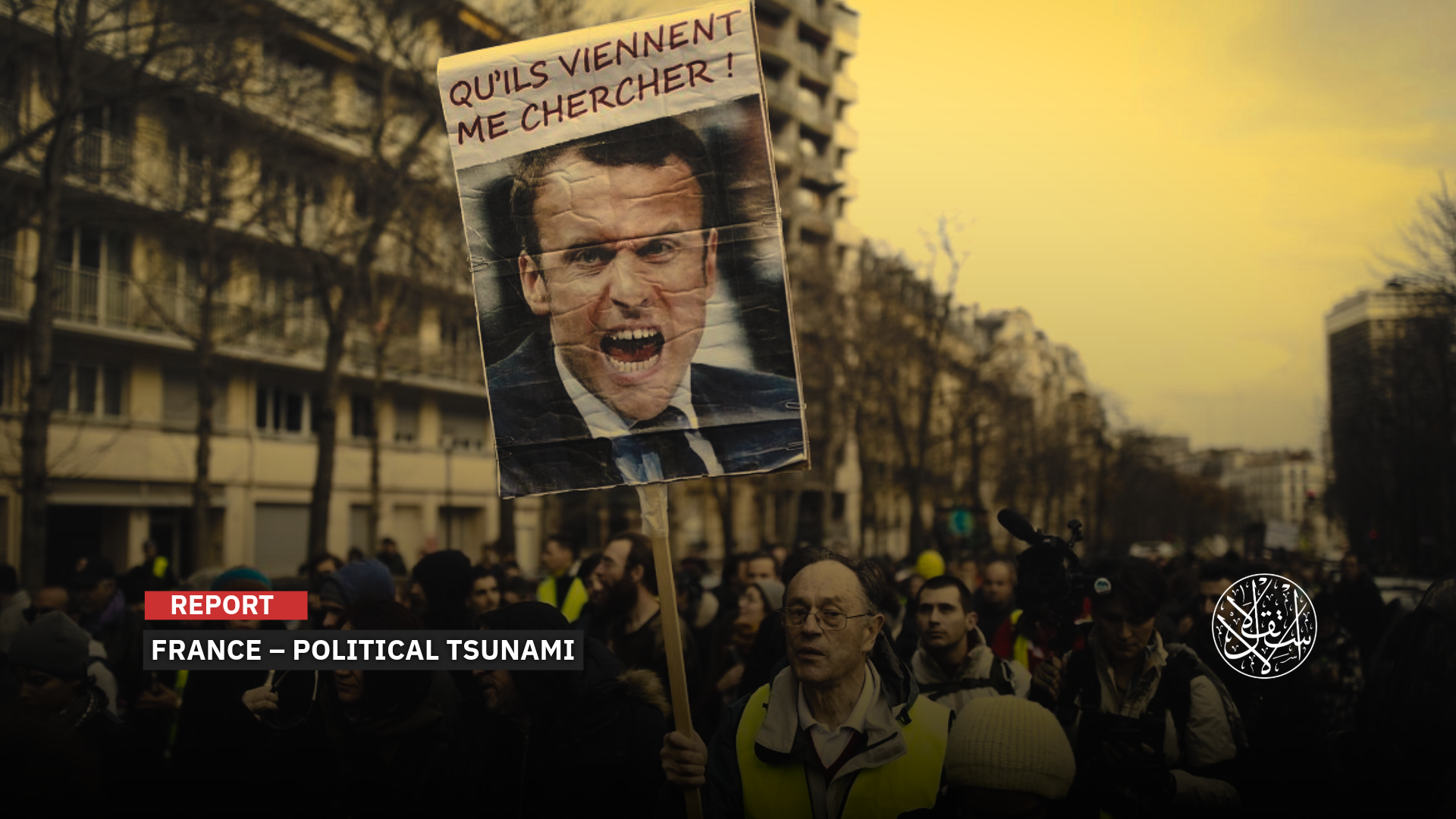
“Pension reform a major blocking point in forming a new French government.”
France's political crisis has worsened since President Emmanuel Macron's decision to dissolve Parliament on July 7, 2024, and the fall of three successive prime ministers: Michel Barnier, Francois Bayrou, and most recently, Sebastien Lecornu, who resigned this week just 14 hours after announcing his government, making it the shortest-lived government in modern French history.
Lecornu's resignation came after allies and the opposition threatened to bring down his government in Parliament, and amid sharp criticism from across the political spectrum that several ministers retained their portfolios.
As a result, passing an austerity budget, demanded by investors who are increasingly concerned about France's rising fiscal deficit, has become extremely difficult due to the political paralysis.
The next few days will be crucial in determining the fate of the French political landscape, given the lack of a clear consensus, mounting economic pressures, and an opposition poised for elections at any moment.
Political Negotiations
Reuters revealed that French President Emmanuel Macron now has three main options: appointing a new prime minister with a different government, calling snap parliamentary elections, or resigning (which he previously confirmed he would not do).
Macron recently began his first option: searching for his sixth prime minister in less than two years, hoping his new government can pass the budget amid a parliament torn by political polarization.
Macron's office said the president will appoint a new prime minister within 48 hours, after the outgoing prime minister held two days of talks with political forces to find a way out of France's worst political crisis in decades.
Several names were being floated in political circles, including former socialist prime minister Bernard Cazeneuve, head of the public auditor Pierre Moscovici, and veteran centrist Jean-Louis Borloo.
Despite his resignation, the Elysee announced that Macron had assigned Lecornu a new mission to hold final negotiations with leaders of the major parties to formulate a platform for action and stability for the country.
On December 8, Lecornu said he told Macron that the next prime minister should not be affiliated with the president's political party and should not have any ambitions to run in the presidential elections scheduled for 2027.
He emphasized that the majority of lawmakers oppose snap parliamentary elections, noting that there is a somewhat difficult path to passing the budget by the end of the year.
The outgoing prime minister had agreed to reduce the austerity budget ceiling set by his predecessor Bayrou at €22 billion to €11 billion.
Another outstanding issue is the possibility of increasing taxes on the wealthy, a primary demand that has driven popular and union protests in recent weeks.
Another obstacle is the left's call to repeal or suspend Macron's 2023 pension reform law, which gradually raises the retirement age from 62 to 64.
Momentum appears to be building to address this unpopular law. Former Prime Minister Elisabeth sparked surprise when she came out in support of suspending the pensions reforms that she herself had forced through parliament.
The move was seen as a sign that the French president may be considering making a major concession to get the left on board, and avoid snap elections that would leave his party weakened in parliament.
Far-right leader Marine Le Pen confidently anticipated this concession, seeing it as the only way for Macron's camp to avoid dissolving parliament.
She confirmed that she would support the suspension but expressed hope that an alternative pension reform would be proposed if she came to power.
Socialist party leader Olivier Faure, however, appeared more cautious, saying there was no certainty regarding the suspension of the pension law.
But neither the Republicans nor the center-right Horizons party are in favor of suspending the pensions reform, which would undermine budget talks even before they have begun.
The political crisis in France escalated sharply following Le Pen's threats to oust any prime minister appointed by Macron unless he called for the dissolution of parliament, stating that every new government was a means of circumventing the will of the people.
Other parties were accused of being afraid to return to the polls for fear of losing seats, at a time when the National Rally could emerge stronger from the process, according to Politico.
Jordan Bardella, leader of the far-right National Rally, also reiterated the party's demand for new parliamentary elections.
The hard-left France Unbowed and the far-right National Rally parties have launched campaigns urging the French to register to vote in anticipation of the possible dissolution of the National Assembly.
/https%3A%2F%2Fengelsbergideas.com%2Fwp-content%2Fuploads%2F2025%2F09%2FLecornu-Macron-1.jpg)
Economic Deterioration
These political developments are negatively impacting economic circles, which are expressing their concern about the situation.
Patrick Martin, president of the largest employers' federation (MEDEF), expressed his dismay and concern.
European Central Bank President Christine Lagarde emphasized that all European bodies are closely monitoring current developments in the French political situation.
The political crisis had caused tension in financial markets, but bonds maintained their earlier gains amid optimism that political leaders could agree on a budget soon.
However, with the constitutional deadline for submitting the draft budget approaching on October 13, the government may find itself forced to resort to emergency legislation.
This is indicated by Lecornu's warning that failure to pass the budget will worsen the French deficit to 6% of GDP, instead of declining to 4.6% from 5.4% this year, according to Bloomberg.
The current political crisis appears to have no clear end in sight, amid a deteriorating financial situation, with France's debt reaching approximately €3.4 trillion, equivalent to 115.6% of GDP.
Lecornu's recent resignation represents the latest in a series of government collapses, following Bayrou's resignation last month after losing a confidence vote, and Barnier's resignation last December over austerity proposals.
All successive governments have struggled to pass a budget amid a divided parliament and deep disagreements over the spending cuts and tax increases required to curb the eurozone's largest deficit.
In Brussels and other European capitals, officials and diplomats privately expressed concerns that Macron's ability to decisively lead international issues, such as Ukraine and Gaza, would be weakened. Some expressed concern that this could jeopardize the entire eurozone economy.
France is the second-largest economy in the EU after Germany, a major player in the G7, the only nuclear-armed EU country, and a permanent member of the UN Security Council.
Macron's Isolation
Macron appears more isolated than ever, and his resignation is now a matter of serious debate in French politics.
The Bureau of France’s National Assembly rejected, during its December 8 meeting, a motion to impeach Macron submitted by lawmakers from the hard-left France Unbowed and several Green deputies.
A few days ago, former Prime Minister Edouard Philippe (2017-2020) broke the silence within the presidential camp by publicly calling for the president's orderly and respectful departure through early presidential elections.
A similar position was expressed by former Prime Minister Gabriel Attal (January-September 2024), who was very close to Macron but has now distanced himself from the president.
Manuel Bompard, of the hard-left France Unbowed, repeated his calls for Macron to resign.
Le Pen described Macron's resignation, if it occurred, as a wise decision.
Given the current situation, this option appears to have significant negative consequences, as it could trigger a series of unpredictable political reactions, which observers view as a choice that could lead to the end of the Fifth Republic.

An Ifop poll showed that the French president's popularity rating has fallen to 17%, his worst result since coming to power in the spring of 2017.
Another poll published by Opinion newspaper indicated that either far-right candidate Marine Le Pen or Jordan Bardella would lead the upcoming presidential race, with a landslide lead over their rivals.
Although the next presidential election will not take place for another 18 months, the race between the candidates is already heating up.
Paris-based activist Mehran Homsi told Al-Estiklal that “the French president has been living in unprecedented isolation since his arrival at the Elysee Palace in 2017.
“Therefore, he will not risk forming a government that does not have the confidence of the parliament,” he added.
“The collapse of three governments in a year and a half has plunged the country into a dark tunnel, the repercussions of which have impacted France's image and its European and global role, as well as its economy and finances,” he said.
He pointed out that “the French political situation has become extremely complex, exacerbated by the ambitions of those seeking to reach the presidency and their calculations linked to this election.”
Sources
- Macron searches for France's sixth prime minister in under two years
- Time may be running out for master of clocks Macron: What next for France?
- France’s crisis takes an unexpected turn as Macron’s allies defy him
- Can Emmanuel Macron break France’s political deadlock?
- Macron’s record low approval marks twilight of presidency
- Marine Le Pen or Jordan Bardella? Identity crisis grips France's far right