‘Legal Land Theft’: What the Cabinet’s Recent Decisions Mean for the West Bank
“The international protection system is just ink on paper.”
Since occupying the West Bank in 1967, the Israeli Occupation has maintained a patchwork of Ottoman, British, and Jordanian laws governing land ownership, including a key 1953 Jordanian law that criminalized the sale of land to non-Arabs.
But as of February 8, 2026, the Israeli government no longer recognizes this law, which was originally designed to protect Palestinian communities from losing land to settlers—a move that comes as part of a broader series of laws aimed at expanding settlements.

Cabinet Decisions
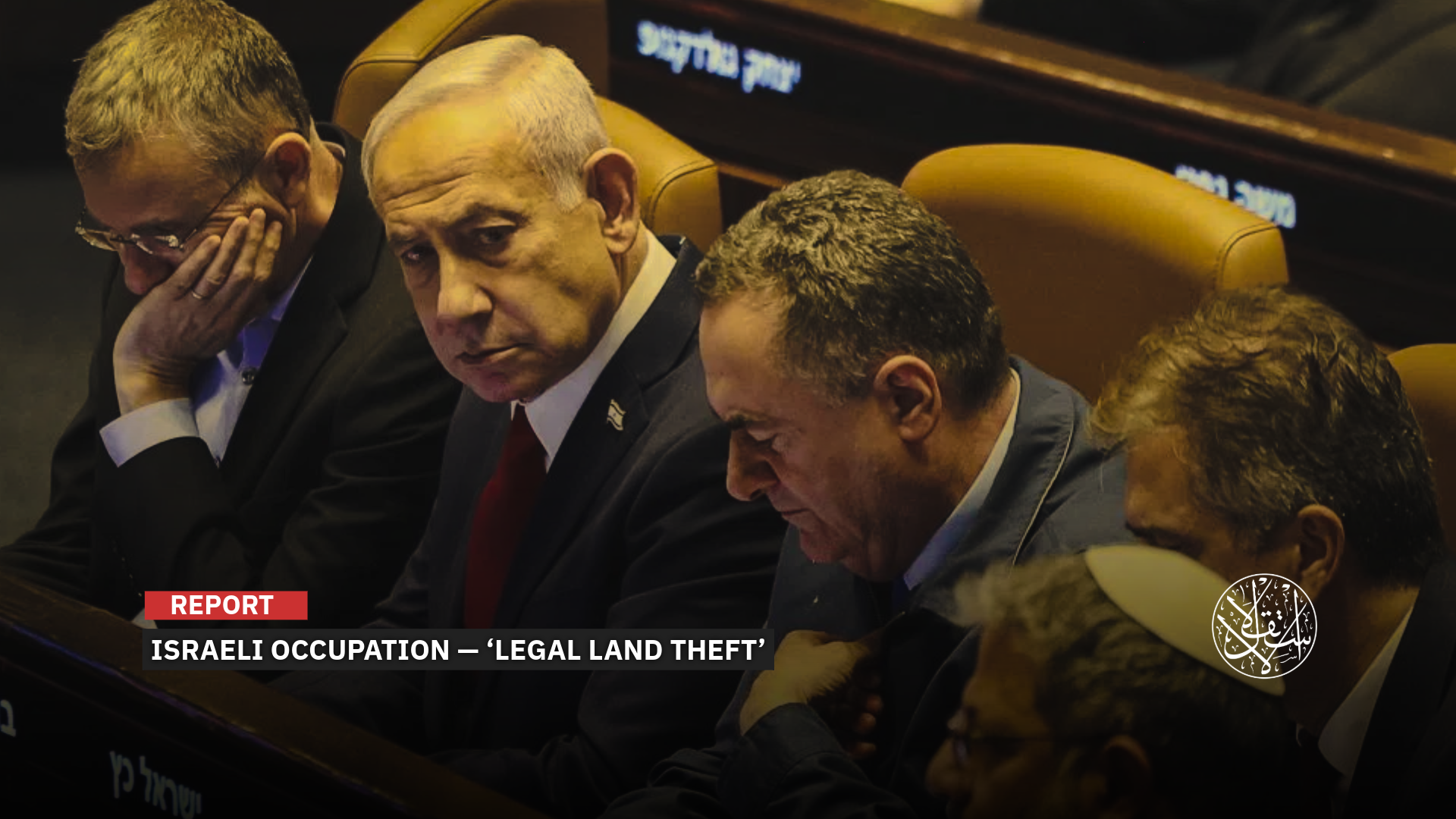
Extremist Finance Minister Bezalel Smotrich and War Minister Israel Katz announced a series of measures approved by the security cabinet aimed at deepening Israeli control over the West Bank.
At the top of the new decisions is the repeal of the Jordanian law that prohibited the sale of land to non-Arabs. Israeli reports indicate the cabinet now allows settlers to buy land just as their counterparts do in Tel Aviv. The new text also removes the requirement for a “transaction license,” limiting conditions to simple professional criteria.
Yedioth Ahronoth noted that the previous restriction forced Jews to purchase land through registered companies. Those limitations have now been removed.
Second, the Israeli Occupation government decided to make land ownership records public after decades of secrecy, allowing anyone to identify Palestinian landowners and contact them. This move could make it easier for settlers to pressure owners to sell or to intimidate, extort, or pursue them through broker networks.
Third, the Land Purchase Committee, a government body dormant for nearly twenty years, will be revived to allow occupation authorities to “preemptively buy land” and secure reserves for settlement expansion.
Fourth, the cabinet expanded enforcement powers to Areas A and B, which are nominally under Palestinian Authority control under the 1993 Oslo Accords. The army and the Civilian Administration were granted executive authority in these areas under the guise of addressing environmental law violations, water theft, and site vandalism. i24 News reported that this means Israeli Occupation authorities can demolish Palestinian homes and seize land in PA-controlled zones.
Fifth, planning and licensing powers in the Jewish neighborhood of Hebron and the Ibrahimi Mosque were transferred from the city’s Palestinian Authority-run municipality to Israeli institutions. Yedioth Ahronoth noted that changes to Jewish construction previously required approval from both the Palestinian municipality and the Israeli Civilian Administration; under the new rules, the Israeli Occupation army’s approval alone suffices, effectively breaching the 1997 Hebron Protocol.
Finally, the cabinet decided to establish a local authority at the Ibrahimi Mosque and Rachel’s Tomb in Bethlehem, creating a separate Israeli administration over holy sites located within Palestinian municipal boundaries—effectively annexing these areas.

The Agenda in Focus
While the Israeli Occupation government describes the steps as “streamlining procedures” and “normalizing life,” official statements and expert analyses point to deeper objectives.
Extremist Finance Minister Bezalel Smotrich boasted that the measures end what he called “racist Jordanian laws,” declaring that the developments “bury the idea of a Palestinian state.” He added that settlers would no longer be second-class citizens and that the government is deepening its grip on all of the “land of Israel.”
War Minister Israel Katz said the decisions reflect a clear policy—strengthening “Israel’s” hold over the West Bank, expanding settlements, and securing “our future.”
Looking at the government’s long-term plans, these steps are part of a creeping annexation strategy. In early 2026, the Israeli Peace Now organization reported that the Netanyahu government was working to weaken the Palestinian Authority and prepare the ground for annexing Areas A and B.
A report by the Foundation for Middle East Peace (FMEP) on pending Knesset legislation noted that the proposed “Judea and Samaria Heritage Authority” would allow the purchase and seizure of land under the pretext of protecting antiquities; if passed, it would extend Israeli law over the territories—a step toward annexation.
This aligns with current cabinet decisions, which expand the powers of the so-called Israeli Civil Administration and place more land under Israeli Occupation law.
In recent years, the Israeli government has moved to legalize unauthorized settlement outposts and grant formal approval to more than 50,000 settlement housing units, while also creating separate administrative bodies for settlers—such as the Area C Management Council—and granting Smotrich unprecedented authority within the Civil Administration.
Yedioth Ahronoth reported that the ministers aim to implement these measures ahead of the general elections on November 3, 2026, to satisfy the radical settler base that forms a core part of the coalition.
Meanwhile, the settler organization, Regavim, welcomed the decisions, calling them a clear message that “Zionism is not measured in speeches or declarations, but in action on the ground.” The group said the measures allow settlers to “develop new areas” and urged even bolder steps to tighten control, reflecting support from “Israel’s” hard-right for these policies.
The Yesha Council described the decisions as a historic day for settlements, calling them the most important step in 60 years.
Israeli right-wing media celebrated the cabinet’s moves. The official Kan channel said the cabinet “abolished the unjust Jordanian law,” allowing settlers to buy land as they do in Israeli cities. Yedioth Ahronoth described the changes as deep reforms in land registration systems, “granting the state the power to demolish Palestinian buildings in Area A,” and called the steps a “breakdown” of the Hebron Agreement.

No Accountability!
While Israeli media and officials celebrate these measures, the steps are catastrophic for Palestinians. Allowing settlers to purchase Palestinian land means properties already vulnerable to theft or legal harassment face a higher risk of forced sale, according to Yedioth Ahronoth.
Opening land ownership records makes it easier to identify landowners, exposing them to pressure, violence, and coercion to sell. Transferring planning powers to Israeli Occupation authorities gives settlers control over all construction in Hebron and around the Ibrahimi Mosque.
This, in turn, will increase approvals for settlement expansion projects while rejecting Palestinian building permits, leaving Palestinian homes increasingly at risk of demolition.
Expanding authority into Areas A and B allows the Israeli Occupation army to seize more Palestinian land and displace residents under the pretext of protecting environmental and archaeological sites, according to the official Palestinian Wafa Agency.
Reviving the Land Purchase Committee opens the door to direct Israeli involvement in buying Palestinian land, increasing land seizure and undermining Palestinians’ ability to retain their property.
Establishing Israeli municipal authorities within Palestinian lands strengthens Israeli administrative presence and separates these areas from Palestinian institutions.
Haaretz noted that extending enforcement powers into Areas A and B challenges the Oslo Accords and allows “Israel” to pursue Palestinians in zones nominally under Palestinian Authority administration.
The Palestinian Ministry of Foreign Affairs stated that the Israeli decisions constitute an effective annexation of Palestinian land, describing them as “Israel’s relentless attempt to create a new reality on the ground through colonial settlements and by changing the legal status and standing of occupied Palestinian territory, including Jerusalem.”
Amid the growing settlement expansion, the international response has been limited to condemnation and calls for “Israel” to reverse its actions, without activating any accountability mechanisms or imposing sanctions.
“The international stance on the accelerating pace of settlement in the West Bank is nothing new,” Mohammed Imad, director of Legal Affairs and Policy at Skyline International for Human Rights, told Al-Estiklal.
“After the international community’s humiliating silence over two years of Israeli crimes in Gaza, no meaningful response is expected.”
“No action is expected from those who fail to enforce international law protecting human rights, do not restrain Israel’s killing machinery, and do not implement the international criminal protection mechanisms outlined in the Universal Declaration of Human Rights, the Hague and Geneva Conventions, and other international legal norms,” he added.
The legal expert said that after the war on Gaza, “we fully realized that the international community has implicitly sided with Israel, reflected in its silence over the horrific massacres in Gaza and what is happening in the West Bank today.”
“Israel justified its crimes in Gaza as a response to the [Palestinian] Resistance, but in the West Bank, there is almost no resistance, yet it continues its arrogance, impunity, and violations of international law without accountability—so it doesn’t even need a pretext,” according to Imad.
“It has become clear that the international community does not intend to take any real legal action. It is politicized and aligned with the U.S. narrative, with few exceptions such as Spain, Latin American countries, and others.”
“The international protection system is just ink on paper. It has no real mechanisms for enforcement, protection, or accountability. The international community turns a blind eye to what is happening in Palestinian territories and participates in Israel’s crimes through its unjustified silence.”
Sources
- Security cabinet okays deepened Israeli control of West Bank; Hamas urges ‘escalation’
- 'To Kill the Idea of a Palestinian State' Israel to Expand Law Enforcement in Palestinian-controlled West Bank Areas, Defying Oslo Accords
- Settlement & Annexation Report: February 6, 2026
- Security Cabinet approves measures expanding Israeli control in West Bank
- The Security Cabinet Approves a Series of Decisions to Deepen Annexation in the West Bank [Arabic]
- Just Before Netanyahu’s Flight: Cabinet Approves Dramatic Measures to Deepen West Bank Annexation [Arabic]