Egypt at the Center of Sudan’s War: Secret Bases, Turkish Drones, and Red Lines
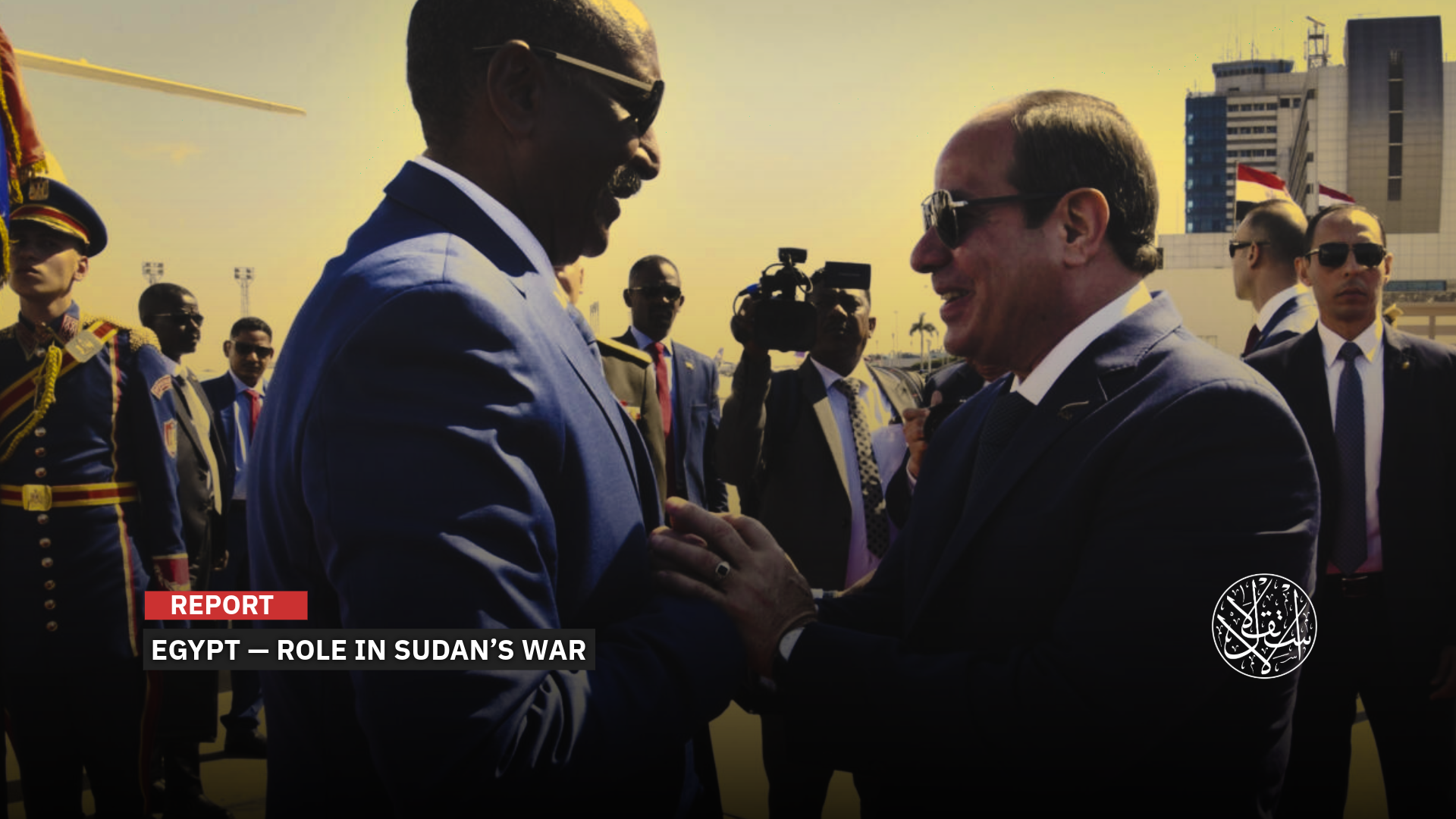
Egypt’s support for the Sudanese army went beyond providing weapons and military equipment.
Since October 2025, when Rapid Support Forces (RSF) leader Mohamed Hamdan Dagalo, known as Hemedti, overran el-Fasher, the capital of Sudan’s Darfur region, fears of a second national breakup have surged, reviving memories of South Sudan’s 2011 secession and raising fresh alarms about the country’s security.
In response, Egypt has ramped up military support for the Sudanese army in its fight against the RSF.
Driven in large part by Saudi Arabia’s confrontation with what it calls the “Abu Dhabi government militia” in Sudan, Cairo took bolder steps than it had previously, despite its close ties with Mohammed bin Zayed.
Despite official silence, reports and leaked information over the past three months indicate that Egypt’s support for the Sudanese army has gone beyond supplying weapons and military equipment to regain the upper hand on the battlefield.
It has also included designating an Egyptian airport near the Sudanese border, about 60 kilometers away, as a launch base for drones targeting RSF positions and supply convoys.
By early February 2026, a new round of reports and satellite imagery, most notably published by The New York Times (NYT), pointed to a surge in activity at an Egyptian drone base used to strike RSF movements inside Sudan.
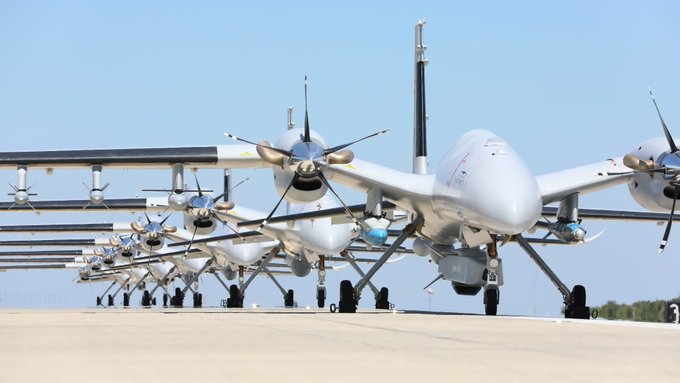
Those reports identified the site as East Oweinat, near the Sudanese border, where a civilian airport was converted into a covert military base. From there, Turkish-made Bayraktar Akinci drones, transferred to the Sudanese government via Egypt, have been launched, reflecting growing alignment between Cairo and Ankara in backing the Sudanese army.
Secret Base
Following a series of political and military meetings and visits between Egypt and Sudan, Egyptian moves have revealed Cairo’s direct involvement in Sudan’s military conflict—not only through traditional military support but also by operating a secret airbase inside Egyptian territory, hidden within a massive agricultural project in the Western desert.
From this base, drones are launched to support the Sudanese army under Abdel Fattah al-Burhan in its fight against the RSF, led by Hemedti.
Under the headline “The Secret Egyptian Air Base Behind Sudan’s Drone War,” The New York Times published a report in early February 2026 by four journalists, including Declan Walsh, the paper’s former Cairo correspondent.
The report included high-resolution satellite images and video footage showing heavy military activity at a landing site in East Oweinat, southwest Egypt. It suggested the location serves as a secret base for Turkish Akinci drones, launched to strike the RSF in Sudan, backed by the UAE, with the drones likely operating on behalf of the Sudanese Armed Forces (SAF).
These findings coincided with reports of Turkish operations at the East Oweinat base, conducted with Egyptian approval, where drones are delivered by Ankara and operated by the Sudanese army to target Hemedti’s RSF positions.
Earlier satellite imagery from late December 2025 had already shown Turkish-made Akinci drones at the East Oweinat base in southern Egypt.
This development appears to reflect a coordinated Egyptian-Turkish air strategy aimed at preventing Sudan’s fragmentation and consolidating the country under the Sudanese army, in opposition to the RSF militia, which is supported by the UAE and the Israeli Occupation.
According to the NYT, Egypt allowed Turkiye to use the East Oweinat airfield in southern Egypt as a launch point for operations targeting the RSF, signaling direct support for the Sudanese army.
While Cairo has offered no official comment, pro-government Egyptian online networks quickly moved to confirm the report’s claims, framing the support for Sudan as “an honor we do not claim and a charge we do not deny.”
On November 6, 2025, the Middle East Eye (MEE) revealed in an exclusive report that Egypt and Turkiye had ramped up support for the Sudanese army following the RSF’s takeover of el-Fasher.
MEE described the fall of North Darfur’s capital as a major turning point, especially after RSF leader Hemedti consolidated control over the Sudanese side of the arid tri-border region linking Egypt and Libya.
The report cited a senior Egyptian military intelligence source confirming direct coordination between the Egyptian and Sudanese armies to establish a joint command force aimed at deterring RSF incursions and preventing any potential infiltration into Egyptian territory along the Sudanese or Libyan borders.
It also noted that Egypt and Turkiye have been supplying the Sudanese army with weapons, highlighting Egyptian Chief of Staff Ahmed Fathi’s back-to-back visits within 24 hours to Saudi Arabia and Sudan, part of a regional coordination that included a Saudi role in financing Turkish arms deals for Khartoum.
The report further mentioned the creation of an Egyptian-Sudanese joint operations room in North Kordofan, alongside the deployment of new radar and early warning systems to counter RSF movements, which sources said could be preparing for a potential attack on Omdurman—considered a “red line” by Cairo.
The intelligence source added that the joint operations room would enable the Sudanese army to regain control over Darfur, which Egypt describes as vital for regional stability and the protection of its southern borders.
A Turkish source familiar with the situation told MEE that the Egyptian and Turkish armies had begun direct cooperation inside Sudan, with preparations underway to retake el-Fasher and the surrounding areas while preventing any foreign air support from reaching the RSF.
According to the same source, Turkiye has been supplying the Sudanese army since 2024 with military drones, air-to-ground missiles, and command centers, while Turkish drone operators are active inside Sudanese territory.
Military Zone
In January 2025, social media accounts claiming affiliation with “Friends of the Egyptian Armed Forces” reported that Cairo had converted Oweinat’s civilian airport into a military base.
Satellite images confirmed construction and expansion work at the site, including lengthened runways and new buildings and bunkers for warplanes, suggesting it had become a support base for the Bernice base near the Libyan border.
Posts indicated that the new military base at Oweinat would serve as an operations hub to secure Egypt’s southern border with Sudan and would be geographically closest in the event of a direct intervention, with clear hints at potential use against RSF militias. One post noted, “Even if it is not used in the Janjaweed file, the Oweinat base represents a critical safeguard for the southern and western borders.”
The NYT report reinforced earlier findings, citing photos and video showing that Oweinat Airport is actively being used in operations against the RSF, with Turkish-made Bayraktar Akinci drones launching from the base, operated by Sudanese personnel, and possibly supported technically by Turkish and Egyptian teams.
The report explained that Egypt, long reliant on Emirati support and investment and previously taking a cautious diplomatic stance toward the conflict between the Sudanese army and the RSF, shifted its position after el-Fasher fell in October 2025.
According to the newspaper, Cairo developed a hidden airbase within a large wheat farm project in the Western desert, at Oweinat, turning it into a secret hub for combat drones purchased by the Sudanese army from Turkiye, a deal confirmed by Ankara.
These advanced Bayraktar Akinci drones launch from Egyptian territory to strike RSF targets inside Sudan, though the report did not clarify whether the drones are operated solely by Sudanese forces or with direct Egyptian involvement.
Four U.S. officials and one Middle East source told NYT that the Turkish drones are being hidden in Egypt for their protection, particularly after previous threats from Hemedti, who vowed to target “any airport from which these drones operate,” which may explain why Cairo has kept the operation under wraps.
The NYT noted that since the head of the Egyptian regime, Abdel Fattah el-Sisi, warned in December 2025 against crossing “red lines” in Sudan and discussed activating the joint defense agreement, Bayraktar Akinci drones have been conducting deep strikes inside Sudan, targeting RSF fighters and their supply convoys.
RSF forces, in turn, appear to have acquired Chinese drone-jamming and surface-to-air missile systems, likely provided by its Emirati sponsors, said Wim Zwijnenburg, a drone expert at the Dutch organization PAX.
Images from combat zones, verified by NYT, show RSF fighters claiming to have shot down at least four Turkish Akinci drones—each valued at roughly $25 million—over the past four months.
Oweinat Airport was originally a civilian facility, but in 2025 it was transformed into a military airfield in Egypt’s remote New Valley governorate, over 60 kilometers from the Sudanese border. Satellite imagery since January 2025 documented extensive expansion, including runway lengthening from 110 to 151 meters, construction of an additional runway, and new access roads, supporting its conversion into a military base.
This buildup coincided with a sharp escalation in Cairo’s political rhetoric regarding Sudan, signaling that the airport would become a strategic hub for protecting Egypt’s southern frontier, an area of national importance given its large-scale agricultural projects and proximity to volatile border regions.
On January 10, 2025, the ECAD platform documented the airport’s upgrades, coinciding with el-Sisi’s statements about activating the joint defense agreement with Sudan.
According to the NYT, the Oweinat project originally relied on a single runway used for transporting workers and exporting agricultural products, but satellite imagery shows that expansion began gradually as early as 2018.
By 2024, a second runway and around 17 aircraft hangars were added for military purposes, with small fighter jets and drones stationed on the base.
Turkish Akinci Drones
Satellite data from the U.S.-based imagery intelligence firm URSA Space shows Turkish cargo planes landing at Oweinat Airport in southwestern Egypt in early July 2025.
In the following weeks, the base saw intense activity, including the installation of a satellite communications system next to one of the hangars and vehicles believed to be part of a ground control network for drones. By mid-July, imagery confirmed Bayraktar Akinci drones on the tarmac, coinciding with the arrival and departure of Turkish cargo flights on July 21, 2025.
The Sudanese army had already finalized deals with the Turkish manufacturer Baykar in November 2023. Seven months into the civil war, Sudan signed a $120 million contract to purchase six Bayraktar TB2-class Akinci drones, along with 600 warheads and a full training and maintenance package.
Once the Akinci drones arrived in Egypt in 2025, they provided the Sudanese army with precision capabilities to strike RSF and disrupt supply lines coming via Khalifa Haftar’s militias in Libya.
Experts note that the Akinci boasts a range exceeding 4,500 miles and can carry at least three times the payload of a standard TB2 drone, with each aircraft costing more than four times the price of a TB2.
By December 2025, at least two Akinci drones were operational from the Egyptian base, conducting strikes inside Sudan, according to video footage reviewed by the NYT. One clip shows a drone dropping a guided bomb on a gathering of RSF fighters in a Darfur village, more than 800 miles from the launch site.
Three weapons experts identified the munition as a guided bomb produced by Turkiye’s Roketsan, noting that the Akinci is the only drone capable of delivering such long-range strikes.
While the drones were conducting missions in Sudan, Turkish cargo and military flights continued to land at Oweinat, some originating from Port Sudan. Several flights also departed from Turkiye’s Corlu Airbase, where Baykar develops and tests the Akinci, according to flight-tracking data from the aviation monitoring firm, Aireon.
MEE highlighted on January 24, 2026, a potential agreement between Egypt and Turkiye granting Ankara access to military facilities in southern Egypt, most notably Oweinat Airport, to support the SAF in their fight against the UAE-backed RSF.

Recorded Confessions
The RSF militias said in a statement on January 27, 2026, that they had evidence of what they called “direct Egyptian involvement in the war in Sudan,” warning that Cairo was no longer operating from the sidelines.
In the statements, they described the Sudanese army as “terrorist Sudanese armed forces operating under the banner of the Islamic movement,” branding it “Muslim Brotherhood militias,” and accusing Egypt of backing it despite Cairo’s publicly declared hostility toward the Brotherhood.
“Our forces have obtained conclusive physical evidence,” the statement said, pointing to Egyptian-made armored combat vehicles, weapons, and ammunition allegedly found in the possession of Sudanese army units and “allied militias,” which it claimed proves the Egyptian government’s involvement in supporting what it called a “war against the Sudanese people.”
The RSF also claimed that captured military commanders gave recorded confessions admitting to receiving Egyptian military support, including shipments of weapons, ammunition, aircraft, drones, and armored vehicles, as well as training and political, diplomatic, and media backing, in addition to medical treatment for wounded fighters.
According to the statement, Egypt supplied the Sudanese army in August with eight K‑8 aircraft that arrived at Port Sudan and were later used to bomb civilians. It also accused Cairo of providing the Sudanese army with U.S.-made 250‑kilogram bombs allegedly used to destroy homes, markets, and civilian infrastructure.
The RSF described this military support as “a clear act of aggression against the Sudanese people,” holding the Egyptian government “fully responsible for the crimes committed.”
These were not the first such accusations. In June 2025, the RSF issued a similar statement claiming it possessed “conclusive physical evidence” of Egypt’s involvement in backing the Sudanese army through Egyptian-made weapons, ammunition, and armored vehicles.
In October 2025, RSF leader Hemedti escalated his rhetoric further, warning that “any aircraft or airport from which attacks are launched against our forces from a neighboring country will be considered a legitimate target.”
On December 18, 2025, Egypt announced what it called “red lines” for its national security, warning that any threat to Sudan’s territorial integrity, its legitimate state institutions, or its sovereignty constitutes a direct threat to Egypt’s national security.
The declaration came during a visit to Cairo by Sudan’s Transitional Sovereignty Council head, Abdel Fattah al-Burhan. In a statement, the Egyptian presidency stressed that Egypt’s national security is directly linked to Sudan’s national security and affirmed that Cairo reserves the full right to take all necessary measures, under international law and the Egypt-Sudan mutual defense agreement, to enforce these red lines.
Observers note the significance of the statement lies in its clear definition of “red lines” and its implicit threat of direct military intervention under the mutual defense pact if the RSF crosses them.