Narrative Battle: Why U.S. Media Sided Against Saudi Arabia in Its Dispute With the UAE
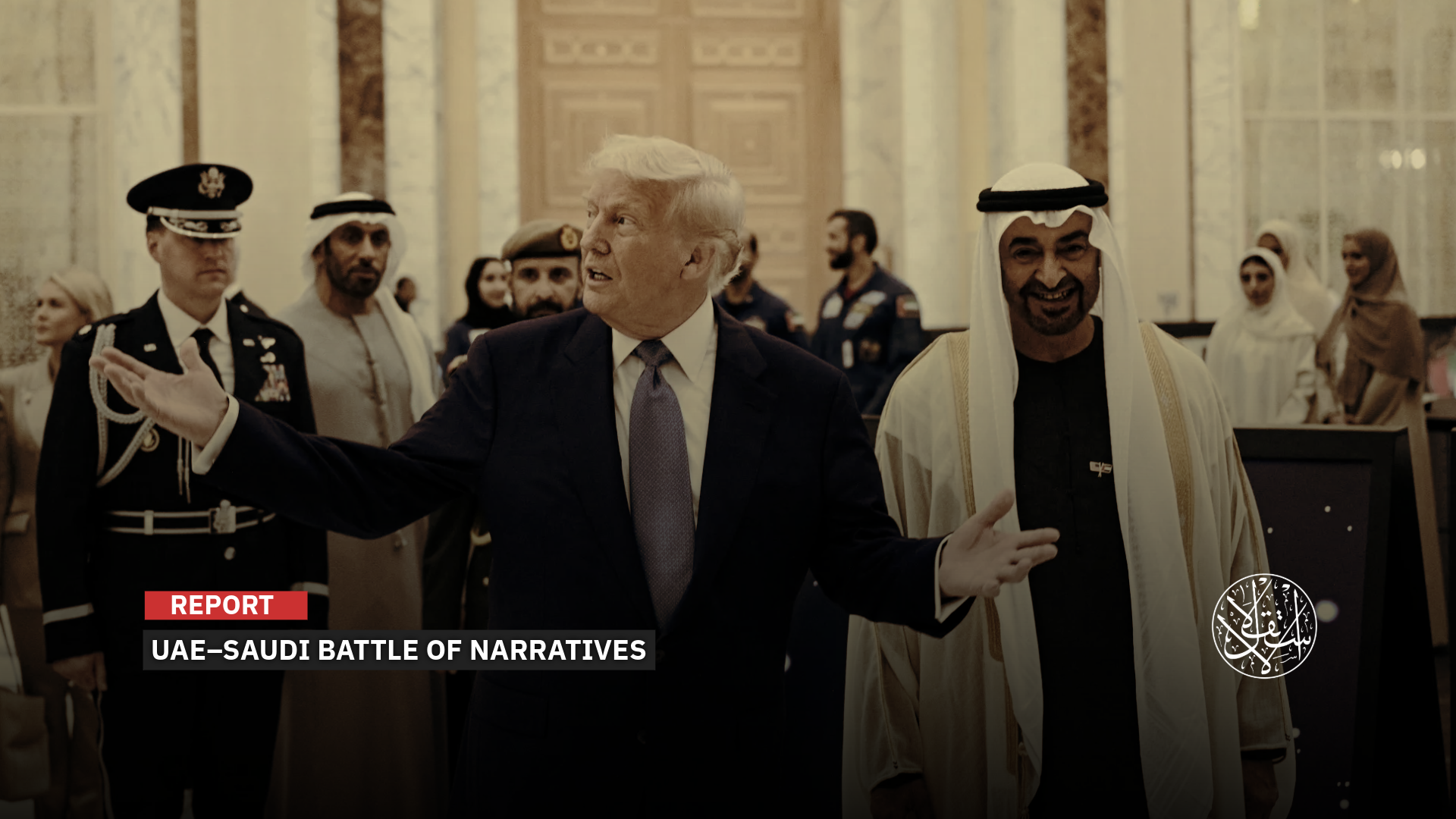
Coverage in the U.S. frames the UAE as the voice of reason, preserving stability, unlike Saudi Arabia.
As the Saudi–Emirati dispute shifted from muted differences to an open political and media crisis, it became clear that the scene extended beyond a clash of positions between two Gulf capitals, evolving into a battle of narratives within the American and Western media space.
Within a few weeks, major U.S. newspapers, specialized magazines, and public radio reports were filled with analyses that were similar in structure and language, largely converging on a single depiction of the crisis: Saudi Arabia as the party that initiated escalation and changed the rules of the game, versus the UAE portrayed as a rational power seeking to preserve regional stability.
This raises a fundamental question: how and why did this bias form? The issue goes beyond explicit editorial stances, appearing in word choice, headline construction, assignment of responsibility, and the roles distributed within news and analysis texts in the American media.
From the first days the dispute became public, a clear trend emerged in U.S. media to define Saudi Arabia as the source of the crisis and the root of the problem, placing responsibility on it for allowing tensions to reach this level of escalation.
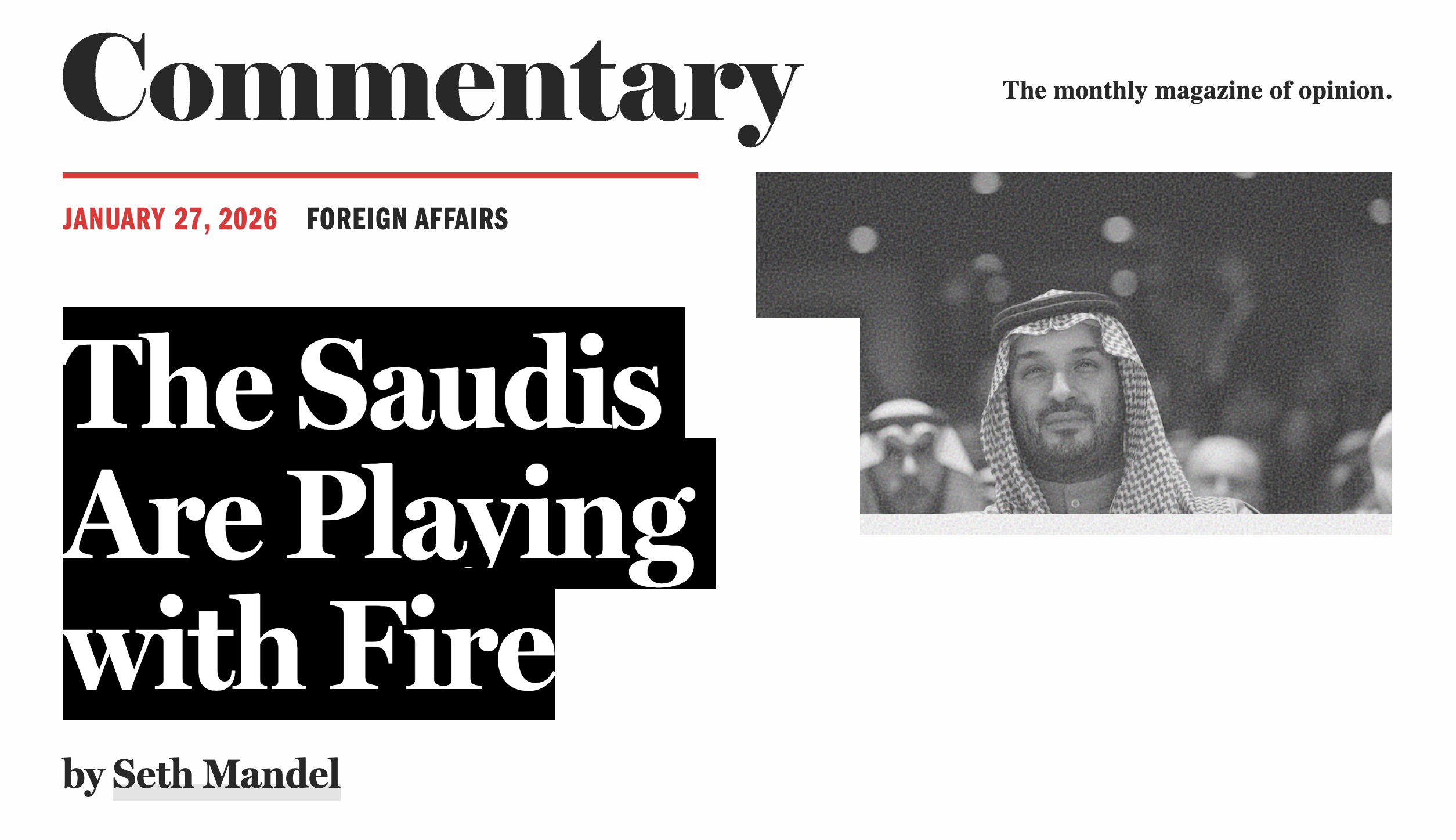
On January 27, 2026, Commentary magazine, associated with the American Zionist current, published an article titled, “Saudis Are Playing with Fire,” a headline leaving little room for interpretation; Saudi Arabia is not portrayed as a party to a conflict, but as a reckless actor threatening the regional balance.
The language in the article is rooted more in moral judgment than political analysis, presenting Saudi moves as uncalculated risks, while portraying the UAE as a rational ally to Washington and “Tel Aviv,” seeking to maintain stability in the face of what is described as Saudi impulsiveness.
This framing was not limited to opinion journalism, but quickly spread to the economic media.
On the same day, January 27, 2026, Bloomberg published a report titled, “Saudi Arabia-UAE Tensions Put Middle East Businesses on Edge.”
Although the report ostensibly focused on the implications of the crisis for business and investment environments, it reproduced the same narrative by linking the risks to what it described as Saudi escalation, while presenting the UAE as a party attempting to contain the fallout rather than create it.
Reinforcing the Bias
In U.S. coverage, certain terms are repeatedly used when discussing Saudi Arabia, including “escalation,” “warning,” “aggressive response,” and “destabilizing.”
These words are not used casually; they play a central role in shaping a mental image of the kingdom as the party that broke the existing balance and plunged the region into a new state of instability.
On January 27, 2026, Foreign Policy went further in an article titled, “The Middle East Has Two New Rival Teams.”
The magazine divided the regional scene into two axes, presenting the UAE as part of what it called the “pragmatic stability axis,” while depicting Saudi Arabia as a power challenging the regional order.
In U.S. political literature, this description carries an explicitly negative connotation, typically used to label states seen as a threat to the existing international system.
Within this framework, Saudi motives or context are not examined; it is assumed in advance that its actions aim to forcibly reshape the region, an assumption repeated in various forms across multiple media platforms.
Notably, this pattern of framing is not limited to specialized journalism but is also evident in general media aimed at a broad American audience.
On January 17, 2026, NPR aired a report titled, “A Saudi-UAE rift is turning two close allies into regional rivals.”
Although the report used simplified language, it reinforced bias through a clear narrative: Saudi Arabia is changing the rules of the game, while the UAE preserves stability.
This simplification, despite its apparent neutrality, establishes a one-sided mental image for the audience.
On January 9, 2026, the Associated Press published a story on Saudi restrictions on flights between Aden and the UAE.
Despite the neutral news tone, the narrative structure portrayed Saudi Arabia as the direct source of disruption, without any parallel scrutiny of the UAE’s role in complicating the Yemeni scene over the past years.
On January 20, 2026, The Washington Post ran a report titled, “After Yemen rift, Saudi Arabia aims to quash UAE’s power in wider region”.
The choice of the word “quash” is not a minor linguistic detail; it implicitly assumes UAE influence as normal and stable, while portraying Saudi action as an aggressive move against an existing reality.
In the same vein, The Los Angeles Times, in a report published on January 21, 2026, described Saudi Arabia as the party initiating the attack, criticizing its rapprochement with Turkiye and linking the dispute to potential consequences for “Israel’s” stability, particularly regarding the UAE’s role in Somalia.
Political analysis intersects with unspoken criteria, where positions on “Israel” become a measure of the rationality or risk of any regional move, reflecting a structural bias that goes beyond the Gulf dispute itself.

Framing for the Narrative
Even economic coverage, which is usually presented as the most neutral, has not escaped this broader pattern of bias.
On January 19, 2026, the U.S. magazine Semafor published a report examining the impact of the Saudi-UAE dispute on the Davos forum atmosphere.
Although the report was calm and analytical in tone, it focused on market concerns about Saudi moves, while treating UAE policies as a given source of stability.
A central role in reinforcing this approach is played by U.S. think tanks, whose analytical papers later circulate in the media as quasi-academic references.
Reports from the Center for Strategic and International Studies, the Washington Institute for Near East Policy, and the Council on Foreign Relations, issued during January 2026, converged on almost a single idea: Saudi moves are the crisis trigger, while the UAE is presented as a party seeking containment.
When this perspective enters journalism, it is framed as objective analysis, despite ignoring problematic or even conspiratorial UAE roles in complex issues such as Yemen and the Horn of Africa.
What is notable this time is not only the U.S. coverage biased toward the UAE, but also the emergence of a counter-narrative led by Saudi writers, commentators, and social media activists.
They sought to deconstruct the hostile language toward Riyadh and respond to what they see as a systematic bias that does more than describe events, instead redistributing responsibility in a way that makes Saudi Arabia the primary culprit before the full story is known.
At the center of this Saudi response to the Western narrative was an opinion piece by Saudi writer and political commentator Ali Shihabi, published on January 30, 2026, in the U.S. magazine Newsweek under the title, “Is Saudi Arabia Drifting Away From the U.S.?”
The article does not treat the Saudi-UAE dispute as an indicator of Saudi decline. Instead, it warns against the dangers of interpreting tactical disagreements with other U.S. allies as a strategic break from Washington.
According to Shihabi, such a misunderstanding could undermine partners working to prevent the emergence of the next generation of failed states in Yemen, Somalia, and Libya, arenas where he argues the UAE is pushing toward that outcome.
From his perspective, U.S. media does not treat Saudi Arabia as a state with security interests, borders, and strategies, but as an actor expected to remain disciplined within a framework set by others, namely the United States and “Israel,” and whenever it acts outside that framework, it is immediately presented as a problem, rather than as a party with legitimate grievances.
Disappointment
Saudi researcher and commentator Salman al-Ansari, meanwhile, used a more direct tone in a series of tweets on his X account, arguing that a large part of U.S. coverage of the crisis is driven less by facts than by political disappointment.
Al-Ansari believes that the American media has long viewed Saudi Arabia as a pillar of stability operating within an unwritten framework of understandings, and when Riyadh decided to redefine its red lines on issues in Yemen, the Red Sea, and the Horn of Africa, this shift was portrayed as a deviation from the script rather than a legitimate sovereign repositioning.
Al-Ansari goes further, arguing that Western media in general does not tolerate the idea of Saudi Arabia independently rearranging its security priorities, without waiting for a green light from Washington or consensus with “Israel.”
In this sense, he reads media coverage as an unofficial tool of pressure aimed at pushing Riyadh back onto the desired path, rather than a neutral reflection of complex political developments.