Honoring French Colonial Soldiers: A Moroccan Protocol Misstep or a Betrayal of History?
“‘Shared memory’ is being used to rewrite history from the colonizer’s view.”
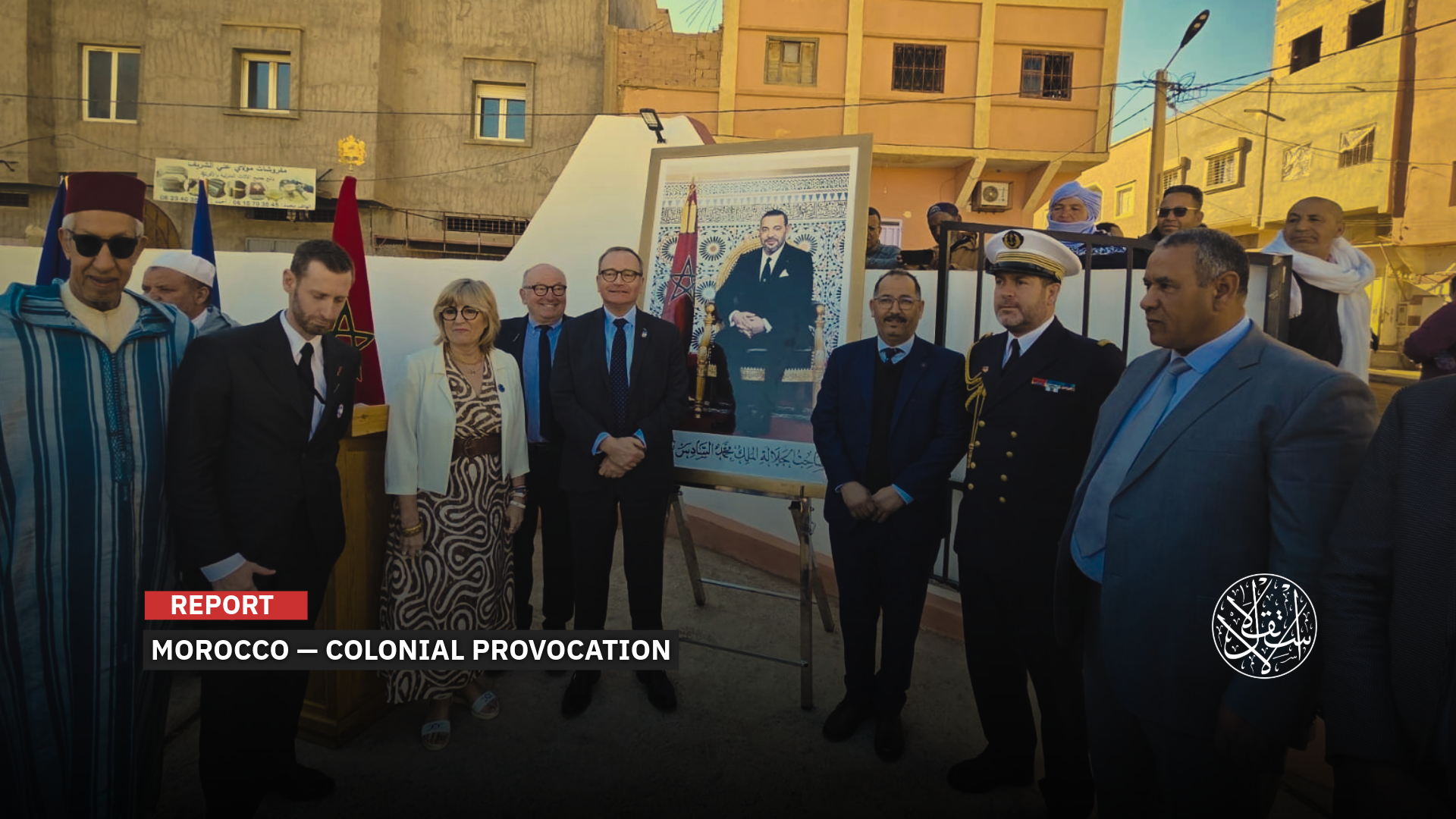
In a move described as “historical audacity and a stab in the back of the resistance,” the Tinghir Province region in southern Morocco witnessed a French ceremony honoring its soldiers who died fighting local populations and resistance during the colonial period.
The event, held on February 12, 2026, took the form of commemorating what was called the “military square” at the Alnif-Bougafer Cemetery in the Tinghir area, promoted by the French embassy in Morocco under the banner of “shared memory.”
The affair sparked a wave of outrage among Moroccans, after it emerged that it was an official tribute to the 15 soldiers killed during France’s bloody war against the Ait Atta tribes in the famous Bougafer battle of 1933, with official Moroccan participation.
French Crimes
The ceremony was attended by the French Consul General in Marrakech, Quentin Teisseire, the Director of Memory and Culture at the French Ministry of Armed Forces, Evans Richard, and the Director General of the National Office for Veterans and War Victims, Marie-Christine Verdier-Jouclas, with full funding from the French Ministry of Armed Forces.
According to a post by the French embassy, the cemetery includes soldiers killed during the Bougafer battle between February 13 and March 25, 1933.
It stated that “this inauguration reflects the shared will of Morocco and France to value a common memory based on respect, mutual recognition, and the transmission of history to future generations.”
It should be noted that in the wake of the French colonization of most Moroccan territory, following the signing of the protectorate until 1933, the colonial forces did not find it easy to impose control over the southeastern population, particularly in the Saghro region, home to the Ait Atta Berber tribes, who were not under French authority at the time.
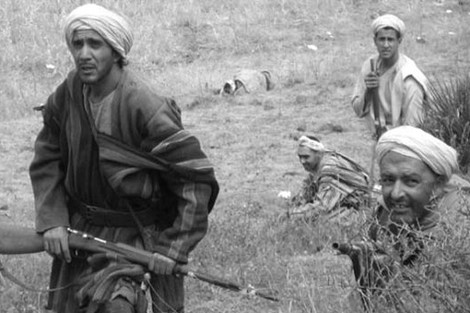
The Bougafer battle was the most prominent episode in attempts to subdue Saghro in February and March 1933.
The Moroccan resistance, entrenched in the high mountains, repelled the French presence, forcing them to turn to political measures and dialogue with the Ait Atta resistance leader Assou Oubslam, but negotiations failed.
France felt deeply humiliated, seeing the “Bedouin” who united the Berber tribes as humiliating the French army in the Saghro mud and exposing the troops to ambush attacks.
This led it to maneuver under what it called the “pacification of Saghro,” though in reality it amounted to crimes against humanity, employing an enormous arsenal of weapons and equipment to kill more than 1,300 Moroccans who fell in the Bougafer mountains defending their land and honor.
However, the controversy was not about the French presence, which routinely organizes activities related to the colonial period, but focused on the official participation of Moroccan officials in a ceremony honouring the remains of 15 soldiers of the “Com” forces, who were killed during military operations targeting Moroccan resistors in the course of armed confrontations.

A petition of Condemnation
The event prompted local human rights activists to issue a denunciatory petition under the slogan, “The Blood of Bougafer… A Pact That Cannot Be Sold or Compromised.”
The petition stated that this initiative, presented under the guise of “shared memory” and “reconciliation,” is nothing but a blatant provocation of Moroccan sentiments, a flagrant distortion of history, and a grave betrayal of the sacrifices of ancestors who gave their lives for freedom and dignity.
It stressed that “the Bougafer battle (1933) is not merely a fleeting military event in Moroccan history, but an immortal heroic epic written by the men and women of the Ait Atta Berber tribes, led by the hero Assou Oubslam, in confronting the French colonial war machine.”
It added, “Bougafer, the peak of the Saghro mountains, witnessed legendary steadfastness, where Moroccan resistors, armed only with simple weapons and unwavering faith, faced an army equipped with the latest arms and aircraft.”
The petition affirmed that “this battle inflicted heavy losses on French forces, demonstrated to the entire world that the will of peoples for liberation is unconquerable, and confirmed that the blood of the martyrs shed on Bougafer soil is a trust for future generations, a symbol of sacrifice and devotion that cannot be compromised or desecrated in any form.”
It concluded that “the restoration of these cemeteries, attended by Moroccan and French officials, is a desperate attempt to whitewash the colonial page, portray the invaders as victims, and ignore the heinous crimes they committed against the Moroccan people.”
In this context, the local political activist Abdelwahad Siddiqi said he had followed with great interest the reactions of a number of activists regarding the restoration of a cemetery in the Alnif commune in Tinghir Province, which contains the remains of 15 members who collaborated with the French army, the “Com” forces, and fell in the Bougafer battle.
Siddiqi told Al Estiklal that he welcomed all the angry reactions, proud to defend the historical memory of the region and the inalienable rights in confronting the colonizer, while elevating the role of the resistance front and its men.
He expressed regret that many of these same activists, until recently, belittled the Palestinian resistance and its fighters, and at times even praised the brutal Zionist entity.
Nevertheless, Siddiqi added, resistance anywhere is not a fleeting choice, but a principle and a dignity renewed in every time and place.
“Colonialism will remain a dark chapter in history, and nothing can whitewash its stain,” he concluded.
Social Interaction
Social media platforms saw widespread reactions to the event. In this context, journalist Mostafa el Asri said that what occurred was a “betrayal of Morocco’s martyrs during the Bougafer battle, where seven thousand Moroccans armed with simple rifles faced 83,000 French soldiers, including Moroccan collaborators, supported by 44 aircraft, heavy artillery, and advanced weapons…”
El Asri emphasized in a post on his Facebook account on February 13, 2026, that what France did under Moroccan sponsorship, amid the silence of the government-run High Commission for Former Fighters, was “a contempt for the struggle and jihad of Moroccans against the occupation.”
Writer and researcher Driss el Ganbouri said that “France’s honoring of the collaborators who fought alongside it during the occupation is no different from what it did after independence, placing its agents at the head of several executive positions.”
El Ganbouri added in a post on Facebook on February 16 that “France thus seeks to remind Moroccans that independence occurred under its dependency, and that the Moroccan resistance was terrorism, as France and its newspapers described the resistors at the time, and as the West today describes anyone who resists American and Israeli domination.”
“The extremist Amazigh right remained silent in the face of what happened, while the free Amazigh spoke out,” estimating that “the Amazigh right is an ally of colonial France and its creation,” he noted.
Meanwhile, the leader of the National Action Group for Palestine, Aziz Hanawi, reacted to the event in a post on Facebook on February 14, raising two questions about the incident.
The first was, “Could the German embassy erect a tomb for Hitler’s soldiers on French soil in honor of the Nazi army during Germany’s colonial period in France?”
He criticized the double standards of members of the so-called “Draa-Tafilalet Coexistence Institution,” who have long championed normalization with the Zionist entity and targeted the Palestinian resistance and supporters of Palestine in Morocco.
In this context, Hanawi asked, “Why does the debate ignite among you over honoring the remains of French colonial soldiers who committed the Bougafer massacres against your ancestors, while you celebrate Israeli soldiers and army?”
Similarly, university professor and head of the National Coalition for the Arabic Language, Fouad Bouali, said that this event comes at a time when countries and governments that suffered under colonialism are demanding that the French state apologize for its historical crimes.
Bouali added in a post on Facebook on February 15 that “this colonialism left many scars on the national self that continue to suffer from its effects to this day.”
“The event also comes at a time when France consistently refuses, despite successive governments, to issue an official apology for its crimes, preferring to acknowledge only some to avoid legal and financial consequences,” he continued.
Bouali sharply criticized what he described as “the elites dominating public affairs in Morocco,” who, in his view, persistently seek to demonstrate “absolute loyalty to the French master, even apologizing to him, including through the participation of officials in honoring the collaborators on France’s behalf.”

Zionist Advocates
In contrast to all these positions defending Moroccan history and rejecting colonial crimes, the UAE-funded site Hespress chose to oppose this approach.
The site said in a report published on February 14 that what occurred was a “Moroccan-French initiative that preserves part of the painful shared memory of the twentieth century, through the restoration of a cemetery linked to the Bougafer battle.”
It cited the former president of the Bougafer Association, Youssef Benamro, who confirmed that the idea of restoring the cemetery had been discussed with the French side since 2012 during events commemorating the Bougafer battle.
He explained that the restoration stems from the fact that “the cemetery symbolizes a shared heritage and historical era, and it was in a deplorable state unworthy of the dead or the living (…)”.
Benamro added that this joint initiative “is an investment in the historical period, despite its bloodiness, because the time has come to invest it for the future, to preserve a shared legacy in memory, and we want the site to be a cultural and tourist destination.”
Meanwhile, the site Tanwir published an editorial on February 14, 2026, asserting that “it is time for the Moroccan state and civil society to restore dignity to the martyrs of Bougafer and its figures, including Assou Oubslam and his companions, and all the nation’s martyrs in the mountain peaks, valleys, and deserts.”
The site added, “This includes establishing a national memorial, incorporating historical battles into school curricula, organizing official celebrations worthy of their epic, and obliging France to restore dignity and apologize for its crimes.”
It warned that, despite the historical heroism of the local resistance, a symbol of national dignity and Amazigh steadfastness against occupation, the Moroccan state has so far not conducted any official, large-scale commemoration or memorialization of the Bougafer martyrs to a level befitting their sacrifices.
It continued, “Similarly, France, keen to preserve shared history in all its bloodiness and peace, has not taken the trouble to show remorse or apologize, even by honoring the Amazigh warriors who fought it with the dignity of a soldier, through a prominent memorial recognizing their courage and bravery in defending their independence.”
A Political Interpretation
The researcher in political sociology and head of the Moroccan Observatory Against Normalization, Ahmed Ouihmane, emphasized that “the issue is not merely a protocol or diplomatic event, but a matter that touches the living memory of the region, and the sense of historical belonging and symbolic dignity of the descendants of the resistance fighters and martyrs.”
Ouihmane stressed in an interview with Al-Estiklal that the struggle is no longer only political or economic, but has become a conflict over historical narrative and who holds the power to shape the ‘shared memory’ with Morocco, because those who control memory can influence the present and stake the future.
He warned that the competition over what is called ‘shared memory’ is merely a cultural facade for a deeper struggle over investments, monopolizing Morocco’s resources, and seizing its wealth.
The most dangerous aspect, Ouihmane said, is the official Moroccan presence alongside the French representation, granting these initiatives symbolic legitimacy that undermines national sovereignty and deeply wounds the sentiments of Moroccans and the descendants of martyrs who sacrificed for the country’s independence.
“What is happening are attempts to impose narratives that will make future generations live in rupture with their true history, a path far more dangerous than direct military occupation because it targets consciousness itself.”
“The reality is that we are today at a critical juncture; either we defend national memory as part of national sovereignty, or we leave the door open to the re-colonization of Moroccan consciousness through soft tools, yet deeply impactful at the heart of everything in the country, including the honoring of traitors and celebrating them, which necessarily amounts to contempt for the martyrs and their families, victims of the criminals being honored.”
Ouihmane stressed that what is happening today in the name of ‘shared memory’ is not reconciliation with history, but an attempt to rewrite history from the perspective of the colonizer, and from the perspective of those seeking domination over Morocco’s present and future.
“And before it is an insult to the feelings of Moroccans and the descendants of martyrs, it is a direct assault on national sovereignty and the historical right of the nation to protect its memory, narrative, and identity, and this is a wrongdoing that must stop, immediately,” Ouihmane added.