Hijabi On-Air Reporters Re-Framing the Picture of Muslim Females on US Media
The media is one of the most powerful tools directing public opinion and shaping popular understanding and beliefs all over the world. Aware of the crucial role of media, many veiled Muslim females in the US chose the journalism field in order to confront the increasingly rising islamophobia and to correct the misunderstanding about Muslims’ religious and cultural practices.
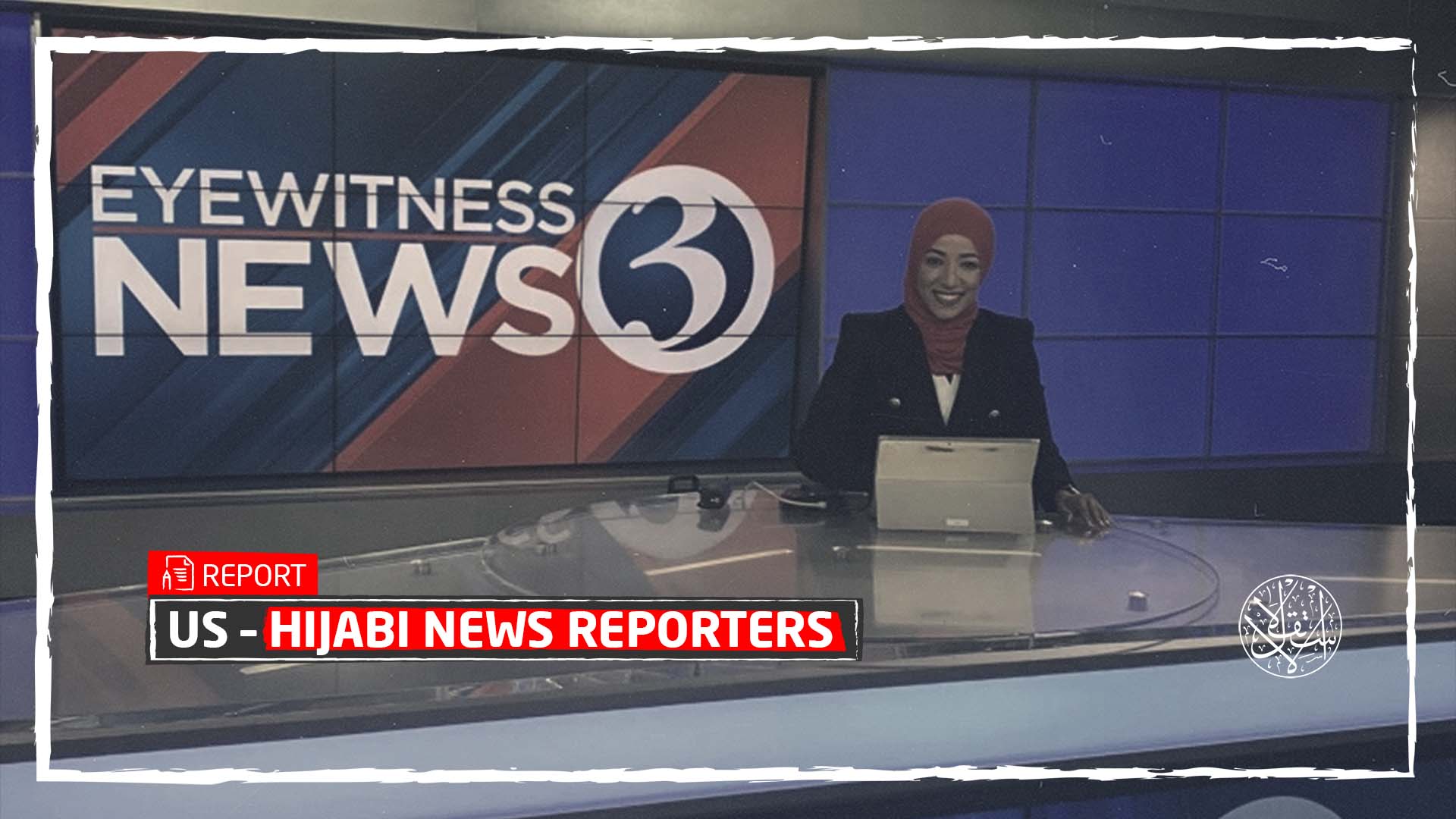
Saturday, December 24, was an exceptional day for Ayah Galal and for the Muslim community in the Connecticut state in the US. Ayah Galal anchored WFSB’s news coverage, to become the first veiled woman to report on-air news in Connecticut and the fourth-veiled Muslim broadcast reporter in North America.
Galal disclosed the factors that drove her towards the media coverage: “For years, I have seen how Muslims have been misrepresented in the media. I think there are a lot of misconceptions and misunderstandings about Muslims.
“Representation in the media matters and on-air talent should reflect the diversity of the communities we are reporting on. Muslims are a part of the fabric of this country, and growing up, there were not people who looked like me on television,” Galal said. “I’ve received so many messages from Muslim families, happy to see a Muslim on-air.”
Muslim Females in US Media
In her article: Confronting Prejudice against Muslim Women in the West, Anoosh Soltani pointed out that: “Popular Western media outlets strongly perpetuate a hegemonic view of Muslim women. On one hand, dominant media coverage of Muslim women is associated with being oppressed and passive. On the other hand, media outlets regularly express concerns surrounding the veil as a cultural-religious sign that is incompatible with the values and norms of the Western world. At the same time, the media situates and links the latter issues with the concerns and discourses around the integration of Muslim minorities in the West.”
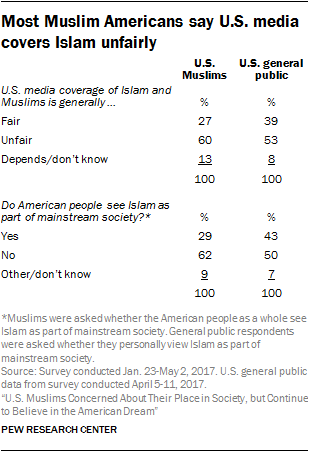
On the same truck, the American Pew Research Center conducted a study about how Muslims are portrayed in the US media reporting that: “Most Muslims (60%) perceive media coverage of Muslims and Islam as unfair, and a similar share (62%) think the American people as a whole do not see Islam as part of mainstream American society. These views are largely echoed by U.S. adults overall, many of whom agree that media coverage of Muslims is unfair and say they personally do not see Islam as part of mainstream society.”
The research center added: “Experiences with discriminatory treatment are especially common among those whose appearance identifies them as Muslim. Overall, about four-in-ten Muslims (38%)—including half of the Muslim women (49%)—say that on a typical day, there is something distinctive about their appearance, voice, or clothing that people might associate with Muslims. Of those whose appearance is identifiably Muslim, nearly two-thirds (64%) say they have experienced at least one of the specific types of discrimination asked about in the survey. Among Muslims who say they do not have a distinctively Muslim appearance, fewer report these types of experiences (39%).”
Light Against Misconceptions
Amnesty International and the Organization of Islamic Cooperation have often uncovered and condemned the long-standing prejudice prevailing in the Western Media against Muslims.
Since Muslim veiled female is always disclosing their Muslim identity through their Hijab, they were most subjected to discrimination and has been portrayed as oppressed or even uneducated.
Yet, many Muslim females decided to counter these misrepresentations and choose the journalism path to shed light on the reality of Hijab as a choice and source of pride and empowerment.
Galal said: “I didn’t want to compromise my faith for my profession,” she added, “throughout my journey, I had doubts about being able to break into the industry, particularly as someone who wears the hijab, but fortunately, I’ve had incredibly supportive colleagues who’ve encouraged me along the way.”
Galal’s great achievement is not the first of its kind. In February 2018, Tahera Rahman made history to become the first Hijabi presenting a TV news report in the US. She fulfilled her dream of being a light for people’ as she appeared onscreen for Local 4 News.
:quality(70)/cloudfront-eu-central-1.images.arcpublishing.com/thenational/YY2HQNCYTCPBASGA3QGRGCYCCM.jpg)
Rahman said: “Despite many rejections over the years, I refused to give up on my dream of appearing on-air. I was like, someday, someone is going to notice the work I’m putting in and give me a chance,” she stressed.
“When people said it was going to be tough, I was just like, I know, but life is tough,” Rahman said. “People live in places where it is hard to even practice journalism in general. I live in America, and I was born and raised with the values of equality and democracy and hard work getting you to your dream, to the American dream.
“What I prayed for every night for years is to be able to soften people’s hearts and basically be a light for people in a scary world with a lot of misconceptions,” Rahman added.
Breaking Barriers
Tahera, the first full-time reporter wearing a headscarf on mainstream TV news in the United States, was inspired by Ginella Massa Canada’s first Hijabi Muslim TV news reporter in 2015.
Ginella Massa is actively involved in reporting issues and incidents affecting Muslims in North America. She had worked both behind-the-scenes and on-air for local and national Canadian news agencies since 2010, including CityNews, CTV, NEWSTALK 1010, and Rogers TV.
Rahman describes Massa saying: "She has her own prime time TV show and that's just insanely incredible and powerful."
The third US hijabi on air-reporter Ubah Ali emphasized: “Honestly, I didn’t give it much thought to be a model for Muslim women. But when young, hijab-wearing women reached out to me askıng about pursuing careers in the news industry I realized that my presence gave them courage.
Ubah commented on her Hijab by saying: “It represents my religion. Anyone who sees me wearing hijab will know I am Muslim. It keeps me grounded.”
Ubah, Galal and Rahman hope their presence on air in the US will have the ripple effect for years to come. “Eventually this shouldn’t be exciting or new,” Rahman said. “Instead of seeing a hijab-wearing TV reporter, maybe it’ll just be a reporter who happens to wear the hijab.”

Sources
- U.S. Muslims Concerned About Their Place in Society, but Continue to Believe in the American Dream
- Confronting Prejudice Against Muslim Women in the West
- Hijab-wearing TV news reporters in the US seek to inspire: 'Eventually this shouldn’t be exciting or new'
- First full-time hijab-wearing on-air reporter breaks barriers in US
- WISCONSIN’S FIRST HIJAB-WEARING ON-AIR NEWS REPORTER JOINS TMJ4
- WFSB’s Galal first woman wearing a hijab to anchor news in Connecticut