A New Farce in Tunisia: This Is Why Ghannouchi Was Sentenced to Two Years in Prison

“The ruling against Ghannouchi is a total scandal, no two ways about it.”
Tunisian President Kais Saied is pressing ahead with his campaign against Ennahda leader Rached Ghannouchi, using the courts as his primary weapon. The latest ruling has shocked both Tunisians and international human rights groups.
On November 14, 2025, the Criminal Chamber of the Court of First Instance in Tunis sentenced Ghannouchi to two years in prison and imposed a fine over his donation of the international award for promoting Gandhian principles of peace and tolerance to the Tunisian Red Crescent.
Ghannouchi’s lawyers said he was awarded on November 7, 2016, for his work promoting peace, tolerance, and coexistence, making him the first Arab to ever receive the honor.
They explained that he immediately donated the prize money (more than $14,000) to support the Red Crescent’s humanitarian and charitable work inside and outside Tunisia. The donation was made publicly, during a ceremony attended by representatives of the organization, officials, and political figures, and was covered widely by the media.
The defense denounced the ruling as “political and unjust,” citing what it described as clear procedural violations, including prosecuting Ghannouchi despite the legal time limit for the case having expired and relying on police reports previously deemed invalid due to “fundamental flaws.”
They added that the verdict was issued during the very first hearing—despite the defense being present—without allowing them time to prepare arguments or plead the case, calling it “an unprecedented move that reveals the political nature of the trial.”
The lawyers also condemned what they describe as the ongoing campaign to target Ghannouchi through dozens of cases in which he has repeatedly been cleared. This case, they said, is yet another example of politically motivated prosecutions aimed at smearing a globally recognized figure known for advocating peace and tolerance.
‘Off the Rails’
Tunisian political activist and media figure Nasreddine Souilmi said the new ruling against Ghannouchi “once again shows that Kais Saied is going off the rails.”
Speaking to Al-Estiklal, Souilmi argued that the ruling proves Saied, who overthrew the constitution and democratic legitimacy, listens only to the remnants of the Ben Ali regime, the thugs, and the clique that has built a career attacking Ghannouchi.
“After his power grab, Saied gave them exactly what they wanted,” Souilmi said. “He shut down Ennahda’s offices and jailed its leaders.”
According to Souilmi, the new charge against Ghannouchi is “a badge of honor for any decent person, a new medal in the man’s long career.” He added that the case reminded Tunisians that Ghannouchi was the first Arab to win the international Gandhian peace award and that he donated its entire monetary value to charity.
Souilmi noted that Ghannouchi’s opponents actually wanted a very different kind of case, like accusations of corruption, theft, forgery, or moral scandals—anything that could assassinate the symbolic stature Ghannouchi has built over decades. “The corrupt camp wants to kill the man’s symbolism,” he said.
The political analyst argued that what separates Ghannouchi from his rivals, who are trying to push him out through the back door, is that he knows how to reach sources of democratic decision-making, both domestically and internationally, and how to influence them.
His opponents, he said, “have no access to decision-makers, neither inside nor outside Tunisia. And on the rare occasion they do, it’s only to use that access against their own country’s democracy.”
Souilmi added that Ghannouchi engages openly with all major political figures at home. He has no red lines as long as the courts and the ballot box have legitimized them. The same applies abroad, he said, citing Ghannouchi’s meetings with leaders from Turkiye, Qatar, Malaysia, Saudi Arabia, China, India, the European Union, the United States, and others.
“His opponents, by contrast, sit on the sidelines obsessing over Ghannouchi and his movement,” Souilmi continued. “They have no real relationships and make no effort to build any. They know they are not statesmen—only people dedicated to tearing down actual statesmen.”
Souilmi concluded that democracy gave Ghannouchi space to act and grow, while dictatorship gave his rivals nothing but irrelevance. “Ghannouchi invested in democracy and grew,” he said. “His opponents invested in dictatorship and withered. The difference isn’t that Ghannouchi is stronger; the difference is that democracy breathes oxygen, while dictatorship breathes mustard gas.”
An Unjust Verdict
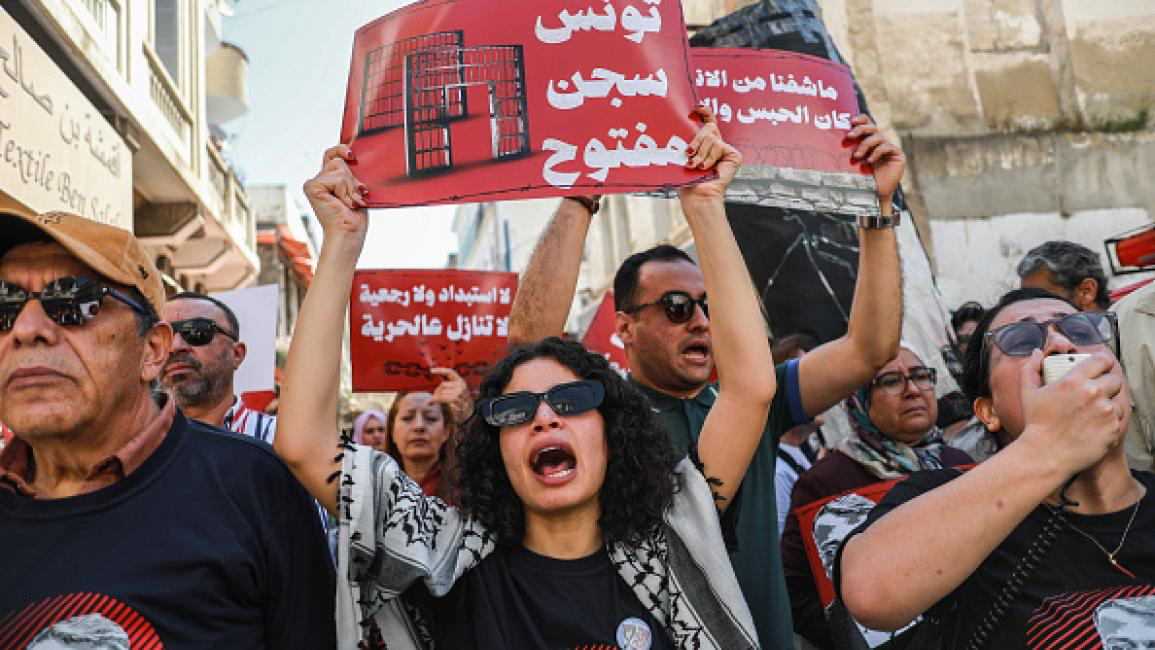
Reacting to what it called an “unjust” ruling, Tunisia’s Ennahda movement said the sentence was part of “a blatant series of political trials targeting every shade of the political spectrum and civil society since the coup of July 25, 2021.”
The movement said the authorities could offer no justification for the conviction beyond what they described as a procedural pretext—that representatives of the Tunisian Red Crescent received Ghannouchi’s donation check directly, rather than through the Central Bank.
Ennahda condemned what it called “the ongoing campaign against Mr. Ghannouchi and the string of politically motivated verdicts issued against him.”
The party demanded an end to “all forms of injustice” against its imprisoned leader, calling for his release as well as the release of all political detainees, and urging the country to close the chapter of repression that has targeted “every free voice.”
Ennahda warned that attempts to criminalize political and civic activity will ultimately fail to impose a new reality on Tunisians, who have repeatedly affirmed their commitment to dignity and freedom.
The Justice for Human Rights Organization condemned the ruling, stressing that it “offers yet another example of how the judiciary is being weaponized to target political opponents.”
In its statement, the organization called for “respecting the right to a fair trial, ending politically motivated prosecutions, and ensuring the protection of all political detainees.”
It added that these demands have become even more urgent “after Ghannouchi launched an open-ended hunger strike in solidarity with activist Jawhar Ben Mbarek, amid real and growing risks to both men’s lives inside prison.”
The Association of Victims of Torture in Tunisia (AVTT) also issued a statement condemning the verdict, saying it was handed down “without questioning the defendant and without allowing the defense team to plead its case—an unmistakable violation of fair-trial standards and even the most basic requirements of justice.”
The organization stressed that the ruling “is not an isolated incident but part of a broader pattern of arbitrary judgments targeting Mr. Ghannouchi.”
It added that “the accumulation of such rulings, issued with no regard for procedural safeguards, demonstrates the systematic use of the judiciary as a political tool to sideline opposition figures and pursue successive cases against Ennahda’s leadership that fail to meet even minimum legal standards.”
The association urged Tunisian authorities to uphold their international obligations, particularly the International Covenant on Civil and Political Rights, and to open an independent investigation into these procedural violations.
It also called on UN bodies and international organizations to closely monitor the case, calling it “another alarming indicator of the erosion of judicial guarantees in Tunisia.”
Former Moroccan Prime Minister Abdelilah Benkirane described the ruling against Ghannouchi as “a total scandal, no two ways about it.”
Benkirane emphasized in a video that “there is nothing wrong with what Ghannouchi donated.”
Tunisian Reactions
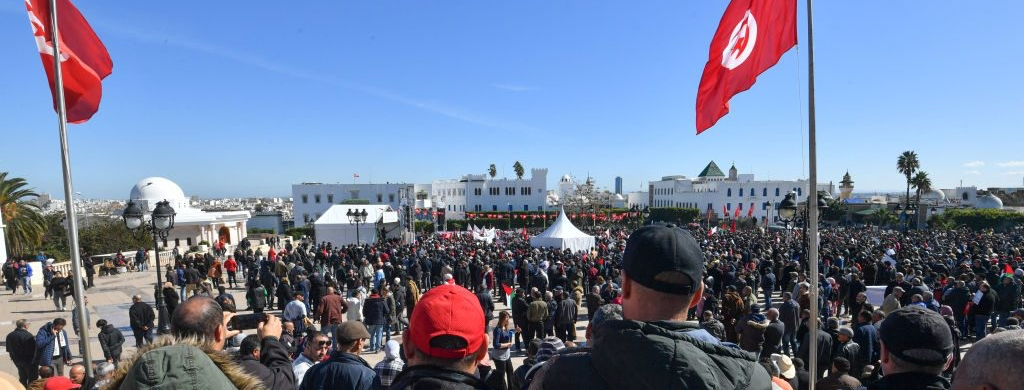
The ruling triggered a wave of reactions across Tunisia’s social media platforms. Among them was leftist activist and political analyst Bouajila Habib, who argued that the latest judgment only reinforces what many already believe: that all ongoing trials targeting political figures are fundamentally political cases.
In a Facebook post on November 14, Habib stressed that these prosecutions collapse the moment they’re tested against basic logic, let alone when subjected to real legal scrutiny in public court hearings.
He added that “the only groups still siding with the current dominant power are the same functional networks in politics and the media that historically served the old authoritarian systems.”
“These are the very forces that spent years defending the remnants of corruption and dictatorship, attacking Tunisia’s post-2011 democratic transition, and distorting public awareness through the media. Today, those same groups remain silent, or when they do speak, they repeat claims that simply don’t hold up against the facts or the court records,” Habib said.
Tunisian journalist Ameur Ayed, from the private channel Zitouna TV, argued that the verdict “is just another exhibit in the regime’s museum of absurdities,” adding that the authorities seem intent on building “a state fueled entirely by resentment.”
“Tyrants always invent charges stranger than fiction, but this time, they’ve crossed from fantasy into pure dark comedy,” he posted on Facebook.
Speaking directly to Ghannouchi, he said, “You’ve turned into a political puzzle that even the sharpest minds in repression can’t crack. The more you stand your ground, the more they unravel, and the more they unravel, the more bogus charges they cook up. Their power fades, while yours only grows.”
Political activist and human rights advocate Noureddine Ghiloufi said the ruling “shows that the authorities, had they found even a single charge capable of convicting Ghannouchi, would have presented it to the world and paraded it to satisfy their grudge.”
“They found no charge against him, or any of the 19 Ennahda leaders long imprisoned, that could justify the regime’s crackdown.”
“As absurd and nauseating as this verdict is, it ultimately stands as a testament to Ghannouchi, not against him,” he added.
“This regime is hungry to punish its people. It digs through its bag for evidence, and when it finds none, it invents charges. Ironically, those very charges often end up proving their innocence, and they don’t even see it,” according to Ghiloufi.
‘A Regime Without a Future’
On the day the verdict against Ghannouchi was announced, his daughter, Soumaya, published an article on Middle East Eye, writing, “Tunisia’s misfortune is that into the space opened by that democratic experiment stepped a populist fanatic who understood democracy only as a ladder. [Kais] Saied climbed it to reach power, then kicked it away.”
“He dismantled the system my father and so many others had struggled to build: dissolving parliament, abolishing the constitution, concentrating all authority into his own hands, and turning political life into a sequence of arrests and persecutions.”
“My father endured the dungeons of the Bourguiba and Ben Ali regimes and lived to see them both fall. Today, under Saied’s despotism, he endures once more, among the oldest political prisoners in the world,” Soumaya added.
“This new counter-revolution, with its deceitful populist mask, will also pass. Even now, the cracks are visible. The regime is hollow, exhausted, without a future. There is a growing conviction that change is inevitable; that the darkness is already thinning at its edges.”
“This dictatorship will be remembered only as a brief and shameful interlude in Tunisia’s long story. My father’s ideas will outlive it, as they have outlived every prison, every slander, every tyrant,” she concluded.
The judicial decision against Ghannouchi comes amid a growing crackdown on human rights defenders and independent NGOs.
Amnesty International warned on November 14, 2025, that what is happening in Tunisia is unprecedented. Six NGO workers and human rights defenders working for the Tunisian Council for Refugees are being criminally prosecuted on charges related to their legitimate work supporting asylum seekers.
The organization noted that in just the past four months, at least 14 Tunisian and international NGOs received court orders to suspend their activities for 30 days, calling the situation “deeply alarming.”
Amnesty emphasized that the current authorities are systematically undermining the rule of law, shrinking civic space, and suppressing all forms of opposition.
It called on Tunisian authorities to immediately end this campaign of intimidation, noting that this multi-pronged judicial and administrative harassment has created a pervasive climate of fear, restricting the rights to association and freedom of expression and smothering Tunisia’s civic space.