Clash of State Trolls: UAE Funding Exposed in Egypt
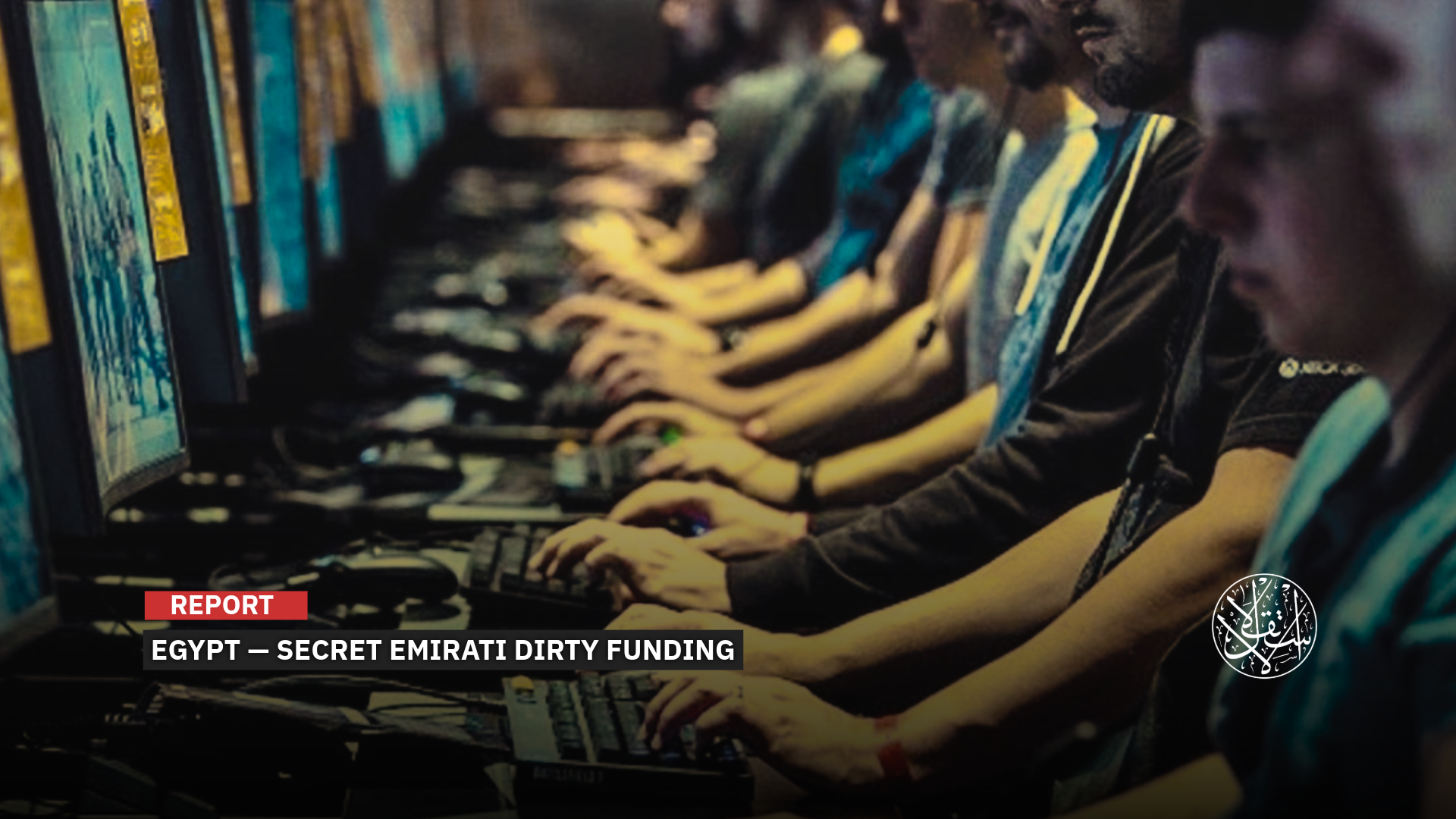
“Sisi’s visit to Abu Dhabi is not about coordination, consultation, or even diplomatic courtesy; it’s a summons of a subordinate, not a partner.”
As the head of the Egyptian regime, Abdel Fattah el-Sisi, arrived in the United Arab Emirates (UAE), questions swirled over whether the visit was truly fraternal, as officially billed, or a pointed Emirati warning tied to Cairo’s growing alignment with Riyadh at odds with Abu Dhabi’s plans in Yemen and Sudan. Almost simultaneously, Egyptian and Emirati digital squads went head-to-head in an online showdown.
Social media platforms became the stage for a rare public feud between Egyptian online activists who had previously worked on behalf of Abu Dhabi and their former Emirati handlers, after financial and professional disputes spilled into the open.
What followed was a cascade of accusations over funding, with former operatives turning on their sponsors, issuing threats to expose financial pipelines and influence networks linked to the UAE in Egypt. The fallout laid bare a shadowy ecosystem of online manipulation, revealing how disinformation networks are built, funded, and deployed, and how quickly they fracture when interests diverge.
Al-Estiklal traces part of this cyber warfare, examining the role of these online committees, the flow of Emirati funding before and after Egypt’s 2013 coup, and how growing tensions between Cairo and Abu Dhabi helped pry open sealed chapters of a long campaign to derail Egypt’s revolution and remove the country’s first democratically elected president.
What Is the Story?
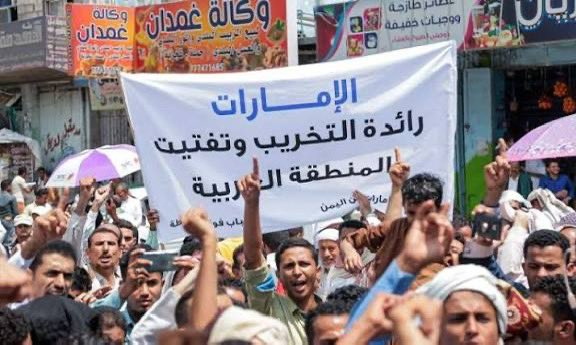
What began as a loose, grassroots phenomenon during Egypt’s January 2011 revolution has since evolved into a tightly managed industry. Online activist networks once driven by young revolutionaries were gradually absorbed by state institutions tasked with defending the regime, with funding and backing from the United Arab Emirates.
The latest episode exposing Emirati financing emerged from a very public online feud involving Mohamed Kandiel, a controversial Egyptian YouTuber linked to pro-regime digital networks, and Emirati online operatives. What started as a social media clash quickly spiraled into something far more revealing.
During the exchange, Kandiel acknowledged that he and other Egyptian YouTubers had been in contact with Emirati security-linked entities. The dispute pulled back the curtain on how online propaganda networks are run, shaped by money, politics, and loyalty rather than ideology.
Social media platforms soon filled with accusations traded between Kandiel and his former Emirati backers after financial and professional disputes surfaced. Emirati-linked accounts accused him of taking money, while Kandiel openly admitted receiving payments, even as he threatened to expose funding channels, coordination mechanisms, and alleged ties to security agencies.
In one exchange, responding to threats from an Emirati account, Kandiel openly dared them to report him to Egyptian authorities, saying he would then publicly explain how Emirati security services had worked with him and other Egyptian YouTubers, how much they were paid each month, and through which channels.
After turning against his former sponsors, Kandiel admitted he had received roughly $30,000 to establish a YouTube channel aligned with their agenda while claiming he later refused a larger sum. He went further, threatening to name other Egyptians who, he said, had accepted thousands of dollars in similar arrangements.
The fallout prompted a wave of questions inside Egypt. How many online networks and public figures, critics asked, are receiving money from foreign intelligence services under the guise of media work or political advocacy?
Following Kandiel’s admissions, calls grew louder for authorities to disclose the identities of Egyptians accused of receiving funding, support, or residency privileges from foreign intelligence agencies. In a country where collaboration with foreign services is treated as a serious crime, the revelations have struck a raw nerve about sovereignty, influence, and the unseen mechanics of digital power.
Egyptian activists say Kandiel’s unusually defiant tone toward the Emiratis was no accident. They point out that he is affiliated with a Facebook page known as “The Hawks of Egyptian Intelligence,” which has around 480,000 followers. Once aligned with Emirati interests, Kandiel is now seen as having shifted his loyalties toward Saudi Arabia.
According to these activists, after years of working for the UAE against Saudi interests, under the guise of defending Egypt, cheering Abu Dhabi, and ignoring its controversies, Kandiel switched to criticizing Abu Dhabi and praising Saudi Arabia after tensions grew between both Cairo and Riyadh and the UAE over its support for Yemeni and Sudanese militias that threatened the region’s security.
Kandiel later appeared in a photograph shared by the “Hawks of Egyptian Intelligence,” seated in the second row, second from the left, a detail activists cite as further confirmation of his role within pro-state online networks.
He has since published a series of videos openly criticizing Abu Dhabi, in which he spoke about “limiting the UAE’s influence in the region” and “the UAE: when power becomes a curse.”
The revelations have fueled wider questions about the scope of Emirati influence. Are all of these figures receiving money from Emirati security agencies, especially after one participant openly admitted that he and several Egyptian YouTubers were being paid by the UAE’s national security apparatus? And more broadly, are all of el-Sisi’s online networks shown in the photo operating on Emirati payrolls?
Nezam Mahdawi, editor-in-chief of the Watan website, has estimated that each of the figures who present themselves as Egyptian YouTubers but function as pro-regime operatives receives around $100,000 a year from the United Arab Emirates.
Companies and Generals
In a report published on September 6, 2019, The New York Times (NYT) for the first time detailed the companies behind Egypt’s online propaganda operations, where they were run from, and how Emirati funding sustained the country’s digital influence campaigns.
The paper identified an Egyptian company called New Waves and a similarly named Emirati firm, Newave, as central players in managing these online battles. Both were owned by Amr Hussein, a retired Egyptian army officer. According to the report, new recruits were paid about $180 a month to produce pro-military posts and messages on social media, often guided by assigned hashtags and talking points.
The NYT reported that the Egyptian and Emirati companies, nearly identical in name, misled followers through fake accounts that together amassed more than 14 million followers on Facebook and thousands more on Instagram.
The messaging produced by these firms, the report noted, closely mirrored the foreign policy goals of Egypt, the UAE, and Saudi Arabia at the time. Since 2011, these networks have played a powerful role across the Middle East, bolstering authoritarian allies and shaping narratives around regional wars.
Beyond domestic coordination, Egyptian and Emirati digital networks also collaborated on foreign-based platforms, funded with millions of dollars from the UAE, designed to polish the image of both regimes abroad.
One such platform was The Investigative Journal, launched under the guise of a neutral investigative outlet. British courts later ruled that it was in fact run by external propaganda networks, according to The Guardian in an investigation published on October 11, 2021.
The site’s former editor in chief, Jane Cahane, said she had been misled and exploited by the regimes of el-Sisi and Mohammed bin Zayed under the banner of independent journalism. A British court awarded her nearly £80,000 in damages for the deception.
Cahane told the court that she had been recruited by Mohamed Fahmy, a former Al Jazeera English journalist who was jailed in Egypt in the so-called Marriott Cell case before his release and subsequent move to Canada. She said Fahmy later cooperated with the el-Sisi regime.
In her testimony, Cahane said Fahmy received support and direction from UAE-backed proxies and met with Abdel Fattah el-Sisi in June 2019 to discuss the site’s editorial direction and content.
The outlet’s design, purpose, funding, and operations were all geared toward promoting and legitimizing authoritarian regimes in the Middle East, particularly those of Egypt and the United Arab Emirates, according to her.
The ‘Rebel’ Committees
The story of Egypt’s online committees and Emirati funding dates back to the rise of the “Rebel” movement (Tamarod in Arabic), which emerged before the official coup against President Mohamed Morsi and claimed to have collected endorsements from 22 million Egyptians.
At the time, activists who later broke with the movement and investigative reports revealed that “Rebel” spent lavishly, renting dozens of offices. Islam Hammam, a member of the movement’s central committee, told the press that they also maintained “secret offices,” fueling speculation that both domestic and foreign actors were supporting “Rebel.”
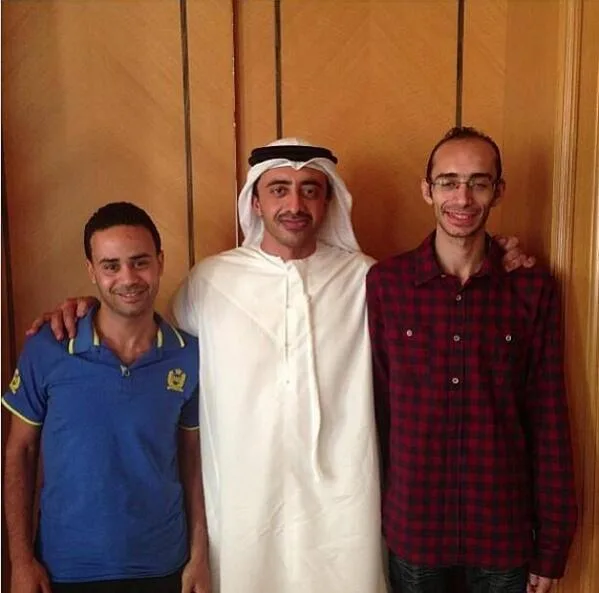
A widely circulated photo following the coup against Morsi showed UAE Foreign Minister Abdullah bin Zayed with “Rebel” founders Mahmoud Badr and Mohamed Abdel Aziz, underscoring Abu Dhabi’s role in promoting and backing the movement financially and through media channels.
Later, as some members defected in frustration over el-Sisi’s rise to power and the continued crackdown on all political currents, several, including journalists Mahmoud al-Sakka and Moheb Doss, revealed that the movement had received funding from foreign sources.
In March 2016, Doss publicly admitted that an official from the UAE embassy had contacted him, saying he had a $30,000 check for “Rebel” and, since the movement had no official headquarters, asked Doss to facilitate its delivery.
On the March 23, 2016, episode of al-Ashira Masa’an on Dream2 TV, Mohamed Fadel, a lawyer defending Moheb Doss—one of the five founders of the “Rebel” movement—stunned fellow panelists, including movement member Mohamed Nabawi, by revealing on air evidence of funds the movement had received from the UAE and other foreign sources before June 30. Fadel confirmed the movement had received multiple payments, noting, “Some of it is loose change, and there’s more besides.”
Fadel said that Mahmoud al-Sakka, a former “Rebel” member and defendant in the “January 25 Movement” case, had been questioned about the movement’s foreign funding. He mentioned Mahmoud Badr, Mohamed Nabawi, and Hassan Shahin by name.
According to Fadel, a UAE embassy official contacted Duaa Khalifa and Moheb Doss, informing them of a $30,000 check for the movement, to be sent to their home addresses. When Doss initially refused the money, the official reportedly said, “The same check was sent to X, Y, and Z.”
Fadel submitted a report to Egypt’s public prosecutor against Badr and Nabawi, alleging that they had received millions of pounds from foreign sources. He said the complaint included images of the checks and witness statements. One set of transactions involved six checks of one million Egyptian pounds each, provided by Sinai tribal leaders before June 30, 2013, ostensibly to support field operations. Another set included thirty checks of $100,000 each, purportedly from the Arab diaspora in the United States, delivered via intermediaries including the head of the diaspora and a producer affiliated with Saudi Arabia’s al-Arabiya channel.
Islam Hammam, “Rebel’s” social media director at the time, had also mentioned a $100,000 check from a wealthy Egyptian abroad, which activists suspected was actually Emirati money routed through multiple channels.
In March 2015, the opposition channel Mekameleen released a leak involving Abbas Kamel, then head of el-Sisi’s office, and former Defense Minister Sedki Sobhi, showing the UAE’s direct role in financing “Rebel” and how this support was part of Abu Dhabi’s broader strategy to topple Morsi.
Although receiving foreign funding is legally considered espionage in Egypt, members of “Rebel” later leveraged that support to become businesspeople and parliamentarians, yet no one has been held accountable.
How the Committees Operate
Former MP Mostafa Alnaggar, missing since 2018 amid speculation that he was killed, described the workings of these committees in an al-Masry al-Youm article published on September 26, 2014. He recounted the experience of a young rural man, who asked to remain anonymous for his safety, after he responded to an online ad seeking youth for a new website in Cairo with attractive salaries.
When he arrived, he discovered a spacious apartment in Mohandessin filled with 100 computers. Each workstation was occupied by a young operator, supervised every ten computers by a senior staffer, with a large screen displaying text that included insults, reprimands, or propaganda, which the workers were required to repost or adapt on their own accounts.
They were then asked to go to someone’s page—on Facebook, Twitter, or a popular news site—find a specific post or article, and copy the comment that appeared on their screen, reposting it either on that person’s account or as a comment under the article or post.
When he met the manager, a man surrounded by five mobile phones and multiple screens showing the operators’ work, he was told that to become journalists, they first had to defend the country and combat traitors through these committees. “It’s not impossible that one of you will prove successful and become a prominent broadcaster or media figure,” the manager added.
When asked who they were working for, they were told, “You’re working with those who know what’s best for the country. This website exists for Egypt, and the people funding it, paying your salaries, are doing it for Egypt too.”
Alnaggar concluded his article by asking, “Who is financing these digital committees that specialize in smearing opponents and attacking them?”
A ‘Fraternal’ Visit or a Warning?
El-Sisi’s visit to Abu Dhabi and his meeting with Mohammed bin Zayed on February 9, 2026, coincided with the public feud between Egyptian committees and their Emirati handlers, prompting speculation about the visit’s purpose.
Was it meant to smooth tensions and navigate the delicate Cairo-Abu Dhabi-Riyadh triangle, or was it a warning from Abu Dhabi, signaling that Egypt should not drift from UAE influence after aligning more closely with Saudi Arabia?
Khaled Mahmoued, a prominent semi-official Egyptian committee member who clashed with Emiratis over Sudanese affairs affecting Egypt’s national security, confirmed that disagreements persist. He described the visit as “a leap over the clear differences in perspectives regarding Libya, Yemen, Somalia, and Sudan,” while noting ongoing tensions over Egypt’s support for the Sudanese army versus the UAE-backed Hemedti militias and over Abu Dhabi’s openness to a separatist project in Somaliland.
Both sides emphasized “the importance of continuing efforts to resolve crises peacefully, preserving the unity and sovereignty of states and the well-being of their populations while avoiding escalation in the region,” suggesting that Abu Dhabi may be recalibrating its regional stance in response to these complex challenges.
Human rights lawyer Osama Rushdi described el-Sisi’s visit to Abu Dhabi as “not a trip about coordination, consultation, or even diplomatic courtesy; it’s a summons of a subordinate, not a partner.”
“El-Sisi is not free to make his own decisions, has no room for maneuver, and cannot alter his regional positioning,” he added, dismissing rumors of a potential Egyptian-Saudi-Turkish alliance.
Saudi journalist Turki AlRumaih outlined six ways in which the UAE has acted against Egypt’s interests.
He said the Emirates bought Egyptian writers, influencers, and newspapers to create internal divisions and ignite tensions between Egyptians, as well as between Egypt and other Arab countries.
Abu Dhabi also destroyed Sudan by backing the Rapid Support Forces (RSF) militias, which threaten Egypt’s southern border, and supported militias and armed groups in Libya along Egypt’s western frontier.
The UAE funded-forces jeopardized the Bab el-Mandeb Strait and the Suez Canal while exploiting Ethiopia’s Grand Renaissance Dam, which reduces Egypt’s share of the Nile.
Finally, in 2022, the UAE seized a stake in “Israel’s” Haifa port through DP World, countering Cairo’s efforts to strengthen the Suez Canal and its ports as a hub for East Mediterranean trade and gas.
In the weeks leading up to the visit, Cairo sent a series of messages to Abu Dhabi, signaling that el-Sisi’s trip was neither a routine diplomatic call nor a courtesy visit. Analysts suggest it was likely an effort to revive strained relations and clarify positions on the chaos in Sudan and Abu Dhabi’s proxy projects in the Horn of Africa.
Among these messages was Egypt’s deeper involvement in the Sudanese conflict, including the use of secret bases, Turkish drones, and red lines. Cairo reportedly opened el-Oweinat Airport in southern Egypt to allow Turkish Anka drones to strike supply lines supporting militias backed by the UAE.
This operation was detailed in a NYT report in early February 2026, titled “The Secret Egyptian Airbase Powering Sudan’s Drone War.”
Egyptian cargo planes have delivered weapons to the Sudanese army. Cairo has also established a military presence in Somalia, deployed naval forces at the port of Assab, and signed a joint defense agreement with Eritrea.