In Case of Macron’s Departure, Who Will Support Tyrannical Arab Regimes?
France is a few months away from the presidential elections in April 2022, in which current President Emmanuel Macron is expected to run.
This comes amid a rising wave of populism that may come out with a president more radical than Macron himself, who incited hatred against Muslims.
This is in addition to his support for major dictatorships in Arab countries such as Saudi Arabia, Egypt and the UAE, in addition to his support and supply of the coup of retired Libyan Major General Khalifa Haftar and the Libyan civil war with weapons and logistical support.
Going back to history, freedom, equality and fraternity were the slogans of the French Revolution, which represented an ancient starting point for France's current reality.
France has always promoted itself in international forums as the guardian of the fundamental rights and freedoms of citizens in various countries of the world.
However, French justice had many contradictions, according to human rights organizations, with regard to the complex issues of the Middle East, and the tyrannical Arab rulers of presidents and princes, who were rejected at the international level.
Paris opened the doors of support, communication and care for these regimes, which caused many criticisms directed at the French presidency and government, as reported by human rights organizations.
In doing so, the big problem now is what will the Arab rulers, who relied on Macron's policies, do in the future?
If the latter fails to retain his seat, will France's view of the Middle East be changed?
Macron and MBS
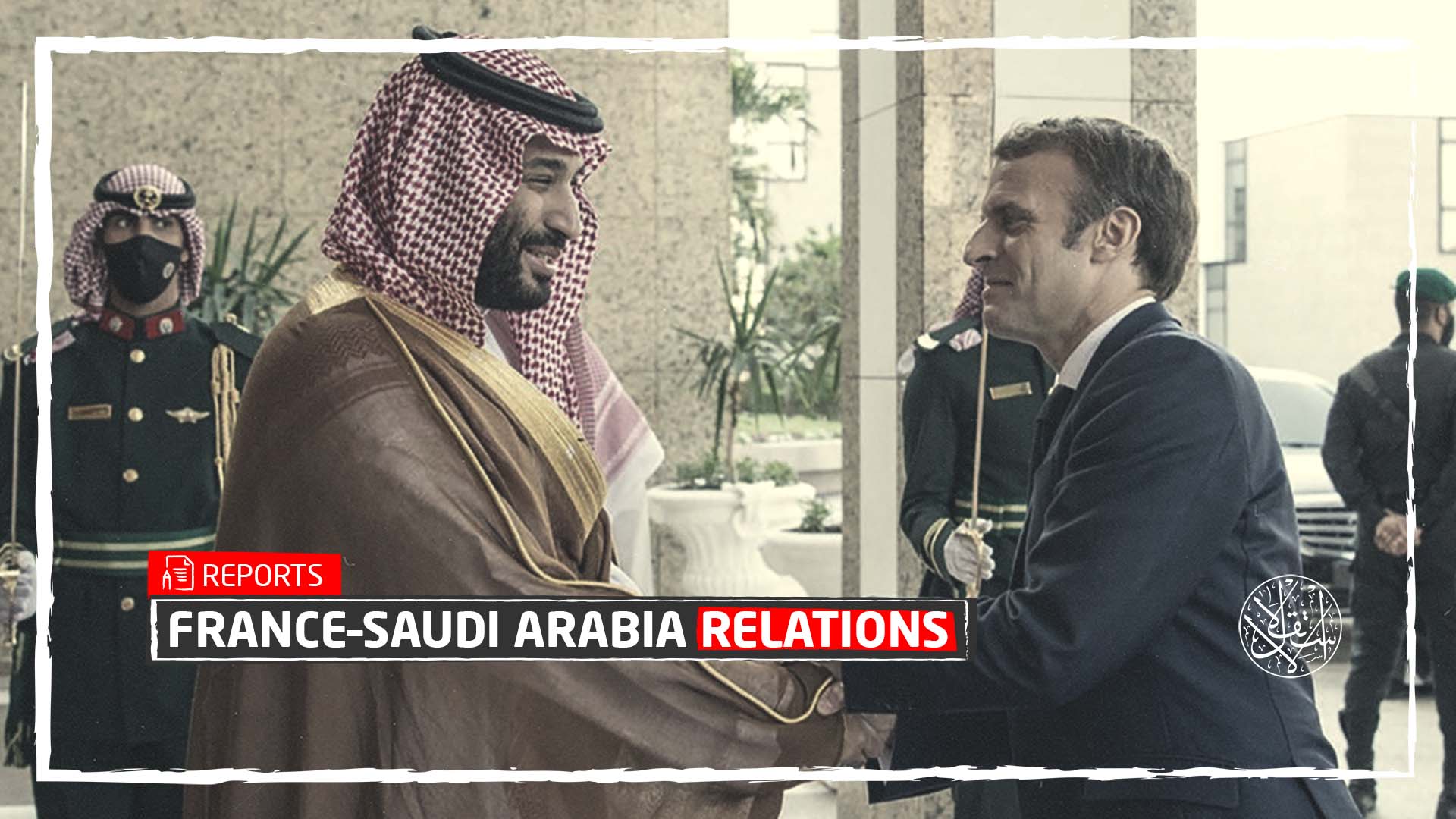
The visit of French President Emmanuel Macron to Saudi Arabia on December 4, 2021, was to hold direct talks with Crown Prince Mohammed bin Salman.
Through this visit, Macron became the first Western leader to visit Saudi Arabia since the killing of journalist Jamal Khashoggi in his country's consulate in Istanbul in 2018, breaking the barrier of European leaders' concern about delegations to the Kingdom, for fear of human rights organizations attack.
Regarding the reasons, France 24 reported that it is important for Macron to help himself set a peace agreement including Iran, as he believes that it would be an ally in the battle against what he calls “Islamic militants” from the Middle East to West Africa, and a bulwark against the Muslim Brotherhood.
Concerning the economy, France is one of the kingdom's main arms suppliers, but it is facing increasing pressure to reconsider its sales due to the conflict between the Saudi-led coalition and the Iran-allied Houthis in Yemen, which is mired in one of the world's worst humanitarian crises.
That visit of Macron, who is preparing for his presidential election battle, left questions about the secret of his closeness to bin Salman, even in the darkest political moments.

Saudi Crown Prince Mohammed bin Salman, MBS, is considered one of the most controversial figures regarding human rights and democracy files, after his repeated campaigns against activists, religious scholars and politicians in his country.
The situation reached its climax when a special squad of the security apparatus of bin Salman assassinated the Saudi journalist, Jamal Khashoggi.
Then, MBS faced an international crisis and became an "international pariah", when prominent world leaders refused to meet and talk with him.
In the midst of this unprecedented crisis, the close relationship of bin Salman and Macron was clear on November 30, 2018, when the G-20 summit held in Argentina was launched.
At that time, Ibn Salman found himself isolated from all leaders and presidents, and most of them avoided taking pictures or talking to him.
The only leader was Macron, who had a 5-minute-conversation with MBS, during which he assured him that he would deal with the Khashoggi case, while the Crown Prince’s reaction was just a smile.
The French president at the time focused his attention on supporting bin Salman, and; this was interpreted by focusing on the Saudi market, wanting the incursion of French companies into the Kingdom, seeking to open a new horizon in the scope of military cooperation and selling French weapons to Saudi Arabia in any way possible, even if it will be against human rights.
On April 17, 2019, the French journalist, of Moroccan origin, Ali Baddou, embarrassed the French Minister of the Armed Forces, Florence Parly, when he asked her the following question on France Inter: “Madam Minister, I have a question that will bother you, should we stop selling arms to Saudi Arabia?”.
As Baddou insisted on the question, the minister, close to President Macron, put her hands on the table and ended the discussion with one sentence: "I have no knowledge that French weapons are directly used in this conflict."
After that meeting, the French newspaper, Mediapart, reported that the arms contracts between France and Saudi Arabia raised a moral, political and legal debate, and that Paris provided weapons to a client (the Saudi regime) who used them to kill civilians in Yemen for four years.
Sisi Support
When Emmanuel Macron arrived at the Elysee Palace on May 14, 2017, he created a special relationship with the Egyptian regime in particular.
Macron developed his relationship with the head of the Egyptian regime, Abdel Fattah al-Sisi, and the mutual visits between them did not stop, so Cairo became one of Paris' most important customers in terms of buying billions of weapons.
The relationship between Sisi and Macron has alarmed human rights defenders, at a time when Cairo is accused of committing a series of horrific violations against civilians and civil society leaders in Egypt.
On December 19, 2020, 12 human rights organizations, including Human Rights Watch, Amnesty International, and the International Federation for Human Rights, announced in a joint statement that “French diplomacy at the highest levels has long been condoning Sisi's brutal repression of any form of opposition, and President Macron will not stand up to defend his stated commitment to advancing human rights in Egypt.”
It was stated that "the French government, headed by Macron, is not only a major supplier of arms to Egypt, as it sells warships and combat aircraft, but also allows French companies to provide Cairo with monitoring and crowd control equipment."
"We are amazed that France is rolling out a red carpet for a dictator with more than 60,000 prisoners of conscience in Egypt today," said Antoine Madeleine, Director of International Protection at the International Federation for Human Rights.
In December 2020, Macron announced that he "will not make the sale of arms to Egypt conditional on human rights because he does not want to weaken Cairo's ability to combat terrorism in the region."
On May 5, 2021, Cairo held the second largest arms deal since Sisi came to power, crowning the warm relations between Egypt and France during the Macron era.
The two countries signed a contract to purchase 30 Rafale combat aircraft, according to a statement by the Egyptian armed forces.
In 2015, Egypt and France signed several huge arms deals, including 24 Rafale fighter planes, a multi-mission frigate, and two Mistral-class warships, with a total value of about 6 billion euros.
The total Egyptian imports of French weapons amounted to 7.7 billion euros between 2010 and 2019, making Cairo the fourth country in terms of arms purchases from France, according to the annual report of the French Parliament.
Through these huge deals, and the advanced relationship, Sisi was described as Macron's favorite "dictator" in the east, as was called by the Russian writer, who specializes in Middle East affairs, Jacob Hartig.
Partnership with Bin Zayed
The triangle of Macron's relations with the Arab emperors was completed through his close relationship with the Crown Prince of Abu Dhabi and the most powerful man in the Emirates, Mohammed bin Zayed.
This was clearly demonstrated on September 15, 2021, when he welcomed MBZ in France with passion, and had a working dinner with him at the "Fontainebleau" Palace, south of Paris, in order to discuss the strategic partnership between the two countries and all regional issues.
However, the manner of reception and meeting prompted the French media to question the secret of the relationship between the Emirates and France, and Macron's interest in bin Zayed in particular.
On December 6, 2021, international human rights organizations criticized Macron’s set of military deals with the UAE, which is involved in armed conflicts in several countries in the region, and its suspicious participation in human rights violations, during a visit on the third of the same month as part of a Gulf tour that also included Saudi Arabia.
The international human rights organizations, led by Human Rights Watch, stated that the weapons supplied by Paris to Abu Dhabi are "used in illegal attacks and war crimes" in Yemen and Libya, conflicts in which the UAE was accused of being involved through local agents within these countries.
The human rights organizations confirmed that France is moving forward with these sales despite the UAE playing a leading role in the brutal military operations led by the Saudi-led coalition in Yemen.
The French investigative website, Disclose, stated that "Paris has delivered tens of thousands of bombs to the UAE and Saudi Arabia despite knowing that they would be used in the aggression against Yemen."
The website quoted "secret defense documents" that the French government had allowed the delivery of about 150,000 shells to the UAE, its Gulf ally.
Based on the Emirati-French interaction, bin Zayed was at the head of the regimes that supported Macron, in October 2020.
He announced his support for the president and the economy in France in response to the Muslim world's campaign to boycott Paris economically, against the abuse it claims against Islam, Muslims and the Prophet Muhammad.
At the time, the Crown Prince of Abu Dhabi announced his full support for the French economy against the systematic war led by the global Muslim Brotherhood, boycotting French products.
Therefore, it was not surprising what Emmanuel Macron said about Ibn Zayed on September 16, 2021, which was reported by the French newspaper Le Point.
The newspaper pointed out that the French president considers Mohammed bin Zayed a model for the modern Arab ruler, ignoring the number of violations committed by the Emirati prince in human rights files inside his country, or the regional wars in Yemen and Libya.

Blurred Future
Human rights researcher, Mustafa Ezz el-Din, said in his interview with Al-Estiklal that “talking about a feature of change that may have occurred in France's post-Macron policies at the human rights level and support for human rights in the Middle East is questionable.
He attributed this to the fact that France's policies towards supporting civil organizations and human rights groups in Arab countries are contradictory and selective.
He indicated that Paris is interested in supporting liberals away from citizens with religious or left-wing tendencies, "these people, in the French concept of human rights, do not deserve freedom or defense at all."
He added that “at the governmental level, the next president of France, in the event of Macron's failure, may play the human rights card, as a pressure factor to blackmail the tyrannical regimes in the east, and achieve the greatest economic and political gains.”
This is what Macron himself does "so that he can first open the door for French investments, as well as sell as many arms deals as possible to Arab governments and armies."
The Human Rights Researcher added that “France has become teeming with extreme right-wing parties, and the rise of populism that threatens minorities in the country itself, so what about the Arab and Islamic countries, and from here we see that all options are bitter."
“Who is the frontrunner against Macron? It is Eric Zemmour, an extremist Jew who hates Muslims and wants to expel them completely from Europe, and encourages eastern governments to arrest Islamists,” says Ezz El-Din.
He stated that "the crisis for the Arab regimes will only be in dealing with new faces and different mechanisms, especially the economic one. As for public policies, the expected fundamental difference will not be made.”
He explained that "the French elections differ from the American ones in terms of strength and influence, and changing policies. Macron is not [former US President Donald] Trump, and the next for France will not be [the current US president] Joe Biden," he concluded.
Sources
- Macron, the youngest president in the history of France [Arabic]
- French elections 2022: Conservatives are drowning in a wave of populism that may produce an extremist president after Macron [Arabic]
- The French president arrives in Saudi Arabia for talks with the Crown Prince. [Arabic]
- What is the significance of Sisi's military deals with France? 'Dangerous effects' [Arabic]
- A bitter setback; Will Macron spend his last days at the Elysee? [Arabic]
- Human rights criticism of Macron’s conclusion of military deals with the UAE [Arabic]
- Le Point: Macron considers Mohammed bin Zayed a model of the modern Arab ruler [Arabic]
- Egypt buys 30 French Rafale fighters, and Paris considers the deal a 'strengthening of the strategic partnership' [Arabic]
- Macron welcomed bin Zayed; What is the secret of the relationship between the Emirates and France? [Arabic]