Understandings and Obstacles: Is a New Era Beginning Between Putin's Russia and Sharaa's Syria?
“Syria has contracted with Russian firms to print Syria’s new currency.”
Russia remained in Syria after the fall of the Assad regime, despite expectations of a collapse in its influence.
It maintained its military bases in Tartus, Hmeimim, and Qamishli, and strengthened its relations with the new government headed by Ahmed al-Sharaa.
Its diplomats quickly reached out to the new rulers in Damascus, capitalizing on their tendency to build positive relationships and zero problems with all foreign governments.
Syria's new leaders, meanwhile, believe it is beneficial to maintain friendly relations with the Kremlin, hoping to secure its support in UN votes, as well as energy, grain, and perhaps even weapons.
By opening up to Russia, the al-Sharaa government also seeks to deter former Assad supporters from attempting a comeback, sending a message to Western countries that Damascus is capable of seeking other partners.
However, these pragmatic positions on both sides do not necessarily mean that relations have become normal or tension-free.
There are heavy pending issues: Russian military bases in Syria, the fate of Bashar al-Assad, accumulated debts, frozen assets, and more.
New Phase
Until a few days before the launch of Operation ‘Deterrence of Aggression’, which toppled Bashar al-Assad's regime, Russian aircraft were bombing Syrian opposition positions in the northwest of the country.
But everything changed on December 7, as Moscow stood by and watched the Assad regime fall, then rushed to undertake an unprecedented political repositioning.
Russian President Vladimir Putin personally approved the granting of refugee status to Bashar al-Assad and his family on humanitarian grounds.
However, Moscow was careful to send a clear message stating that its alliance with Syria was not linked to Assad or his government, but to Syria as a state, a clear indication of the Kremlin's willingness to engage with the new government.
On the other hand, the new Syrian President, Ahmed al-Sharaa, emerged only two weeks after entering Damascus, emphasizing the importance of cooperation with Moscow.
At the beginning of this year, relations between Damascus and Moscow entered a new, more complex phase, based on mutual interests and geopolitical imperatives.
Over the past few months, Russia and Syria have sought to turn a new page, in parallel with a series of intensive and qualitative political and diplomatic engagements, preceded by mutual visits by high-ranking Russian and Syrian officials.
Despite some obstacles, Moscow has been able to secure its interests with the new Syrian government, including the continued Russian military presence on the Syrian coast and the return of the Qamishli airport in the northeast of the country.
Russian Foreign Minister Sergei Lavrov, in an interview with Russia Today on October 8, stressed that Moscow continues to maintain what he described as a non-opportunistic friendship with Damascus.
He pointed to Moscow's continued support for Damascus in the economic, industrial, agricultural, and energy sectors, as well as the continuation of projects initiated during the Soviet era and after 2011.
He also addressed the issue of Russian military bases in Syria, explaining that President Vladimir Putin has repeatedly emphasized that the Russian presence will not continue against the will of the Syrian leadership.
However, he noted that the Syrian leadership and several countries in the region are interested in maintaining this presence.
He also emphasized the importance of Ahmed al-Sharaa's participation in the Russian-Arab summit, which was scheduled for October 15 but was postponed.
He indicated that the Kurdish issue could explode in other countries in the region if attempts to manipulate the Kurds' demands for autonomy and secession lead to practical steps.
He stressed that his country will support its Syrian partners in every possible way and that it is ready to cooperate with other countries with interests in Syria, calling for the recognition that Syria's unity represents a common interest for all.
Military Cooperation
Regarding the nature of the relationship between Damascus and Moscow, al-Sharaa announced in an interview broadcast on September 12 that during Operation ‘Deterrence of Aggression’, negotiations were held with the Russians stipulating their withdrawal from the military scene, specifically when military factions reached the central city of Homs, which had a significant positive impact.
He also described the relationship with Russia as close and long-standing, noting the existence of shared strategic interests, as well as several previous ties, particularly in food and weapons, that must be preserved and managed calmly.
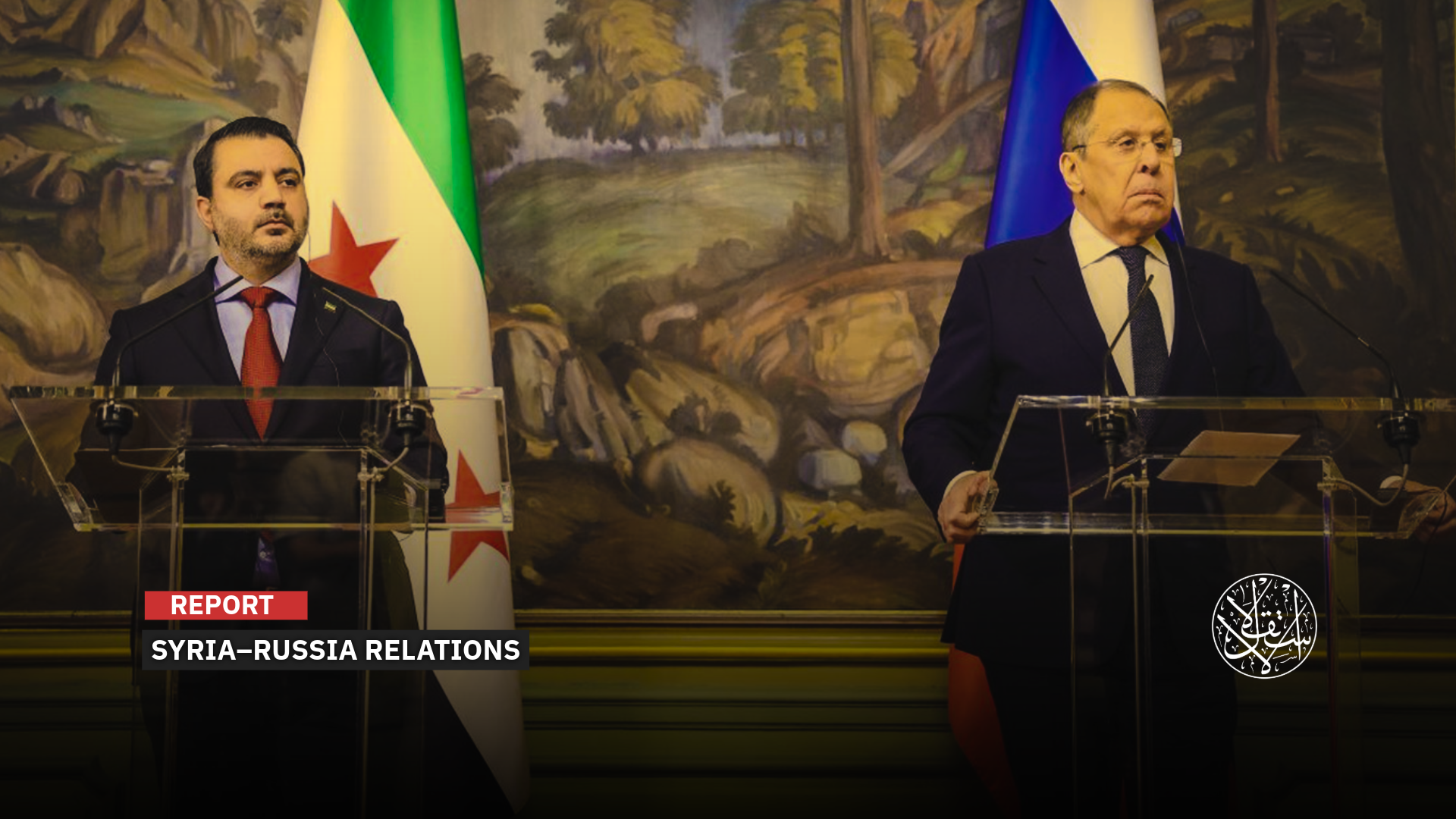
On September 9, Russian Deputy Prime Minister Alexander Novak, accompanied by representatives from more than 13 different ministries, including defense and foreign affairs, paid a working visit to Damascus.
He also held private talks with both al-Sharaa and Foreign Minister Asaad al-Sheibani, emphasizing the opening of a new chapter in relations with Syria.
He pointed to the need to strengthen bilateral cooperation between the two countries, emphasizing the possibility of Russia providing support to Syria in rebuilding infrastructure and providing humanitarian aid.
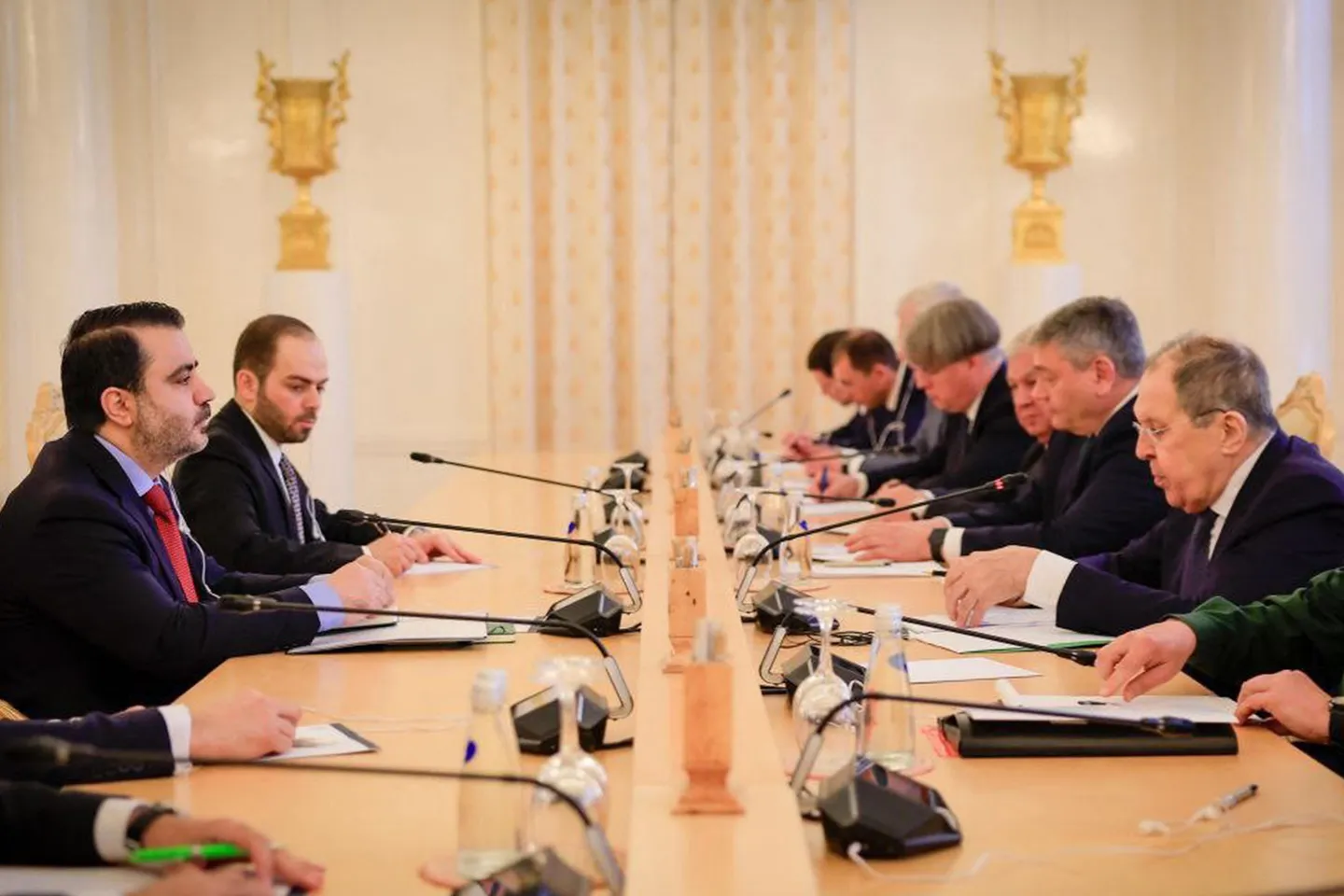
On July 31, a large Syrian delegation, including Syrian government figures, most notably al-Sheibani, visited Moscow, which analysts considered a pivotal moment in bilateral relations.
Separately, the rebuilding of the Syrian army is a key area for future partnership between the two countries, especially since its capabilities were largely destroyed by Israeli strikes over the past year.
The new Syrian army still possesses Russian and Soviet-origin equipment and weapons, and hopes to acquire Russian weapons in the future. This makes the rehabilitation and development process dependent on Moscow, which has extensive experience in training and military operations outside its borders.
International sanctions imposed on Syria represent an obstacle to any Western arms deals, while pro-“Israel” lobby groups in the U.S. are working to prevent the lifting of these sanctions to prevent the rebuilding of Syrian military capabilities.
In early October, the Russian Ministry of Defense announced that a high-level Syrian military delegation had arrived in Moscow on a visit aimed at developing coordination mechanisms between the two countries' defense ministries.
The Russian Ministry of Defense stated that Russian Deputy Defense Minister Yunus-Bek Yevkurov received the Syrian delegation, noting that the discussions focused on ways to enhance military and security cooperation between Moscow and Damascus.

Thorny Obstacles
Researcher Eva J. Koulouriotis confirmed that key issues have served as a gateway to a return to positive relations between Damascus and Moscow.
“The first is the fate of Russian military bases on the Syrian coast, the second is the Syrian currency printed in Moscow, and the third relates to energy, debts, and reconstruction,” she added.
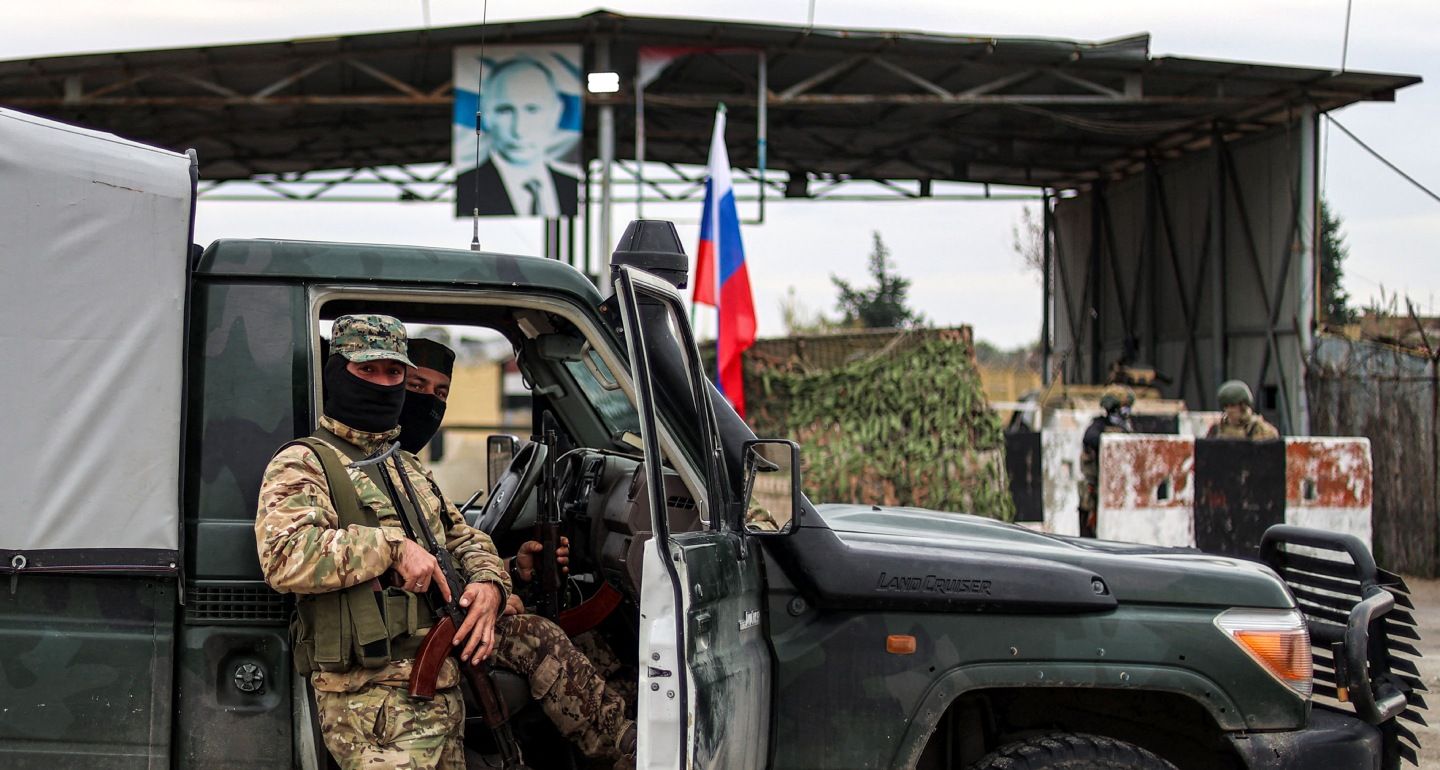
Russia appears determined to preserve the two military bases, but is willing to negotiate the details of their continued existence.
On the other hand, the Syrian government is demanding a review of contracts concluded during the eras of Hafez and Bashar al-Assad.
Nikolai Sukhov, a senior researcher at the Center for Middle Eastern Studies at the Russian Academy of Sciences, said that the Syrian authorities expect to receive virtually free fuel in exchange for guarantees for Russian military bases and personnel.
Russia, in its need to secure its military bases, also appears more willing to make concessions on other issues, such as debts, frozen assets, or reconstruction.
Last spring, Russia sent shipments of oil, diesel, and wheat, while the Russian company Goznak issued new Syrian banknotes, after having printed the local currency for years.
On the other hand, the Russian debt poses one of the most complex issues in negotiations between the two sides, especially since Russia tops the list of countries crediting Syria.
Syria's external debt generally ranges between $20 and $23 billion, according to the Syrian Ministry of Finance.
The new government believes that Russian debts should be cancelled or at least restructured, especially since a large portion of them were used to finance military operations against civilians and the opposition.
Russian Cover
The Russian return to the Syrian arena, although it has not completely withdrawn, demonstrates a renewed and old influence that cannot be overlooked, especially when combined with the balance it maintained with Israel, which the new Syrian leadership appears to be in dire need of.
Despite American statements strongly supporting the al-Sharaa government, the bias toward the Israeli perspective is pushing the Syrians to consider some kind of balance that would restore some of their leverage in the negotiating arena.
With the implementation of the ceasefire agreement in Gaza underway, attention will once again turn to Syria, specifically the ongoing negotiations to sign a new security agreement that would clarify the relationship between Damascus and Tel Aviv.
Syria's new rulers hope that Russian President Vladimir Putin will leverage his good relationship with Israeli Prime Minister Benjamin Netanyahu to force “Israel” to curb its military activities in Syria.
Other parties see an interest in continuing a limited Russian presence in Syria. While various powers compete for influence, Russia has emerged as a preferred refuge for all.
Both “Israel” and Turkiye believe that Russian influence can be exploited to prevent the other side from becoming too powerful.
The Syrian Democratic Forces (SDF), meanwhile, want Russia on their side in case the U.S. abandons them or the Syrian government attempts to curb their ambitions for autonomy.
Reuters reported in March that Israeli officials have quietly lobbied Washington to maintain Russian military bases in Syria, viewing Moscow as a preferable alternative to expanded Turkish control along Israel’s northern border.

For his part, political analyst Ibrahim Khatib told Al-Estiklal that “confronting the escalating Israeli threats, which recently culminated with the Israeli invasion of Quneitra Governorate, is possible through the Russian presence, which constitutes a balancing factor.”
“Russia, as a permanent member of the Security Council, is capable of providing diplomatic and political cover that limits the US-backed Israeli superiority,” he added.
“The current Syrian leadership realizes that cooperation with Moscow has become an indispensable pillar in light of the complex internal and regional conditions, which requires adopting a careful approach that balances benefiting from Russian support with preserving the margin of independent national decision-making to achieve the interests of the Syrian people,” he noted.
Sources
- Foreign Minister Sergey Lavrov’s interview with RT’s Bridges to the East project, Moscow, October 9, 2025
- Russia Isn’t Done With Syria
- Official delegation from the Syrian Defense Ministry arrives in Moscow
- Russia Aims to Open a ‘New Page’ with Post-Assad Syria
- Russia hosts Syria’s new foreign minister for the first time since Assad’s ouster