These Are the Reasons Why the Russian Ruble Returned to Its Pre-Sanctions Level
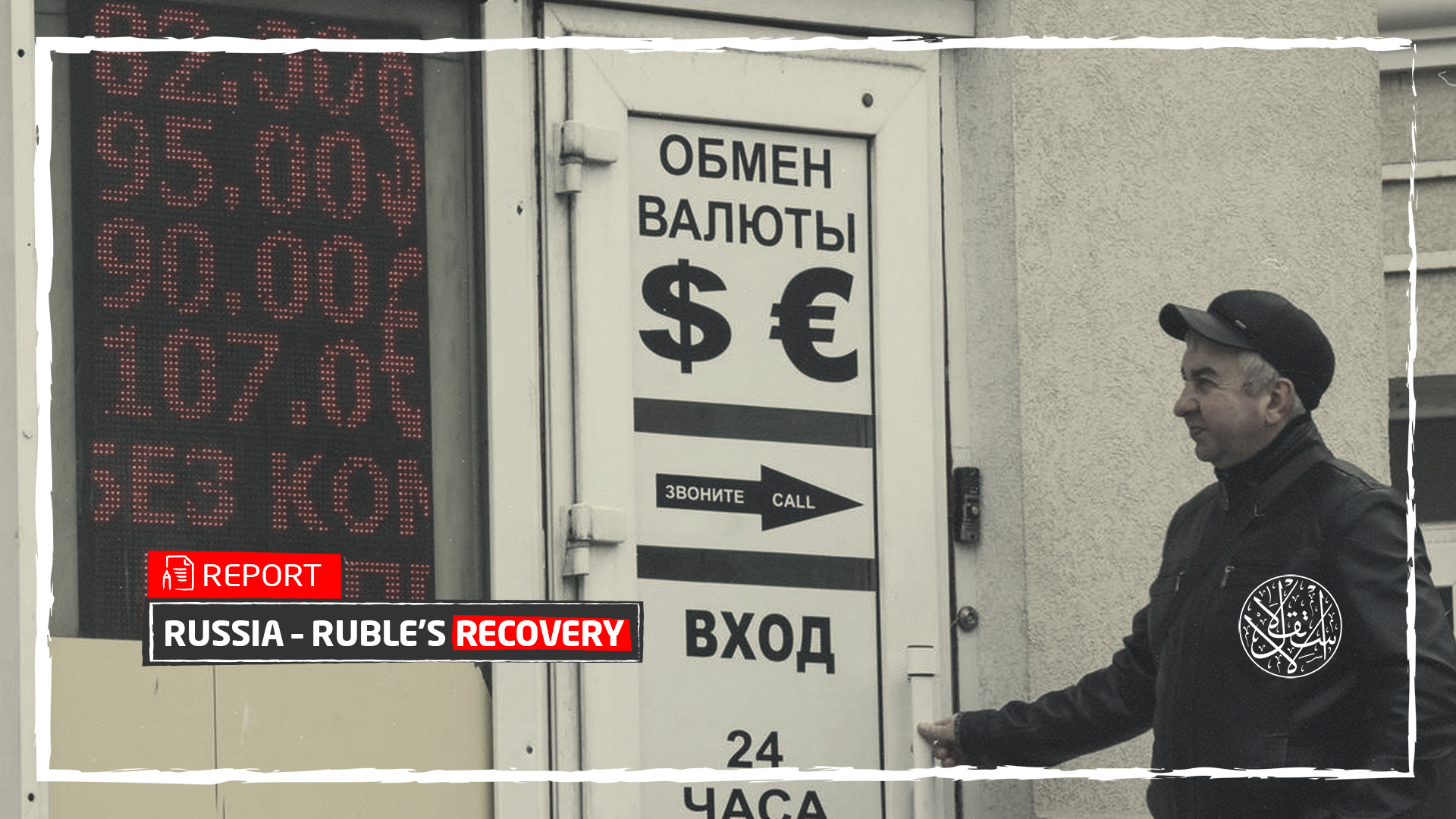
After it fell historically and unprecedentedly on March 10, and crossed the barrier of 120 rubles against the dollar and to 132 against the euro, the Russian ruble has staged a remarkable comeback, reaching the level before the recent Western sanctions at a rate of 75 rubles against the dollar and 81 against the euro.
The discussion is currently revolving largely in blogs and forums about whether the ruble may reach 40, 50 or 60 per dollar, and economists attribute this to low imports, tight state control over capital, international restrictions on investment, and expectations that Russia's current account surplus will reach a new record high in 2022.
The decline in the exchange rate of the dollar against the Russian ruble by almost 40% raises questions about the reasons for this strong recovery of the ruble, and the possible prospects for hard currency rates against it.
At a time when Western countries are erecting comprehensive barriers to the Russian economy, the Russian financial authorities are taking countermeasures to achieve stability in its financial system. The state has created 12% commissions for buying dollars, euros and sterling, which do not apply only to individuals, but also to companies.

Capital Restrictions
The ruble recovery can be partially explained by Russia’s stronger financial position after the sanctions. Its revenues from oil and gas exports are in steady rise and its imports are in sharp decline.
Bloomberg Economics expects that “Russia will earn nearly $321 billion (€292 billion) from energy exports in 2022, if its major customers, including the European Union, continue buying Russian oil and gas.”
From another hand, as Western countries expanded their economic sanctions on Russia over its war on Ukraine, Elvira Nabiullina, the governor of the Russian Central Bank and the most famous person in President Vladimir Putin's government took strict actions to control the capitals.
As a key weapon in the government's financial armory, the bank governor enacted rules that limited the money allowed to move in and out of the country.
Nabiullina could not bear the shock of the West freezing half of the foreign exchange reserves she had spent years building, so she lost her nerve, and doubled the interest rate on the ruble to 20 percent from 9 percent before the imposition of sanctions. The accompanying media hype caused the Russian currency to lose nearly sixty percent of its value.
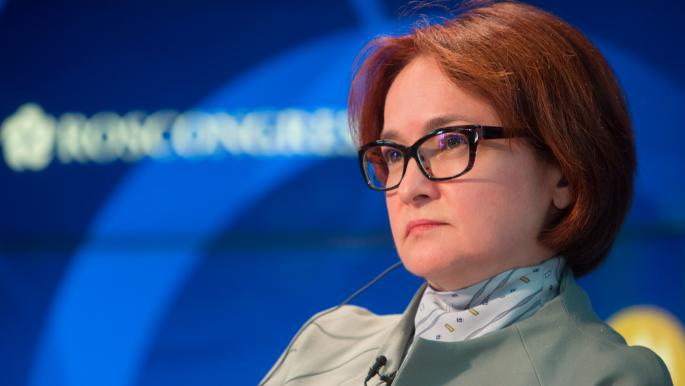
However, after Putin’s decision to sell Russia’s oil and gas exports in Russian ruble, and the subsequent media uproar that exaggerated the effects of the decision, and with Nabiullina’s interventions not backed by real forces in the currency market, the ruble returned to the pre-sanctions level of the 24 of February.
Thus, one cannot deny the role of Nabiullina's restrictions on capital and foreign exchange movements abroad early last month in providing some "temporary" protection for the ruble.
On 10 April, the price of the dollar reached about 76 rubles, after it reached 100 rubles, after the start of the Russian war on Ukraine.
Observers and analysts are closely monitoring how the Bank governor will manage more than $640 billion in foreign exchange reserves, about half of which Western banks have suspended. They are also supervising the impact of the Russian president's decision to sell energy products for the ruble.
Protecting the Reserves
In an interview with Al-Estiklal the academician, researcher in politics, and specialist in strategic issues in the Arab world Hazem Ayyad explained: “Russia insists on dealing with the Russian Central Bank to carry out purchase transactions, thus imposing the ruble price set by the bank. Moreover, Russian gold is in addition to the rates of global supply and demand for gas and oil, and not the value of its trading and speculation in international markets.”
The economic expert added: “The main goal is to protect Russian reserves in European financial markets by maintaining their actual value against the ruble before the crisis, as Russia has reserves estimated at 650 billion dollars, 300 billion outside Russia. It was suspended as a result of the sanctions.”
He pointed out: “Russia wants to recover its financial rights in Europe and preserve them at the same time. The battle with Europe is to preserve these reserves and the value of the economy, which represents 40 percent of Russian oil and gas exports.”
He concluded: “India, China and Russia are trying to form a stable mechanism, while Europe is attempting to recover rights from a negotiating standpoint where Russia has an advantage.”
Manipulation?
US Secretary of State Antony Blinken has stated that the ruble's rebound was being driven by "a lot of manipulation."
Blinken revealed to NBC: "People are being prevented from unloading rubles. That's artificially propping up the value. That's not sustainable. So, I think you're going to see that change."
WATCH: Secretary of State Antony Blinken says the “exodus” of businesses leaving Russia shows more than “just an immediate impact, but a long-term impact on the country’s economy."@SecBlinken: “[The ruble is under] more than a little manipulation, it’s a lot of manipulation.” pic.twitter.com/0P8B26l4Db
— Meet the Press (@MeetThePress) April 3, 2022
The economic analyst Alexander Botavin believes that the ruble can recover if the excess supply of foreign currency in the market declines and capital restrictions are not removed.
He added that for some time the Russian government can raise the ruble exchange rate in order to ease the psychological discomfort of ordinary citizens and curb inflation, but he does not rule out that the dollar might fall significantly below the 80 mark against the ruble.
The financial news website Insider commented on the ruble recovery: “It's not a reflection of the strength of the economy, but rather more of the strict controls the government has put on the financial system and tough rules on exporters.”
"This is not a free market anymore," Lee Hardman, currency analyst at Japanese bank MUFG, told Insider.
Sources
- Putin tactics drive rebound in Russian ruble
- Russia's ruble has bounced back to pre-invasion levels but the country's economy is still in a dire state. Here's what's going on
- After its resounding fall in March, how did the Russian ruble rise again and return to its pre-sanctions level? [Arabic]
- Elvira Nabiullina – The lady who kept the Russian ruble strong despite war and severe sanctions [Arabic]