Only 3 Percent of Gaza’s Land Is Safe: How Can Agriculture Be Restored?
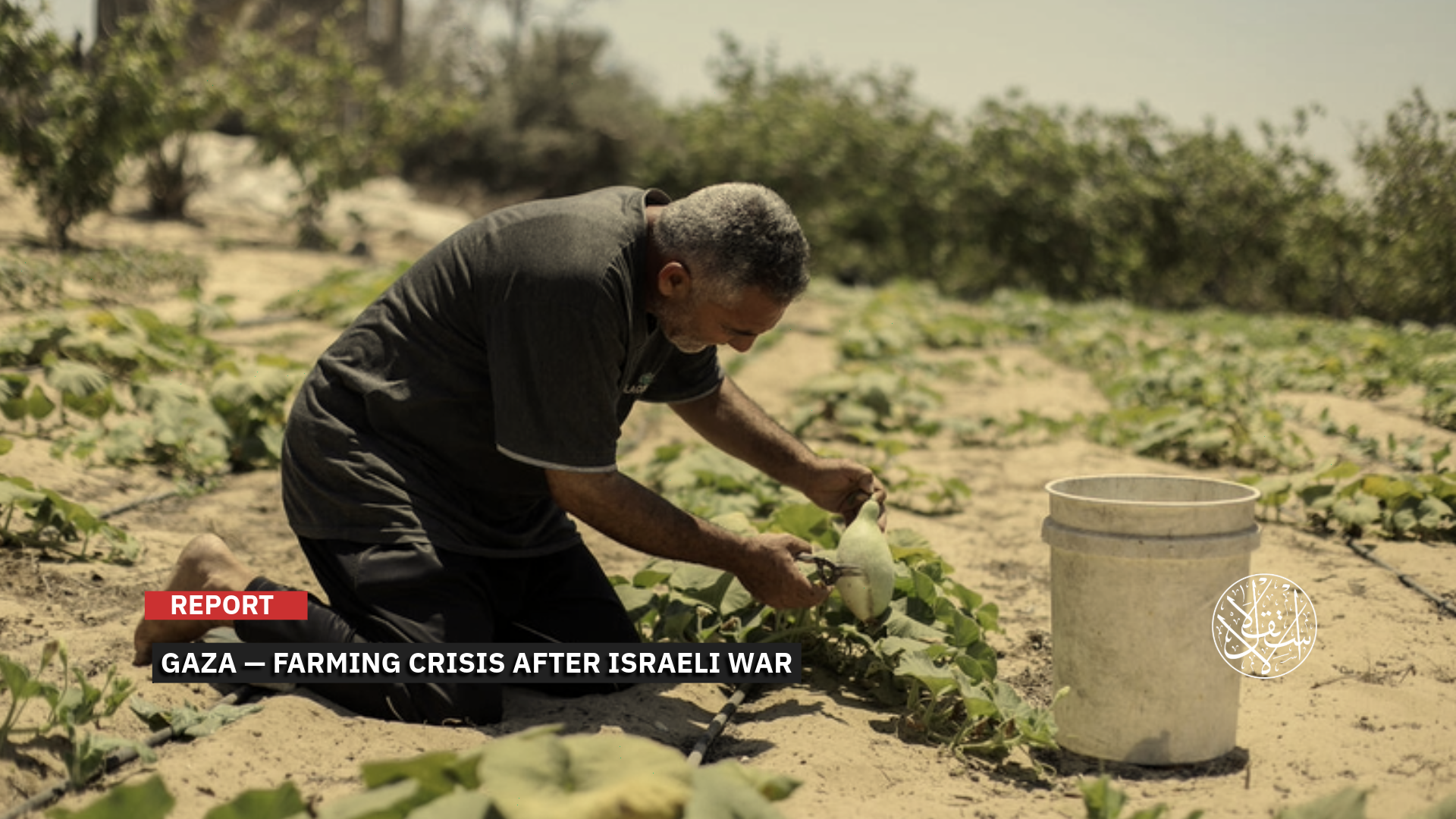
Limited trials have shown that some production can resume when land and the necessary inputs are available.
When Palestinian farmer Taysir al-Dahdouh returned to his land in Gaza City’s eastern Zeitoun neighborhood, he found little more than the remnants of the farm that had once supported his family. The greenhouses, water hoses, and equipment he had relied on for years to grow tomatoes and cucumbers had all been destroyed.
With basic tools, al-Dahdouh, his wife, and their children began restoring what they could. They managed to bring about one dunam of land back into cultivation, hoping to recover a livelihood lost to the war. But their experience also lays bare the scale of the challenge facing agriculture across Gaza.
The Israeli war on Gaza has not only destroyed crops. It has torn apart the entire food production system, from farmland, wells, irrigation networks, and greenhouses to livestock and fishing boats. Military occupation has also taken vast areas out of production, while shortages of water, seeds, fertilizers, fuel, and equipment have further limited farmers’ ability to return to their land.
With only 3% of Gaza’s agricultural land still intact and accessible, according to the latest UN assessment, the territory faces another battle no less daunting than rebuilding its homes and infrastructure: restoring its ability to produce food and reducing its growing dependence on aid, border crossings, and external markets.

The Collapse of Gaza’s Food System
When Wajiha al-Dahdouh returned with her family to their land in Zeitoun, she found that restoring part of it was not enough to bring the farm back to life. Water, seeds, fertilizers, and agricultural equipment were all in short supply. In a testimony published by the UN on July 17, 2026, she said the family had returned to farming simply to survive, but water shortages and a lack of essential inputs were making it difficult to keep production going.
The same scene is playing out across Gaza. Some farmers have managed to reach their land only to find that the irrigation networks, wells, greenhouses, and equipment on which their farms depended have been destroyed.
In the latest assessment published by the UN Food and Agriculture Organization (FAO) and the UN Satellite Center (UNOSAT) on August 18, 2026, only 448 hectares of agricultural land remained intact and accessible to farmers, equivalent to just 3% of the total agricultural land in Gaza.
That figure tells only part of the story. On June 24, access was possible to 4,091 hectares, or 27% of Gaza’s agricultural land. But 3,643 hectares of that area had been damaged and needed rehabilitation before production could resume. Nearly three quarters of Gaza’s agricultural land was therefore already beyond farmers’ reach, while most of what remained accessible needed repairs.
The Gaza Urban and Peri-Urban Agriculture Forum (GUPAP) says the war has dismantled large parts of the food production system that once connected farmers to land, water, nurseries, seeds, livestock breeders, food-processing businesses, and markets.
The Palestinian nongovernmental organization, which works to promote urban agriculture and food sovereignty while supporting farming households and productive enterprises, told Al-Estiklal that the scale of the loss goes far beyond the number of damaged dunams, wells, and greenhouses.
It has also wiped out “agricultural and social capital built over decades,” including trees, productive soil, equipment, marketing networks, farming knowledge, and relationships between farmers, seed keepers, and local communities.
Efforts to restore production are under way across a limited area of Gaza. Some accessible land needs rehabilitation, while other farmland lies behind areas under Israeli military occupation or near zones where workers face the risk of gunfire.
GUPAP says the war has also changed where and how food is produced. For many families, farming efforts have shifted to home gardens, rooftops, and small plots around displacement sites and population centers, alongside attempts to maintain livestock and home-based food processing. During the Israeli war, it says, these practices have become a local line of defense against hunger and disrupted supply chains.
Greenhouses are among the most important sources of vegetable production in Gaza’s limited agricultural space. The latest FAO assessment, published on August 18, 2026, found that only 224 hectares of greenhouse space remained intact and accessible to farmers, just 16.6% of the total greenhouse area in Gaza.
In previous months, farmers had managed to rehabilitate around 24 hectares and build another 22 hectares, most of them in Khan Younis and Deir al-Balah in southern and central Gaza. The FAO described these rehabilitation efforts as limited compared with the scale of destruction and concentrated in areas where farmers had been able to return and secure some resources.
The testimony of a farmer from al-Zawaida, identified by the UN Office for the Coordination of Humanitarian Affairs (OCHA) as “Karim” to protect his identity, offers a glimpse into what farmers face when they return to their land.
He had spent more than 30 years working in greenhouses. In a field report published by OCHA on February 10, 2026, he said the cost of pumping water had consumed a large share of his resources, while in an earlier attempt he lost a parsley crop because of the poor quality of the seeds he was able to obtain.
Other farmers face similar shortages of seeds, fertilizers, irrigation equipment, and fuel. The FAO’s August assessment described these inputs as scarce and expensive, while some are subject to Israeli restrictions on entry into Gaza.
Livestock has shown limited signs of recovery in 2026. By May, sheep numbers had risen by 33% and goats by 8%, following increased deliveries of animal feed and veterinary assistance to livestock owners.
By June, the FAO was distributing around 600 tons of animal feed a month, while a new round of assistance in August targeted around 2,200 livestock owners.
But the recovery remains dependent on continued access to feed and veterinary medicines. In a report issued on August 14, OCHA recorded just eight trucks carrying animal feed among the commercial trucks entering Gaza during the period covered by the report.
Fishing has also remained severely restricted in 2026, with access largely limited to waters close to shore. In July, the FAO said the sector’s recovery depended on allowing fishermen to reach fishing grounds and bringing boats, nets, and other equipment into Gaza, amid continued Israeli Occupation restrictions that have deprived thousands of families of a source of food and income.

Growing Dependence on Border Crossings
Before the war, Gaza imported grains, flour, cooking oil and other basic commodities, while agriculture, livestock, and fishing supplied a large share of the vegetables, eggs, milk, poultry, and fresh fish sold in local markets.
According to the FAO, work in these sectors provided a full or partial livelihood for more than 560,000 people. The loss of production therefore had a double impact, reducing the supply of locally produced food while stripping income from families who depended on these activities.
The impact is visible in the markets. In a report issued on August 14, 2026, OCHA cited Gaza’s Consumer Price Index, which showed inflation had risen 209% from its level before October 2023, despite relatively stable prices for some goods in the preceding weeks.
In July, 77% of households surveyed by the World Food Program struggled to access markets. Lack of cash and an inability to afford prevailing prices were among the main reasons.
The movement of goods through border crossings has become one of the fastest-moving factors affecting food availability and prices. On July 23, the FAO, the World Food Program, and UNICEF said that most of Gaza’s population remained dependent on humanitarian assistance, while Karem Abu Salem was the only functioning crossing for bringing goods into the territory at the time.
The three agencies linked the modest improvement in food security to increased flows of humanitarian aid and commercial goods, while local production remained limited and restrictions continued to affect agricultural inputs and access to land and the sea.
According to an Integrated Food Security Phase Classification assessment issued on July 23, 2026, more than 1.2 million Palestinians in Gaza, or 59% of the population, were experiencing crisis levels of food insecurity or worse during the period through the end of June. Of them, 212,000 were facing emergency levels.
The assessment projected that the number could rise to around 1.4 million people, or 67% of the population, during the second half of the year if conditions deteriorated. It identified restoring local production as one of the essential steps toward reducing Gaza’s vulnerability to further disruptions in external supplies.
As of August 23, humanitarian agencies were providing general food assistance to around 620,000 people during the monthly distribution cycle. Meanwhile, 95 kitchens were producing about 712,000 meals a day, while subsidized bakeries were providing nearly 100,000 bundles of bread daily.
The figures show how much of the burden of feeding Gaza’s population has shifted to humanitarian aid as the capacity of farms, livestock producers, and fishermen to supply local markets has dwindled. They also highlight the gap between providing enough basic calories to survive and restoring the production of vegetables, fruit, milk, eggs, meat, and fish within Gaza itself.

What Would It Take to Bring Gaza Back to Farming?
Limited experiments during 2026 have shown that some production can resume when land and essential inputs are available. In July, the FAO expanded a program supporting 1,500 small-scale farmers, each receiving assistance to cultivate at least one dunam. The agency estimated that the produce from these plots could provide the recommended annual amount of vegetables for around 100,000 people.
In Deir al-Balah, farmer Salama Muhanna is trying to restore another resource that agriculture lost during the Israeli war. Together with other farmers, he rebuilt a local seed bank inside a tent. By the summer of 2026, they had collected seeds from 32 Palestinian varieties after the original stock was lost.
GUPAP considers restoring local seeds an essential part of recovery because they include varieties adapted to the land and water scarcity, along with farming knowledge passed down through generations.
In comments to Al-Estiklal, it points to the revival of the al-Qarara seed bank as an example of rebuilding local capacity to produce and exchange these resources. It also calls for community seed and nursery initiatives, support for those preserving local varieties, and the transfer of agricultural knowledge between generations.
The biggest obstacle begins with the land itself. In the latest assessment, more than 70% of agricultural land remained inaccessible to farmers, while 3,643 hectares of the 4,091 hectares that could be reached had been damaged and required rehabilitation to varying degrees.
Then there is the danger posed by unexploded ordnance. On August 7, OCHA said mine-action teams had carried out 3,199 explosive hazard assessment missions since the start of the war, while restrictions on handling explosive remnants and bringing specialized equipment into Gaza were hampering clearance efforts.
In agricultural areas of Sheikh Ajleen, farmers were unable to return to parts of their land until explosive hazard assessments had been conducted and dangerous sites marked.
Agricultural inputs form the next link in the chain. In its August 18 assessment, the FAO said farmers faced severe shortages of seeds, fertilizers, irrigation equipment, and fuel, while livestock owners struggled to obtain feed, veterinary medicines, and animal health services.
On August 28, OCHA listed easing restrictions on the entry of agricultural inputs, oils, and spare parts among the most urgent needs, along with maintaining the flow of animal feed, supporting the removal of war debris, and ensuring safe access to land from which owners remain barred.
GUPAP puts land and water at the start of the recovery process. It calls for identifying areas that can be safely accessed, assessing the risks from war debris and the condition of soil and water, and then rehabilitating wells, irrigation networks, greenhouses, nurseries, storage facilities, and processing sites that can be restored.
At the same time, it calls for expanding household, urban, and peri-urban farming by making use of safe farmland, gardens, rooftops, and community spaces, while adopting water-saving techniques where technically and economically feasible.
Recovery also depends on energy, storage, refrigeration, transportation, and markets. Seasonal crops, some greenhouses, and small irrigation networks can return to production relatively quickly, while wells, major water networks, livestock shelters, and storage and processing facilities require broader investment. Olive groves, citrus orchards, and other perennial trees that have been uprooted, meanwhile, will take years to grow back and regain their productivity.
GUPAP says sustained production will require flexible small-scale financing, technical guidance, and follow-up, as well as reliable access to inputs and markets. In this context, it proposes what it calls “solidarity marketing,” in which part of the food assistance programs’ needs would be purchased from farmers, women producers, and small food businesses inside Gaza. The aim is to channel part of humanitarian spending toward local producers and keep more resources circulating within the local economy.
The latest comprehensive assessment by the World Bank, the UN, and the European Union, published in April 2026, estimates that Gaza’s agriculture and food system needs $10.5 billion, including around $7.5 billion during the first 18 months.
The figure covers food security, urgent nutritional needs, the recovery of agriculture and livestock, markets, storage, and food supply chains, as well as the reconstruction of damaged assets. It therefore represents the cost of restarting the food system on a broad scale, rather than simply rebuilding destroyed agricultural facilities.
GUPAP’s vision extends into reconstruction itself. It calls for food production to be incorporated into the planning of neighborhoods and cities by protecting farmland and productive spaces, identifying irrigation water sources and sites for markets, nurseries, storage, and processing facilities, and involving farming households, women, and young people in decisions shaping the system.
The efforts already under way in Gaza point to the practical starting point. When some farmers have been able to reach their land and secure seeds and water, they have replanted small plots and repaired greenhouses. When feed and medicines have arrived, some livestock herds have begun to recover.
Whether these efforts can grow into a broader recovery will depend on how much land farmers can safely access, the removal of war debris, the flow of inputs through border crossings, the restoration of water and markets, and the lifting of Israeli restrictions on fishing, movement, and the materials needed for production.
Sources
- Gaza Strip: Only 3 percent of Gaza’s cropland remains accessible and undamaged, new assessment finds
- Gaza Strip’s agriculture and livestock sectors show early signs of recovery amid widespread destruction
- Gaza Farmers Struggle to Bring Destroyed Farmland Back to Life [Arabic]
- Helping greenhouse farmers in Gaza restore their livelihoods
- Humanitarian Situation Report | 7 August 2026
- Gaza Strip: Acute Food Insecurity Situation for 16 April - 30 June 2026 and Projection for 1 July - 31 December 2026
- Rapid Damage and Needs Assessment, Gaza Strip, April 2026
- Gaza seed bank helps farmers cultivate the little land they have left