How Arab and Muslim Candidates Are Trying To Enter the American Political Arena
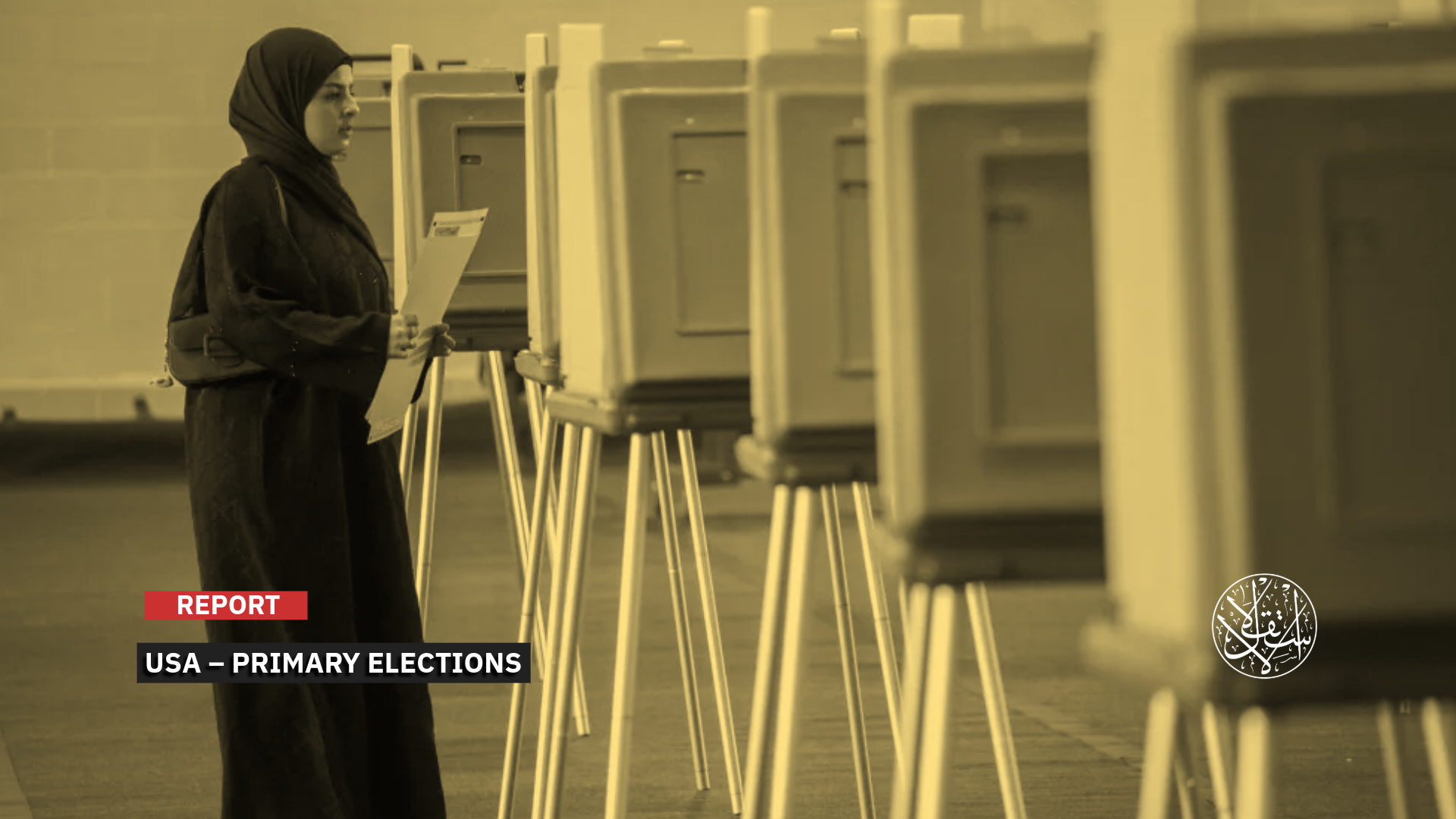
“Some Muslims are running in the 2026 midterms for re-election, while others are aiming to hold office for the first time.”
The ongoing U.S. primary elections highlight a profound transformation for Arab and Muslim communities, who have transitioned from the political periphery a decade ago to active mainstream participants today.
This surge in civic engagement is unfolding in the buildup to November's midterm elections, where voters will decide on crucial federal, state, and local positions—including Senate and House seats, gubernatorial races, and municipal offices.
Rather than merely reacting to Washington’s decisions, these communities are now aiming to shape them. Candidates are leveraging their growing demographic weight and enhanced organizational networks to pivot from being passive observers to active policy influencers.
This political awakening has been heavily accelerated by past challenges, specifically the restrictive immigration and Islamophobic rhetoric associated with the Trump administration, alongside deep-seated concerns over persistent conflicts in the Middle East.
The significance of this trend extends beyond high voter turnout; it is reflected in the sophisticated, forward-thinking rhetoric of Arab and Muslim candidates who are redefining their place in the American political landscape.
Political Awareness
The current primaries across 39 states are setting the stage for November’s critical midterm elections, where all 435 House of Representatives seats and 35 Senate seats are up for grabs.
These elections are a pivotal turning point that will shape American governance for the next two years, determining whether the current administration’s agenda moves forward unchecked or faces severe legislative gridlock.
Despite their growing societal influence, American Muslims have historically shown irregular voter turnout and remain heavily underrepresented on Capitol Hill.
A Pew Research Center study revealed that 461 members of Congress are Christian, including 55.5% Protestants and 28.2% Catholics, compared to 32 Jews, four Hindus, three Buddhists, and four Muslims. All of these Muslim members are concentrated in the House of Representatives, with no Muslim senators.
However, a recent poll conducted by the Council on American-Islamic Relations (CAIR) signals an abrupt shift in the political tides.
In four electorally critical states—Texas, Illinois (Chicago), North Carolina, and Georgia—an astounding 83% of registered Muslim voters confirmed their absolute intention to cast ballots in the ongoing primary elections.
Analysts note that while the American Muslim electorate holds immense potential power, it has historically been undercut by a lack of centralized organization and limited political awareness.
This has been compounded by systemic Islamophobia, anti-immigrant sentiment, and steep financial barriers to entering politics.
However, Zahran Mamdani's victory in the New York City mayoral race late last year proved that voters in major metropolitan areas are willing to elect Muslim leaders of immigrant backgrounds to high-profile executive offices.
Despite these breakthroughs, intense polarization and hostility toward immigrants present real dangers.
For instance, Deqa Dhalac—the historic first Somali-American Muslim mayor—recently announced she would not seek re-election in South Portland, Maine, citing systemic racism and direct safety threats.
Despite the risks, hundreds of Muslim candidates are stepping into gubernatorial, legislative, and municipal races nationwide, running on heavy human rights and justice platforms.
The advocacy group Emgage Action points out that the defining characteristic of this election cycle is a unified, progressive vision.
These emerging leaders are championing a platform that aims to empower the American working class while dismantling domestic racism and systemic corruption, and extract the U.S. from foreign conflicts and end its complicity in the Gaza Strip genocide.
Election Campaigns
Nowhere is this shift more evident than in Michigan, home to the nation’s largest concentrated Arab and Muslim population.
Dr. Abdul El-Sayed, an Ivy League academic and physician of Egyptian descent, has captured nationwide attention in his high-stakes bid for the U.S. Senate.
If elected, he will make history as the first Arab-American Muslim ever to enter the upper house of Congress.
First rising to prominence during his historic 2018 gubernatorial run, El-Sayed enters the final stretch of the primary leading the pack.
Recent polling places him at the front of the race, commanding 34 percent of the state's Democratic primary electorate.
El-Sayed’s campaign explicitly challenges both the exclusionary Republican platform and standard Democratic establishment policies, which he characterizes as variations of class-based capitalism.
On foreign affairs, he stands firmly against unconditional U.S. financial and military aid to Israel’s colonial policies.
Meanwhile, in New Jersey’s 12th Congressional District, Dr. Adam Hamawi achieved a historic primary nomination before facing structural hurdles against the heavily funded pro-Israel lobby's pick, Brad Cohen.
During his groundbreaking run, Hamawi broke boundaries with a bold anti-establishment platform that called for absolute economic sanctions and aid freezes against Israel.
Domestically, his platform championed universal healthcare, the complete dissolution of Immigration and Customs Enforcement (ICE), and an open refusal to endorse senior Democratic congressional leaders like Chuck Schumer and Hakeem Jeffries.
Political analysts stress that because this district leans heavily Democratic, primary battles are historically decisive for the national stage.
Simultaneously, in California's 14th Congressional District, Aisha Wahab—an American Muslim of Afghan immigrant lineage—is rapidly consolidating institutional power to capture the House seat vacated by Eric Swalwell.
Her campaign has effectively united mainstream party forces, drawing formal endorsements from over 100 top Democratic leaders and multiple progressive political organizations.
This modern wave of political newcomers relies heavily on the electoral foundations laid by pioneering Muslim lawmakers who continue to defend their congressional seats while mentoring the incoming class of leaders, including: Rep. Ilhan Omar (Minnesota), Rep. Rashida Tlaib (Michigan), Rep. Andre Carson (Indiana) and Rep. Lateefah Simon (California).

Missing Impact
In contrast, pro-"Israel" lobbying groups, most notably AIPAC, mobilized significant efforts to prevent the victory of candidates who supported the Palestinian cause, especially Muslim candidates, through advertising campaigns and generous financial support for their more pro-"Israel" rivals.
Instead of focusing on their political positions, AIPAC resorted to questioning their professional backgrounds and personal histories, concentrating its efforts on denying their eligibility and suitability for the positions they were running for, without directly mentioning Israel or US foreign policy.
In the Illinois primary elections, AIPAC poured approximately $22 million into primary races, representing roughly one-fifth of its announced $100 million spending target for the current primaries.
Illinois is one of the most important states in US-Israeli relations, given its large Arab and Muslim population and its significant economic weight.
A source close to AIPAC says the group's main goal in Chicago is stopping who it sees as 6 potential Squad members: Robert Peters, Kina Collins, Junaid Ahmed, Yasmeen Bankole, Kat Abughazaleh and Bushra Amiwala.
In the House primary for the state's 9th Congressional District, AIPAC spent between five and seven million dollars in an effort to defeat Kat Abughazaleh.
Kat is a Palestinian-American who made a notable impact in the current election cycle, building her campaign on sharp criticism of the Democratic establishment, the capitalist system, and American support for the Israeli war on Gaza.
AIPAC publicly celebrated Kat's defeat, despite the loss of its own candidate, Laura Fine, who came in third with 20% of the vote.
On the other hand, Dr. Adam Hamawy's 28% share of the vote in New Jersey's 12th Congressional District came as a shock even to some within the traditional Democratic establishment.
Some interpretations have focused on the role of millions of dollars in donations in building Hamawy's strong electoral base.
This time, pro-Israel groups have attempted to shift blame to the organization American Priorities, which they describe as pro-Palestinian, accusing it of providing $2 million to Hamawi's campaign, thus giving him access to voters and a platform that his opponents lacked.
Social Polarization
In a development reflecting the rapid shifts within the American political landscape, the Muslim community in the U.S. has emerged as one of the most influential actors at the local and state levels, following the results of the primary elections held in early June 2026 in several key states.
These results reflected the growing political presence of American Muslims and their increasing ability to mobilize voters and participate effectively in shaping public policy within legislative and administrative institutions.
This political advancement has occurred amidst ongoing demographic and social changes in the United States in recent years.
Political participation rates have risen among members of Muslim communities, whether through running for public office or through involvement in election campaigns and civil society organizations.
Conversely, these political gains have coincided with escalating concerns related to the security of Islamic institutions.
A recent report indicated a significant increase in acts of vandalism and threats targeting a number of mosques and Islamic centers compared to the same period last year.
These findings have reignited the debate surrounding the rise of hate speech against religious minorities and the need to strengthen security measures for places of worship across the United States.
This reality reflects a paradox within the American Muslim community, which is achieving unprecedented political presence within elected institutions while simultaneously facing challenges related to societal polarization and escalating hostile rhetoric targeting religious and ethnic minorities.
Experts have emphasized that this disparity necessitates that Muslim political and community leaders adopt more comprehensive strategies to promote social integration and build broader partnerships with various civil and human rights organizations.

In this context, political activist Omar Taha, in a statement to Al-Estiklal, praised the recent election results, considering them a clear indication of the growing influence of the Muslim community within the American political landscape.
He emphasized that political participation has become a key tool for defending civil and religious rights and ensuring more effective representation for Muslims in decision-making circles at both the local and national levels.
On another note, he pointed out that the success of Muslim candidates in reaching influential legislative and administrative positions could contribute to strengthening policies that support religious pluralism and combat discrimination.
However, sustaining these gains requires addressing the accompanying security and social challenges and working to bridge the gap between political progress and societal acceptance, he said.
He concluded that with the ongoing transformations within American society, the Muslim community appears to be at a pivotal stage in its political history, combining expanding opportunities to influence decision-making on the one hand, and the need to confront the challenges of hatred, polarization, and community security on the other.
"Between these two paths, Muslim Americans, or those of Arab descent, continue to solidify their presence as a growing civic and political force within one of the world's most influential democracies," he said.